5.5.3 What makes atoms different?
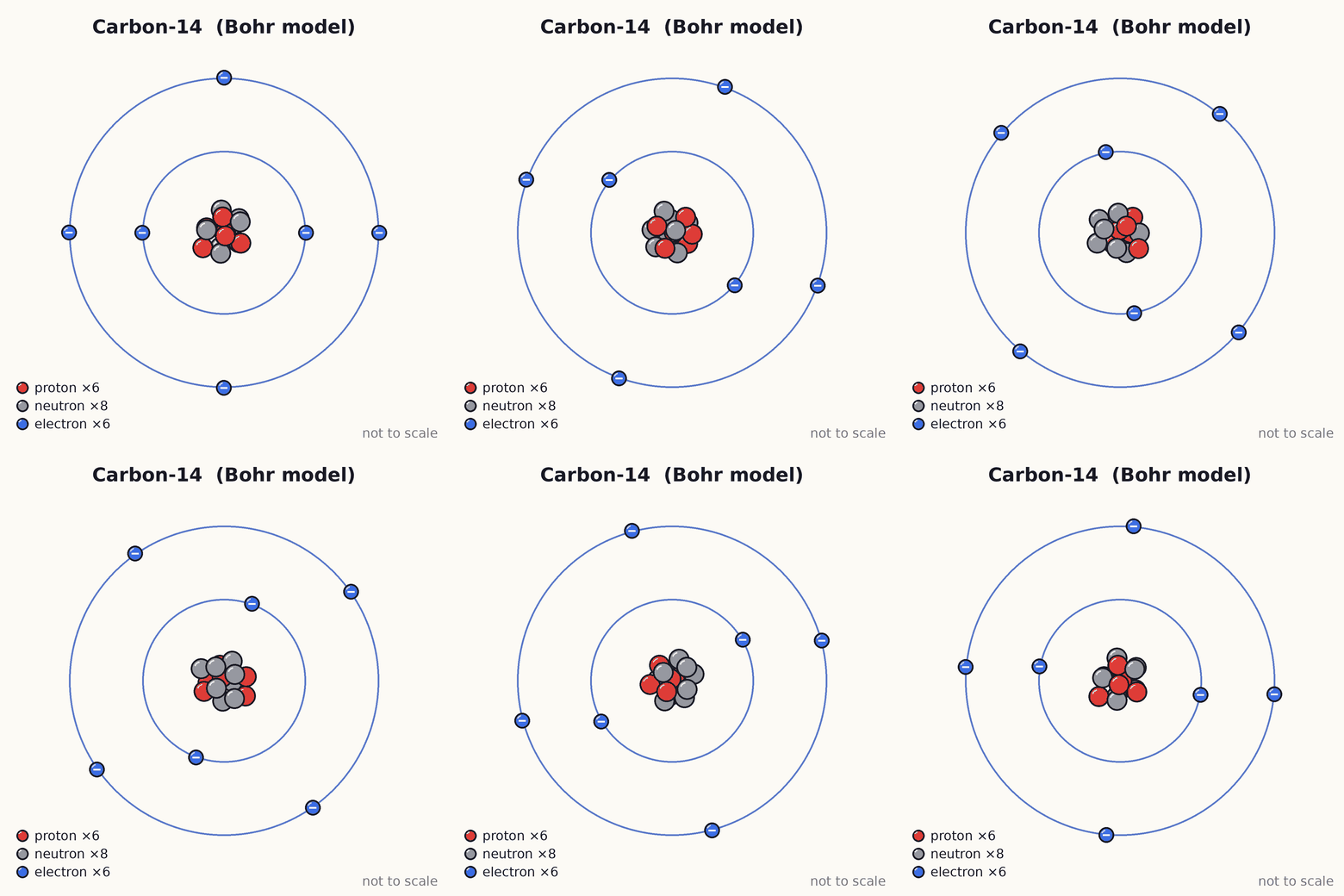
On this page you will inquire into the structure of atoms and find out about atomic cousins, or isotopes. You will also find out how we can tell whether an atom is stable or not.
Inquiry: What are atoms made from? What are ‘fundamental’ particles?
In 5.5.2 What's in an atom? you explored the evidence that was gathered to show that the atom was not, as Democritus thought, ‘uncuttable’ but consisted of a tiny, positively charged nucleus surrounded mostly by empty space with a few electrons. The story doesn't stop there!
While Rutherford, Geiger and Marsden could deduce that the nucleus contained positively-charged matter, the maths of the atom still didn't seem to add up and there was some awkward evidence that didn't quite fit.
Firstly, J.J. Thomson - not satisfied with having shown that the electron was a negatively-charged, fundamental particle, nor with finding the ratio of its charge to mass \frac{e}{m}- had carried out experiments with Neon ions which produced some unexpected results:
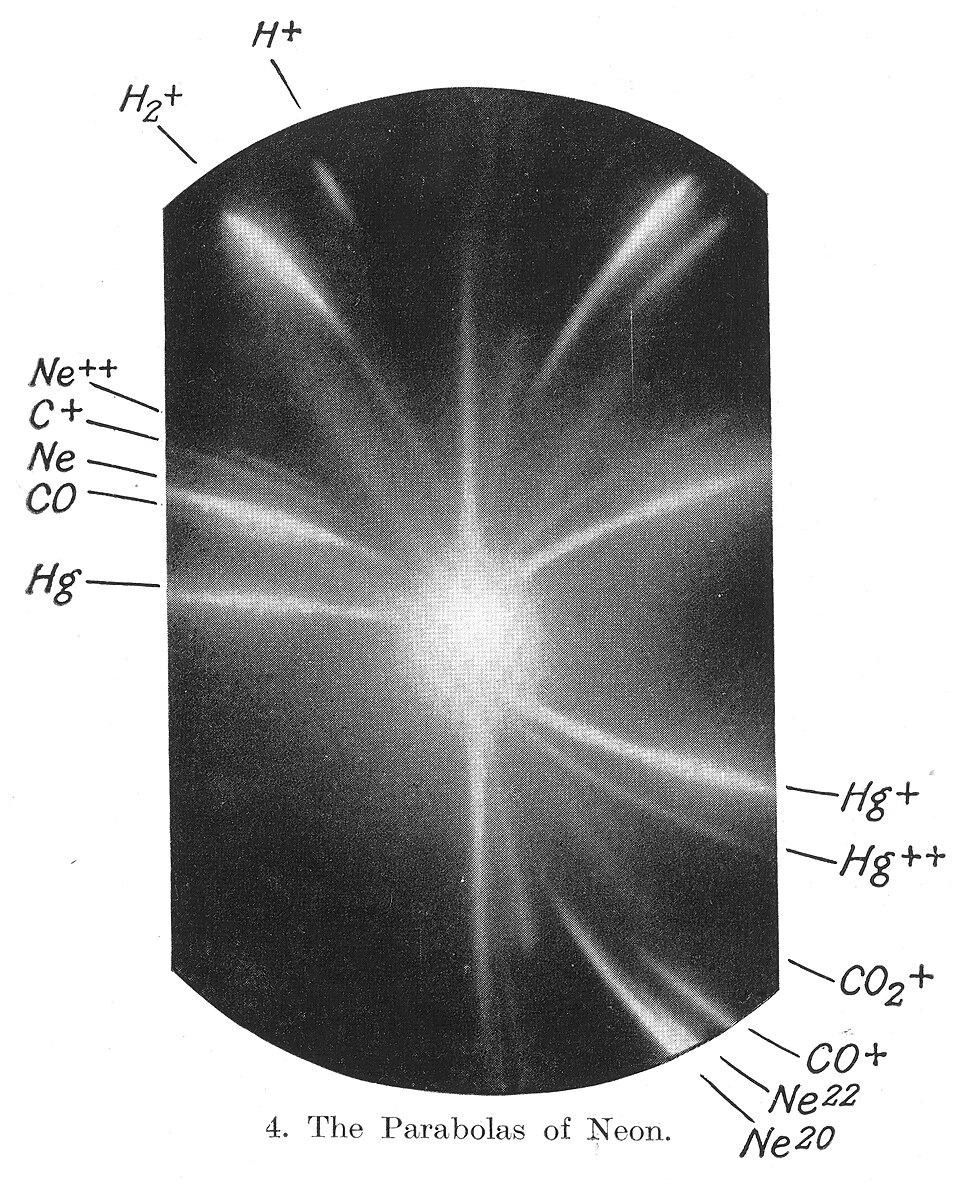
This image, called ‘The Parabolas of Neon’, is a photograph taken when Thomson tried deflecting ions of different elements with electric fields. The traces made by the different ions of elements are labelled around the outside. Notice to the left there is a trace for Neon, Ne in a double ionized state (Ne++). However, there are other traces on the bottom right. Thomson showed that the trajectories of these particles could only be explained if they were also Neon particles, but with slightly different masses.

Approaches to Learning: Transfer and links - Chemistry
Meanwhile, Ernest Rutherford had already noticed that the measured masses of atoms did not seem to correspond to what they should be, if the nucleus consisted only of sufficient Hydrogen nuclei to make up the measured positive charge of the nucleus. James Chadwick (who was a student of Rutherford) showed in 1932 that when Beryllium was bombarded with alpha particles, the radioactive particles produced behaved in ways which suggested another particle was present. This particle wasn't detectable using electric fields, and anyway there were already sufficient positive particles in the nucleus to make up the measured charge: so the new particle had to be electrically neutral, but with about the same mass as a Hydrogen nucleus.
Chadwick called the new particle a neutron.
The model of the atom now looked like this:
The nucleus consisted of positively charged protons and neutral neutrons, with approximately the same mass. Since these particles exist inside the nucleus, they are called nucleons. Electrons with negative charges filled the empty space around the nucleus. The electrons had much smaller mass than the nucleons.
Check for understanding
Drag and drop to complete the table to show the relative masses and charges of the subatomic particles.
-1 0 1 1 0.000549 +1
| Particle | Relative atomic mass (u) (1 u = 1.67 ×1027 kg) | Electric charge (multiples of e = 1.6 × 10⁻¹⁹ C) |
|---|---|---|
| proton | | |
| neutron | | |
| electron | | |
Note that the mass of the neutron is very slightly greater than 1 u, but to one significant figure we can consider it as about the same as that of the proton.
Inquiry: How can we know what an atom is like? How do we represent the structure of atoms?
Physicists could now describe the properties of all the elements discovered in the periodic table in terms of these three particles. Until the late twentieth century, it was thought that protons, neutrons and electrons were fundamental particles - meaning that they could not be ‘split’ into anything smaller. Now we know that only electrons are fundamental (they are a member of a class of particles called leptons) while the nucleons consist of even smaller particles called quarks.
In the periodic table, you may see elements represented like this:
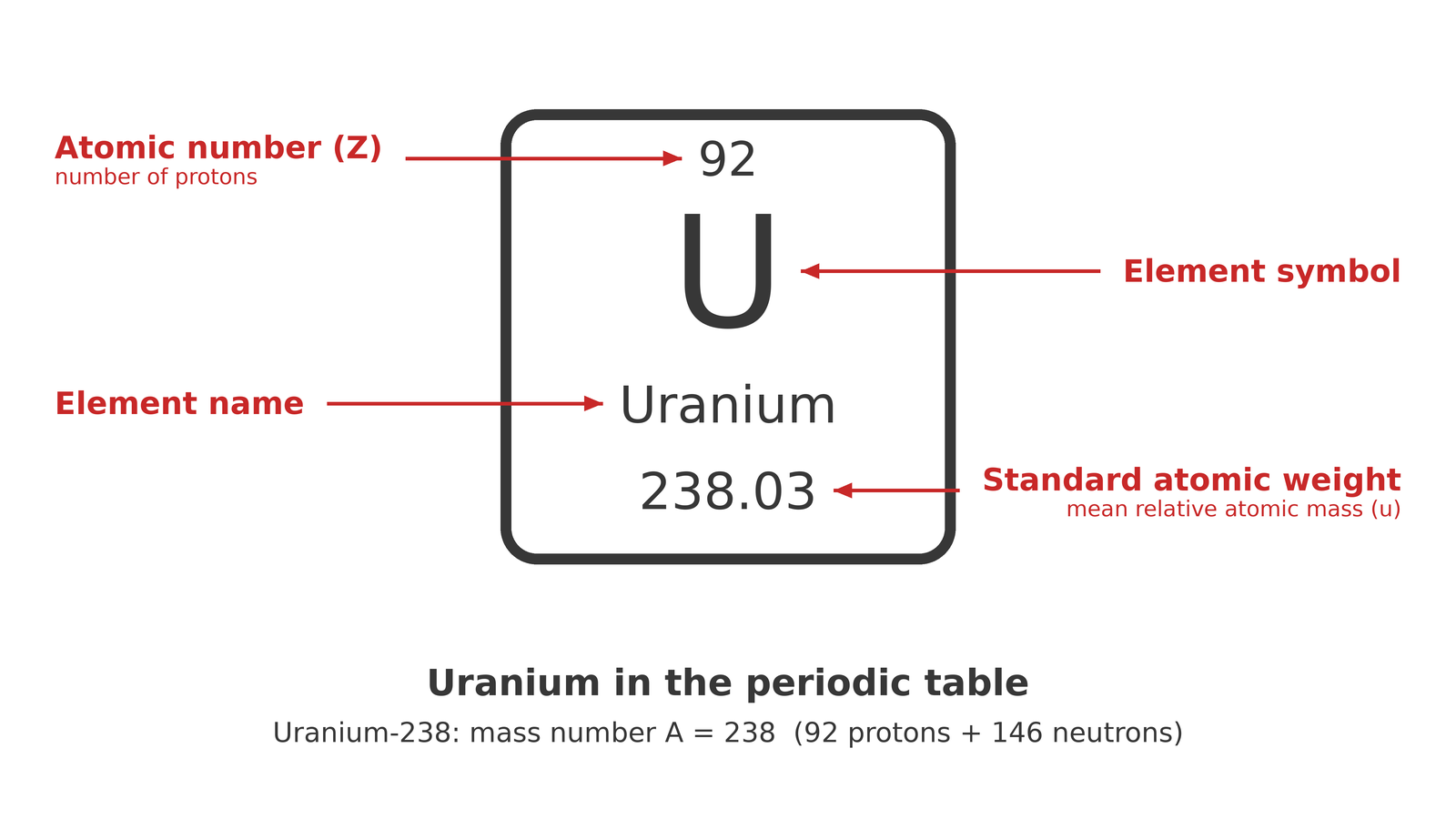
Notice that the standard atomic weight (or mean relative atomic mass) is not an integer.
In atomic and nuclear physics, we represent the elements in a different way:
{_{92}^{238}}U or {_{Z}^{A}}X
Here,
A is the mass number, also the nucleon number.
Z is the atomic number, also the proton number Z
So
For standard nuclide notation,
{_{Z}^{A}}X
where
A=N+Z
and N is the number of neutrons in the nucleus.
Check for understanding
Fill in the gaps to identify the correct values of standard nuclide notation for the nuclei shown.
Since A = N + Z then you can rearrange to find the values. But did you notice that Hydrogen (H-1) has the same number of protons Z as Hydrogen-2? What was different?
You can use this as a way to introduce isotopes!
Inquiry: What are isotopes?
Look at these nuclides.
Identify
What do they have that is the same? Organise them into sets
The Hydrogen H nuclides all have Z = 1 protonThe Helium He nuclides all have Z = 2 protonsThe Uranium U nuclides all have Z = 92 protonsWhat do they have that is different?
They have different numbers of neutrons, N.
Isotopes of an element have the same number of protons Z but different numbers of neutrons N.
Isotopes are like atomic ‘cousins.’ Since they all have the same proton number, the electric charge of the nucleus is the same and so they also have the same number of electrons in a stable configuration. This means that they behave in the same way chemically - you can have water containing only Hydrogen-1 H_2O or you can have ‘heavy water’ that contains the isotope Deuterium or Hydrogen-2, D_2O. However, since they have different numbers of neutrons their masses are slightly different. In practice, this is how isotopes can be separated from a mixture - more on this later! In his mass spectrometry experiment, Thomson was observing the effect of different isotopes of Neon with different masses.
The isotopes in this list are all stable, meaning that they occur naturally - although they may not all occur with the same abundance - meaning how much of them there is. When chemists calculate the atomic weight of an element, they have to factor in the slightly different masses of all the stable isotopes that exist. This is why the atomic weight shown in the periodic table is often not an integer, but a decimal number, since it is an average.
Check for understanding
Which of the following values for nuclide notation could correspond to isotopes of carbon? (Careful: there could be more than one correct answer!)
All carbon isotopes have Z = 6 protons.
Assessment opportunities
Try the assessed task C Atom builder to explore atoms and isotopes in the periodic table.