MYP Physics Global Contexts
How can we use the MYP Global Contexts to make learning Physics authentic? How can we develop international mindedness through MYP Physics?
Contexts, relevance and authenticity
The best learning takes place when the learner can see the meaning of the learning in its context. One can learn Latin for example through memorisation of conjugation and declension, but how much more interesting would it be to learn Latin through decoding a medieval spell from a movie you saw recently?
If you have come here, I expect this message is uncontroversial. However, I would like to add a rider here.
On a different project, I was once challenged by a senior curriculum leader in the IBO to consider how my resources “could be made directly relevant to the daily lived experience of the adolescent.”[1] Often, contextual learning seems to be conflated with this idea of relevance in learning - in the sense that all learning should somehow be made directly relevant to the daily lives of learners.
While this might often be desirable, I don't believe it is necessary. If it were, we might end up throwing out a lot of Physics which in fact learners find interesting. For example, many years ago as a young teacher I was teaching UK national curriculum physics in an inclusive (comprehensive) school with a relatively disadvantaged student catchment. It wasn't easy. But I was able to bring twenty or so GCSE students in at lunchtimes for ‘extra physics’ because I was teaching them astrophysics. Many of those students were young women from the recently immigrated, Bangladeshi community in that locality. I still count this as one of my all-time career successes. I do not think that astrophysics was relevant to them in the way I just described - but somehow it was authentic and interesting. I prefer to use the idea of authentic learning in this sense.
The IBO states the case thus:
“An IB education creates learning and teaching communities and opportunities that help students increase their understanding of language and culture, and become more globally engaged… Using global contexts in planning and teaching helps learners by providing relevance and meaning, which may lead to increased student engagement.”
MYP From Principles into Practice (IBO 2022) p.12
So the contexts we choose in MYP should emphasise the dimension of international mindedness:
“In the MYP, learning contexts should be (or should model) authentic world settings, events and circumstances. Contexts for learning in the MYP are chosen from global contexts to encourage international mindedness and global engagement within the programme.”
MYP From Principles into Practice (IBO 2022) p.18
This doesn't mean that everything we do should have an exclusively global dimension. In more recent developments of the MYP that are reflected in these resources, the global contexts are given individual, local and global dimensions. So each global context offers a way for students to reflect on themselves as agents, their connectedness with local communities, and the part those communities play in our interconnected world.
In the unit planners, the global context for the inquiry is given at the beginning, immediately after the conceptual inquiry statements:
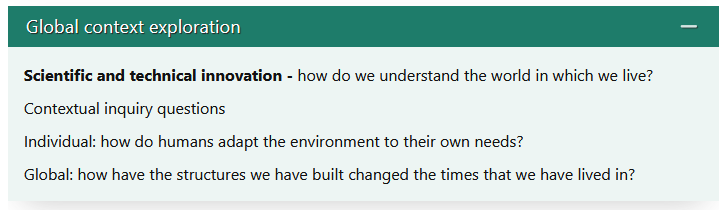
Notice that this is presented as an exploration, with guiding questions that have individual, local and/or lobal dimensions.
The learning activities in Learning reflect this choice of global context and I use these icons to flag contexts:

Scientific and technical innovation

Orientation in space and time
Personal and cultural expression

Fairness and development

Globalization and sustainability
 Identities and Relationships
Finally, in the Student e-course MYP 4-5 , the end-of-unit reflection brings students back to the global context(s):
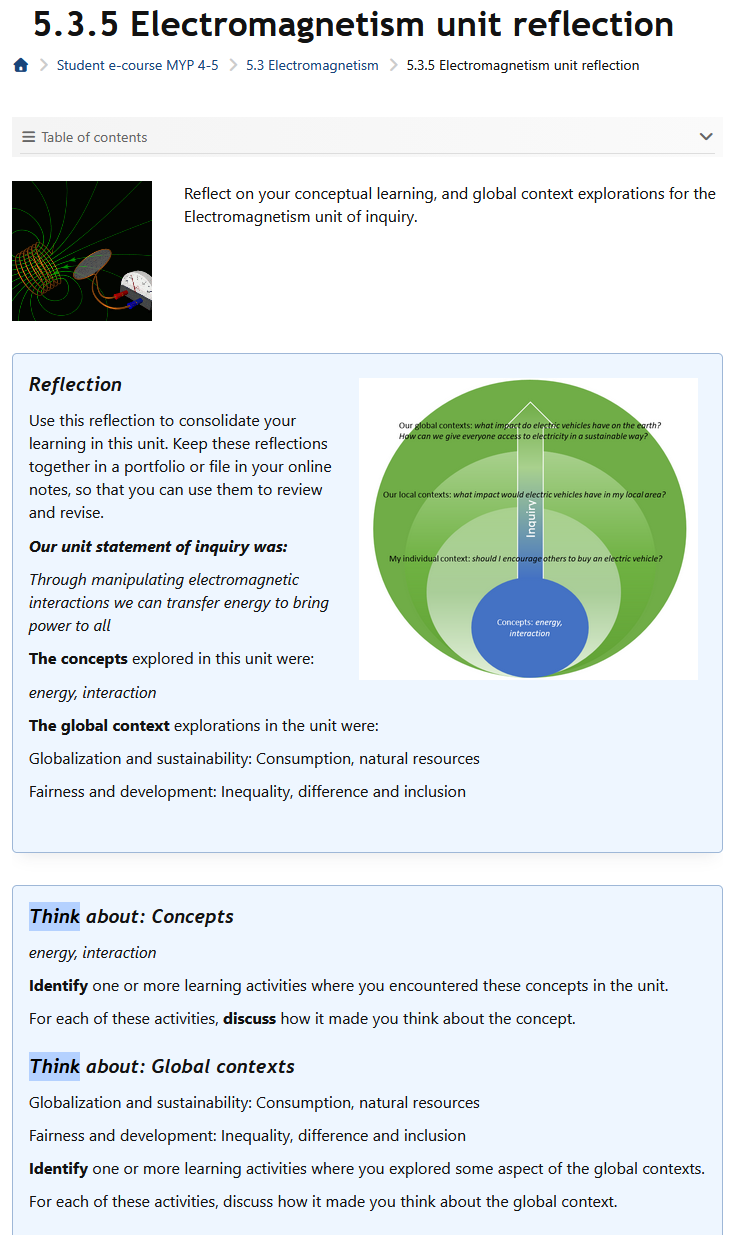
Sometimes, I felt it appropriate to have more than one global context for a unit - since the inquiry could develop in different ways depending on the global context chosen. Using a second global context in a unit also provides an opportunity for students to transfer learning.
A model
As I mentioned in the introduction to this section, my approach is empirical in the sense that I have tried things out over the years and then tried to frame those practices in terms of my developing understanding of education theory. So to round off this part of the site I thought I would try to capture all of this in a ‘curriculum learning cycle’ of my own. Here it is, as sketched out on my tablet:
Footnotes
1. This quote is verbatim, not paraphrased. It was burnt into my memory in that moment!