Lesson 5 - TV Theme Music
Putting Research into Practice
In this final instalment, we move from researcher to creator. Here, you will have the opportunity to examine an Exploring as a Creator practical exercise based on the TV show Murder, She Wrote. This page illustrates how to take extracted conventions, such as thematic duality, structured orchestration, and compact formal designs, and translate them into a realised exercise. The page will also include a rationale to solidify your understanding further.
“Consuming” Photo by Gérard GRIFFAY on Unsplash
Reminding ourselves of the conventions that were ascertained from viewing the three selected instrumental TV themes from the 1980s and 1990s in the previous lessons, here is a table displaying the key extracted conventions and what aspects should be applied to the creating exercise:
Musical Feature | Creating Convention | Application Takeaway |
Instrumentation and Texture | Dominant single melodic lead supported by a clean homophonic texture; orchestration is deployed structurally to demarcate returns, transitions, and arrivals | Assign the primary melodic voice to one distinct instrument/timbre rather than dispersing it across competing voices |
Melodic Design and Phrasing | Short, bounded 4-bar phrases engineered for their memorability; relies on internal contrast (contrasting articulation, direction, or rhythm between antecedent and consequent halves | Keep the theme tightly bounded (4–8 bars) and build in an immediate contrast between phrases |
Rhythm & Metre | Standard rhythmic framework enriched by metric specialities (swung values, syncopation, hemiola, or moto perpetuo) to inject forward momentum and wit | Consider some disruption of the underlying pulse with unexpected accents/syncopation, or drive the pace forward with continuous running figuration. |
Formal Structure | Ternary (ABA') or miniature sonata design; compresses a complete formal arc (exposition-departure/development-recapitulation). | Map out a clear 3-part micro-structure: establish Theme A, depart briefly in Section B, and return with a concise A' resolution. |
Harmonic Language | Diatonic foundation using primary chords (I, IV, V), elevated by strategically placed chromatic or modal colours (secondary dominants, borrowed chords, mediant shifts) at phrase boundaries. | Keep the core changes accessible, but use a surprising chord, such as ♭VI, secondary dominant, or modal substitution, to signal structural pivot points. |
| Developmental Techniques | Extreme developmental economy within a tight timeframe; ascending/descending sequences, motivic fragmentation, and foreshadowing are favoured. | Develop existing motifs through sequencing or truncation rather than introducing completely unrelated new material. |
Dramatic Function and Duality | Musical links to the programme’s central character or premise, typically formulated through a central thematic duality, such as warmth vs. wit, opulence vs. conflict. | Decide what two contrasting traits the theme must capture and assign specific musical devices to each. |
Some students may wish to work from an infographic. Here is one such example that I have created that may similarly help students as they embark on their creative exercise.
I have simply copied the table above into Gemini Notebook for this.
Here is an infographic version of the table above that you may find easier to work from as you begin your own creative exercise.
This has been created with the assistance of Gemini Notebook.
Here is an explanation of my decision-making addressing the various categories that appear above.
This is an imagined student rationale for the Statement on the Creating Exercise, which is a required portion of the packaging for Upload 1 for Exploring Music in Context.
The word count has been purposefully exceeded, but only in the interests of comprehensibility. You need to write succinctly, only selecting the most pertinent information for inclusion in the final submission.
Student Rationale
I decided to write for a reduced orchestra so that the final result is more intimate, but at the same time offers scope for a variety of timbres. I have based my creating exercise largely on the TV Theme music from Murder, She Wrote, but used the generic conventions that I have identified in the other pieces as well.
The primary instrument is piano, which offers a clear melodic line with an accompanying Alberti-like bass, which was prevalent in the original. My material begins with a 2-bar introduction (see below), setting the foundation with a simple harmonic progression, largely based on the primary chords (I, IV and V: C, F and G), but also the inclusion of the supertonic (ii: Dm).

https://teacher-sites-storage.inthinking.net/ib/music/music-links/opening-portion.mp3
This two-bar harmonic progression continues with the introduction of the melodic line (RH of the piano, the entire passage boxed in GREEN above) that begins in a rather lyrical fashion, but then is contrasted, against the same harmonic progression, with a series of descending sequences in a more comic variation (see below labelled in ORANGE above). Thus, the harmonic underpinning functions almost as a ‘chaconne’, grounding the material in which varied material can appear above.
The piano's left hand also draws on the Baroque-like moto perpetuo identified in the original. While this is not in itself a standard feature of instrumental television theme music of the 1980s and 1990s, the distinctive metric character and the contrastive nature of the material that follows certainly are.
Note that the Alberti style is replaced with a rag-like bass in bars 5-6.
Against this background, the opening 4-bar melodic passage is divided into two very distinctive sub-phrases. I wanted to emulate the stark character contrasts that were identified in the original - the serious nature of the protagonist pitted against her whimsy in dealing with troubled situations.
The accompaniment in the cello just reinforces the largely descending bass line (C-B-A-G-F-E-D-G, see below) with singular notes on the beat rendered pizzicato. The viola and the tuba join in bb.5-6 (see below for their continuation) to contribute to the contrast of the second half of the theme.
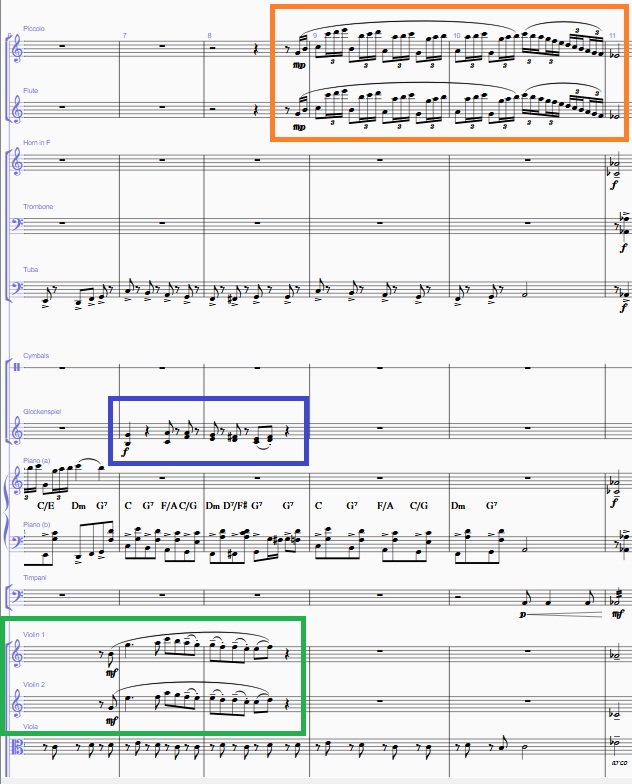
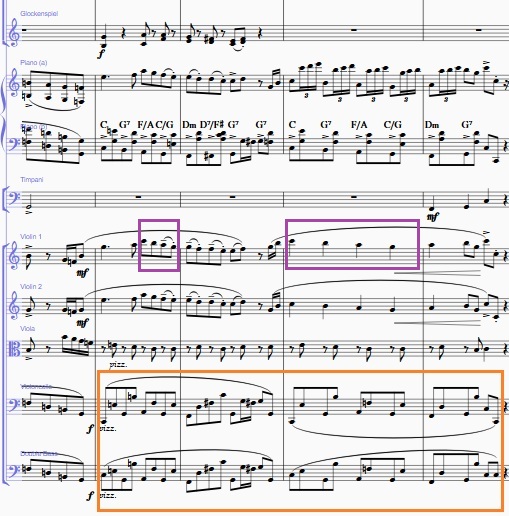
To better contribute to the memorability of the theme, the material is repeated but with new timbres: initially the upper strings play the opening two bars (see below BOXED in GREEN) and the flute and piccolo provide the contrasting sub-phrase with the inclusion of a descending scalic flourish that leads into the B Section (BOXED in ORANGE). The inclusion of the glockenspiel was added (BOXED in PURPLE), as revealed by my research, to demarcate repetition as well as reinforce the suspensions inherent in the theme.
I have also made a slight change in the harmonic progression here by including the secondary dominant of D7 to strengthen the cadence onto G7 (original chords were C-Dm7-G7). The melodic line also now appears in parallel thirds in the violins.
https://teacher-sites-storage.inthinking.net/ib/music/music-links/repeat-of-theme-a.mp3
The material then moves into the rather unrelated key of A♭ minor for Section B - the lowered submediant of the original C major (see HERE for more on official scale degree names). This is in line with the modal shifts that we identified in our research - here the borrowed chord of A♭ from the parallel minor equivalent (Cm) has been utilised to form a mediant shift.
Remember that we have identified this new section as a departure from the opening, although the material is not entirely unrelated.
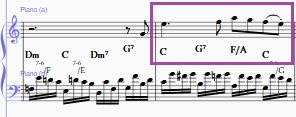
I have extracted a fragment from Section A (see below BOXED in PURPLE), modified it slightly by syncopating the opening rhythm, compressing it into a minor mode equivalent (initially A♭-C♭-B♭-A♭-G), and offered it in an ascending sequential form (see below boxed in ORANGE).
https://teacher-sites-storage.inthinking.net/ib/music/music-links/opening-fragment.mp3
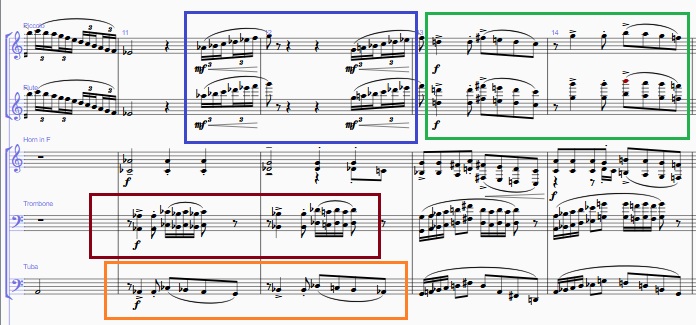
The fragment first appears in the bass - only the brass and woodwind portion of the full score is shown here - in traditional sequential fashion, with the second reiteration a step higher (both BOXED in ORANGE in the tuba). It then continues in the flute and piccolo (BOXED in GREEN), but at a more expansive interval: a fourth. However, the harmonic material that underpins this maintains that sequential ascent (outlining Gm-D initially and then Aø7-G7). Thus, more broadly, the initial bass pitches of the four bars of Section B (bb.11-14), swirl around a chromatic configuration (A♭-B♭-G-A). I was inspired to include this, given the chromatic touches I observed in the selected pieces for study.
The materials in the trombone (boxed in RED) and the flute and piccolo (boxed in BLUE) function as decorative enhancements. However, the triplet flourishes appeared earlier as a transitional element (b.10). Thus, the earlier descending triplet run not only appears as a connective element, but its purpose is also to foreshadow.
I was mindful of the fact that these theme songs operate on great developmental economy, which explains the extreme brevity of this section.
https://teacher-sites-storage.inthinking.net/ib/music/music-links/section-b.mp3
The return of the A Section is not simply an exact repetition, but subtle changes have been included for greater forms of unification. The rag-like bass accompaniment returns, but it is a much fuller setting, as is customary within these mini-sonata form models (only a portion of the score is shown here; see below boxed in ORANGE in the lower strings).
Even though this is a richer setting, I still wanted to keep the overall effect rather light in keeping with the protagonist's character.
The violins also now enunciate the descending line in the humorous decorative passage in the piano (and in the flute and piccolo although not shown below), providing a more obvious link to the main theme that may not have been so readily apparent earlier (see the material boxed in PURPLE of which the second is an augmented version of the first).
Thus, the conscious effort to avoid the moto perpetuo material here gives it greater significance in the material that follows (see the piano fragment below).
https://teacher-sites-storage.inthinking.net/ib/music/music-links/return-of-a.mp3
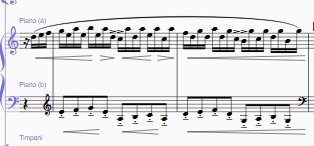
Similarly to how this appears in the original Murder, She Wrote theme music, the moto perpetuo theme has been ‘evaluated’ from its accompanying function, witnessed at the start (see below), to its own melodic importance. The melodic ‘movement’ in the right hand alternates between the upper notes (see b.19 for example: G-A-B-A) and the lower ones (C-D-E-C). This ‘internal’ dialogue was included to represent the character's thought processes.
The material has been set in a standard cycle of fifths harmonic progression (outlining: Em-Am-Dm-G).
https://teacher-sites-storage.inthinking.net/ib/music/music-links/piano-closing.mp3

https://teacher-sites-storage.inthinking.net/ib/music/music-links/opening-measures-of-piano.mp3
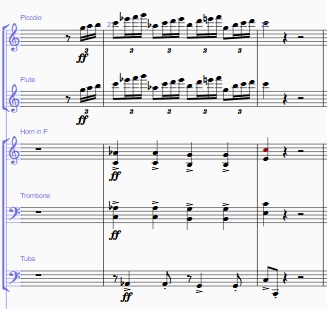
The closing measures again include the borrowed chord of A♭, before the standard final perfect cadence (V7-I: G7-C; see below). As identified in my analytical investigations, I wanted the Coda to function as a quick summary of the materials elsewhere; thus, I included these decorative passages (seen in the piccolo and flute) in these closing measures, along with a quick harmonic ‘diversion’ to A♭.
https://teacher-sites-storage.inthinking.net/ib/music/music-links/coda.mp3
Remember that the requirement for the CREATING EXERCISE for submission purposes is no longer than 1 minute in duration (see p.46 of the Music Guide).
Summary
In the student exercise “Murder, She Don't”, these isolated findings were not treated as a rigid checklist, but attempts were made to create an interconnected musical work that represented the earlier findings.
- The piece hopefully establishes Jessica Fletcher’s narrative duality immediately in the opening phrase -balancing the warmth of a lyrical, legato opening with the sudden wit of a decorative (but related), playful response.
- Rather than letting the rhythm sit statically, the left-hand keyboard accompaniment adapts the moto perpetuo semiquavers in various guises, giving the small chamber ensemble a sense of forward investigative momentum.
- Rather than introducing unrelated filler in Section B, the piece develops through melodic economy - fragmenting the initial motif, plunging into the minor mode, and using ascending sequences to build tension toward the return.
- The recapitulation doesn't just repeat Theme A; it reinterprets it. Its concluding material moves through the cycle of fifths; the previously "background" semiquaver motif is promoted into the high register as the primary melodic voice, delivering a decisive sense of both arrival and resolution.
Over the course of these five lessons, here is what we have achieved:
Lesson 1: Decoding the narrative function and musical devices of an iconic theme (Murder, She Wrote).
Lessons 2-3: Broadening your comparative lens across different dramatic genres (Dynasty and St. Elsewhere).
Lesson 4: Distinguishing one-off compositional quirks from genuine, recurring creating conventions.
Lesson 5: Putting research into purposeful practice through a fully justified practical exercise and rationale.
We hope you found this unit valuable in demystifying how conventions inform creative work.
Take a moment now to reflect in your Music Journal on the following prompts:
- How will you approach a genre or style of music that has little academic research material available?
- Which of the conventions do you think you would find the easiest - or most challenging - to apply to your own creating ideas? Where does additional personal work need to be undertaken in order for you to better prepare for the practical exercise?
- How can you use this same "research-to-creation" framework for other Areas of Inquiry and the unfamiliar traditions in your Exploring portfolio or elsewhere? What adaptations might you need to make?