Thoughts on the Arts and Creativity

An Interview with Dr. Lois Hetland
Dr. Lois Hetland is a retired professor and former chair of Art Education at Massachusetts College of Art and Design. She received her Ed.D. from the Harvard Graduate School of Education in 2000. She has been a contributing author for several arts education journals. Lois served as education chair of Project Zero’s annual summer institute from 1996 to 2005, and consults nationally and internationally on arts and on teaching and learning for understanding. She shares her thoughts on creativity and its relationship to the arts.
Here are thoughts on teaching in the arts, creativity, and more.
Background recording: Bach Cello Suite #1 in G Major - Prelude
Yo Yo Ma
A written transcript of the podcast follows
JIM: Hello, everyone. It's indeed an honor and a privilege for me to introduce my next guest in the series of podcasts. Today, we're going to be talking with Doctor Lois Hetland, a very dear friend and colleague. I first met Lois in the mid 90s at the Project Zero Summer Institute at Harvard University. At that time, Lois was a doctoral student who became a principlal investigation at Project Zero (note: corrected annotation from dialogue). Since that time, I've had a chance to work with Lois on various projects and been associated with Lois on various ideas involving the arts and arts education. I have to say, and this is why I'm so tickled with this podcast, there are very few people in my life and my career who have influenced me to the degree with my own approach to arts education than Lois.
She's been a remarkable influence on how I approach my work, how I approach looking at the arts, looking at music, and working with students. I can just simply sum that up, that she is an arts teacher's teacher. She recently retired as a professional and graduate coordinator at the Art Education Department at the Massachusetts College of Art and Design. So, Lois, without further ado, it's again an honor and a privilege for me to be speaking with you today. This is a conversation I wanted to happen a long time ago, and I can't wait for this one to start. So maybe, Lois, you can get started by telling us just a bit about yourself and your role with arts education in general.
LOIS: Sure. Yeah. It's a real pleasure to be here, Jim. I'm delighted to be talking to music educators. You know, it's funny. I always felt more like I could say that I was a musician. And I've never been able to call myself an artist. I don't know exactly why that is. I think it's because I actually performed music, and I haven't really exhibited my art. So, I'm working on that. Various friends are working on it with me, too, trying to get me to understand that I can accept the label artist for myself, but OK, my role with art education in general. I was a music and visual art major in college, and then there were no jobs in music and visual art education.
When I was getting into the teaching field, I didn't think that I was skilled enough to have performing be my way of being in the field. So I went into education, and I got a general education degree as well as a visual arts degree, but there were no visual arts degrees there. There were no visual art jobs in New Haven, CT, which is where I was. So I, I worked in a general classroom, and I worked in a daycare center, and I got jobs in private schools. I was a public school kid from the word go, but the jobs were in private schools. And so I got those. And once you're in there, you can't switch because of the timing. It's like they're hiring for the private schools in February and not for the public schools until June. And I was supporting our family. So we really needed the income. Anyway, I did that for a little under 20 years in a couple of different schools, a couple of different situations, lots of different grade levels. And then I went to the Graduate School of Education at Harvard.
And Jim, I really wasn't the senior research associate or whatever you said I was at Project Zero. I was the director of the summer institute. So I was the founding director. That institute was hard to get off the ground because Project Zero was a bunch of researchers. So Arts Propel happened like a minute and a half before I got to Project Zero, but it was very influential to me.
I mostly came in (to Project Zero) working on teaching for understanding and the dimensions of understanding, and then started working on my doctoral degree, which is a really gnarly statistical process where you combine research studies as if they are individual data points. So this study says this is how big the effect of music on spatial reasoning was. This study says this. And so you combine them all in various ways in a complicated way that allows you to come up with variables that exist across the studies, but that maybe people didn't test directly within the studies. So it was very interesting to do that. I did this with Ellen Winter. And what happened with that was that the two meta-analyses I did on effective music on spatial reasoning were positive. And so was one on drama in the effect of drama on verbal outcomes.
But the rest of them were either no or not, and especially the one that Ellen did, which offered no evidence yet to demonstrate that music makes you (generally) smarter in other subjects. Well, this really annoyed a whole lot of people who thought they'd thrown their hat into the ring of music or arts education, making you (generally) smarter in other subjects. And so they didn't like the fact that we said, well, you know, the science isn't there. You can't really say that, but I got hate mail. You have single-handedly ruined the case for music education for the next 20 years. What was really interesting, though, was that the artists, I don't mean the visual, I mean the people who were professionals in the fields, had no problem with this.
What do the arts give us?
They were thinking, why would anybody want to justify the arts on the basis of it? It makes you smarter in math. That just seems ridiculous. I mean, it's like you want to do the arts because of what the arts can do. So we thought about that and thought, well, maybe people don't really know. Maybe they don't know how to talk about what the arts do, what the arts give us. So that's why we did the Studio Thinking Project, which is when we went into two different intensive high school arts high schools and videotaped teachers in their classrooms for a year. I think we had 105 hours of videotape that we analyzed, and we weren't testing whether anybody learned anything. Our question was, what do teachers intend students to learn from teaching them the arts? And what we came out with are 4 studio structures.
Studio Structures include: Demonstration/Lecture, Students at Work, Critique, and Exhibition
So the four studio structures are demonstration/lecture, students at work, critique, and then exhibition. I call them the ways that teachers organize time, space, and interaction in their classrooms. They move them around a lot to get to do what they need to do. But it was really interesting to see that those things happened in all sorts of disciplines. If you're conducting an ensemble, you're actually doing a demonstration/lecture and students at work at the same time. So it's not that you know that these things play out differently in different disciplines.
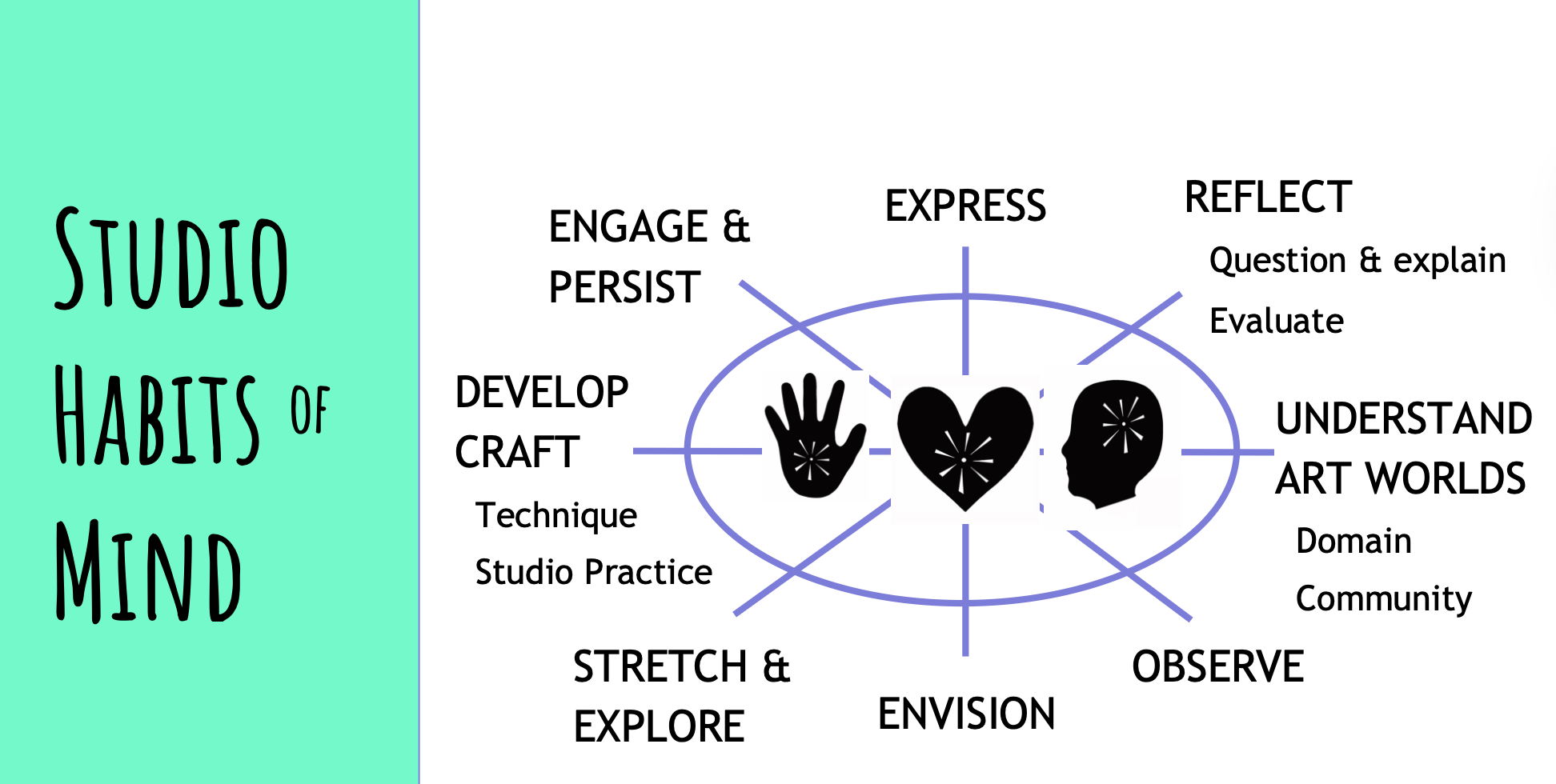
It's like the teacher would do a demonstration lecture that took 30 seconds, the students would do a 2-minute students-at- work, and then there'd be a 15-second critique, and then they'd do it again. They'd just do it really, really quickly. And then in the studio Habits of Mind, we analyzed everything we saw, and we were looking for how artists think. So we had eight habits of mind. The habits of mind are the categories that artists think in and with. They're dispositions. The idea of dispositions is the idea that skill is really important, and skill is a part of dispositions.
Studio Thinking includes Studio Habits of Mind: the categories that artists think in and with.
If you have a skill, it's really not enough because it can be inert. It's like if you know how to read and you don't read, what difference does it make that you have the skill of reading? So the skills are in a triangle with two other elements. One from David Perkins and his group is inclination. And that's about drive, motivation, or passion (see: Finding Musical Passion). It's what causes you to put the skill into action. You want to use that skill to do something, and that's the inclination. Then the third part is alertness. You have to notice that there's an opportunity to use the skill.
In this case, let's say you're practicing and there's a hard part, and you could use your skill of slowing down and working on the hard parts, or playing the hard parts in a variety of different ways. You know, approaching them from different ways and seeing what you could do by that. So these dispositions, the skill, inclination, and alertness all work together in the 8 studio habits of mind. You've got the skill of observation, the inclination to observe, and the alertness to notice when observing would be a useful thing to do. Then there's envisioning, which is like observing, except you're looking at the things that exist in your head that don't have form yet. It's imagination. There's stretch and explore, which is wonderful. It's playful, it's risk-taking. But the most important thing, I think, is that it has to do with error.
If you're playing around and taking risks, you're going to make mistakes. And if you do, there are opportunities. They are potential discoveries, and you can understand how to do something better, or you can understand a new thing that you could do instead. So those are three of the studio habits. The other is develop craft, which has a community, taking care of the studio, the instruments, or whatever. Engage and persist; I really love this idea of finding that thing which you love, and it's that which is the engine that helps you continue with it, to persist at it through the ups and downs, and then express, which has to do with meaning.
Studio Habits of Mind were developed by Project Zero at Harvard University. They represent the eight essential thinking skills artists use, which teach creative processes applicable across all subjects: Develop Craft, Engage & Persist, Envision, Express, Observe, Reflect, Stretch & Explore, and Understand Art Worlds
It's like looking at cross-disciplinarity, looking within your discipline, looking within the arts, looking within the other arts, looking within all the disciplines, trying to find the connections that are going to move your thinking forward.
Source: Hetland, Winner, Veenema, & Sheridan. (2007/2013). Studio Thinking: The Real Benefits of Visual Arts Education
Source: Hogan, Hetland, Jaquith, & Winner. (2018). Studio Thinking from the Start: The K-8 Art Educator’s Handbook
Slides by Diane Jaquith, 2018
JIM: Yeah, it's interesting. I just finished a workshop on a component of the IB Music program. It's called the experimenting component. I found that one of the key features of it is that students need to deal with the unfamiliar. They need to get uncontrolled if they're going to develop new skills and new understandings. They have to be willing to take that step to go into it, but also, they have to figure out ways of making these connections. And that's all in the sort of assessment criteria and the program. It's not prescribed. A lot of music teachers struggle with this. (I often hear…) Just tell us, please tell us what we have to do. It's not going to do that. You have to understand the student persona. But when the student goes on this journey, it parallels what you're saying when they go on this course of experimenting with music. And we're not talking about technical proficiency as such. That's another part of the course, but we're talking about seeking relevance.
In other words, I made this musical decision because… I can justify this musical decision because… I found out this, I know this, and this that I know I can connect, which I don't know, and I want to find out more about. So you mentioned this whole idea of purpose, and I think that's what struck me about the work I've observed with you and the work through Project Zero. (There are) So many parallels. This music curriculum has Project Zero written all over it. We could unpack several things. So why don't we taper it down just a little bit? You've done a lot of work with creativity.
You've made this diagram called the creativity diamond. I will make sure that there's a visual representation of this when we do post it on the site. Maybe you could talk about the notion of creativity and the creativity diamond and unpack that for us.
Lois: Creativity is such a hot button. There's a whole field that studies creativity. Howard Gardner and Mahaly Csikszentmihalyi, and various people have studied it, and they talk about big C or little C, big C being something like Freud, people who change domains.
Anna Deavere Smith transformed drama into a monologue by representing figures with different characters through her own body, and then having the audience see it. She's a creative person. She really did these things. But that has never been that interesting to me because I'm really interested in all the little C issues around creativity. It's more about where you use your creativity, in which concept. Mahaly Csikszentmihalyi made the model of creativity that I find extremely helpful. He said, you don't have a creative individual all by yourself. The creative individual interacts with the domain. That means the stuff that institutions and other people have made, with a field. Meaning, people are the judges, use the stuff, and determine its value.
So if you are a creative person, you are an individual, and your creative ability interacts with the domain in the field. Without the domain in the field, there's no frame to really see the creativity. Dave Perkins used to talk about adaptive novelty. I think that's a very useful thing to remember about creativity: it's adaptive novelty.
So you can look at the (creative) process that you're using and think about how creative that is. Then you can look at creative places. So you can look at cultures, locations, and communities, and see how creative that space is. Is the (music) ensemble a creative space, or is it (tick off the box) skill-based? And then there is the product. And that I think a lot of people think that a creative product is all that we're interested in. It's like, can you design something that will be useful and field-breaking?
What's the interaction of the person with the creativity of the place? You know, the lab or the studio or the practice hall. How do we interact with each other on a stage? An improvisational stage is a creative place. It's set up for people to listen to each other, to respond to each other, to make spontaneous moves in response to each other.
Frameworks are Viewfinders
One of the things people are probably hearing (is a response to) is what my role is in the arts field. I think my role in arts education in general is to introduce frameworks to people. Frameworks are viewfinders. Dave Perkins used to talk about thinking frames. It's like the lens of a camera. You look through it, and you point it at something that you want to look at, and then you adjust the focus. Maybe you put in a different lens, maybe you put in some colored lenses. Maybe you can do all sorts of things once you have a viewfinder. I think that's what these frameworks are, that they're not recipes. Teachers are often looking for recipes that tell them here's what to do and here's how you do it. But I think what we're suggesting is that you need a viewfinder, you need a framework, and the framework has places within it. It suggests what you ought to be looking for or envisioning. You ought to be looking for stretching and exploring, or you ought to be looking for engaging and persisting.
Teachers are often looking for recipes that tell them here's what to do and here's how you do it.
So the viewfinder, the framework, tells you what to look for in what you're looking at. I think that's a really important thing. You can use the studio thinking framework to look for creativity. By starting with observe, envision, and stretch/explore. Those three together will bounce off each other and push you toward creativity. Express will come in there; develop craft will come in there, Engage and persist will come in there. But if you think about imagination, observation, and playing around, you're going to have creativity.
OK…the Creativity Diamond. The Creativity Diamond is a framework that I discovered when I met Jim. So we're talking 1996, and it came from a friend of mine, Judith Larson, who is an artist, and she introduced me to this.
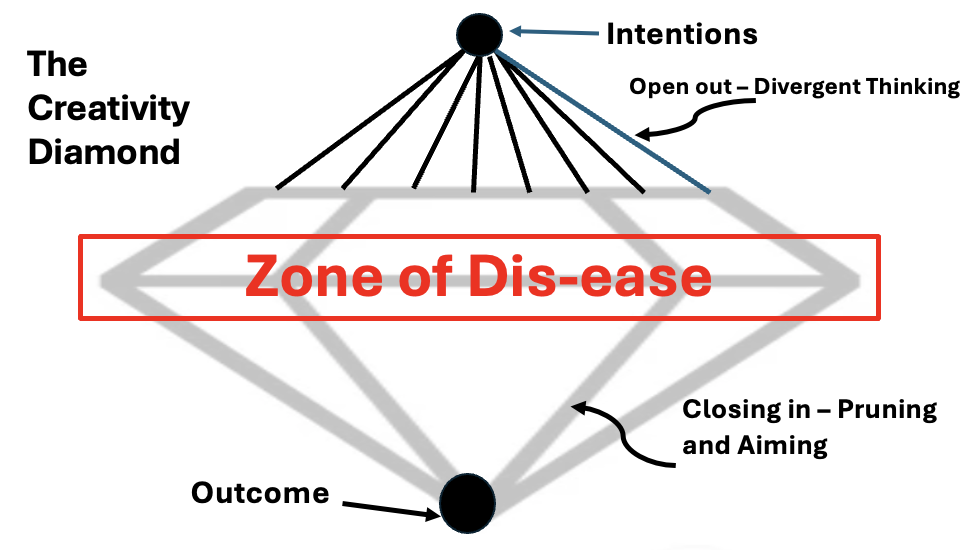
She had found it somewhere, and she said it was from Synecdox, which was a group in Cambridge. It is a depiction that is useful to me and has been useful to lots of other people. So I want to give Synecdox credit, but it's possible that they wouldn't want it or that they don't think they deserve it. I don't know who deserves it, but I didn't create it, so I've just popularized it. I think I popularized frameworks and various things. I used to say that because I traveled around to lots of different locations that I was like a pollinator and that I would like bumble into somebody's flower and I'd get all their good pollen on me and then I'd go fly over to some other flower and dump that pollen over there. And so it was a way of connecting and nourishing the practices in a variety of places, not by me, but by picking up what I picked up from other people and just putting them together.
JIM: If I just may interject, it's very interesting that you're saying this because that's what I find with the first two components of this IB music curriculum, the exploring and the experimenting component. It's not defined. It's just a framework, and your conversations here about finding the vision, finding the cue, finding the purpose are really powerful, really important.
LOIS: I hope that people can use this idea of a framework, and we'll give you another framework that is really important to me, the dimensions of understanding. But let's start with the creativity diamond. So the creativity diamond is this idea that if you start with something that is a puzzle, it's maybe not a problem, but it's a possibility.
It's a possibility space. And so let's make it a dot up at the top, this possibility space. And then you want to open up the possibility space. What could we do with this possibility? And so that's when you use divergent thinking and open-ended thinking. You explore, you come up with different possibilities. And so now you've got this ray coming from the dot of the possibility space that's opening out with many possibilities, those lines or possibilities. But at a certain point, I mean, that could be what they would call bizarre. You know, it's not adaptive novelty, it's just novelty. But at some point, you have to start thinking about where that possibility space is going to end up.
You're going to do something with the possibility space that defines it, that solves it, that makes it into something useful, valuable, interesting. What you have to do at that point is you have to turn the direction of those rays that are opening out. You have to turn them in and aim for an outcome. And you also have to prune possibilities. You know, you can't have all those possibilities. Some of them you have to say, Nope, gonna go with this one. Not that one. Nope. So what happens is you end up with these rays, fewer of them, and they're pointing in. Then, if you draw the line across the middle, you see the diamond. It's still the rays going out and the rays coming in. But for me, the most interesting thing about the creativity diamond is that it's just a description. But what is true, I think, is that in the middle of the creativity diamond, when you are turning from going out to going in, that is really uncomfortable. You know, you've been having a great time playing around, opening it up.
The middle of the creativity diamond…is really uncomfortable.
And now you have to do critical thinking. You have to say, this one's better than that one. I'm not going to follow that Ave. I'm going to follow this Ave. I want to aim toward an outcome. And it's like, eh, that's hard. And so we call that the zone of dis-ease. You notice that you're in it because all this blame starts popping up. It's like I'm too stupid to do this. I can't do this. I don't have the skills I need to figure this problem out, or this is a stupid framework. I can't do this. You know, nobody could use this framework. It will never work. Or this is a ridiculous thing to ask of a violin. You know, a violin couldn't possibly do this, or you find I'm blaming my teachers, I'm blaming myself, I'm blaming my materials, I'm blaming the space. I'm blaming the whole situation.
The thing is, I used to think that I would grow up and mature, maybe have enough therapy that I would finally not have to worry about that space in the creative process, that I wouldn't get into this self-doubt and second-guessing and all of those blocks that keep you from moving forward. But it turns out that that space is inherent in the creative process, that it absolutely will exist. Everybody will experience it, and everybody will experience it a lot. So what you have to do is you have to notice, unless it's the alertness that you're in that space, and then you have to be inclined to do something about it. And then you have to use your skills to manage how to work through this space of unease.
And skills can be going and taking a walk, going and doing, you know, going and taking a nap, going and working on another problem, talking to somebody. Going on a walk is a really good idea. I love working. I mean, I'm often working on two or three pieces at a time. Some people are working on 6 at a time. It really helps to walk out of the piece that you're blocked on and go over to another piece that you're not blocked on. And as you're working on that, it's like, oh, what if I tried this? So that's the Creativity Diamond, and I have found it really useful and useful for kids, useful for teachers to teach kids that this is how this creative process is going to work, and this is what you can do to make it better for you.
JIM: When I'm looking at this diamond, I'm thinking again of this conversation that we had about the experimenting component when we're trying to get kids to deal with the unfamiliar, and you have this area of unease. And I said, and many colleagues agreed with me, that first of all, the experimenting process isn't going to be something that happens quickly, that's for sure. It needs time. Don't think that you're going to get this done as a unit of study. Don't think you're even going to get this done in terms of even a week or a semester or even longer, a year or longer. This is all going to take time. And I said, one common element of that was that you're going to get to the point where students are going to get frustrated, and they're going to say, oh, I'm not finding anything. Can I change my topic, please? And the, the tone of the conversation was, well, let's turn this around because now it could be that the students are really starting to make progress. And this is where they need the teacher's mentorship to say, let's ask some really good prompting questions here and see if we can come to some terms and find some relevance in what this uncomfortable area that you're in right now.
I really felt that this being uncomfortable or this area of unease is a really strong component of the experimenting component and of the creative process. I thought that this diamond diagram and your discussion of it were so powerful. It describes this whole component.
Maybe we could turn our thoughts a little bit to understanding. The dimensions of understanding have been powerful for me. It's just sort of changed my approach to teaching. We're certainly not going to have time to go into all of that, but maybe we can focus it down just a little bit and talk about the four dimensions of understanding more specifically. Once we can see these connections, these are inherent, these are obvious, even though they're not mentioned that way, but they unpack, and they are applicable to every aspect of the music curriculum, the IB music curriculum. Could you share your thoughts about the four dimensions of understanding?
LOIS: So, the dimensions of understanding are when we were working on the teaching for understanding framework, we were thinking about understanding goals. You want your goals to aim for understanding, but how do you know if your goals are good? How do you know if you've aimed for enough understanding or the right understanding or whatever? So the dimensions of understanding are 4 categories or dimensions that every discipline has. So I always used to show an iceberg with the part that was sticking up above the water. That's the topic, that's the part you're working on. And the discipline is what's lying underneath the water.
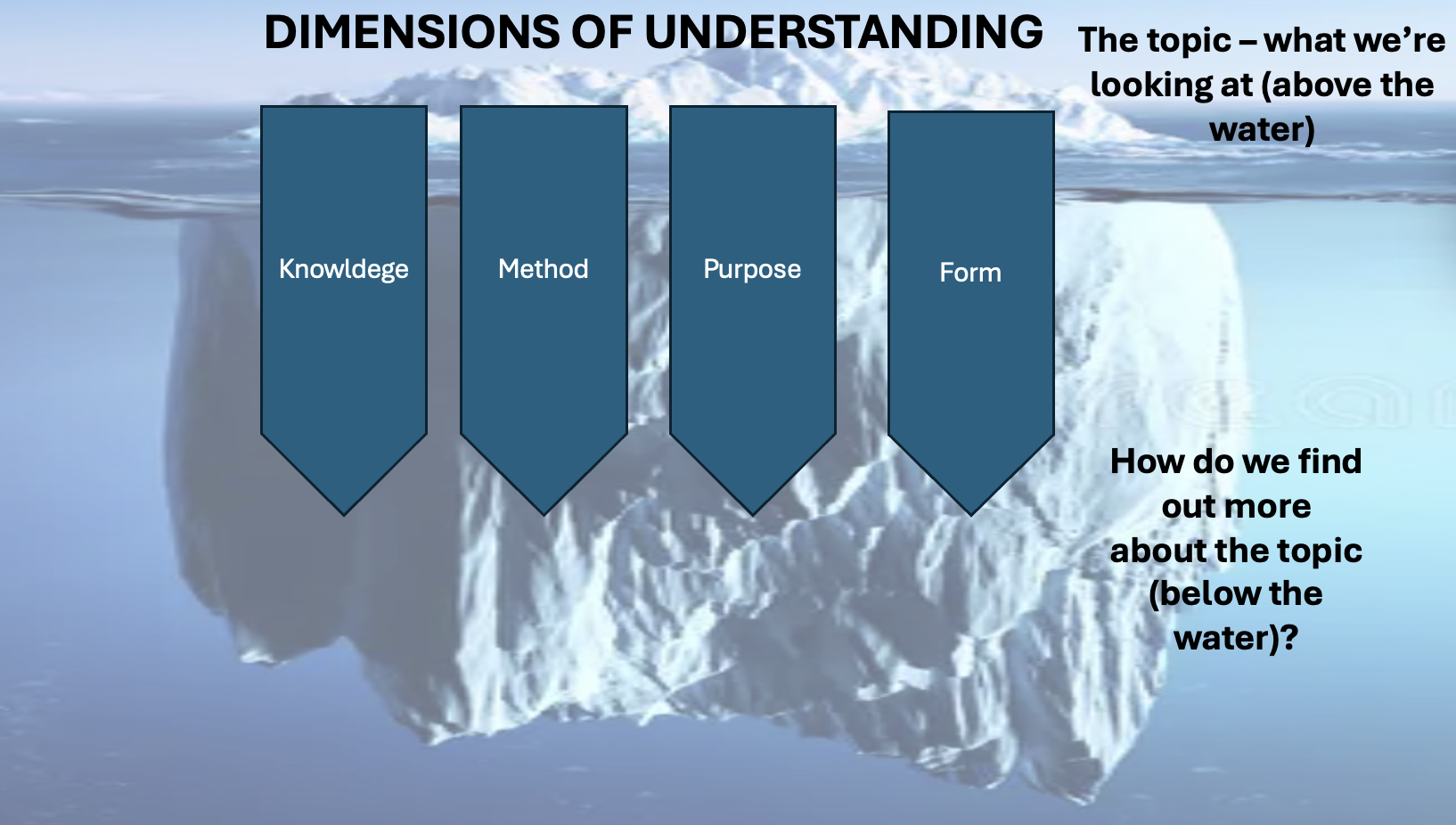
The iceberg is divided into 4 parts. There are 4 considerations that every discipline has. I guess they're mostly behaviors. They're how you think about it. So the one that I always put first now is purposes. For me, that was the most powerful. People seem really resistant to making purpose a goal. It's like, why are we playing an etude or why are we experimenting? You know, who cares? What's this for? Who's going to use this? Why does it matter?
If you have a goal like that, you're instantly engaging the students in making decisions. It's like, wait a minute, why are we doing this? Oh, because if we do this, then we can do this. Or could we do this anyway? It just gets their minds engaged with the centrality of disciplinary thinking. And so I think it's really important, and you can't forget the purposes. So you should certainly have an understanding goal that is related to purpose.
Then the one that I always put next, none of these aren't linear, but I talk about them in a way that are methods. Methods is not teaching methods. Methods are disciplinary methods. So it's like, how does a musician explore, experiment, make meaning, compose?
How does a musician practice and improve? How does a musician do all those things? So in the methods dimension, you can list, guess, and check or draft and revise or work on the hard parts or play out of town, all of Dave Perkins's whole game learning stuff. You know, it's like these are the things that you do to find out about this topic that you're working on and to judge the quality of what you're doing with it. So if you've got purposes and methods, you are way along the game, you might almost be able to stop. But there are two more, and the one I go to next is forms of expression.
Forms of expression are really useful because a lot of times, we don't teach people the why. We don't teach them how the bow is a tool that operates in a certain way and can have certain capabilities, certain affordances that can make things happen. So let's study the way these things show up. So the purpose is why the methods are how, and the forms are where and when they show up? And so you're looking at the genres, you're looking at the symbol systems.
It shows up in notations, it shows up in scores, it shows up in ensembles, it shows up in practice, and descriptions of how to practice. It shows up in graphs and charts. It shows up in pieces of music. It shows up in the musical forms. We need to teach kids about those forms so that they understand what they're working on in order to show what they know.
The 4th one, which a lot of people used to think of as the first one, is knowledge. Knowledge is a network, and it's all the discrete bits of information. You know, just the facts, ma'am. But it's not just the facts, ma'am, you know, just randomly arrayed.
It's bits of information and the connections between them, and how we organize them in systematic, useful architectures so that we can enter from a whole bunch of different directions and move around in there and put things together and add on.
With those 4 dimensions of understanding, you could just have a why question for your unit. You could have a how question. You could have a where does it show question and a what is it question. Then you know for sure that you will have a comprehensive approach to this disciplinary topic and that you will learn something. You will begin to understand something that matters to people who are working with this discipline.
FOUR DIMENSIONS OF UNDERSTANDING:
PURPOSE = THE WHY
METHODS = THE HOW
FORMS = THE WHERE AND WHEN
KNOWLEDGE = THE NETWORK (CONNECTIONS)
JIM: As you're speaking here and finding the connection, say, between method and knowledge and purpose. One of the questions that arises, especially with this part of the curriculum, the experimental curriculum, is who it is geared toward. Is this for the proficient musician? The musician who, after high school, has this goal of going off to a conservatory, to Juilliard? Is the goal to go to Berklee? The goal is to do this. And the answer is, yeah, it could be. But this is also for the student who just loves music, who wants to be the third clarinet player in the band, who wants to be the second alto in the middle of the section of the choir that just wants to sit at the computer and create music. What do they have to know? How much theory do they need to know? First of all, maybe theory isn't just strictly Western theory. But whatever it is they have to do, they need to find out the purpose of what it is they're doing and the knowledge that they gain. Once they understand the purpose and the relevance of what it is they're trying to do, that will gradually unpack and make sense.
That'll be different for the student who's a classically trained pianist, to the student who just simply wants to play in an ensemble and enjoy music, to the student who just likes to listen to music, and to the student who likes to make Computer Music that really can't read Western notation at all, but understands how it works. So again, the discussion is powerful and rich. You've basically unpacked the whole experimentation process. We could go on, but I'm looking at the clock, and I want to wrap up a couple of things here. There was 1 philosophical question that I want to ask you before run out of time.
If you had the power to change any aspect of arts education, what would it be?
LOIS: I don't think it would be one thing. OK, so the first thing I would say is that making needs to stay at the center. Art can't be about studying about art. It really differs from scholarship, but not in the sense that scholarship requires deep and rich and applied intelligence, because art does that too. But as (Arts) Propel reminds us, making has to be central with reflection and perception interacting with it during the process. So I would just want to make sure that everybody understood that art education K through 12 is primarily a making enterprise. You've got to be making stuff. Another thing that I would wish I could insist upon is that kids have to make choices. They don't have to make a choice all the time, but they've got to make it a lot. Art is really tied to our deepest personal concerns and linked to the world. Those things are really complex. It requires personal commitment or engagement.
I think you can't have that unless kids get to choose among the complexity that they're dealing with, and they have to practice choosing at the heart of what they do. So making and choosing. Another thing is that they have to practice making decisions. They have to understand that what they're doing as they're making art is making decisions, and artists are both made from and understood by thinking. So kids need the chance to think about it in every possible way. The decisions are thought. They have to have imaginative thought and decisions, creative thought and decisions, critical thought and decisions, reasoned thought and decisions, predictive thought and precision.
It has to be decisions that they're making over and over and over, and they really need to understand that that is a major part of the task. The last thing I would say is about models. I think the kids really need frequent exposure to practicing artists, like either in videos or exhibitions, or live in the process of thinking through the making that they're doing. So they need to see how artists think in order to get in on what that looks like and sounds like and feels like. So human beings are mimetic creatures. We need lots of models, many models, so we don't get confused and think we're meant to copy someone else's style. I whittled it down to four. I think that's not too bad. So making choices, decisions, and models.
Arts education involves Making, Choices, Decisions, and Models
JIM: It's interesting, this thread of discussion right now. It so echoes the experimenting component in the music curriculum. You've pretty much outlined the curriculum, and many aspects about decision making, choices and so on in the curriculum without having a direct knowledge of it. We could go on and on with this discussion. Lois, any final thoughts that you'd like to leave for us arts educators?
LOIS: I'm tempted to say no, I think we really covered it all. But the thing that I would add is that this is about joy. This is about fun. This is about a fundamental way to be human, and it's as important as any other way, and maybe more important than the ways that don't put joy and the connections to self so centrally in the process. So no matter what's going on, don't forget that you're doing it because of love. You're doing it because it is the thing that makes you feel alive and awake. It's what makes life worth living. It really is a matter of life and death in a totally joyful way. This is why we bother.
JIM: I close every workshop. And maybe it's apropos for closing this podcast. I close every workshop by sharing that our role as arts educators, of finding these relationships of understanding, the connections between human cultures, our role as arts educators has never been as essential and as critical in the world as it is right now at this moment. I salute everyone in this field. And I am willing to work harder and harder to push that cause forward, regardless of what type of background or political persuasion you are or where you come from, because if we want to seek these connections, we'll find those through the arts. We'll find the respect, we'll find the understanding when we delve into the arts. Yeah, and you've been an inspiration to me for many, many years in that regard. So I want to say thank you. This has been powerful.
I think this podcast is going to lead to several pages (on the site). Lois, you're wonderful. You've been very gracious with your time. On behalf of everyone that's listening, I want to say thank you.
LOIS: Well, thank you. It's a pleasure to speak to people who are going to take what I say and use it to do something to help kids learn themselves to whatever. It's really gratifying to have something to give that might be useful. I hope it's useful.
Csikszentmihalyi, Mihaly. “Creativity: The Flow and the Psychology of Discovery and Invention". Harper Press, New York, NY 1996
Hetland, Winner, Veenema, and Sheridan. Studio Thinking. Teachers College PR (2013)
Hetland, Winner, Veenema, and Sheridan. Studio Thinking 2: The Real Benefits of Visual Arts Education
Hogan, Sheridan, Veenema, Winner, & Hetland (2022). Studio Thinking 3: The Real Benefits of Visual Arts Education. Teachers College PR (2022)
Davidson, Scripp, Myford, Palsket, Swinton, Torff, Waanders, and Winner. “Arts PROPEL: A Handbook for Music". Harvard Project Zero. Boston, MA (1995).
Winner, Ellen, “Arts PROPEL: An Introduction Handbook”. Harvard Project Zero. Boston, MA (1993).
Wiske, Martha (editor). “Teaching for Understanding: Linking Research to Practice”. Jossey-Bass, San Francisco, CA. 1998.