Presenting as a Creator
Exploring Lofi
As an introductory session in the "Using Music Technology" series, this page provides ideas for you to generate material for an original composition. For these activities, the genre of lo-fi has been selected, with a recommendation to utilise GarageBand (free on Mac computers) or BandLab (free on PC computers) as accessible digital audio workstations (DAWs) if you have no other alternatives. These platforms do not require downloads, payments, or the possession of a MIDI keyboard.
“Lo-fi” Photo by Jonathan Formento on Unsplash
It has been suggested that Digital Audio Workstations (DAWs) such as GarageBand and BandLab may present limitations for students undertaking the IBDP course in music. While this assertion holds some validity, it is important to acknowledge that these platforms offer an accessible entry point for creating music with technology. They have been selected specifically for their relative simplicity, with the aim of alleviating any apprehensions you or your students may have regarding the utilisation of such technology.
While the content has been structured around the "Performing as a Creator" component, it is versatile and can be adapted for use in a variety of other contexts within the course.
It is also essential to clarify that this page is not intended to serve as a comprehensive tutorial on the operation of these software applications, as various instructional videos on platforms such as YouTube are readily available for that purpose. Instead, the approach here aligns with the IB inquiry-based methodology, where the exercises that you will engage with have been designed to stimulate creativity and engagement.
“DAW” Photo by Ivan Jermakov on Unsplash
Challenging Assumptions
In your music journal, write down FIVE points that you think you know about lo-fi music and THREE questions that you would like to explore further about this music. You should NOT refer to the Internet or other reference materials in order to complete this task. This is a starting point for you to consider what you know and what you would like to know.
Here is a sample of what a student may write:
What I Think I Know
- It is music primarily written in order to relax or de-stress and contains repetitive drum patterns.
- It has only recently become popular and is ordinary presented without vocals.
- It is marked by repetitive harmonic patterns with some of the chords jazzy in nature.
- Many students use this genre as a type of background music whilst studying.
- Instrumentation normally consists of drums, piano, bass, guitar and maybe some brass.
Questions I am Pondering
- What is the origin of the misplayed notes? Do these intentional imperfections share a similar origin with the improvisational techniques used in early scat singing, such as Louis Armstrong's unrehearsed vocal improvisation after forgetting lyrics in a recording?
- Why is lo-fi music particularly popular for students during study sessions? Is there empirical evidence suggesting that listening to lo-fi music yields positive cognitive outcomes, beyond its recognized stress-relief effects?
- Given that music production tools are now accessible to anyone with internet access, what implications does this have for the future development of music technology and the creation of alternative musical forms?
Continuing in your music journal, complete the following tasks:
1). Determine to what extend your initial assumptions about lo-fi are accurate, AND
2). Attempt to address the questions that you have posed.
In both cases, ensure that you have maintained a record of any websites/resources that you have used.
Again, here is a sample of how a student may respond to the above:
"It is music primarily written in order to relax or de-stress and contains repetitive drum patterns."
Yes, it is true that Lo-fi music is often characterised by its relaxing, calming qualities, and it frequently features repetitive drum patterns that help create a soothing atmosphere. This genre is designed to relax listeners or serve as background ambiance. This is according to Chan (2020) who states that lo-fi predominantly serves as calming background music, often with repetitive beats and mellow soundscapes.
Chan, T. (2020). Understanding lo-fi: A genre for relaxation and focus. Journal of Modern Music, 15(3), 45-58."It has only recently become popular and is ordinarily presented without vocals."
While lo-fi has gained widespread popularity in recent years, especially via online platforms like YouTube and Twitch, I was unaware that it had roots stretching back decades. It is often instrumental, emphasising beats and ambiance over vocals, although some tracks incorporate vocal samples. Gao (2019) notes that the lo-fi aesthetic is primarily instrumental and has seen a surge in popularity with the rise of internet streaming.
Gao, L. (2019). The rise of lo-fi: Internet culture and lo-fi's resurgence. Music & Society Journal, 22(2), 112-130."It is marked by repetitive harmonic patterns with some of the chords jazzy in nature."
Lo-fi often features repetitive harmonic progressions, and some tracks incorporate jazzy chords (presumably this means extension chords), adding a mellow, soulful character. Cheng (2021) alsol highlights that lo-fi frequently uses jazz-influenced harmonies to create a warm, nostalgic feel.
Cheng, M. (2021). Harmonic analysis of lo-fi music: Jazz influences and repeated patterns. Journal of Contemporary Music Studies, 10(4), 72-85."Many students use this genre as a type of background music whilst studying."
Lo-fi is popularly used by students and individuals alike for studying, working, or relaxing, due to its unobtrusive and calming qualities. Griffin (2022) reports that the genre’s steady beats and mellow sounds make it ideal for focus and concentration. The Vaughn College article supports these assumptions as well.
Griffin, S. (2022). Lo-fi as study music: An exploration of its popularity among students. Educational Psychology Review, 34(1), 33-47.
Vaughn College. (2023, May 16). Studying to lo-fidelity: Lo-fi music gets high marks with students. Vaughn College.
"Instrumentation normally consists of drums, piano, bass, guitar and maybe some brass."
Lo-fi instrumentation is typically simple, featuring drum loops, piano, bass, and sometimes guitar or sampled sounds; brass instruments are less common but may appear in some tracks for added texture. Lo-fi production often emphasizes sampling and layered textures. According to Lee (2018), the genre primarily relies on a minimal setup focusing on acoustic and sampled instruments, with occasional variety.
Lee, A. (2018). Instrumental textures in lo-fi beats: An analytical overview. Music Production Journal, 7(2), 89-104.
1. What is the origin of the misplayed notes? Do these intentional imperfections share a similar origin with the improvisational techniques used in early scat singing, such as Louis Armstrong's unrehearsed vocal improvisation after forgetting lyrics in a recording?
I think that the intentional imperfections, like misplayed notes and static sounds, are designed to make lo-fi music feel more genuine and nostalgic. Instead of the super-polished sound found in many pop songs, lo-fi embraces these flaws to create a cozy, human vibe that listeners can relate to. It’s kind of like early jazz and scat singing, where artists improvised spontaneously and valued improvisation as a form of expression. I read that lo-fi’s use of imperfections is similar to jazz (Music Gateway) because it emphasizes authenticity and realness over technical perfection, making the genre somewhat unique. It makes me feel like the music is more heartfelt and personal.
Machado, P. (2020). The aesthetics of imperfection: Lo-fi as musical authenticity. Journal of Popular Music Studies, 33(2), 105-122.
Music Gateway. (2023, March 22). Lo-fi music: The aesthetic of imperfection. https://www.musicgateway.com/blog/spotify/lo-fi-music-the-aesthetic-of-imperfection
2. Why is lo-fi music particularly popular for students during study sessions? Is there empirical evidence suggesting that listening to lo-fi music yields positive cognitive outcomes, beyond its recognized stress-relief effects?
I think many students listen to lo-fi music because it’s really calming and doesn’t distract you while you’re trying to focus. The repetitive beats and soft melodies make a good background sound that helps maintain concentration. I read a study (Brown and Kim, 2021), which suggest that listening to lo-fi can actually help improve attention and working memory during study sessions. Even though there does not seem to be a lot of research specifically on lo-fi yet, its relaxing, steady rhythm perhaps can support better focus and mental performance.
Brown, L., & Kim, S. (2021). Lo-fi beats and cognitive performance: An exploratory study. International Journal of Psychology and Music, 15(1), 45-58.
3. Given that music production tools are now accessible to anyone with internet access, what implications does this have for the future development of music technology and the creation of alternative musical forms?
Thanks to the internet, almost anyone can now use music production software to create their own lo-fi tracks. I think this has really opened up opportunities for many new artists to experiment and come up with fresh, unique sounds. It’s led to a lot of creative mixing of genres, like combining lo-fi with hip-hop, jazz, or ambient music. Yoon (2022) believes this makes music more decentralised, meaning many different voices can contribute and explore new ideas, which makes the genre more diverse and innovative. It’s exciting to see how technology is shaping the future of lo-fi and music in general.
Yoon, S. (2022). The democratization of lo-fi: How accessible production tools are transforming musical innovation. Journal of Music & Society, 29(3), 188-204.
It is advisable to subsequently incorporate pair work or small group discussions to explore students' insights and findings regarding the genre. Such collaboration allows students to reflect on how their initial assumptions may have been challenged or transformed through the research process. It is essential that the information students have uncovered is articulated in novel ways, encouraging the presentation of fresh perspectives and critical engagement with the material.
Student Task:
Listen to this standard example of of lo-fi music and attempt to write about its features. Your teacher may assign MORE or FEWER categories to you than this, but here are a list of musical features that you may wish to address:
- MELODY
- TEMPO
- DYNAMICS
- TEXTURE
- STRUCTURE
- HARMONY
- INSTRUMENTATION
- RHYTHM
- EXPRESSIVE FEATURES
- OTHER SPECIAL FEATURES
You may wish to assign individual students (or pairs) certain musical features to focus on, such that collectively all of the areas above will be addressed. Then, come together to share observations.
This example of lo-fi music has been selected as it is deemed a representative example of the genre. For those who are unfamiliar with this type of music, the piece and the album more broadly will offer you standard features of the music.
“Weightless” from "Life Forms" by Kupla
Musical Analysis of “Weightless” from "Life Forms" by Kupla
Melody
The melody in "Weightless" is characterised by gentle, flowing motifs (fragments of ideas rather than anything more melodically substantial) often played on soft piano or synthesiser lines. It is minimalistic in nature, emphasising atmospheric soundscape, rather than complex melodic development. The ‘melodies’ evoke a sense of serenity and introspection.
Tempo
The tempo of "Weightless" is typically slow, around 70-80 BPM. This moderate to slow pace contributes to a relaxed, almost meditative mood, allowing the listener to immerse in the subtle nuances of the soundscape.
Dynamics
Dynamics are generally subdued throughout the track, with occasional crescendos and decrescendos that build a sense of ebb and flow. Kupla tends to use dynamic variation sparingly but there are relative highpoints that contribute to heightened emotional impact. The atmosphere, however, is unequivocally gentle.
Texture
The texture is layered yet transparent, often built from sparse instrumentation with careful use of space. There is a blend of ambient soundscapes, soft melodic lines, and gentle percussion, creating a rich but uncluttered sound that feels in some ways expansive.
Structure
The structure of "Weightless" can be viewed as a form of progressive development, with slow evolution of the motifs and textures. However, the opening two sections do return at the end, and, as such, one could almost label this a combination of chain form and basic ternary form (perhaps: intro-AABCDAB-outro). There are no sharp or abrupt sectional changes; instead, the track smoothly transitions through different phases, maintaining an overall cohesion that is almost meditative in character.
Harmony
Harmonic content is typically based on simple chord progressions, often using extended chords or drones. The opening progression (according to Chord AI is BM7-BM7-C#m7-F#sus4) is used repeatedly through the piece, which is of course build on the standard I-I-ii-V inherent in many Western Art works and standard pop fare. There is a shift to B-D#m-C#m-F#, which is a somewhat less conventional progression (I-iii-ii-V), but still has clear links to standard harmonic unfolding. The second of these progressions does not include the use of the 7th, which renders it perhaps less jazzy than the opening series of chords.
For more information on Chord AI, you may visit HERE.
Instrumentation
- Soft piano or possible electric piano
- Ambient synthesisers and lush pads (sustained sounds)
- Gentle electronic textures
- Light sounding percussion and simple rhythmic elements
- Possibly field recordings of tickling water and other atmospheric overlays
Rhythm
Rhythmic elements are minimalistic; percussion is often subdued and plays a supporting role, sometimes with slow, steady kicks. On other tracks there are even shimmering hi-hats, or brushed drums. The emphasis is on creating a calm groove rather than driving rhythm.
Expressive Features
"Weightless" exudes a sense of calmness, introspection, and weightlessness—matching its title. The use of reverb and delay effects enhances the spaciousness, making the track feel like floating or drifting through an ethereal environment. Subtle modulations and dynamic shifts add emotional nuances essential to its contemplative mood.
Other Special Features
- Use of ambient sound design
- Emphasis on textures and spatial effects
- Minimalist arrangement with a focus on mood and atmosphere
- Gradual, seamless unfolding of musical ideas
- This is a typical example ambient electronic style rooted in lush soundscapes
Remember that the use of music technology for Presenting as a Creator (see p.35 of the Guide) that ALL parts must be MIDI entered, or performed and recorded by you. This is the same for any kind of sampled parts OR drum loops. Your teacher must be able to verify that the samples have been performed or recorded by you. In other words:

MIDI Entered:
- The music parts should be input into a music technology program using MIDI (Musical Instrument Digital Interface).
- This involves using a MIDI keyboard, controller, or other device to record the notes directly into the software, or manually inputting the notes via a MIDI editing interface.
- Performed and Recorded by the Student:
- If not MIDI entered, the parts must be performed live by you and recorded.
These recordings can then be used as part of the creation process.
Photo by James Lee on Unsplash
In essence, all parts should originate from your own performance or your own MIDI input work, not from imported or pre-made audio recordings that you did not create. This ensures that the work truly reflects your skills in creating or MIDI programming.
Based on the research that I have completed, discussions with my peers and further input from my teacher, I have decided to initially focus on the following characteristics of lo-fi music to create my example of Presenting as a Creator. I have used the music observations from “Weightless” from "Life Forms" by Kupla and other examples from the album to assist me in shaping my work.
Here are some of the feature I have used specific:
a basic chord progression: Dmin11 – Gmin7 – Dmin11 – Ebmin11 – C#dim7
Note that in the Guide it is essential that for Presenting as a Creator (see p.34) that students need to prepare “original works”. However, students may work from a stimulus. In this particular case, the student has selected a chord progression and appropriately referenced and cited it in the bibliography.
This has been taken from the site Lofi chord progressions (Albanese, 2025). I have selected this for the range of extension chords in use, resulting in clear links to a jazzy progression; however, I have adapted the beat-dependent rhythm (initially one chord per bar) in the example in an attempt to achieve a contemplative atmosphere that is not bound by a strictness in pulse. By that I mean that some of the notes in the broken chord appear in a non-standard manner (see below), apart from the bass note that always falls on the beat.
I also included some effects in order to gain a grainy and less polished effect. These included:
- tape stimulator - audio processing tool that emulates the characteristics of analogue tape recording,
- univerb - controls the balance of wet and dry signals, AND
- exciter - adds subtle harmonic distortion, particularly in the higher frequencies.
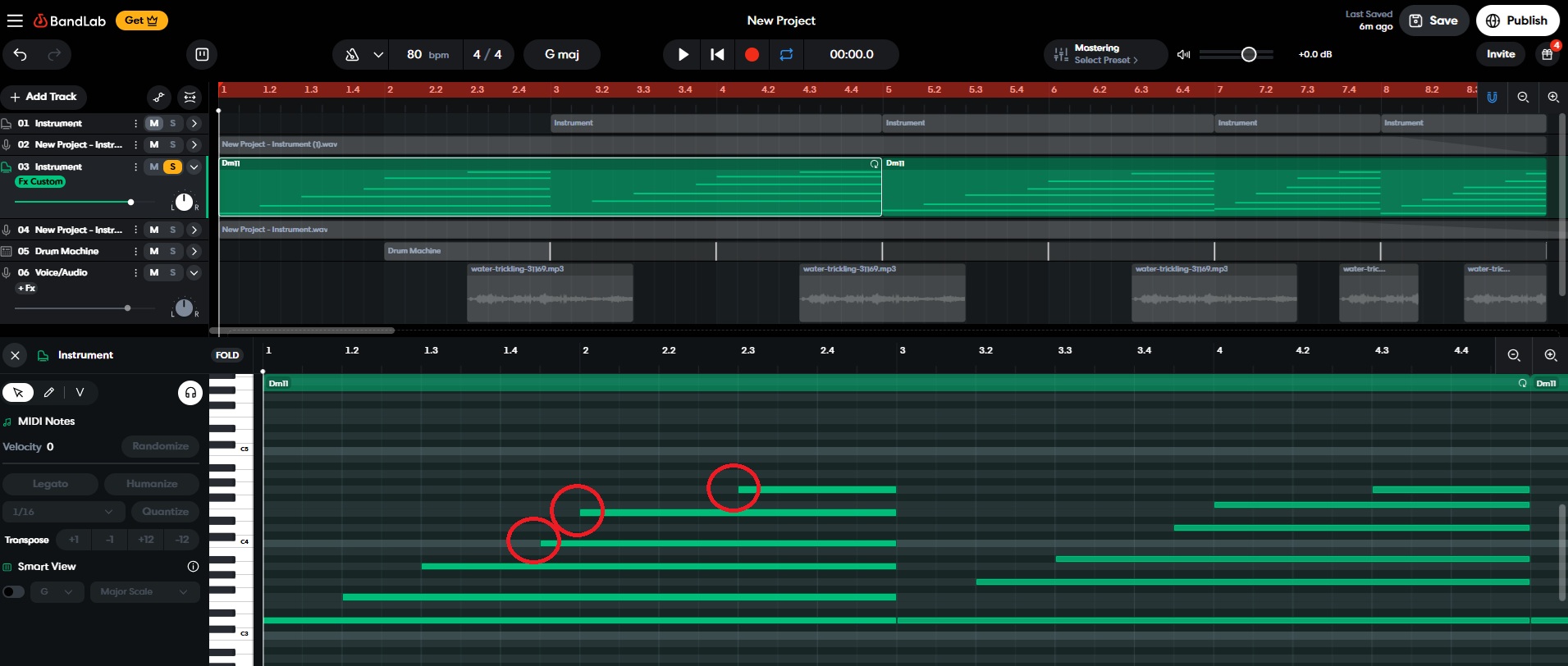
Here you can see that the opening chord unfolds in a non-conventional manner, where notes 4, 5 and 6 of the chord (circled in RED) enter at perhaps unexpected times (that is, not following the pattern that was initially set up with notes 2 and 3, which appear on beats 2 and 3).
This image has been extracted from a project on BandLab
https://teacher-sites-storage.inthinking.net/ib/music/music-links/piano-only-from-lo-fi-example.mp3
I have created a rather simple line that is more motivic than anything melodic substantial, which is in line with one of the essential characteristics of the genre. I have also included rather lengthy pauses between some of these statements to give a feel of expanse, which again attempts to contribute to the characteristic feeling of spaciousness (see below).
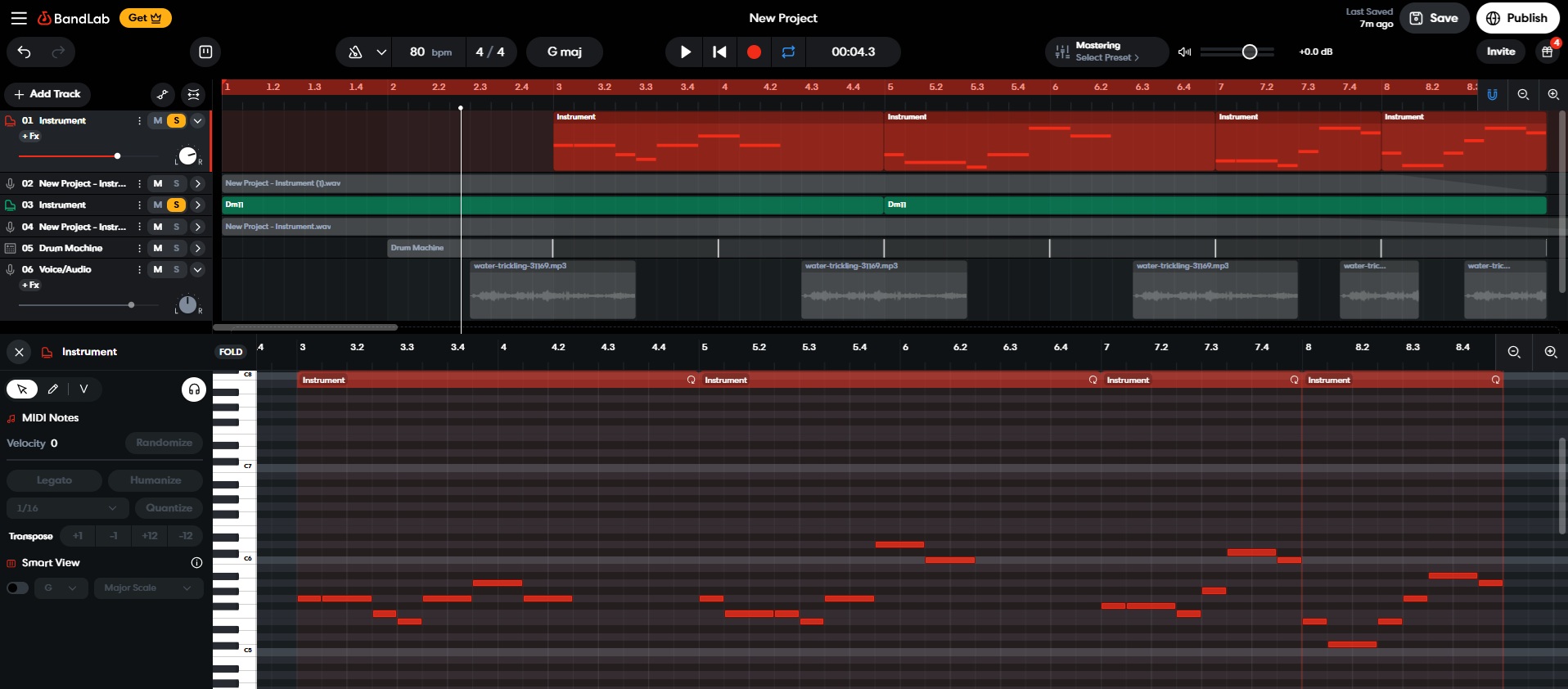
Here you can see that the motif essentially maintains is contour (adjustments are only made to match the underlying chord progression, and there are rather lengthy pauses between each rendering of the material to contribute to serenity and introspection.
This image has been extracted from a project on BandLab
Other Characteristics
I have chosen a relatively slow tempo (80 BPM) and standard instrumentation for lo-fi music, that is electric piano and the lo-fi piano option, both with sustained effects, a simple drum beat (example extracted from Berner, 2023), and an imported example of trickling water (Pixabay, n.d.). I organised the materials to ensure sparse instrumentation in which each of the layers can be easily identified. I learnt that in order to include gradual dynamic changes, I needed to export the track to an audio version and then re-import it so I could make the adjustment. The BLACK LINES that have been added to the image illustrate this process (see below):
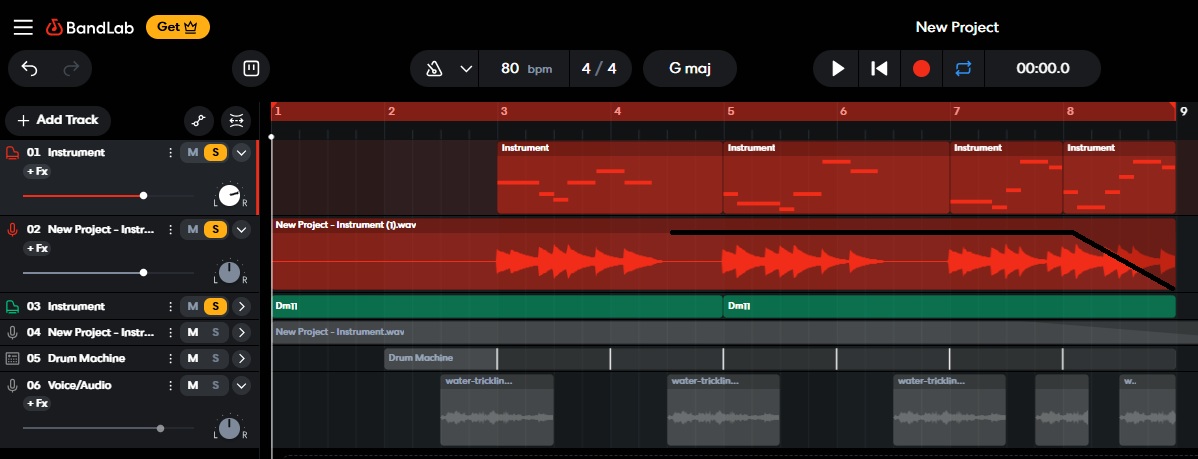
In order to achieve a gradual change in dynamics on BandLab, one needs to export the track (both tracks APPEAR in RED above) and then shift a small white box to the desired location, depending on the length of the crescendo/decrescendo. This has been illustrated with the black line superimposed on the image. Again, my research revealed that these changes of dynamic only appear sparingly. I have decided to include the first of these to indicate a sectional demarcation.
This image has been extracted from a project on BandLab
Bibliography
Albanese, A. (2025, March 12). Lofi chord progressions: Tips and ideas for your beats. Landr Blog.
https://blog.landr.com/lofi-chord-progressions/
Berner, A. (2023, September 20). How to create lo-fi beats. Soundtrap Blog.
https://blog.soundtrap.com/create-lo-fi-beats/
Hope, A. (2023, August 21). Lo-fi music: The aesthetic of imperfection. Music Gateway.
https://www.musicgateway.com/blog/spotify/lo-fi-music-the-aesthetic-of-imperfection
Pixabay. (n.d.). Sound effects search: trickling water. Retrieved June 14, 2025, from