Effective Inquiry: Trevor MacKenzie

Effective Inquiry: An Interview with Trevor MacKenzie
Trevor MacKenzie is an experienced teacher, author, keynote speaker, and inquiry consultant who has worked in schools throughout Australia, Asia, North America, South Africa, and Europe. Trevor’s passion is supporting schools in implementing inquiry-based learning practices. He is a highly regarded speaker known for his heartfelt storytelling, kind demeanor, and student-first philosophy. Trevor and Jim discuss the importance of effective inquiry and its implementation into effective music teaching.
Note: Due to the file size, the podcast is divided into two parts. We hope you find these discussions on the nature of inquiry enlightening, useful, and inspiring.
Trevor Part A
https://Trevor
Trevor Part B
https://Trevor
An Interview with Trevor MacKenzie
Background Music; The Moody Blues: "Questions"
The written transcription follows below:
Introduction
JY: Hi everyone. Welcome back to this IB podcast on the subject of IB Music. And today we have a very special guest we're talking with Trevor McKenzie. Trevor is a well-known teacher, author, and keynote speaker, and his research has been pioneering into the topic of inquiry. His work is known throughout the world. His research has focused on identifying and removing the barriers to implementing inquiry-based learning. I had the fortunate opportunity of meeting him and actually working with him in the school I was teaching a few years ago and I was incredibly inspired by his work at the time.
I found significant parallels between the topics and the approaches to what he was saying about inquiry and the nature of inquiry within the IBDP music program, especially how that would fit into the music journal. He's written several books on inquiry. We'll get to those, I'm sure, throughout this podcast. But I want to welcome you, Trevor, and I'm looking very much forward. I think more than anyone else, I'm looking forward to this discussion and seeing where it's going to lead. So perhaps I can just go ahead and fire away here. Can you tell us a little bit about yourself and how you became interested in the topic of inquiry?
TM: Yeah, thanks, Jim. What a pleasure it is to be here with you to chat and connect. And, you know, I'm an educator. I've been in the classroom for 22 years now. This is my 22nd year of teaching. I'm high school trained and I have an authorship consultancy to visit schools around the world and support them in implementing inquiry-based learning.

So inquiry is the sense of which I, teach from and within that stance, I think it reflects a series of values, Jim, you know, things that we hold near and dear to our hearts as educators. And I think as a younger teacher, when I think way back to when I started my career and you're kind of really seeking mentors, you're looking for solutions. You've got some big questions for yourself, and teaching looks like, sounds like, and feels like in survival mode of your first five years of teaching.
Thinking back to those first five years, Jim, I'm just so grateful I had mentors who were nudging me in the direction of inquiry-based learning. I didn't name it as such then. I didn't know that language, that school of thinking. I had some amazing mentors who were just student-first philosophy, playful in their pedagogy, playful in their practice, and trying on different things to see how their students would respond.
And then evidence-based getting together as teams of teachers to look at the evidence and reflect and be critical in our approach to teaching and learning. I don't think there was one particular moment, Jim, that was a tipping point for me to become an inquiry-based teacher. But when I look back to those formative years, I'm really grateful I was a part of a community of practice and I had mentors that were, I think, already kind of neck deep in this work. And slowly over the years, learning that school of thinking, learning of the decades of research and authorship before me and just finding a home in that conversation globally has been something that I just feel incredibly grateful for. And as you said, I'm sure a lot of that language and those authors and that school of thinking is going to bubble up in this conversation today, isn't it?
A Culture of Inquiry:
JY: Why is building a culture of inquiry important? Why is it relevant? Why is it purposeful? What are your thoughts on that?
TM: Oftentimes when we think of that word culture of inquiry, and specifically culture, what we look at is our teachers' inquirers themselves. I'm going to be frank here schools adopt an inquiry approach and the belief is that it's something for students. It's something that students experience and it shows up in projects or assignments or even in how they're assessed. That's all fine, the student experience. But when we talk about a culture of inquiry, we need to be inquirers ourselves, as educators. So if we were to have a little playful equation, it would be student as Inquirer plus teacher as Inquirer. Each equals a culture of inquiry if you will. So you know, what do we look for? What does that mean? It looks like teachers are curious about their practice. Teachers are asking big questions of themselves. Again, teachers are looking at the evidence and kind of pivoting towards being most responsive to their students and for their students.
Student as Inquirer + Teacher as Inquirer = Culture of Inquiry
And that culture of inquiry piece, lends beautifully to something that's more of an authentic Inquirer experience rather than the performative. I know that's a really direct word, the performative, but we need inquiry to be how we show up, how we interact with one another. It has to be much more than an assignment or a worksheet or a project, doesn't it? So the most likely space that we see that is when we see teachers as inquirers themselves. And I think evidence of that looks like professional development. It looks like podcasts such as this, teachers connecting with one another globally around the world, engaging in conversations such as this, again, asking big questions of themselves, and seeking out experts in the field and colleagues to help propel that learning forward, if you will. I'm curious, Jim, what about you? When you think about a culture of inquiry, what comes the mind for you?
JY: When I walk into a classroom and I bring up a topic, I say to the kids, if you come to me with one question and I start responding to you and then you end up with 10 questions, then I know I'm doing my job. It inspires deeper thinking. Often we look at the culture of inquiry as being student-based. That's something that just now resonated with me because the whole idea of inquiry in terms of this Music DP program is projected in the journal where the students present a thought, present an idea, and that idea that thought is challenges the teacher to challenge the student to dig deeper into that idea. Not whether it's wrong or not knowing where it's going to go, but now we have a communication going. We have a dialogue happening between teacher and student. I see it as dialogue.
I noticed this in the workshops that I do with music teachers. They want to know about assessment, and what they have to do with assessment. What's the end story? How's it going to end up? What are we supposed to be looking at? And I have to take a step back from that and talk about the process and that inquiry and assessment are all jumbled together in this whole thing that it's not any type of a destination. It's something that no matter when you think you're at a certain level, you still dig deeper into it. I know that we've reached some sort of an understanding when a student turns in an assignment only because eventually you're faced with a due date, you have to, right? But a student keeps on saying, oh, but I still could have done this. Oh, but well, I still could have done that. And you have an opportunity to say, if Mozart was alive today and saw his scores, he'd probably look at them and say why are you still doing it that way? We could go back and change this and do it another way and so on and make it more interesting and more creative so it's constantly evolving.
If Mozart were alive today he might ask, "Why are you playing this music the same way?
TM: Yeah, you said something. You said two things that resonate with me, Jim. It was that little interaction in the classroom where if a student came to you with a question but they left you with 10 more questions. That speaks to a culture of curiosity where students and teachers are engaged in questioning and questions. Students want to take the thinking and take the learning deeper. And again, what takes the learning and the thinking deeper? It's curiosity. So curiosity again, is one of those values I hold near and dear to my practice.
It's also an indicator of a culture of inquiry when we walk into schools that are at that place of inquiry, we see curiosity, we see curious kids and we also see curious adults. If we want curious students, we need curious adults. And what does that look like? In part, it looks like questions and listening to questions, exploring questions, and using questions to plan the next step. So thanks for bringing that up in my thinking, Jim.
(Note: For topics associated with building a culture of inquiry, go to Building a Culture of Inquiry )
Characteristics of an Inquiry-Based Teacher
JY: What are the characteristics of an inquiry-based teacher? But maybe we should extend that and say, inquiry-based teacher and learner. You've already mentioned this idea of curiosity. I coupled that with the idea of passion and with the idea of motivation. What would you expect to see as characteristics of an inquiry-based teacher or learner?
TM: In my work, we've surveyed hundreds of teachers. We've identified 8 that these teachers kind of broadly speaking possess or are working towards refining, sharpening, and strengthening over time. One of them is inquiry-based teachers are curious, they ask questions of themselves, but they also model curiosity, wonderfully for their students. They slow down, they put their finger to their chin. They articulate their questions and their thinking to make that visible. And there's this campfire thing that happens. You know, the teachers' curiosity is like a campfire to others that they're attracted to that curiosity. Students find warmth, interest, and relevance around that curiosity. So curiosity begets more curiosity. And that's one that we look for often in schools. Just how curious are teachers? Another one of those aids, is inquiry teachers know their curriculum gym inside and out. They see their curriculum as something that's malleable. They could take their curriculum to places.
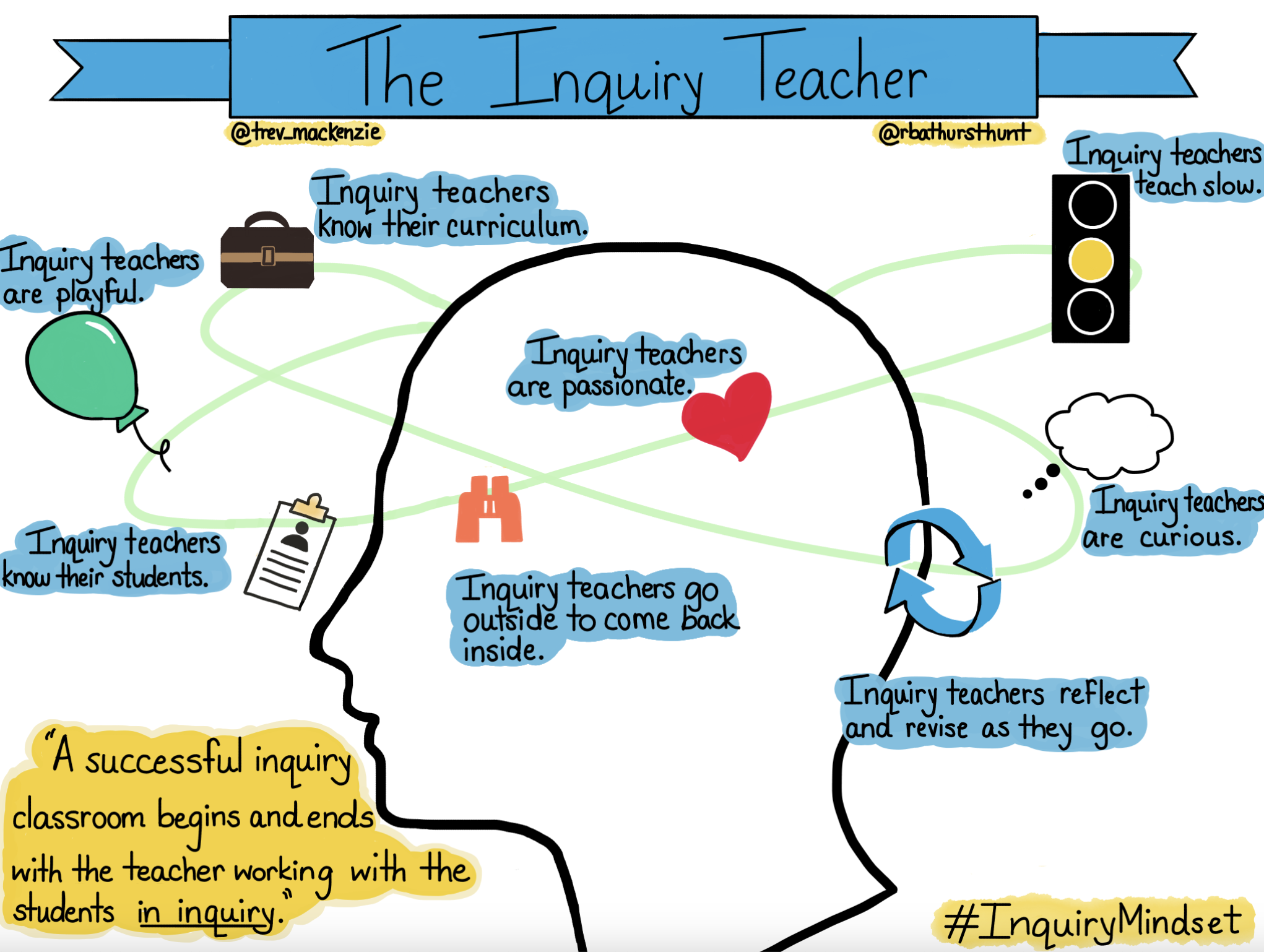
What I mean by that is when an inquiry teacher notices the curiosity of their students, they can see the standards, they can see the objectives, they can see their curriculum kind of going to that place of curiosity in their students. You mentioned process over product ever so briefly earlier, and by knowing our curriculum really beautifully, we can see that there are multiple pathways to the same destination. This is going to be a hard one for new-to-practice teachers, you know, teachers who don't know their curriculum as beautifully as teachers who have gotten their teeth into their curriculum over a course of a number of years. I would say that probably one of the most important objectives in your first few years of teaching is to become more intimately aligned and, aware of your curriculum and how it's malleable and, agile and you could take it to places. And then I'll give you a third one. There are 8. So I don't think we have time to go into all 8 characteristics of the inquiry teacher.
Another one is, that they're playfully minded as play is learning, you know, as students are engaged in play, they are engaged in inquiry experience, but also just playfully minded in that we're flexibly minded. We see the evidence before us and we're able to pivot and go to that evidence or we see a student's curiosity or question and we can see that that's another playful kind of pathway towards the same objective. We're not tightening the reins too much on the learning. There's a relinquishing of control through these playful minds that in being playful, it empowers the students to take on a different role in their learning. So those are just a few of the characteristics of the inquiry teacher. I would say I've been embracing an inquiry stance for a few decades now. I'm not perfect at all. These eight dispositions, they're a work in progress. And day-to-day, week to week, year to year, I'm reflecting on these and how can I be more of this and how can I level up in areas of this. Just being aware of these eight dispositions is so helpful for teachers to be mindful and intentional with the moves they make and how they show up day-to-day to serve their students.
Inqury and the IB Music DP in Practice
JY: You've mentioned these dispositions and I know that we're not going to have the time to go into that much detail at this time. I am going to encourage everyone who's interested in the subject of inquiry to look at some of the research that you've done. What I found out is while I was going through these dispositions that you were talking about, there was a very strong parallel between that and what we know in the DP and IB jargon as the learner profile and the thinking dispositions. There was a very strong profile and connection between them. You've said several things that resonated with me just now. Knowing the curriculum is one of the hurdles that we face as music teachers. And I face this during workshops, especially with younger teachers. They come to me and they say, well, tell me exactly what I got to teach.
Tell me what we need to know for this assessment. What would we have to do? And I have to backtrack and I say, I don't know exactly what it is you have to do. I don't know exactly. You have your program, you have things that you value. You have things and topics that you want to say. That is not to say that the history of music, the technique of music or proficiency, or the theory of music is not important. These are all important. But what's even more important is that before you get to any of that, you have to find the relevance of it within the practice. In other words, it makes very little sense for a student to start practicing music theory unless they know why the application, why the theory is important, and where it's being used. I found personally that inquiry is the key to unlocking that door, to finding that interest.
I find these parallels remarkable between your work and what's happening with this current music curriculum and with the submission of the music journal, and those types of topics. I'm going to go ahead and get on here with the next question. What would you expect to see when you walk into an inquiry-based classroom or an inquiry-based music room?
TM: Well, one thing we would expect to see is just a different relationship between teacher and student. Undeniably the teacher is the expert in their field of study, you know, whether it's music or history or mathematics or literature. But there's a dynamic in the room where the student's ideas and the way that those ideas and connections are being made amongst the students and the teacher facilitating that it's just a very different dynamic. You know, there may be times where Trevor is at the front of the room, facilitating learning and directing learning more in a structured, explicit sense. But in an inquiry setting, you know, there's a limitation to that model.
Teachers and students work together to plan the next steps, working together to make connections
In the inquiry setting, there's a togetherness, a weaving together of ideas. What does that look like? That could look like a turn and talk. That could look like group dynamics. That could look like some kind of equitable talk framework. But there's certainly a flattening of the power in the room. So there's a teacher with students facilitating and co-designing the next steps. You know, that also looks like something visible in the classroom in terms of the evidence on the walls of our classrooms. We want to see evidence of the process towards the product, don't we Jim? So as we're working towards a summative, as we're working towards perhaps in the music setting, a performance, we want to see all those little snippets and morsels of the rehearsals towards the performance, towards the outcome. In a writing setting that looks like draft work toward the final product. In a numeracy setting that looks like practice towards the summative.
We want to see evidence of the learning so we can see the rich formative, we can see the rich story towards the final destination if you will. But I would say above all, there's a different dynamic in the learning environment. Teachers and students work together to plan the next steps, working together to make connections and value ideas where everyone's ideas in the room matter, to build upon and kind of shape and guide the next steps.
Inquiry, The Arts and Critical Thinking
JY: You're segueing actually into the next question. I'll be kind of curious how you feel about this. Would you expect to see differences between inquiry in a classroom in, let's say, a traditional language classroom, science classroom, and so forth, and inquiry in a performing arts class or rehearsal? Would you expect to see differences in the approach? I have some thoughts on that, but I'm curious what you think.
TM: About Yeah, it's a playful question. So the answer is both yes and no. You know, our contents are going to be quite different, isn't it? In a writing setting, and a map setting, and a history setting, and a performing arts setting, the content of which we're exploring ... we're kind of filling in and mapping out, that's going to be quite different, isn't it? But then, you know, those values are going to be transferable. The values of agency, the values of curiosity, the values of co-design, and the values of questioning. You know, there are questioning techniques that we use in a music setting. We use the same questioning techniques in a math setting as we do in a writing setting. So certain underpinnings will transfer beautifully across context subject areas and classrooms. Some content areas are different depending on our spaces. So, my cop-out of an answer is both, Jim, isn't it? It's yes. You know, we're going to see some similarities and then sadly, we're going to see some differences. But the beautiful kind of transferable piece for students is, of course, the skills and competencies that they're acquiring across those different spaces in which they're experiencing inquiry through. So that's another commonality across those settings. Jim, I'm curious to hear your thoughts.
(Note: for more thoughts on critical thinking across disciplines go to Critical and Creative Thinking )

JY: Maybe we're in the middle of some sort of a paradigm shift when it comes to education in general, but say specifically music education. I'll be more specific about that. When I was a young teacher, way back when, I was taught as an American high school music teacher. In other words, I was taught to be a band director, and during my future training, I was taught that when you're on the podium, you need to be the one in control. You need to be the all-knowing, the all-directive. You need to be the one in charge. You need to have complete discipline. You need to have silence. You need to know exactly what to do next. I get that and I understand that and I had a very successful career doing that.
But I find that when we start talking about inquiry and giving student agency and giving student control in the ensemble, and especially when we start working with younger teachers, younger teachers struggle with this because they're still taught to be the one in control and the one being the director and the one being the authoritative resource, knowledgeable person on the podium. And it takes a great deal of confidence and perhaps experience to be able to know that you're still in control. It's a very fine balance between being in control but giving student agency to the ensemble, giving student input to the ensemble, stopping the ensemble rehearsal, asking for student input, bringing students forward to start leading the rehearsals, and leading sectionals to start offering their input. Having students be responsible not only for the repertoire that's chosen but for the reason why that repertoire was chosen. Rather than teach doing it. We have this theme. How are we going to do this? Here are some options we have, why do we want to play this piece, Why is this important?
And even more so, to try to get kids to rewrite music to say, well, this is the way the composer did it. However, if we were going to have this theme, perhaps we could rewrite it. Now I don't feel that the majority of teachers, young teachers that are coming up are being prepared for this.
To be bluntly honest here, they're into a certain mindset of being the band director, being the choir director, being the orchestra director, and there's time and a place for that. But I think that certainly in terms of international education, we're in a bit of a paradigm shift probably more so than state schools where there is a certain type of a framework for the culture of the community and so on. I think international communities probably have a little bit of ability with that type of thing, although I would like to see this more developed and I think we will be getting there.
TM: We are. You said something really that resonated with me. It perhaps takes a great deal of confidence and experience to get to a place where you change how you teach and it could also take just a genuine sense of curiosity and playfulness in your practice. Again, one of those dispositions, you know, those younger teachers can ask themselves, I wonder what would happen if I did it this way and instead of this way. I'm wondering what would happen if I, called on the student to come and, lead the group through this experience or this series of next steps. I wonder what would happen if I asked the class for some feedback right now. You know, as a parent, I have a 15-year-old, He's in grade 9 at my school. He's in music, he's in the band. He absolutely loves it. If you had asked me this time last year whether or not he would be in the orchestra whether or not he would be in the marching band, or whether or not he would be dancing in the marching band, in the local parade, I would have probably said absolutely not, right.
You know, to see him grow and get to that place of ownership and relevance and enjoyment that he's at now. Looking back, I didn't think that would be possible. But Jim, I think what you're referring to are these little micro moments of decision-making teachers engage in personally, and intentionally to empower and lift and change the dynamic in the classroom that leads to something greater than we ever could have imagined. You know, students engaging in these larger-than-life experiences because slowly over time, we're facilitating a different type of learning where students are taking on more ownership and involvement in the music setting. So again, I never would have anticipated my 15-year-old would be in the marching band. But you know, there are those moments where the teacher says, hey, have you thought of this or Hey, would you like to, or hey, I'd like your thoughts on this. And slowly that confidence, that efficacy, that choice, that ownership grows and grows and grows. And then he's stepping into places that again, I never dreamt it would have been possible a year ago.
So yes, it's confidence and experience, but for new teachers who perhaps haven't had those experiences or, sharpened that confidence yet, it does start with curiosity, that question of what would happen if and then those little micro-moments and just observing, how is this yielding something different in my students? Because I'm encouraging, I'm providing more agency.
The Roles of the Inquiry-Based Teacher
JY: You brought up a word that resonates with me and you said the teacher as a facilitator, not as a director, but as a facilitator of whatever the process, whatever the product is going to be. Perhaps you could highlight a little bit more. What do you see as the roles of an inquiry-based teacher? You've already mentioned several of them. Would you care to highlight that just a bit more?
TM: You know what one question I asked myself, gosh, it feels like dozens of times a day, Jim, is am I doing something for my students that they should be doing for themselves? And I find when I ask myself that question, I just get an immediate opportunity to provide more ownership and agency in the learning, whether it's decision making, whether it's them actually having a hand more authentically and building something, designing something, creating something, whether it's a hand in assessment and reflection and decision making. There I find that, you know, we sometimes rob our students of the depth of thinking and the critical thinking and decision making that we actually need them to foster and flex and exercise over time. I asked myself that question dozens of times a day because there are these little micro-moments in the lessons where I realize, oh, that's, that's not a me job at all. That's a we job or that's a them job or in them doing it that way, it may take a little bit more time, but the yield, the return on investment is greater than if I made that decision myself.
This is not a me job, it's a we job.
I find that the more I engage in that thinking, the more we get to what we started out with, Jim, a culture of inquiry. The more I engage in that type of how can I relinquish control over certain parameters of the learning, the more I'm getting to that kind of authentic inquiry thinking, that inquiry mindset, and that inquiry series of experiences where students are actually designing the learning. So that would be a big one for me. Jim, I'm curious what your thoughts are on that.
Facing Challenges - Celebrating Accomplishments
JY: Well, it's again leading to the next question (of) building the inquiry and moving forward with this. If we talked about a paradigm shift in thinking about inquiry, what challenges ahead do you see or what accomplishments have there been? Maybe that's a better way of shaping this question. What accomplishments have there been in the nature of inquiring? What challenges do you see forward? I've already mentioned this idea of being secure and knowing the curriculum. You've talked about the facilitating of knowledge.
I guess one thing that's been very relevant to me again, going back to the old days when we were the ones in charge of trying to find supply material, resource material, websites, recordings, records, cassette tapes, all these things we needed to help, method books, (etc.). We are now in a position, where I think this is going hand in hand with the topic of inquiry... years ago we were the ones, teachers were the ones, were the knowledge givers. We were the ones responsible for that. I've mentioned that earlier. What we all need to understand and assume now, not assume but know is that students have the capacity to learn at a rate faster than we as teachers can impart knowledge to them.
And for the first time, certainly, in my career as a teacher, that shift is going. They can learn faster than the method books that we used to provide or all the resources that we find. We just need to know what type of direction to push them to. (Which questions to ask.) How do you hit that high D? How do you find that efficient use of air when you're having to play the trumpet? I can tell you how to do that, but you're still not going to know how to do that unless you start realizing all the errors that you have to make in that process. I guess what I'm trying to say is I think it's still going back to this paradigm shift in how we approach it. I suppose I just want to pick your brain on that. What do you?
Students have the capacity to learn at a rate faster than we as teachers can impart knowledge to them.
TM: Let's start with that, Jim. What are some things that we can celebrate that we've witnessed over the last 15-20 years? You reference that we're not knowledge keepers and knowledge providers. I'm seeing curricula around the world and jurisdictions and organizations kind of balance out the realms of the curriculum from not just being a knowledge-focused curriculum, but a do curriculum, a curriculum with skill embedded in it. And then the knowing plus the doing equals the understanding, students have a deeper understanding of the consent and, if they're able to apply them and put them into practice and transfer them to other settings. And so gosh, a know, do, understand curricular model that didn't exist 30-40, or 50 years ago. This is revolutionary and it's just sensible.
Knowing + Doing = Understanding
It's just good planning forward in terms of the skills students need to flex and sharpen over time as they're learning the what of our curriculum. So that's a big shift that we've seen over the last, I'd say 20 years, more schools, districts, and jurisdictions adopting a clear disposition/competency focus to their curriculum. So there's a balancing there. It's not just what you know, it's what you do with what you know that empowers a student. Additionally, something to celebrate is I'm seeing amazing things being done in the assessment realm of teaching and learning. I'm seeing great assessment policies. I'm seeing great assessment protocols. I'm seeing assessment being a we job rather than a me job. You know, a teacher can't be the owner of the assessment realm of teaching and learning alone. If we are to propel growth and impact student growth, we need more student involvement in the assessment realm of teaching and learning.
(Note: See Assessment and Time Management )
We need more student involvement in the assessment
And so, you know, it starts with a fantastic assessment policy that talks about the things that we value, the things we do, and the things we don't do. And then you start to see different things in classroom experiences where teachers are empowering students in the assessment realm of learning. So I'm seeing some amazing things there.
Let's get to some limitations currently that we're seeing. I'm still seeing some limitations in that big jump toward higher Ed and university. I'm seeing some universities shift teaching and learning to be much more student-centered. But undeniably I'm still hearing from senior level teachers, who need to get them ready for university. They need to do it this way to get students ready for that thing later on in university. And you know, I don't wait for universities to change. I don't wait for, professors or colleagues and hire to change their practice. I focus on the good things that we have before us.
My job is to not prepare students for an assessment framework or a teaching-learning experience in university. My job is to teach the curriculum and the spirit and authenticity of the curriculum as it is before me. I do think that's a limitation, but certainly, I'm not waiting for them to change different things for students. So does that one make sense, Jim?
JY: That makes a lot of sense. In fact, I just recently had a discussion with practitioners who were complaining about universities (admission standards). My kids (want to know) how is this going to get them into university. And I say, OK, look, in terms of the IB, here's what you do. So do you want to go to university? Is that what you want to do? Contact the university and ask them what you have to do to get in. What repertoire do you have to do? What do you have to know? And let's just make a list of the things you got to know in order to do that. And we'll just incorporate that into the study.
That won't be the primary focus of the study, but in the course of figuring out the things that you want to do, the music you want to play, the music you want to create will incorporate that thinking into it. I know that there is, certainly with art teachers, a very big frustration about the arts in general and what colleges and university and the pressure the colleges and universities are putting on students to be admitted into their universities and how the arts in terms of enrollment suffers those last two years in school. And I think that probably will be a completely other podcast. But I do hope and I do feel that there will be some thinking, the change of thinking going on with universities in terms of what are they expecting from the kid. Who is the kid? Why? How do they know that this kid is going to use their knowledge in peaceful, productive, and positive ways and not just know the knowledge to know the knowledge? There is a lot of work to do there.
And that gets back to the question as far as what you see the challenges are. I do think that there's been progress made, but I think there's a long road ahead. And that's why I think that what we do with critical thinking, critical listening, inquiry-based learning, it's very important to stay on that path and continue to move forward. And those doors will eventually open up. What do you see 5 or 10 years from now?
TM: Well, I continue to see growth in terms of the areas that we've already celebrated and discussed. You know, I think teachers, as we continue to see pockets grow in schools, we begin to see a critical mass. I think we're going to see an evolution of thinking and an evolution that's a mouthful, an evolution of practice. I'm interested, Jim, and embodied learning and embodied learning, of course, in the arts. This has been a long part of the philosophy in terms of the arts.
But the embodied learning pieces, of course, our students are just not a brain on two sticks, you know, on two legs. They have, they have a body, they have a heart, lungs, and organs. There are feelings there. And I believe teachers are going to begin to harness the research around embodied learning and embrace some of how we get students, the whole student prepared for learning and get them in a place where they're ready for the next steps. So I think in the next 5 - 10 years, I think there's going to be a lot more conversation around embodied learning. And then I think we're going to see some different assessment practices. I'm seeing it in the IB, we see it with the PYP exhibition, right? We've got this beautiful showcase of learning. And I think we're going to see more of that showcase of learning to a public audience. I think we're going to see a breaking down of the walls of the classroom, so to speak, where more student articulation and voice with regards to sharing their learning to a public audience is going to happen.
And again, I know that happens a lot in the arts, but why does it only happen in the arts? Why isn't it happening across other subject areas? I think we're going to see more of that practice and that honoring of students and celebrating of students be at the heart of assessment. And again, we're seeing this at schools around the world already. I just don't think it's taken off as much because sadly, schools are data-driven and schools want to see the impact of what these practices, you know, long-term do for students. And so I think we're at a tipping point here in the next few years where some of these dominoes are going to be pushed over. And as teachers begin to see what inquiry is and what inquiry is not, I think we're going to see a lot more inquiry at schools around the world as well.
Levels of Inquiry
JY: This has been just a lovely discussion and we keep on moving on. I must be mindful of the time here. One of the topics of your workshops and of your books is that you were talking about the levels (of inquiry). I remember the swimming pool. That was such a strong illustration for me about the levels of inquiry.
We could have several podcasts on this. I tried to emphasize just a little bit on the website. Could you highlight that a little bit for us? Could you tell us a little bit more about these levels? I know you give it sort of a quick surmise of what these levels are and how we as music teachers might be thinking of them.
TM: I'd love your input as well as the music educator Jim. Let's visualize a swimming pool where we have the shallow end of the pool and the deep end of the pool. We kind of wade into the shallow end and we can feel that the depth of the pool changes underneath our feet. So, if we can imagine the swimming pool and the depths from the shallow to the deep end, these reflect the four types of inquiry.
From the shallow end, we have something called structured inquiry and then we transition to controlled inquiry, then guided inquiry. And then the deepest end of the pool is what we call free inquiry. And so these four types of inquiry reflect a change of agency over time. You know, the the deepest level of agency, the more voice and choice for students, of course, is in free inquiry, the deep bend and there's less voice and choice in the shallow end. It's much more of a teacher-directed inquiry and structured inquiry at the shallowest end. Often when I visit a school and we talk about inquiry, teachers merely think about inquiry as free inquiry. They kind of compartmentalize all inquiry as the deep end of the pool. There are four types of inquiry structured, controlled, guided, and free as a mapping tool.
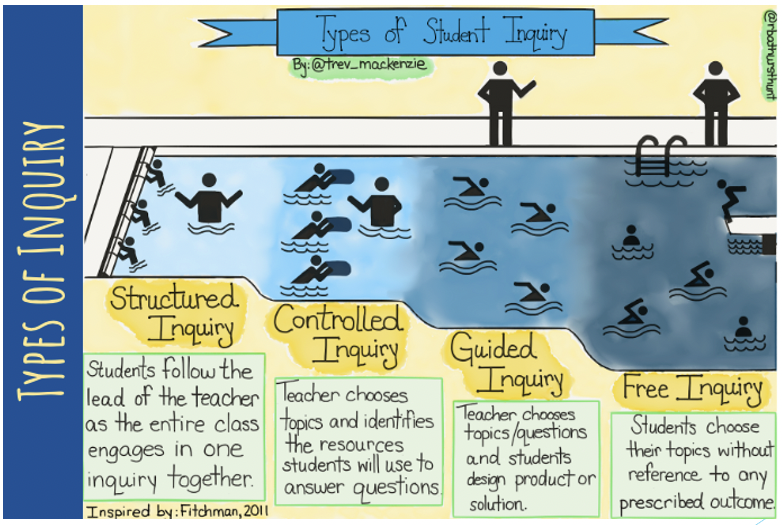
When we look at our curriculum through the lens of these four types and begin to move around different objectives and standards, what, where, where in our curriculum would be structured be beautiful, and where in our curriculum would free be beautiful? And then even how do we want to time that out depending on the skill acquisition of our students? We don't want to throw them too quickly into the deep end in fear that they'll be anxious and overwhelmed and uncertain and free unless they've acquired certain skills that allow them to be competent and confident and free. So that the types of inquiry, these four types are a little bit of a curricular mapping tool and also a skill development tool across time. You know what, what I want to see in classrooms I visit is I want to see a change of agency over time. Do I need to see all four types in Jim's class? No. Do I need to see all four types in every teacher's class? No. But I do want to see a change of agency over time. I want to see students not just acquire certain skills, but I want them to be able to take on more ownership agency over the learning across time. We can easily find that graphic.
It is a mapping tool. It is a planning tool for us to consider how we're looking at our curriculum across the lens of agency over time with students. I'm curious as a music teacher, Jim, when you look at that swimming pool graphic, what really jumps out at you given the music experience with students?
JY: Well, as you're talking about this, I came back to these recent workshops that I had when teachers ask, what do we have to know? What do we teach? What are we doing? And what you said earlier about you still have to know the curriculum. I actually use the swimming pool metaphor. I'll put it together in a musical sense. If you're teaching about Mozart, for example, you still have to know what a whole note is. You still got to know some very, very basic things in terms of in terms of music, how music works. You still have to know what key signatures are. And a lot of that inquiry, structured inquiry, you can guide students to theory sites. You can show them scores, you can analyze things with them. You could say that this is an A or a G and it moves to the relative minor and the relative major, and then out of that comes chords. And it's important to know that stuff and it's important to use that stuff. Of course, we have to know that stuff, but in terms of really understanding it, the student needs to move from it. So why is Mozart relevant? Why did Mozart write that? One of my favorite questions, as I mentioned earlier, is if Mozart were alive today and looked at his work, he would probably listen to it and say, why are you guys still doing it this way? You have so many different choices. You have so many different things you could do.
So after our knowledge of the basic technique, the basic theory efficiency of music expands, and you see that in the students you want to get them to use the ungoogleable questions about things that they could do with chords, how they could alter chords, how they could change the whole steps and half steps with the same basic structure, the same basic knowledge, but now they're free to move on to completely new ideas. This is how music evolved, didn't it? We went from baroque to classical to romantic to contemporary 20th century to jazz to world music. All of these things were a reaction to something that happened previously. And I think that it's important to see those connections. So yes, it's important to have that structured inquiry. This is as you mentioned curriculum design.
I think that is an excellent tool for vertical alignment, saying if it's going to be here and we're going to talk about these concepts of music, they need to know these things, but there's another part of that. They need to know why those things are important, not just that a whole note gets 4 beats and 4/4 time. They got to know why it works that way. I find that sort of shift in the approach to thinking, the approach to teaching and learning with the use of inquiry to make it relevant and to make it to make it purposeful.
TM: Yeah, you know, Jim, you've got me thinking about other settings as well outside of music, because you're referring to this notion of, well, students need to know this critical information in order to apply it to why it's important or maybe a free inquiry experience in every subject area. Teachers say something really similar. You know, in the math setting, they say, well, they need these foundational experiences and understandings to take their learning deeper, right? Or in the literature settings, the same thing. They need to know how to write before they can actually become a poet, right?
And yes, it becomes problematic then when we just get stuck in that teaching mode where we're just giving them all the things that they need to know and we're showing them all the things. Then there's no agency, there's no application, there's no relevance, there's no contextual tie. And so everything you're saying, I've heard something similar from other teachers and other subject areas. The challenge, the tension is we can't sit in that area of the pool the entire time with students. We can't live in the shallow end of the pool, can we? If we live in the shallow end of the pool, there's no change in the dynamic. It's essentially a teacher-directed inquiry all year long. Again, what does Trevor look for in schools that he supports? He looks for a change of agency in every setting. So, if you are in structured inquiry, you have to be mindful of how long you're there for.
Where are there opportunities to empower our students to take more ownership and apply this knowledge, apply this content to a real-world application? That's important, you know, the intentional reflection that we need to engage is are we staying here too long? And how can we empower our students sooner than perhaps we're ready for? Because oftentimes the biggest restriction to inquiry is the teacher's mindset, not the student's capability. So, I just wanted to raise that up, right? Sometimes, we do it to ourselves, don't we? We changed the learning in the class because we're living in the shallow and a little bit too long. Then perhaps our students need us to be there for them.
JY: As you're talking, I'm thinking again of the ensemble music director. Say the band director, you warm up the band and what do you usually do? You play a scale and then you play the scale over again. Well, OK, I got that. I'm standing in the baby pool. What about taking that warm-up scale and applying it, playing it backward, or taking a motif from that scale, taking a segment of the scale, and making a melody? What about playing it upside down? What about playing a modal excerpt? What about improvising on that scale? What about what?
TM: (How) about asking your students what could be done differently now that we got this down? What could we do differently now? Maybe calling up a student to show everybody, right? Like absolutely. There are a dozen ways that we can go about doing that differently once we've got the first down pat. I think that's precisely it. It's that curiosity of the educator. What would happen if we did it differently? What would happen if now we can move on differently? Yeah, that's a nice little analogy there, Jim. I love that one.
The Art of Questioning
JY: I always thought that there was an art to addressing inspiring, probing questions. Do you have any thoughts on that? How could teachers develop the art of relevant, inspiring, motivating, and passionate questions? What would they be looking for? How could they move forward in inspiring?
TM: Yeah, that's such a great question, Jim. Absolutely. And I don't want to take the artistry out of the art. So my response feels a little bit mechanical, so forgive me. But you're absolutely right. There is a there's an art there and there's a nuance there. And in part to get us ready for that artistry and that nuance, I suggest teachers decide on a little handful of questions that they're going to revisit often. So write down four or five or six kinds of thinking questions, if you will, that when you ask students these questions, they could really settle into some reflection and some thinking time. And gosh, having those four or five or six questions, it's going to help us practice the art of questioning essentially. So, find those four or five or six questions, and write them down. Some teachers write them down and they tape them to the back of their staff badge. That way, they can lift their badge as their little CHEAT SHEET.
Once we have our thinking questions, and the other pieces we need, we need to give our students time to settle in and bite into these thinking questions. Often teachers ask these thinking questions to the whole classroom. And there's that kind of awkward silence at first, which I love to live in. That's good. But then we see that the same hands go up. So those students just continue to dictate the learning in the classroom. I love to engage in a turn and talk. You ask that thinking question. I'm going to give you 2 minutes to turn and talk. Every student in the room will turn and talk with a peer. And you just walk through the room and you listen to the thinking in the classroom. So you're not just hearing from the same students who put their hands up, you ask the thinking question, you engage in and turn and talk. (Note: see Think, Pair, Share )
You actually go through the room and you use their discourse as a formative assessment to guide the next steps. Where are they at? Where is their thinking? What can I lift from the room and kind of highlight to everyone else in the room? How can I maybe let students share their thoughts with everyone else in the room? The thinking questions matter. And then the negative space that we create to allow students to engage age and discourse, that's a really important move because you know what teachers want to do. Teachers want to get moving on in the learning. They want to get moving on to the next step. But gosh, if you ask a thinking question, give students a couple of minutes to chew on that question with a peer that they trust. The easiest way to get there is a simple turn and talk. You know, something for teachers to consider. Count how many turn and talks you do in a single lesson in a single day or in a single week and just monitor the difference in your students' thinking and your students' responses as you engage in more turn and talks across time.
I know we don't have an endless amount of time to give space for student discourse, but in classrooms, I visit that engagement in a lot of turn and talks where it's routine. Gosh, the student discourse, the conversation, and then that dynamic of teacher with students, it's totally different. And in part, it's because of the turn and talk, if you will, Jim. So that question about the artistry of questions, it's a really good one. What are five or six questions, thinking questions we ask students? And then how do we let them have time to engage in the thinking of the question and use that to guide our next steps? I think those are three moves we can all make.
JY: That question of time comes up almost in every workshop. Yeah, I know this is great, but I've got a concert or I've got this program I have to prepare for again. I think it'svery important to give reflection, to give thinking time. Even if it's 5 minutes. I think it's going to be time well spent even if it's writing in their journals. What was your takeaway today? What was your main takeaway? What did you get from it? This is going to be important.
TM: Yeah, this is going to be one of those early moves teachers make, giving students a little bit of time to engage in that discourse, that reflection, that thinking. And when I say it's a little move, because as we routinely engage in that, we're going to see a progression of agency. We're going to see a progression of reflection and thinking of ownership and critical thinking. And as you've referenced several times, critical listening, you know, if we begin to do those small moves early in our interactions with students, it's a trajectory that we can't get to without doing those small moves earlier. And so that's something teachers need to kind of embrace. This isn't going to be high-yield now in this moment. It's going to be informative. It's going to be high-yield as I build these experiences upon one another over time.
And there's going to be a progression there. And that's why I said keep track of how many turn and talks you do in a given lesson day or week. What I'm going to ask you to do long term is see how those turn and talks are getting you a different return on investment in several weeks or even several months. It's a small move now. A little bit of time now feels like a sacrifice. It's a great return on investment in several weeks and months once we've created that culture where this is building upon one another to embrace student voice, choice, and thinking.
Closing Thoughts
JY: There are about 100 things I want to say right now, but I'm very mindful of the clock and I want to respect all that. So let's leave it with one last question. Do you have any closing thoughts that you'd like to specifically share? Not just to an IB teacher, a music teacher, just in general. Any any closing thoughts about inquiry music or non-music?
TM: Yeah, You know, I just think it's a beautiful time to be an educator. And I mean that sincerely, Jim. I think of colleagues who, you know, I'm standing on the shoulders of giants now. And it was such a different landscape of education 20-30 years ago. Our access to conversations such as this, our access to professionals around the world, and experts in the field. The door has never been as open as it is now. I invite people who are listening to find those voices, find those spaces that are exciting, that challenge your thinking, that clarify the next steps because it's such a beautiful time to be in education. Evidence of it is a conversation such as this. We're on opposite sides of the globe. We've met each other, face to face a few times, virtually a few times. And to be able to connect and have a conversation such as this, what a beautiful time it is to be an education. So I suppose I just invite people to find those voices around the world that inspire them, challenge them, and guide their next steps. Jim.
JY: Trevor, in closing, I just want to say thanks for your time. I know you're very busy and I know you have to get going, but I very much respect and honor and thank you for the time that you've given us. It again, continues to be an inspiration to talk about these ideas and these concepts. And I can't help but think this is just the beginning of using these into even bigger ideas and bigger presentations. So I'd like to thank you. I highly recommend to our listeners to delve more into some of Trevor Mackenzie's work. It's very inspiring and you'll see all sorts of connections being made there between what he's talking about in the IB program in general, but specifically the IB Music DP program. Trevor, thank you. Thank you very much. I've enjoyed this. This hour has flown by for me, so I appreciate your time.
TM: Grateful for you Jim. Keep doing the powerful work you're doing and helping music teachers around the world. Thank you for your time as well.
JY: Thank you, Trevor.
Related Sites and References
Be sure to visit the section on inquiry on this website: Building a Culture of Inquiry
Reference and materials:
https://www.trevormackenzie.com/
Mackenzie, Trevor. "Dive Into Inquiry" - Amplify Learning and Empower Student Voice. Elevate Books. Columbia SC, USA. 2016
Mackenzie, Trevor. "Inquiry Mindset" - Nurturing the Dreams, Wonders and Curiosities of Our Youngest Learners. Elevate Books. Columbia SC, USA. 2018
Podcast on YouTube
Here is the complete Podcast on YouTube: