As a Creator - Schumann's Carnaval Op.9 I

Experimenting as a Creator
This page is the first in a series of lessons on Schumann's Carnaval, Op.9, and it is intended for the beginning months of the DP music course. These works are perfect for experimenting, as they provide short, intimate musical moments, but are ripe with elements ready for experimentation. The focus here is on pieces 10 - 14, but the entire collection could certainly be utilised.
“Pierrot” Photo by Alexander Shustov on Unsplash
This page is devoted to a series of activities to help to introduce you to the component of Experimenting as a Creator. There is an expectation that both you will have already familiarised yourself with all of the details in the Music Guide (specifically pp.31-33), including the section devoted to assessment (pp.59-64).
It is important when beginning a new work that you not only view this in relation to your own background and familiarity, but also learn of its origin and context through research - the latter is not solely the enterprise of the Music in Context component.
Here are some warm-up questions related to Robert Schumann:
- How familiar are you with the work of Robert Schumann?
- Here is probably one of his most famous works. What do you think it is attempting to ‘say’?
https://teacher-sites-storage.inthinking.net/ib/music/music-links/schumann-kinderszenen
In order to determine the level of engagement that you currently have with this music, you should ask yourself the following:
i. Is this music significant to you? Are you familiar with it? Does it fall within your immediate personal context? Would you say that it is a contributing factor to your own personal musical identity?
ii. Does this music form part of your local, regional or cultural community? Are you aware of its existence in your cultural identity or geographical location?

Your teacher is now going to divide you into two groups. If you believe that this work is “personal” to you; that is, that you have answered “yes” to all or some of the questions above, stand on one side of the room and those who answered “no” on the other. Be prepared to share information that reveals something about your musical identity with the class.
Also, be sure to share information about your familiarity with the composer and your initial or re-visited thoughts about the work.
“A Line on the Road” Photo by Wayne de Klerk on Unsplash
Allow your students to have some personal time, writing in their musical journals, with each of the questions posed above. You then may wish to open this up for a pair/group discussion. You may then wish to have those who believe it is personal to them stand on one side of the room and those in which it is not stand on the other. As a final step, open this up for a larger class discussion on familiarity, musical significance, identity, community and any other issues that emerge. This is in order to solidify an understanding of “personal context”.
Bibliography
Schumann, R. (Composer), & Horowitz, V. (Performer). (2018, July 28). Schumann: Kinderszenen, Op. 15: I. Von fremden Ländern und Menschen [Video]. YouTube. https://www.youtube.com/watch?v=GRAUDWo9WnE
Working with a partner, complete some research on the background of the piece and its performance interpretation.
Here are some links that may be of use in helping you to get started:
Buja, M. (2022, October 24). The cryptic code: Schumann's ASCH-SCHA. Interlude.
https://interlude.hk/the-cryptic-code-schumann-asch-scha/
Abbott, G. (2020, June 5). Schumann's Carnaval [Blog post].
https://www.grahamsmusic.net/post/schumann-s-carnaval
Senegor, M. (2017). Schumann: Carnaval [PDF].
https://www.morissenegor.com/wp-content/uploads/2017/09/Schumann-Carnaval.pdf
Lawson, D. (1997). Interpretations and performance practices of Robert Schumann's "Carnaval". University of Nebraska at Omaha.
https://digitalcommons.unomaha.edu/cgi/viewcontent.cgi?article=3863&context=studentwork
Chou, C.-W. (1998). Aspects of historical background, literary influence, form, and performance interpretation in Robert Schumann's Carnaval (D.M.A. document). The Ohio State University.
https://etd.ohiolink.edu/acprod/odb_etd/ws/send_file/send?accession=osu1114437718&disposition=inline
Nwobilor, C. (2015). Extra-musical inspirations in Robert Schumann's Carnaval, Op. 9 [Undergraduate thesis]. Middle Tennessee State University, University Honors College.
http://jewlscholar.mtsu.edu/handle/mtsu/4719
MacAuslan, J. (2016). A musical carnival, 1834–1837: Carnaval, op. 9. In Schumann’s Music and E. T. A. Hoffmann’s Fiction (pp. 34–69). chapter, Cambridge: Cambridge University Press.
Listen to this interpretation of Chiarina from Schumann's famous work and attempt to make some observations about the important musical features:
Here is a score that may help you analyse deeper. Chiarina begins at the bottom of the page.
Schumann, R. (n.d.). Carnaval, Op. 9 [Musical score]. International Music Score Library Project (IMSLP). Retrieved from https://s9.imslp.org/files/imglnks/usimg/1/1b/IMSLP00712-Schumann_-_Carnaval,_Op_9.pdf
Guide students in their musical observations to maximise the depth of inquiry. You may have already spent some weeks preparing students on simpler tasks to help develop their analytical skills.
You may wish to get them to comment on the following:
- melodic line, structure, inner voices, and phrase lengths,
- harmony,
- interplay between the hands and rhythmic motifs,
- expressive techniques, AND
- variation.
They can work initially as individuals and write their thoughts in their music journals on this.
See HERE for tips on journalling.
Students:
Upon the direction of your teacher, attempt these questions and then click on the “eye” to reveal information that provides further context and explanation.
1. Melodic Line, Structure, Inner Voices, and Phrase Lengths
Complete a melodic skeleton exercise. That is, only select notes that you think are melodically significant, which will help you reveal broader patterns.
What do you notice about the melody? Is it operating on more than one plane?
What comments can you make about the melodic line in terms of how the phrases are balanced (or not)?
Is there a moment in which the melody appears to be “static”? How does this contrast with the material elsewhere?
How would you describe the structure of the piece? Complete a phrase length analysis and assign letters to each of the sections in order to help you make your observations.
Here is a sample melodic skeleton (reduction) analysis that you could use with yours for comparison and reflection:
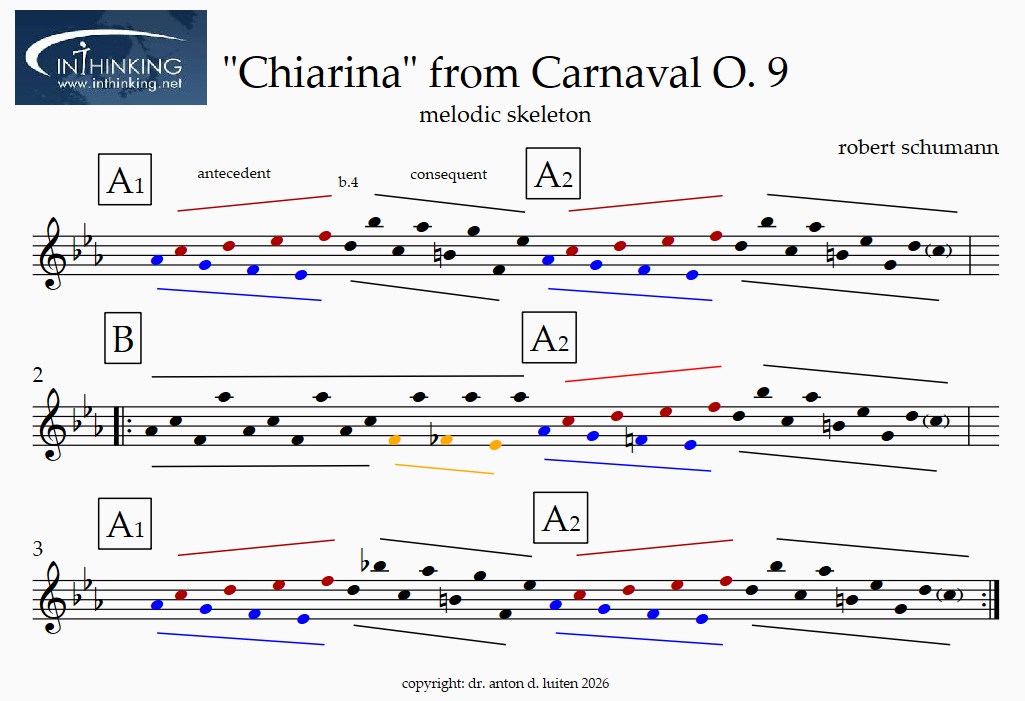
There is an expansive quality to the music in certain sections, namely the opening of sections A1 and A2 (see above). The opening motif initially spans a 3rd (A♭-C), then it becomes a fifth (G-D), then a 7th (F-E♭), and finally a 9th (E♭-F). Another way this can be viewed is in two planes, where the lower “voice” descends (illustrated in BLUE) and the upper “voice” ascends (illustrated in RED), each in step-wise fashion.
The subsequent phrase (pick-up at the end of b.4) is descending in nature (both “voice” parts), providing a balance to the opening (bb.1-4). This forms an antecedent and consequent pairing of phrases, and illustrates that Schumann's approach to phrasing uses a sophisticated form of contour to achieve balance.
This intervallic expansion idea reaches its pinnacle in the B section (bb.17-24) when the melodic intervals are admittedly “static” initially, but then stretch from a minor 10th (F-A♭) to a major 10th (F♭-A♭), to finally a perfect 11th (E♭-A♭) with the descent of the lower “voice”.
Although not illustrated in the melodic skeleton above, the A2 sections are presented in octaves and further differ from the A1 sections by concluding with a melodic variant that enunciates the perfect cadence.
Structurally, the work could be represented as follows, which includes a repeat marking after the first 16 bars :
A1 - A2 (8 + 8 bars)
B - A2 (8 + 8 bars)
A1 - A2 (8 + 8 bars)
B - A2 (8 + 8 bars)
A1 - A2 (8 + 8 bars)
The best representation of this type of structure would be ternary with the opening material returning at the end, but with the inclusion of the A2 material at the end of each section, it appears to be operating like a refrain or a simple rondo form. The material is highly balanced with the length of each phrase at 8 measures, which can be further subdivided into two phrases of 4 bars (as the cadential material in each case punctuates this).
The melody in the A2 sections ends with G-D outlining Chord V followed by C, representative of Chord I.
Melodic Reduction Exercise
It is particularly helpful if you ask students to do this kind of exercise in which the melodic contours (in this case, operating largely on two planes) are revealed. The above melodic skeleton can be offered to your students once the exercise has been attempted for further discussion and understanding.
This task can be particularly helpful to students who prefer to operate with colour and may not be able to see the melodic unfolding so readily, if simply viewing the score.
2. Harmony
Determine what the first four chords used in the piece are.
Is there anything unusual about the selection of chords?
How would you describe the first cadence?
Research how typical suspensions function. How does this appear differently?
Can you make some assumptions about how Robert felt about “Little Clara” based on your harmonic findings?
Compare the bass line of the opening with that in the B section, specifically the material in bb.20-24. What do you notice has happened?
There is an example of a temporary modulation (to B♭) in the B section. Explain how this eventuates and how a return to the home key of C minor is quickly achieved.
Locate the example of a suspension in the B section. Why do you think that it is featured at that moment?
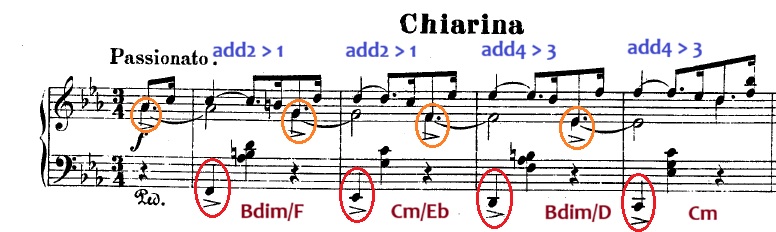
There is a distinctive descending bass line to open (F-E♭-D-C, circled in RED above) that contributes to an alternating vii-i series in C minor. This can be illustrated as follows (in roman numeral form and standard chord notation):
C minor: vii°⁴₃ - i⁶ - vii°⁶5 - i
C minor: Bo/F - Cm/E♭ - Bo/D – Cm
Chords of the opening measures of Schumann's “Chiarina” from Carnaval Op. 9 (bb.1-4)
The piece somewhat oddly begins with a full diminished vii chord, and the first cadence (into b.4) is particularly weak, with the lack of a typically strong dominant. Perhaps one could argue that chord vii here acts as a dominant substitute. Similarly, the formation of the Fm at the beginning is quickly dissipated by the second beat into chord vii.
The reason for this is the notes themselves, “spelling” A♭-C-B♮, but more about the symbolism and cryptology of this in the next lesson.
The added notes, one could argue, do not form a traditional form of suspension, as the note of “resolution” is already present in the accompanying harmony.
Can we make some assumptions about how Schumann felt about “Little Clara” based on your findings?
The answering phrase is more traditional harmonically than the opening, which adopts the standard ii-I-V pattern, forming a typical cadential ⁶₄ that results in an imperfect cadence.
The resolution to I does not appear here as the passage repeats.
C minor: iio⁶ - i⁶₄ - V - V⁷ (-vii°⁴₃)
C minor: Do/F - Cm/G - G - G⁷ (-Bo/F)
Chords of the consequent phrase of Schumann's “Chiarina” from Carnaval Op. 9 (bb.5-8)
One needs to wait until the end of the next phrase to experience that resolution and later, the end of the section (both boxed in RED below).

The descending bass line idea appears in the middle section again (see below circled in BLUE), but now in a chromatically compressed version (E♭-D-D♭-C-B) from the scalic version presented at the start (F-E♭-D-C). Here, it contributes to the following harmonic progression:
C minor: iv⁴₂ - ♭VII⁷ - ♭ii - i⁴₃
C minor: Fm7/E♭ - B♭7/D - D♭m - Cm⁴-³
The ♭ii is also known as a Neapolitan chord (here D♭m), which provides a chromatic pull towards the tonic.
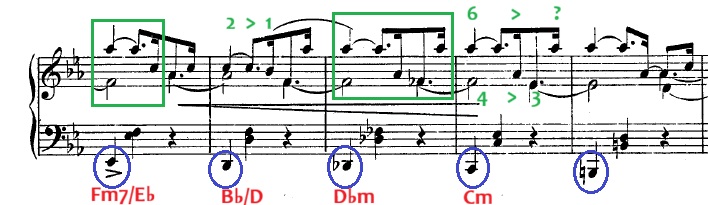
This is a harmonically rich section that contains a temporary modulation to B♭ via a secondary dominant chord in minor form (Fm7), but then quickly moves away from this new key area with the inclusion of the D♭ minor chord. This not only continues the chromatic descent in the bass line, but also offers a Neapolitan chord to return to the original tonic of C.
The added notes that appear extensively through the A section have been replaced here with important chord tones (see b.20 and b.22 boxed in GREEN above), and in bar 21, the melodic notes offered represent a true suspension, as the B♭ is not presented elsewhere (perhaps as this is to draw attention to the only modulation in the piece).
In bar 23, the 6th has been added (A♭), but it does not resolve in any conventional manner. The inner voice returns to adopting the added note, with the inclusion of the flattened 4th (F♭), against the already present E♭ in the bass.
3. Interplay Between the Hands
How can you describe the material in the bass? Is it consistent for the entire piece?
What are some of the features of the melodic line?
How do the hands interact?
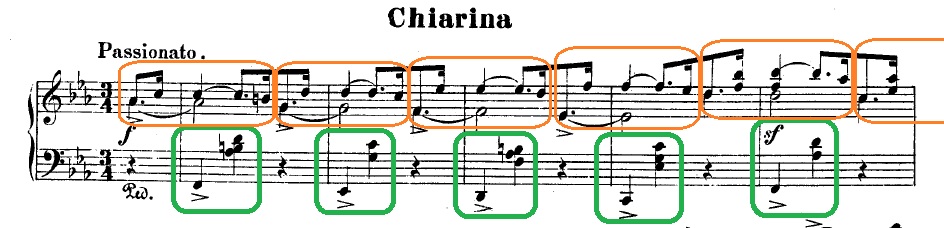
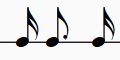
This dotted rhythm pattern is consistent throughout the piece, falling on the latter portion of the second beat and the third beat.
For a lesson that incorporates the stride piano, you may visit HERE.
You may wish to get your students to complete some kind of comparison task between Chiarina and a stride piano piece of your choice. The similarities are quite remarkable.
4. Expressive Techniques and Variation
Comment on the dynamic markings and other forms of expression used. Looking at the opening section (A1 and A2), what observations can you make more broadly about what has been adopted?
What can you state about the use of variation in this piece?
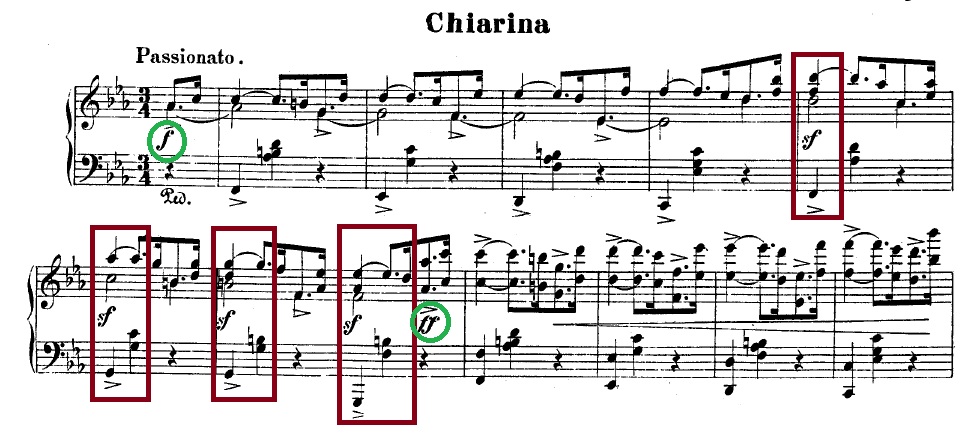
There is actually minimal variation adopted in this piece. The use of the reinforced melodic line in the A2 section (bb.8-16), for example, is one such instance of ‘variation’, but few other examples exist.
As mentioned earlier, there is obviously a slight adjustment made melodically between the A1 and A2 sections, such that the end of the former finishes on the dominant and the end of the latter results in a perfect cadence.
The material is highly repetitive, but with minimal variation, it becomes direct and bold.
 In the next lesson, we are going to research the relationship between Clara and Robert Schumann, as well as his own upbringing, and make some more in-depth connections between the musical features of this piece and the extra-musical aspects of their early encounters. Thus, we will be looking at the character and mood of the piece and attempt to determine whether this is merely a work for his student to enjoy or something more of a ‘love’ letter to Clara.
We will also be looking at the significance of the pitches (A♭-C-B♮), which appear in a number of the works in Carnaval, usually at the start, irrespective of the key adopted.
“Love Letter” Photo by Mark Casey on Unsplash