New Teachers - Start Here

Welcome to the IBDP Music Course
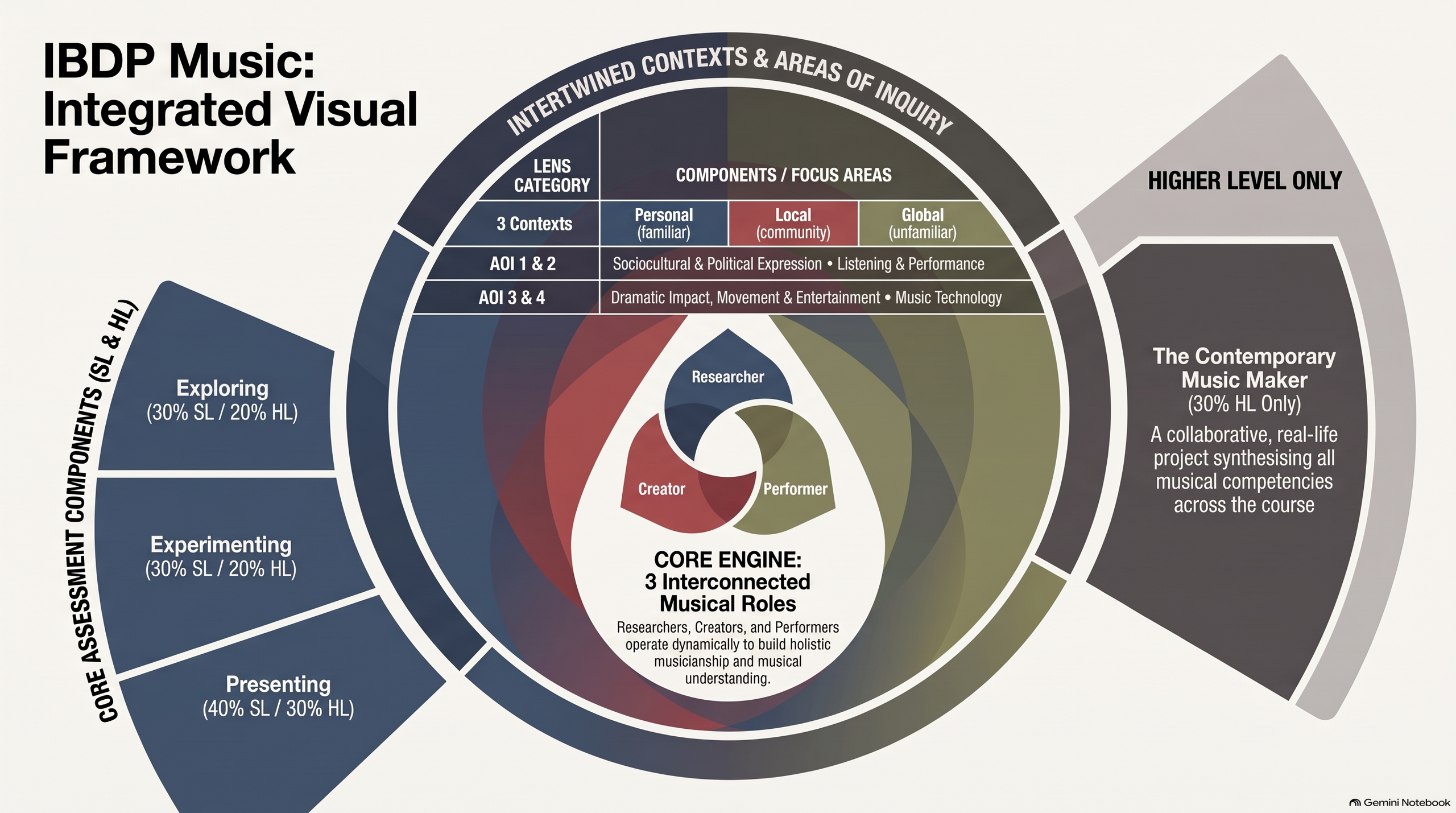
Whether you are an experienced music educator or teaching the IB curriculum for the first time, this course offers an exciting, student-centred framework that develops the holistic musician. The IBDP Music syllabus develops students across three core musical roles (Researcher, Creator, Performer), three contexts (Personal, Local, Global), and four Areas of Inquiry. This page will give you the essentials to help you in your first steps.
“Flower Blooming” Photo by SHIBAM PHOTOGRAPHY on Unsplash
The course comprises several essential areas that must be understood in order to teach with the appropriate mindset and within the correct framework.
Irrespective of whether a student is enrolled at higher level or standard level, there are specific roles that each student must fulfil in relation to each of the musical processes (discussed in further detail below). Students develop as holistic musicians by engaging with all three roles throughout the two-year course. These roles are therefore framed from the students' perspective, and it is the educator's responsibility to ensure that students are given access to these experiences. Whilst the emphasis placed on each role may vary across the different components of the course, students will have developed across all of these fronts by the end of the course.
Further details regarding each of these roles may be found HERE:
| Musical Role | Details |
|---|---|
| Researcher | Investigating musical conventions, contexts, and analytical features |
| Creator | Composing, arranging, and improvising |
| Performer | Solo and ensemble performing, adapting styles, and communicating artistic intent |
Here is an infographic created in Gemini Notebook that summarises the information above.
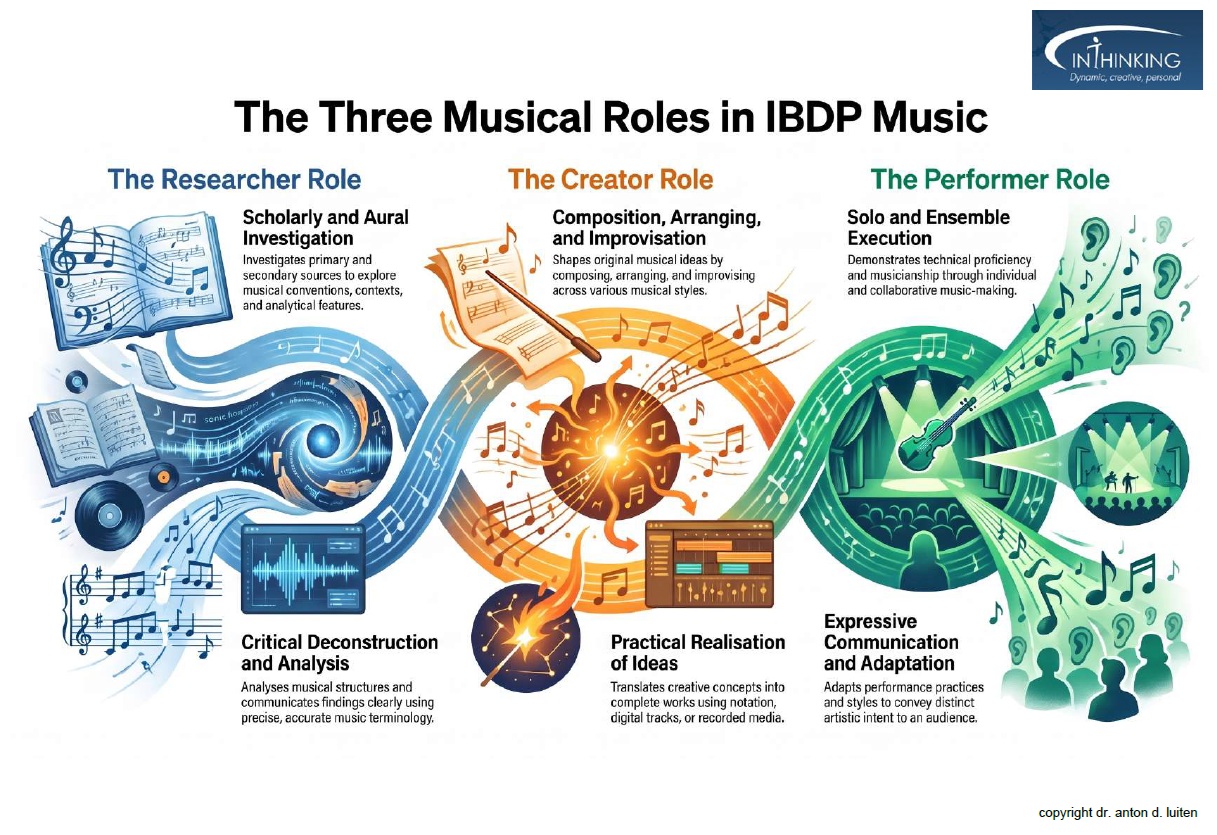
Here is a downloadable version that you may wish to distribute to your students or have in your classroom.
In IBDP Music, students engage with three integrated musical processes that directly structure the core course components, along with an additional real-world project for Higher Level (HL) candidates:
Exploring Music in Context
Students investigate diverse musical material across personal, local, and global contexts. Submission evidence includes a written research portfolio (max 2,400 words), one creating exercise (max 1 min / 32 bars), and one performed adaptation (max 2 mins).
Experimenting with Music
A process-driven "creative sandbox" where students trial unfamiliar prompts and document their musical decisions. They submit a 1,500-word experimentation report supported by 3 creating excerpts (max 5 mins total) and 3 performing excerpts (max 5 mins total).
Presenting Music
Here students present polished, finished works. Submissions include 600-word Programme Notes, a composition(s) or improvisation(s) (max 6 mins), and a solo or ensemble performance (max 12 mins) addressing all four Areas of Inquiry (see below for more on this).
The Contemporary Music Maker (HL Only)
A collaborative, real-life music project where HL students plan, lead, and evaluate their work, documented through a 15-minute multimedia presentation.
The table below illustrates a basic overview of this, but you may read more about the distinction between SL and HL HERE.
| Component | Assessment Type | SL Weight | HL Weight | Core Student Deliverables |
|---|---|---|---|---|
| Exploring Music in Context | External | 30% | 20% | Written research portfolio + practical creating exercise & performed adaptation. |
| Experimenting with Music | Internal | 30% | 20% | 1,500-word experimentation report + 3 creating excerpts & 3 performing excerpts. |
| Presenting Music | External | 40% | 30% | Collection of finished works: 600-word Programme Notes, Composition/Improvisation (max 6 min), Performance (max 12 min) covering all 4 AOIs. |
| The Contemporary Music Maker (CMM) | Internal (HL only) | - | 30% | 15-minute multimedia video documenting a real-life collaborative music project. |
Note:
The information that appears above is only a summary of the key points, and you should view both the Music Guide (for first assessment in 2022) and the Music Teachers Support Material for greater clarity and detail.
Here is another infographic created in Gemini Notebook that summarises the information above.
 You may wish to cut these up and ask each student in your class to research their assigned component for presentations and further discussion.
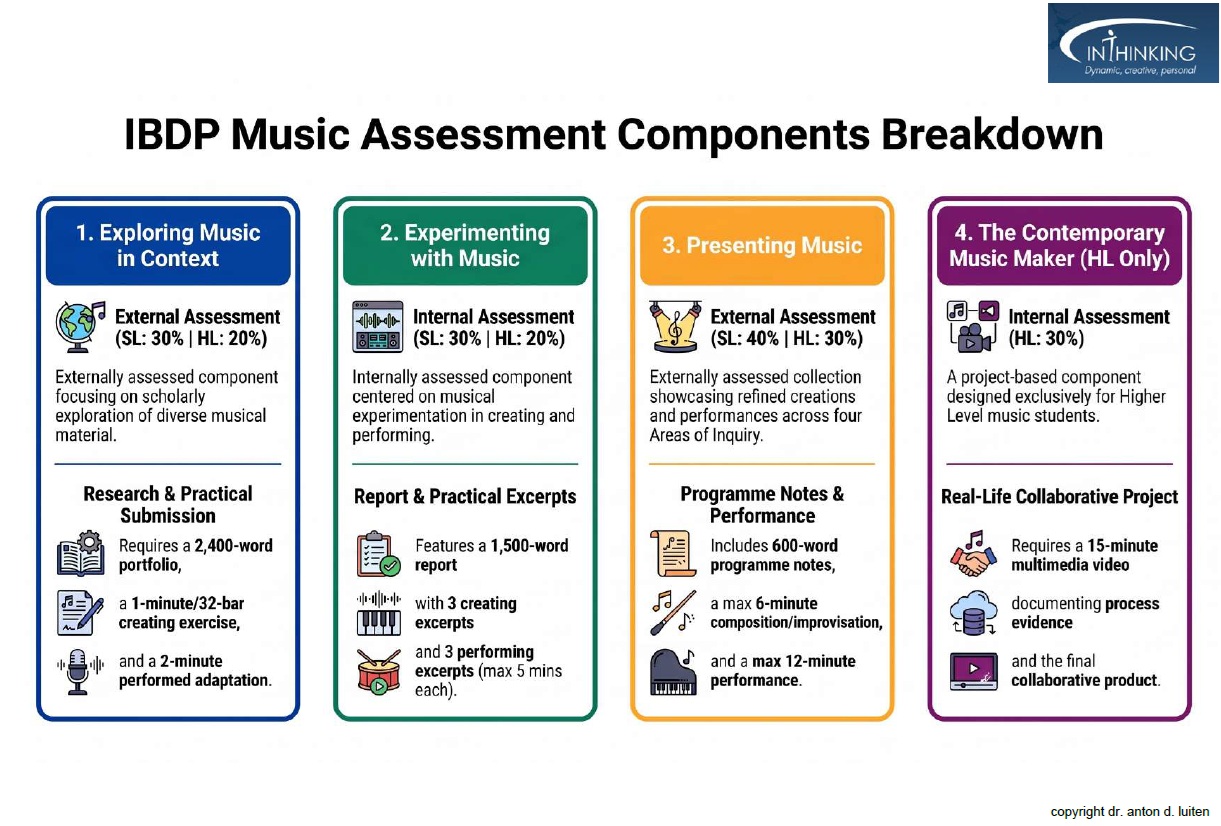
Here is a downloadable version that you may wish to distribute to your students or have in your classroom.
Personal, Local, and Global
In IBDP Music, music is not studied in isolation. Contexts serve as students' primary frames of reference, grounding musical inquiry in real-world practices and encouraging learners to broaden their perspectives beyond the familiar.
To foster international-mindedness and ensure a diverse scope of study, students investigate, create, and perform music across three distinct contexts:
1. Personal Context

This is music that holds personal significance to the student and with which they are most familiar.
Rooted in the student’s immediate cultural environment, personal listening habits, instrument background, and emerging musical identity (you may wish to view some student activities that you can adopt (or modify) on Defining Musical Identity, and Developing Musical Identity. There is also an activity that you can attempt yourself: Reflecting on your Own Musical Identity (click on each of the titles to be redirected).
Serves as a familiar entry point for research and practical work, enabling students to articulate their individual musical voice and prior knowledge.
2. Local Context

Music that has local or regional significance within the student’s community, but with which the student has not personally engaged.
Encompasses music from the school community or the wider amateur and professional local region.
Encourages students to interact with live music-making, local musical practices, ensembles, and artists in their surrounding environment.
3. Global Context

Unfamiliar music from a variety of places, societies, and international cultural traditions.
Involves styles, genres, or practices with which the student has no prior connection - whether from a distant global region or a cultural tradition in closer proximity that was previously inaccessible.
Expands musical horizons, deepens intercultural understanding, and inspires new creative and performing techniques.
Images were created with Gemini Notebook.
Contexts Across Assessment Components
Understanding how contexts function within assessment tasks is crucial for guiding student choice:
- Exploring Music in Context: Submissions require a balanced selection across personal, local, and global contexts to demonstrate breadth and diversity.
- Experimenting with Music: Submissions must be strictly rooted in unfamiliar stimuli from local and/or global contexts, encouraging students to step outside their personal comfort zones.
- The Contemporary Music Maker (HL): Real-life collaborative projects are rooted in the student's personal context and musical identity.
You can read more about the contexts HERE.
The Areas of Inquiry (AOIs) are the core thematic lenses through which all music is studied, created, and performed in the IBDP Music course. Rather than organising the curriculum by a rigid chronological timeline or Eurocentric genre lists, the IB framework uses these four overarching categories to encourage holistic, cross-cultural musical exploration across the three contexts.
AOI 1: Music for Sociocultural and Political Expression

Focuses on music created to express social, cultural, religious, or political thought, values, and identities.
Students examine how music acts as a catalyst for social change, a symbol of national identity, a medium for political commentary, or a vehicle for sacred community ritual.
Stated IB Examples:
Protest songs, such as civil rights anthems, anti-war songs, political hip-hop
Liturgical and sacred music, such as Gregorian chant, Mass settings, devotional traditions
National anthems and patriotic works, such as ceremonial music, state music
AOI 2: Music for Listening and Performance

Focuses on music created primarily for its intrinsic aesthetic value, technical virtuosity, or structural beauty ("absolute music").
Students investigate elements such as formal structures, harmonic languages, counterpoint, and expressive performance techniques within art music traditions across time and place.
Stated IB Examples:
Chamber works, such as string quartets, woodwind quintets, small acoustic ensembles
Classical concertos, such as solo concertos, concerto grosso
Traditional art music, such as Western classical traditions, Indian classical ragas, Japanese Gagaku
AOI 3: Music for Dramatic Impact, Movement, and Entertainment

Focuses on music designed to support dramatic narrative, visual storytelling, theatrical performance, or choreographed movement.
Students explore how musical parameters, such as leitmotifs, orchestration, tempo, and rhythm enhance visual media, evoke specific emotional responses, or drive physical dance.
Stated IB Examples:
Film scoring and soundtrack composition
Dance and ballet music, such as traditional folk dance, contemporary dance scores, classical ballet
Musical theatre and video game audio, such as diegetic vs. non-diegetic game music, Broadway/West End scores
Music Technology in the Electronic and Digital Age

Focuses on music where electronic tools, digital audio workstations (DAWs), and sound design are fundamental to the creation, manipulation, and performance process.
Students engage with digital production techniques, sound synthesis, audio automation, sampling, and electronic performance media.
Stated IB Examples:
Electronic Dance Music (EDM), such as house, techno, dubstep
Audio synthesis and sound design, such as modular synthesis, soundscapes
Digital production and manipulated audio, such as sampling, DAW-based editing, beatmaking
Again, images were created with the assistance of Gemini Notebook.
How the AOIs Function in Assessment
The Areas of Inquiry are integrated across all three musical roles (Researcher, Creator, and Performer):
In Exploring Music in Context and Experimenting with Music, students use the AOIs to frame their research topics, composition exercises, and performing adaptations.
In the final Presenting Music component, students must ensure that their submitted collection of works demonstrates authentic engagement across all four Areas of Inquiry.
You may view these pages, which provide you with numerous examples of works under each of the Areas of Inquiry (click HERE). There is also a summary of the Contexts and Areas of Inquiry in relation to the components of the course.
There is also a separate page devoted to the contexts, which you can access HERE.
Here is an infographic summary of the Contexts and the Areas of Inquiry that you may find useful. This was, again, created with the assistance of Gemini Notebook.
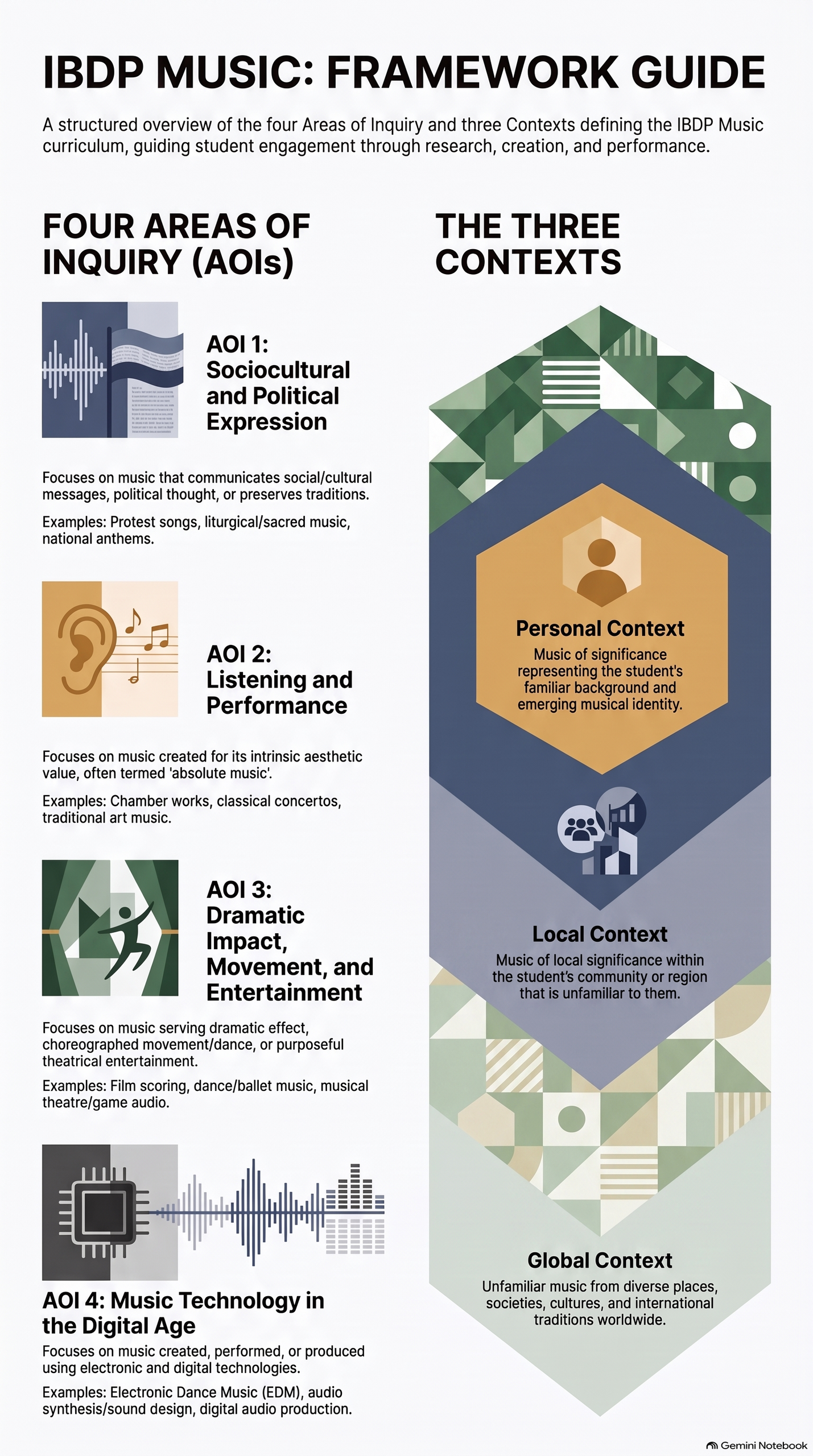
Here is a downloadable version that you may wish to have laminated and in your classroom.
STEP 1: Establish the Student Music Journal Early
The Music Journal is the engine of the entire course. Encourage students to log research findings, audio snippets, process reflections, and teacher feedback from Day 1.
You can find out more about The Music Journal here (and its sub-pages).
STEP 2: Focus on Process Over Product Initially
Use Year 1 to run "mini-explorations" and "mini-experiments" before locking in formal assessment submissions in the second year.
STEP 3: Integrate the Four AOIs Naturally
Design units around overarching themes, such as “How technology transforms rhythm” or “Music as political protest” to weave AOIs and contexts together seamlessly.
There are a number of activities and units that you can either attempt with your students (in a guided capacity) or further examples that support student self-exploration. Click HERE for a number of examples that are constantly expanding.
Explore our detailed unit plans, exemplar student portfolios, examiner report breakdowns, and assessment templates below in order to build your two-year curriculum with confidence. Sample curriculum plans and additional guidance may be found HERE.
We invite you to explore the site at your leisure. Should you require any further assistance, please do not hesitate to reach out by leaving a comment at the bottom of any relevant page or on the Burning Question page.