Assessment in Practice

Understanding Assessment
It is important to recognize that assessment is much more than just grading, but rather, as stated in the Guide (p.40), "an integral part of teaching and learning". It can take many forms and we as educators need to understand this to shape future lessons and better understand how our students are responding to the materials that we are providing for them. The goals of the curriculum are vast and we need to be creative in the manner in which we administer assessment to comprehensively support student learning.
Photo by Sammie Chaffin on Unsplash
The most common types of assessment are, of course, formative (assessment FOR learning) and summative (assessment OF learning). There is some reference to these types of assessment on page 40 of the Guide, but I have instead decided to take definitions from the Teaching Excellence & Educational Innovation section of the Eberly Center of Carnegie Mellon University, which states:
"The goal of formative assessment is to monitor student learning to provide ongoing feedback that can be used by instructors to improve their teaching and by students to improve their learning. More specifically, formative assessments:
- help students identify their strengths and weaknesses and target areas that need work
- help teachers recognize where students are struggling and address problems immediately
Formative assessments are generally low stakes, which means that they have low or no point value".
See here for further details: https://www.cmu.edu/teaching/assessment/basics/formative-summative.html
Some examples of this for music may include:
- draw a concept map to represent their understanding of a topic
- teacher to student interactions
- reflection activities
- peer-to-peer evaluation
- feedback on early drafts of work
Here is an example of a CONCEPT map from a lesson introducing Presenting as a Creator. The students were exposed to several famous pieces of theme and variations and information from the Guide (notably pp.34-35) was discussed.
This was a student reflection (appearing in a Music Journal) on the lesson itself and which of the concepts were illuminated:
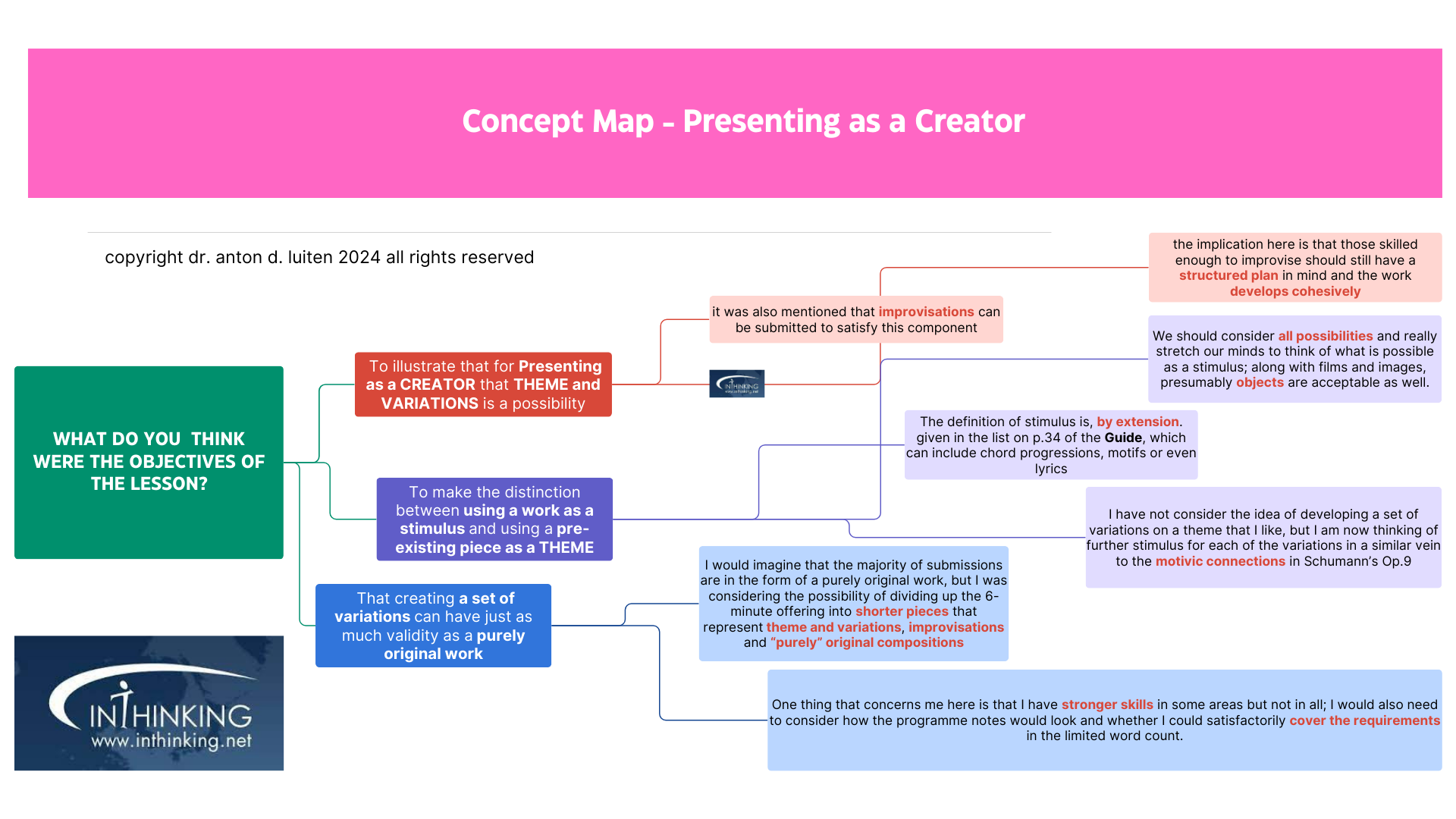
An Example of a Student Reflection on a Presenting as a Creator Lesson using Canva Templates
Teachers must be 'checking in' with this information to ascertain whether the concepts/ideas covered in lessons are being fully comprehended. If not, lessons need to subsequently be modified.
The feedback does not necessarily need to be given in written form but can be shared verbally at the start of an ensuing lesson.
Again taken from the Teaching Excellence & Educational Innovation section of the Eberly Center of Carnegie Mellon University, which defines summative assessment as follows:
"The goal of summative assessment is to evaluate student learning at the end of an instructional unit by comparing it against some standard or benchmark.
Summative assessments are often high stakes, which means that they have a high point value.
See here for further details: https://www.cmu.edu/teaching/assessment/basics/formative-summative.html
In terms of the IBDP Music course, these assessment pieces consist largely of the internal and external components:
- Exploring Music (External)
- Presenting Music (External)
- Experimenting with Music (Internal), and
- The Contemporary Music Maker (Internal, higher-level students only)
However, it is highly likely to expect numerous other forms of summative assessment during the two-year course that could be used for school "internal" purposes only. In other words, certain aspects of each of the components will likely (and should be) assessed at various points in the course.
Any formative assessment that takes place should be based on the assessment criteria. This is also confirmed in the Music Teachers Support Materials (p.8). For more about the importance of understanding the assessment criteria, see HERE.
Here is an example of where and in what capacity summative assessment may be included in the course.
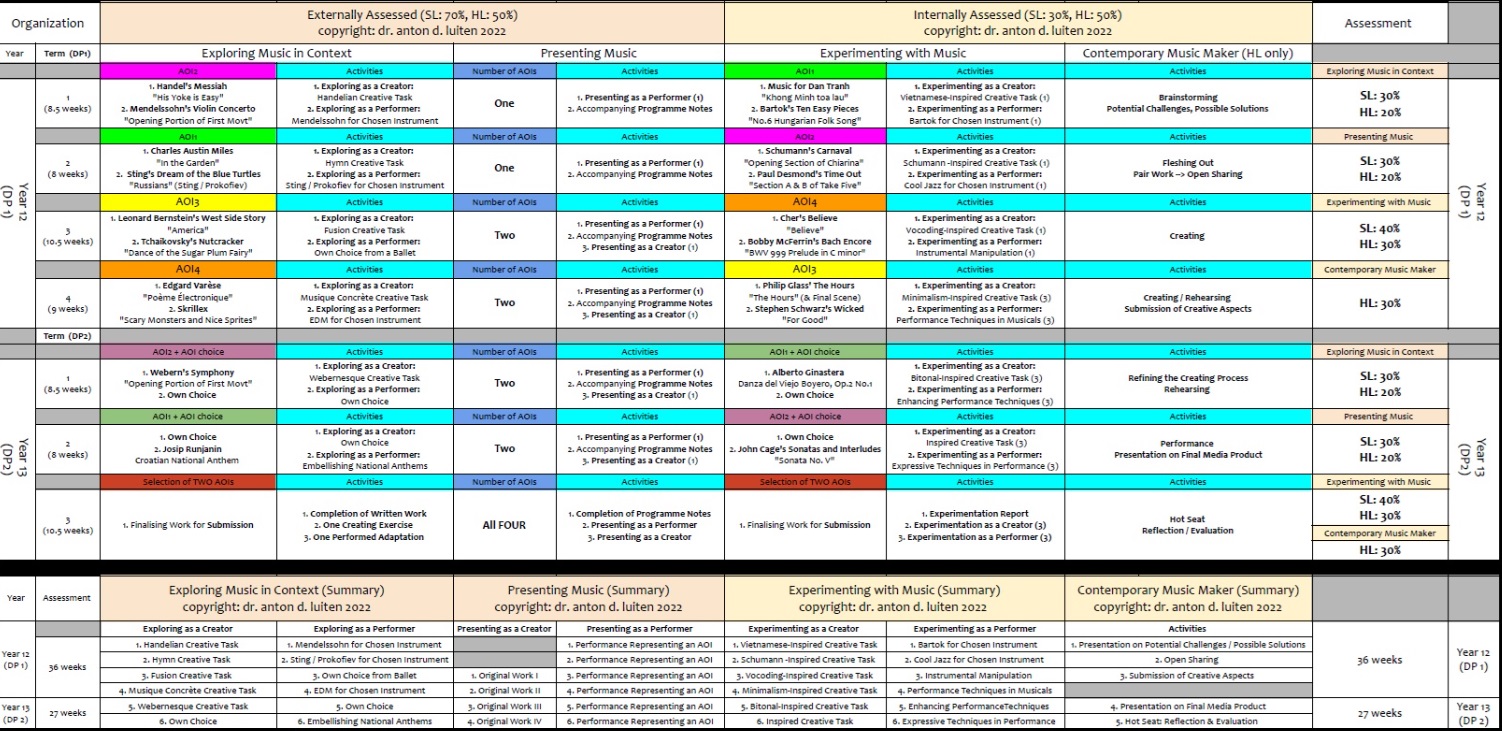
Sample Course Overview Showing a Range of Possible Activities that Could be Used for Formative Feedback
Here, any of the potential exercises, which only constitute a portion of the final submission, can be used for formative feedback.

The IB is very explicit about the Extended Essay on the amount of feedback that is permissible (only comment on ONE DRAFT of a student's work), and equally so in the Music Guide. Reference is made to providing feedback at various points in the course, but further development on the exercise is NOT PERMITTED.
Here is a reference to that information at various points in the Guide:
Photo by Jason Rosewell on Unsplash
Exploring as a Researcher (p.27):
Regular exercises and assignments, paired with effective teacher and peer feedback, will allow students to
develop their skills and collect a range of materials in their music journals.
Exploring as a Creator (p.30):
Regular practice and feedback from teachers will help students improve their musical skills and practical
understanding of conventions relating to creating music. It is recommended that students collect these
exercises in their music journals.
Exploring as a Performer (p.30):
Regular practice and feedback from teachers will help students improve their musical skills and practical
understanding of conventions relating to adapting and performing music. It is recommended that students
collect these exercises in their music journals.
Although these statements all pertain to Exploring, this general summary is explicit in the manner in which work can no longer be manipulated further once submitted for assessment:
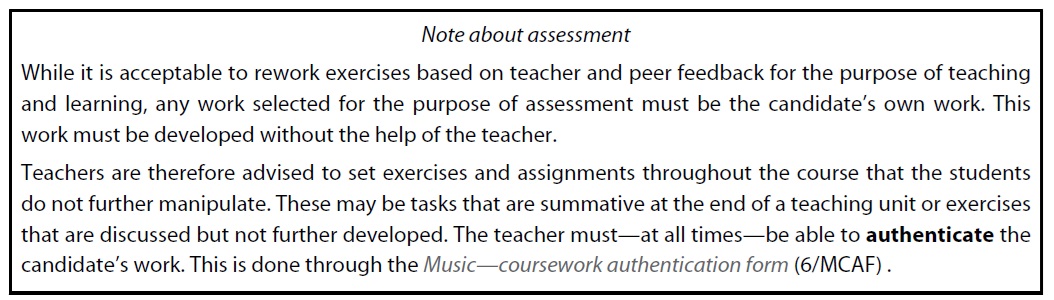
This has been taken from p.27 of the Guide (in the Exploring section) but pertains to assessment more generally.