Importance of Assessment Talk

Can Students Talk the Assessment Talk?
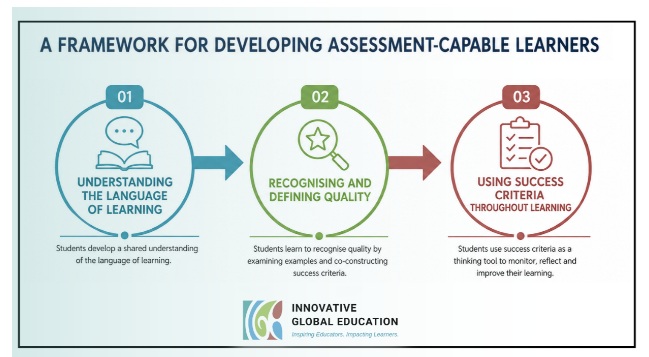
How do we move students from being mere passive recipients of grades to becoming active, empowered participants in the assessment process? This question at the heart of a recent post by Tania Lattanzio, "Developing Assessment-Capable Learners". When we take on all the responsibilities of interpreting criteria, identifying misconceptions, and providing one-way feedback, we accidentally rob students of the chance to think like assessors themselves.
“Students Writing” Photo by Santi Vedrí on Unsplash

Our ultimate goal should be to develop assessment-capable learners; that is, students who understand what quality looks like, can recognise evidence of their own learning, monitor their progress, and make informed decisions about their next steps.
At a previous school, I developed a system designed to put this meta-learning idea to the test: we had students write their own report cards.
“Report Cards” Photo by 2H Media on Unsplash
The benchmark for success was simple: if a student's self-written report card matches what the teacher intended to say, we felt that the educator has been clear in guiding how the student was reflecting and understanding their own learning. In a sense, it proved that the student was fully assessment-capable, seeing their own strengths and growth areas with a degree of clarity and accuracy.
What if the self-assessments skewed significantly from reality?
When a student’s self-assessment diverges from the teacher’s professional judgment, it can be tempting to attribute this discrepancy to a lack of effort. Yet such gaps are, in fact, a valuable diagnostic signal for educators. When a student’s perception of their performance is markedly distant from reality, it indicates a need to reconsider how assessment information is communicated and understood.

We often make the mistake of assuming students understand success criteria simply because we shared a rubric (Lattanzio, 2026). But words like describe, analyse, explain, justify, and evaluate are frequently unclear to learners.
In the IBDP Music curriculum, assessment terms offer a similar role to examination command terms - they are the primary markers of student achievement levels.
Yet, as the most recent subject reports consistently reveal, students often submit explanatory materials that merely "explains" or "describes" when trying to meet the demands of higher-level achievement terms like "evaluates" or "examines," or do not fully understand terms such as "demonstrates" and "justifies" without understanding the required depth.
“Depth” Photo by Max Tcvetkov on Unsplash
There is more on this in a student activity entitled “(Experimenting) As a Creator - Understanding Terminology”. There is a series of steps here to help students understand the difference between recreates, adapts and transforms.
Further, you may wish to view the Subject Reports (click HERE, for a complete set stemming back to 2022), that discuss the application of the achievement levels in detail.
If students do not master this assessment terminology, learning can become frustrating; they are left to speculate as to what the teacher wants (or the IB) rather than recognising what true quality looks like, and/or understanding broader expectations.
Continuous assessment is not about more tests, grades, or quizzes; it is a continuous cycle of noticing, reflecting, adjusting, and responding.
When a student's self-assessment skews, we must provide structured guidance and exemplars to ground their reflective practice.
We must guide them to stop asking "How did I do?" and start asking a more fitting series of questions, which will refocus the student to better reflect on their own learning.
“Multiple Choice” Photo by Nguyen Dang Hoang Nhu on Unsplash
In what way did you address this aspect of the assessment?
What do you think a quality submission would look like?
What are the next steps you would need to take in order to improve this particular aspect?
(Lattanzio, 2026)
There is some further information HERE on the importance of making meaningful observations in the classroom.

Developing assessment capability in our students requires a united teaching faculty, asking the right type of questions, and carefully guiding students.
It requires us to intentionally teach the language of learning and make the pathway to success visible.
When we teach students how to judge quality for themselves, we give them agency over their own educational journey.
“Pathways” Photo by Joe Abellard on Unsplash
Reference:
Lattanzio, T. (2026, August 12). Developing assessment-capable learners. LinkedIn. Retrieved [August 16, 2026], from https://www.linkedin.com/pulse/developing-assessment-capable-learners-tania-lattanzio-nu9le/
There has been a follow-up article to this since my post here.
You may wish to read the additional article on this subject here (click on the image below).