The Four Colours: Mapping Future Skills in Music

Preparing for the Future
I was recently alerted to a fascinating talk by the University of Melbourne's Professor Shanton Chang (delivered in 2024) on how AI is reshaping the workforce. His research revealed that by 2030, 20% of jobs will be entirely new, demanding that we as educators view adaptability as one of the primary skills to be developed. He discusses four colour zones that should be considered in this light, where we can transform the classroom into career preparation.
“Automation” Photo by Homa Appliances on Unsplash
 The global employment landscape is currently navigating a period of unprecedented transformation, driven by both post-pandemic structural shifts and the rapid integration of Artificial Intelligence. Insights presented by Professor Shanton Chang of the University of Melbourne suggest that the traditional focus on "subject competence" is no longer sufficient to guarantee long-term career viability. With twenty percent of the occupations for the year 2030 not yet in existence, and forty percent of current professional roles, including those in medicine and engineering, facing significant disruption due to automation, the educational mandate must shift.
“Framework” Photo by Maria Teneva on Unsplash
For the educator, this necessitates a transition from a content-delivery model to a competency-based framework, where the classroom serves as a critical site for developing the transferable skills required by an AI-driven economy.
 Industry leaders are increasingly prioritising “Technical Creatives”; individuals who can bridge the gap between human expression and technological application. Music students are uniquely positioned to inhabit this space, provided they understand that their training is a series of lessons in adaptability, the "top skill of the moment" according to recent global labour data (Castrillon, 2024).
The music classroom should foster a combination of analytical precision, creative problem-solving, and high-level emotional intelligence.
“Bridging the Gap” Photo by Cody Hiscox on Unsplash
By reframing musical education as a series of transferable competencies, teachers can prepare students for high-level roles, where the ability to interpret human emotions and collaborate across digital divides is paramount.
Bibliography
Castrillon, C. (2024, April 28). Why adaptability in the workplace is more in demand than ever. Forbes. https://www.forbes.com/sites/carolinecastrillon/2024/04/28/adaptability-in-the-workplace/
To effectively bridge these theoretical concepts with classroom practice, Shannon argues, teachers can adopt a "Competency Mapping" exercise based on the four-colour framework (see below). He suggests that teachers should begin by explicitly labelling classroom activities with their corresponding employability colours. For the music teacher, for example:
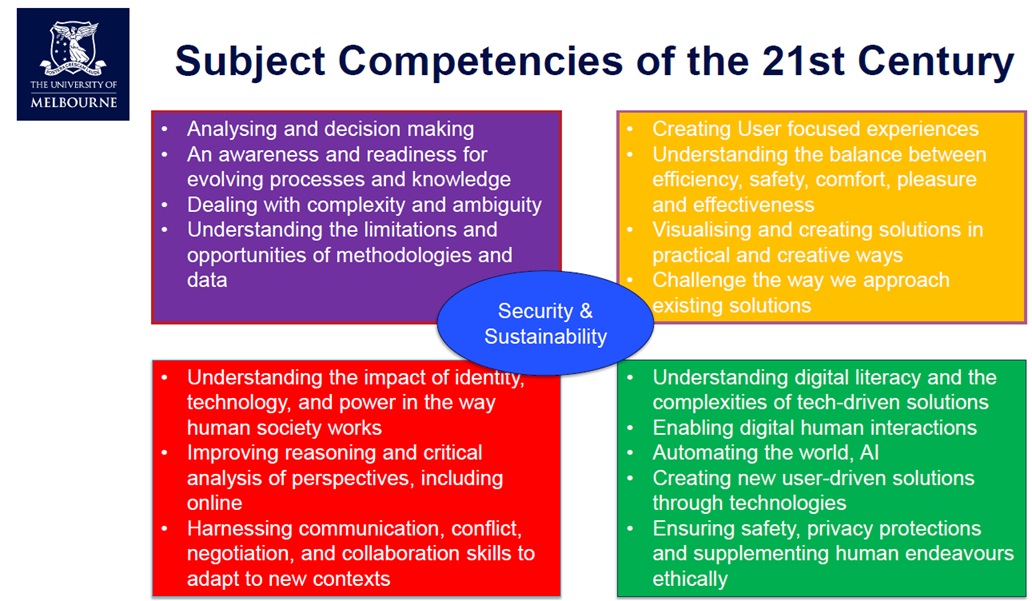
Purple could be for the analysis of complex scores and data-driven decision-making,
Yellow for creative exploration and the visualisation of new solutions,
Red for the human-centric skills of ensemble collaboration and cultural empathy, and
Green for the ethical use of digital tools and automation.
By identifying which "colour" a student is naturally drawn to, the educator can encourage them to diversify their skill set, ensuring they do not spend excessive time in a single zone but rather widen their competencies to mitigate future career risk.
While one may not need to be so explicit in assigning colours to tasks, but thinking of activities in these terms could be enormously beneficial in preparing students for the skills that they will require in future.
Bibliography
Chang, S. (2024, May 15). Careers and employability in a post-pandemic AI-driven world [Seminar]. Cebu International School
 A practical implementation of the four-colour framework could be to assign students a musical passage and ask them to view certain characteristics through a specific “colour” lens. For example, a "Purple" challenge might require students to analyse the frequency of a recurring motif to determine its structural importance, while a "Green" challenge might involve using AI or digital software to create a similar work in a new genre for comparison.
“Different Lenses” Photo by Voice + Video on Unsplash
This approach helps students to recognise that the music classroom can be much more than an isolated entity, but rather the development of skills such as digital literacy, communication, and, perhaps above all, adaptability. By intentionally integrating these practical exercises, music educators ensure their students finish the course not just as musicians but as adaptable professionals ready for the complexities of 2030.