Choosing Art Works to Connect
The Artist Project HL and The Connections Study SL ask students to identify and explore connections with works by other artists. Both benefit from a considered selection: Ideally, you (students) want to find 2+ artworks that have a strong relationship to your own sensibility. This means finding artworks that you like, are curious about, and that address concepts or forms that you are interested in working with.
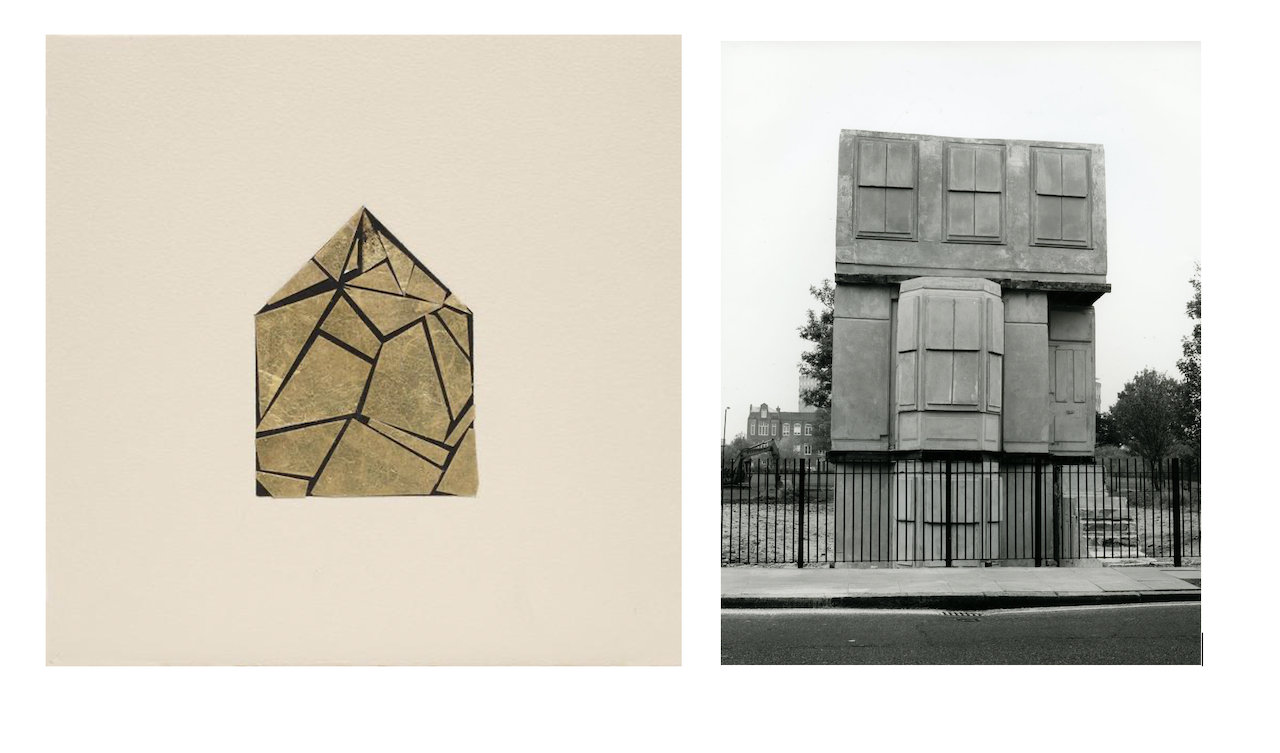
[1]find out more about these 2 artists exploring the concept of home.
The Artist Project
Students will initially propose their project ideas and select two artworks (by different artists) to inform their Artist Project, in relation to a researched understanding of their own context. As students investigate the cultural backgrounds and contexts of the chosen artworks, they will continue to develop and connect their project ideas to the artworks studied.
The Connection Study
SL students select one of their resolved artworks to use as the starting point for their The Connections Study Students choose (at least) two artworks made by different artists to understand, analyze, situate, and reflect upon in connection to their own work. Using research to inform their investigation, students should be able to make connections between their own work and the artworks of their chosen artists in relation to their original audience and across time and place.
Meaningful Connections
When looking for artists to relate to, try not to force a connection. It should feel easy, natural, like an old friend (or a new one). Maybe this artist explores a particular theme or artistic style that interests you. They may not even look visually similar to your work but there's something that you connect to or aspire to.
Reflect on what is meaningful to you and choose artworks that feel equally meaningful. It is SO much easier and more fun to do this task if there is a natural and exciting relationship to your own work, either formally or conceptually, or both.
If your own work is undeveloped, the investigation of other artists can give you a push in a new direction or help get you unstuck. If your work is further along towards resolution, the encounter with other artists can be a rich dialogue.
For Example:
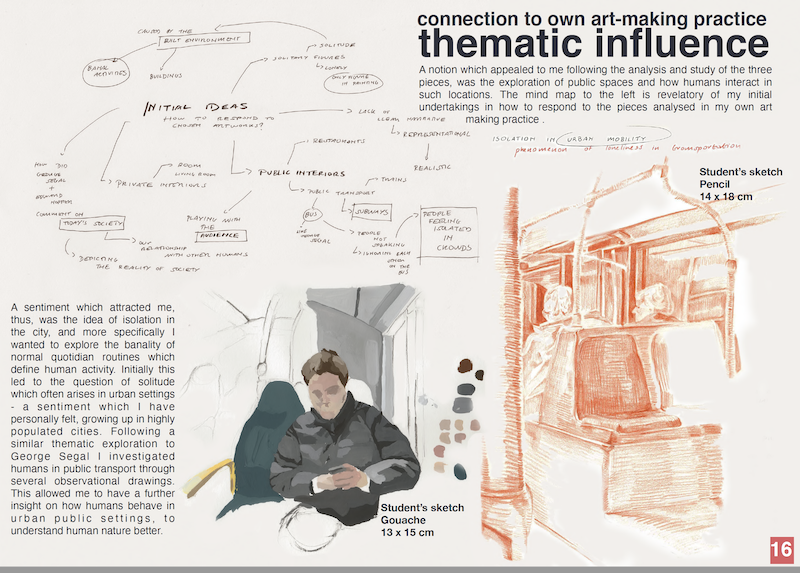
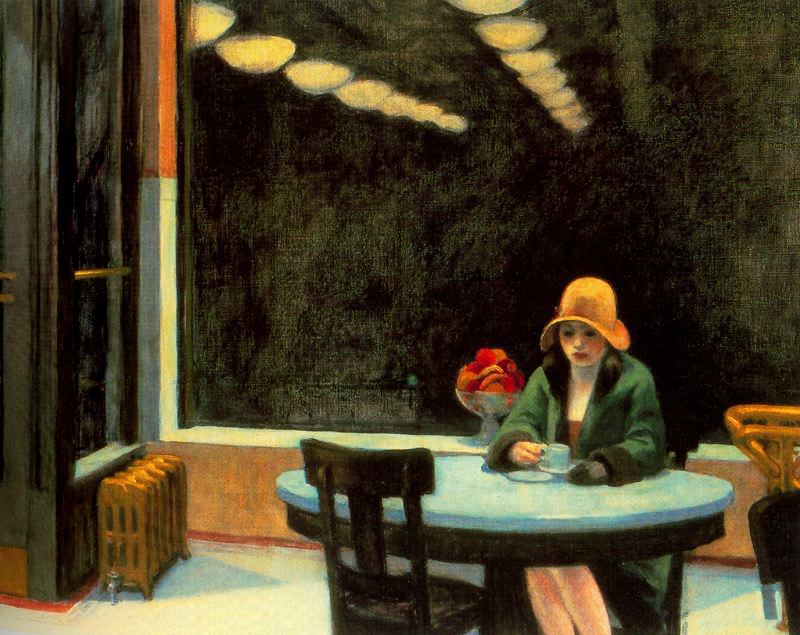
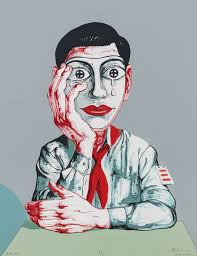
This student, Isabella, was interested in the human condition of alienation and isolation in modern urban contexts. She found 2 artists, Edward Hopper and Zeng Fanzi, who explored these ideas in very different ways. Through her research, she was able to make meaningful connections that enriched her own artwork. This could be a starting point for either a Connection Study or an Artist Project.[2]
Self-Reflection…
- What are you currently working on in the art studio?
- What techniques and media you are exploring?
- What ideas and themes interest you?
- What exhibitions have you seen lately?
- Have you seen any artworks that make you feel wow, I would love to make work like that!?
Where do I find appropriate artworks?
You can find art everywhere….in museums and galleries of course, in artists' studios, in books and films, and on the internet…but let's take a moment to explore a wise approach to image searching:
Just because an image is posted on the internet doesn't necessarily make it art. Anything can be posted on the internet, in a simple search there are no filters or criteria for what passes as art. Advice? Avoid just getting stuff off instagram or pinterest or google image search or other non-discriminatory platforms unless you know about the reliability and quality of your source. You are better off choosing artworks that are "tried and true", in other words, have received significant critical acclaim and have published material for your research....here's why:
Reviewing the Requirements:
- (minimum) two artworks by different artists. You may include more pieces if you wish but try to keep it manageable.
- The artworks can come from any context or time period, even similar ones.
- The artworks can be in any fine or applied art media including painting, drawing, sculpture, print, photography, textiles, installation, new media, architecture, artifacts and designed objects.
Whenever Possible…Go See Art Yourself!
It is always inspiring to see art with your own eyes, in a museum, park, gallery or artist's studio. You can feel the connections with the work, see the textures, experience the scale, the materiality, so much more so than an image on a screen! But alas, this is not always possible, so we try to find good quality reproductions. Art books and exhibition catalogues usually have better quality reproductions than the small low-resolution images found on the internet. A half hour spent browsing art books in a library or bookstore may prove very fruitful indeed.
What is a primary source?
What if I can't see the work myself?
Luckily there are libraries, and of course the good old internet. When using the internet as a research tool, identify the reliability of the website and the author. Many art institutions, museums, universities and established contemporary artists have websites with educational forums and are a reliable source of information. See Sources list at the bottom of this page.
Browsing for images
Although I don't believe social media is a good place to look for art, if you know the author of the account is a reputable institution or a reliable source of art knowledge, it can offer a plethora of new artists . I confess I love the instagram account of Kyle Staver (Note: content may include images of nudity in art) who posts images grouped by similar subject matter. She tends to focus on visual and thematic connections more than conceptual, and covers a range of art history from different cultures and time periods. You might find some artists doing stuff you really like, - there's a potential for connection! Take note of the info and then dive into some research.
Here are a few IG accounts I follow that post a fantastic range of artworks on a daily basis:
https://www.instagram.com/kylestaver/ ( thematically related works)
https://www.instagram.com/folesdog/ ( mostly painting)
https://www.instagram.com/wildmothwildmoth/
https://www.instagram.com/metmuseum/
https://www.instagram.com/themuseumofmodernart/
Whenever possible, expose students to a range of artists: museum and gallery visits are best, but also good quality reproductions. Art books and exhibition catalogues usually have better quality reproductions than the small low-resolution images found on the internet, and can be extremely useful in conducting research. Plan Art Trips to Exhibition Venues, check out a bunch of artbooks from the library or build your own in studio library. Use Film and Video as Teaching Aides, watch Art History Videos. Students need your help if they are to move beyond the handful of familiar works they already know. Otherwise you'll end up with a whole bunch of students making connections to Frida Kahlo, Dali, Van Gogh, Warhol etc…
I compiled this Art research websites pdf a while ago, a new updated version coming soon.
Sources: Art Museum and Education Websites
These are reliable sites for finding and researching art works
Art 21, PBS
//www.pbs.org/art21/
Perhaps my all time favorite online resource for finding out about contemporary artists. Dedicated to the 21st century, this site is extremely intelligent, forward thinking, chock full of interesting artists, interviews, slideshows and video clips. Absolutely wonderful.
Google Arts and Cuture
https://artsandculture.google.com/
Nice to browse for inspiration, and for ideas and topics for the Comparative Study. You can virtually walk around a Museum, or explore by topic, time period, or featured focus. Excellent high resolution images that you can zoom in on.
look, learn about, browse through thousands of artists, including many contemporary less well-known artists.
The Victoria and Albert Museum, London ( V&A)
www.vam.ac.uk
This is one the best Museum websites for IB Art students and teachers; not only for its vast collection of art objects and design but for the exhibitions and teachers resources. I refer to the V&A on several pages of this website.
//www.vam.ac.uk/school_stdnts/schools/teachers_resources/index.html
National Gallery of Art, London
www.nationalgallery.org.uk
An incredible wealth of resources with a very user friendly website. Also look at this //www.nationalgallery.org.uk/learning/inspired-by-the-collection/ , All kinds of artists, writers and filmmakers take inspiration from the National Gallery collection
The Museum of Modern Art, New York ( MOMA)
www.moma.org
A major collection of modernist art,students look specifically at //redstudio.moma.org/# a site within the MOMA especially for teens about contemporary art and //www.moma.org/modernteachers/
Very clear and accessible resources for teachers… lessons, guides,images.
The Tate Galleries
www.tate.org.uk
almost the full collection is online now, very useful website. Check out the Tate learning section and the podcasts
//channel.tate.org.uk/podcasts short interesting podcasts of artists talking about their practice and //www.tate.org.uk/youngtate/ for fun and lively resources for young people interested in contemporary art
The Metropolitan Museum of Art, New York
www.metmuseum. org
A huge collection with a wide cultural and chronological range. Have a look at the interactive timeline of art history
//www.metmuseum.org/toah/
British Museum, London
www.thebritishmuseum.ac.uk
this collection is a wonderful tool to help you locate cultural objects from the past. The collection is searchable by topic, by culture, by time period, truly an IB Art treasure.
National Gallery of Art, Washington D.C.
www.nga.gov
//www.nga.gov/education/classroom/index.mhtm connecting art across the curriculum especially for teachers
The Louvre, Paris
ww.louvre.fr
Not so easy to navigate but it is a huge collection of classical art ranging from Greek art through the 19th century. Try this resource
National Portrait Gallery, London
www.npg.org.uk
A helpful website, lots of good exhibitions based around portraiture arranged thematically
Browse art works through time, period, medium and region...and cross reference by thematic focus
weekly art assignments
search art movements, artists, timelines and ideas
Referencing Sources
As an IB student you must always acknowledge all the sources you have used in any work submitted for assessment. Give the source details of all the images, text extracts and quotes you refer to in your work, including work or ideas of another artist, person or source that you have paraphrased or summarized. You may choose the referencing style you prefer or the one used by your school, but it is important to be consistent throughout. Go to the page on Referencing in Visual Arts
Referencing in Visual Arts
Referencing within the IB Visual Arts course can be a cloudy area for students and teachers alike. On this page we'll discuss ways to develop good habits for documenting sources and clarify when, where,...
Footnotes
1. Go to site page Exploring "House"- Rachel Whiteread and look at Zarina's work on home as a foreign place, at https://www.moma.org/audio/playlist/298/31
2. This is a repurposing of a slide from a student's Comparative Study