Research & Evidence (AP, CS)
In the Artist Project (HL) and Connections Study (SL), you will be asked to research and connect artists and artworks and to provide evidence that's relevant and meaningful to the task. We'll break down where you'll need to focus your research within each task and explore keywords such as evidence and relevance to support your success in these similar tasks.
On this page we will share:
- Research & evidence in the AP & CS
- What is "evidence of research”?
- What makes research “relevant”?
Research & Evidence in the AP & CS
Criterion B, The Artist Project (HL only)
You will select and connect two artworks made by different artists in your Artist Project. In order to gain a meaningful understanding of the cultural significance of each work, and to find relevant connections to your project, you'll need to conduct related research.
Criterion C, Connections Study (SL only)
Similar to your HL counterparts, you will select and connect two artworks made by different artists - the difference is, you're making a connection to a previously made Resolved Artwork. An evaluation, analysis, and clear understanding of cultural significance is needed at the highest level; to achieve this, you'll need to go on the hunt for more information.
Gathering Research
Your quest for more information and evidence may include:
- Internet searches (interviews, art reviews, biographies, historical articles, museum articles, encyclopedia entries, artist's quotes)
- Books (reference books, books about the artist or a related art movement)
- Museum or gallery visits
- Conversations with the artist (online, phone, in person)
Evidence of research will become apparent when you make informed analyses and understandings of artists, their artwork(s), their context, and their audience(s). Your understanding will improve based on evidence that allows you to substantiate your claims in order to avoid superficial judgements. To draw rich conclusions, you will need to find multiple sources to help you gain a sense of perspective on the works you've selected to study and connect. A balance of written and visual imagery is required for both the AP and CS tasks.
Visual evidence
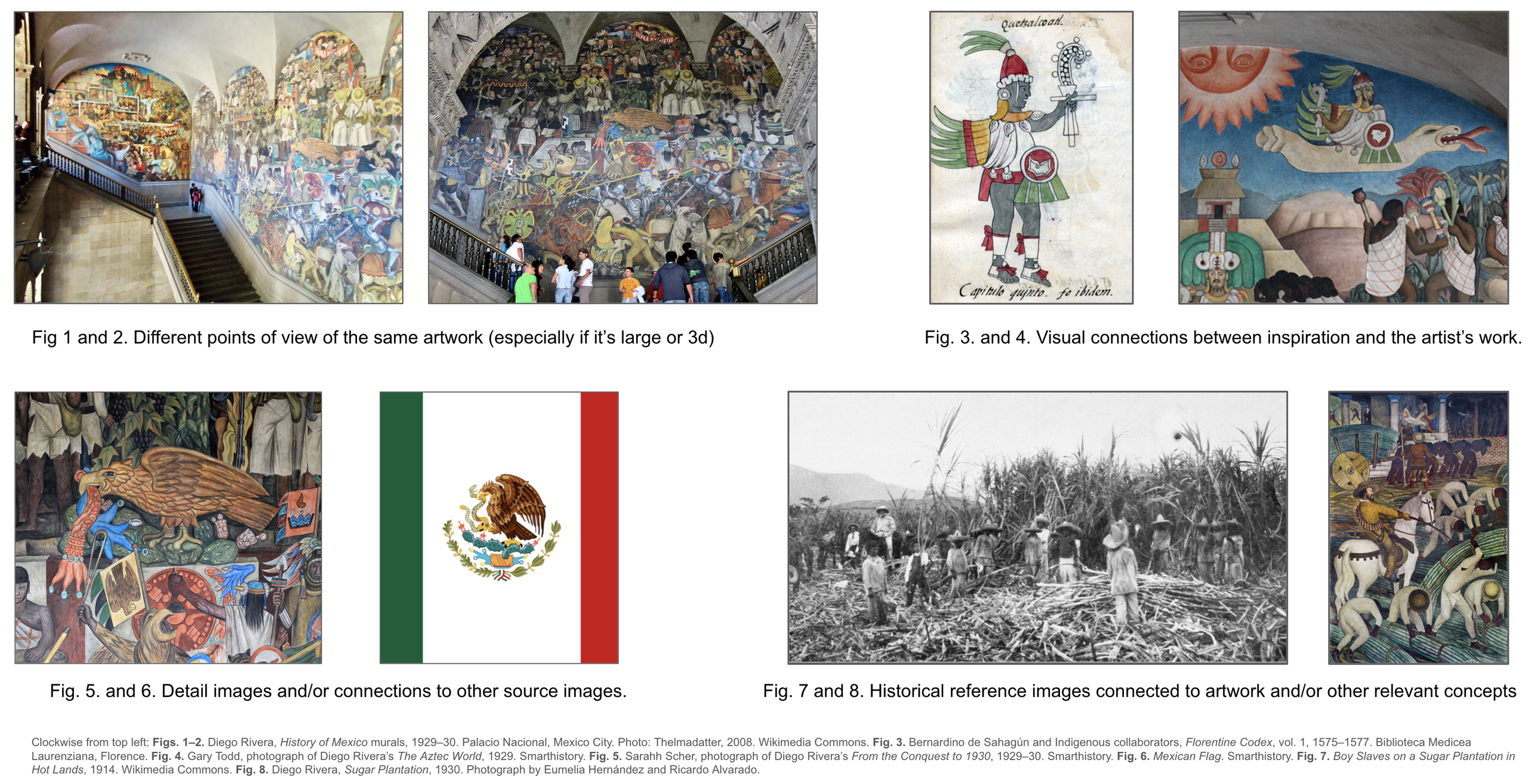
Below are some examples of visual evidence, using Diego Rivera's monumental mural “History of Mexico” as a starting point. Even though a picture speaks a million words, for this task, visual evidence is not enough on its own. On the other hand, images will allow you to elaborate written concepts in meaningful ways and its important to include sketches, artworks, or photos to illustrate key ideas.
Written evidence
A focus on cultural significance and how the work was understood by different audiences should be explored in writing. The question is, how does one show evidence of research in writing? Simply jotting down an in-text citation is not enough!
Here are scaled examples for you to compare, going from minimal to more informed:
Minimally informed example:
Kara Walker uses silhouettes to explore race in her black paper cutouts on white backdrops.
→This example fails to suggest any depth of knowledge or informed research. Insufficient evidence.
Partially informed example:
Kara Walker pulls from the historical traditions of silhouette portraiture. The simple black-and-white contrasts depict the ways Black people have been stereotyped.
→ This example shows a deepening understanding of Walker's choice of silhouette imagery. At the same time, this writing lacks specificity. A student could easily pull this information from one source.
Informed example:
Kara Walker deliberately works with the polite Victorian tradition of silhouette portraits. Her black paper cutouts are bold, showing negative stereotypes of Black figures from a similar era.
→ This example shows a deeper understanding of Walker's choice of silhouette imagery and how it fits within history (i.e. the Victorian era and polite society). At the same time, this writing would improve with more information about how the work depicts negative stereotypes and how that is relevant to the era.
Meaningfully informed example:
Kara Walker intentionally uses the polite Victorian tradition of silhouette portraits to create a paradox. By exaggerating shapes in her silhouettes, she challenges the racial imagery found in antebellum American caricatures and advertising.
→ Now we have it! The student explains the background, but also makes an analysis by naming Walker's aim a “paradox.” In the second sentence, the student attributes the qualities of the materials (anonymous) linking that to the history of racialized imagery of a specific time and place (antebellum America).
The last step is to cite your sources at the point of use. An accurate example would look like this:
Kara Walker intentionally uses the polite Victorian tradition of silhouette portraits to create a paradox. By exaggerating shapes in her silhouettes, she challenges the racial imagery found in antebellum American caricatures and advertising (Buffalo AKG Art Museum, Farrell).
References
Buffalo AKG Art Museum. “Kara Walker: The Emancipation Approximation.” Buffalo AKG Art Museum, 25 Oct. 2003–8 Feb. 2004, https://buffaloakg.org/art/exhibitions/kara-walker-emancipation-approximation.
Farrell, Jennifer. “Traditional Form and a Contemporary Lens: Kara Walker’s Resurrection Story with Patrons.” The Metropolitan Museum of Art, 15 Jan. 2019, www.metmuseum.org/it/perspectives/kara-walker-resurrection-story-with-patrons.
When you research information about artists and artworks, especially famous works, you will quickly find more details than you need. Part of curating your evidence is knowing which information to include and which information is unnecessary, superficial or only partially relevant. Relevant research means sharing the most applicable findings in your final screen-based document.
At a quick glance, here are some types of information or evidence you might come across. Some of these points will be incredibly relevant for some artists and their work, but not always; other examples below are non-essential and superficial. YOU will have to decide what's relevant using your best judgment.
The research for each artwork will be different from one student to the next, depending on how much information is known and also what's relevant to the connections you're making between differing artists and your own ideas.
Essential or non-essential research?
Photo or portrait of the artistAsk yourself: is this essential to understanding cultural significance, context, or audiences? | Photo of the artist's materials or studioAsk yourself: does this evidence provide a meaningful explanation to help you understand the artist and their practice in substantial detail? |
Family background of the artistAsk yourself: does this help you to understand more about the artist's context or is the information of superficial importance? | Identity of the artistAsk yourself: which attributes of the artist's identity have (not only) shaped the artist's life but this specific artwork? Are these details important to understanding the artwork? |
Love life of the artistAsk yourself: do the personal circumstances of the artist relate to the artwork you are investigating? If yes, what's the significance of this information? | Information about the audienceAsk yourself: other than the original context, where else has this artwork been displayed? What examples of audience reactions have been noted? |
Education of the artistAsk yourself: does the education of the artist help to place them into a larger framework, such as an art movement or cultural context? | The artist's creative practiceAsk yourself: is this artwork typical of this artist's creative practice? If yes, then situate the work within their larger body of work. If not, try to consider what's different and how this is significant for the artist's ideas, aesthetics, or use of materials. |
Art movements - before, during, afterAsk yourself: which art movements before, during or after the creation of the artwork were important to its development? Note: Not all movements will equally affect a work and not all artists are influenced by artistic movements; still, many artists draw upon the work and ideas of others, so it's important to consider these relationships. | Historical contextAsk yourself: what was going on at the time when the artwork was being made? Which events may have shaped the work? Note: Students sometimes draw false conclusions by connecting unrelated events to the work (for example, "the artwork was made during climate change, therefore it shows environmental impacts); not only is this irrelevant, it's usually superficial. |
Formal analysisAsk yourself: Which of the formal elements and principles are important in conveying the artist's concepts and intentions? Which aspects call attention to viewers? How do materials combine to communicate meaning? Note: a full formal analysis is unlikely to address the criteria in the AP or CS unless you can connect it to aesthetics in Cultural Significance (i.e. other art movements, communication of ideas). | Images of the artwork being studiedAsk yourself: Is one image sufficient for exploring the artwork? Do other images provide additional details or points of view to be considered? Note 1: artworks change with time but also according to location. An artwork that is seen in different physical contexts can help you to explore questions of significance and (different) audience(s). Note 2: extra images may not be available and this is okay. But at least one high quality image should be included. |
Cultural SignificanceAsk yourself: which aspects of the work are the most significant? Which aspects will require a bit of digging on your part? Which areas can be supported by concrete research and which ones are you only able to make claims about using inferences or opinions? Note: Cultural significance is a big deal (see all about it here)! There are multiple areas to consider: scientific, aesthetic, historic, social, and spiritual significance. | Other artworks by the artistAsk yourself: are there other artworks by the same artist that are better known that help you to answer some of the questions you're having? How can you use these artworks to inform your understanding of the artwork you've selected? Note: looking at an artist's broader artistic practice can help inform your understanding of the work, but it's not always relevant, especially if you're just using images of other artworks as page filler. |
Referencing in Visual Arts
How and when to reference, in text citation, image labels, list of sources and references in the assessed tasks.
Unpacking Cultural Significance
What is it that makes an artwork matter? How do we determine what makes an artwork significant? We look at five aspects of cultural significance, exemplified by Marc Chagall's famous ceiling painting...
CS Crit C: Investigation of Cultural Significance
The task for Crit C Investigation of Cultural Significance in The Connections Study SL, analyses and evaluates the cultural significance of the 2+ works by other artists, AND how this connects with the...
AP Crit B: Connections
The second step of the Artist Project is Criterion B, Connections. Each student will cast their net to identify two artworks (by two different artists) that are personally relevant to the ideas laid out...
References
Title image:
Ronald Paris, In Praise of Communism, 1969–70, fresco. Detail, DDR Museum, Berlin. DDR Museum.
Full Image (figures) citations for Diego Rivera's work (above):
Fig. 1 and 2) Thelmadatter. RiveraMuralNationalPalace.jpg. 2008. Wikimedia Commons, https://commons.wikimedia.org/wiki/File:RiveraMuralNationalPalace.jpg.
Fig. 3) Sahagún, Bernardino de, and Indigenous collaborators. Florentine Codex, vol. 1, 1575–1577. Biblioteca Medicea Laurenziana, Florence. Image via Smarthistory.
Fig. 4) Todd, Gary. Photograph of Diego Rivera’s “The Aztec World,” History of Mexico murals, 1929. Smarthistory, https://smarthistory.org/mexico-diego-rivera-murals-national-palace/.
Fig. 5) Scher, Sarahh. Photograph of Diego Rivera’s “From the Conquest to 1930,” History of Mexico murals, 1929–30. Smarthistory, https://smarthistory.org/mexico-diego-rivera-murals-national-palace/.
Fig. 6) Mexican Flag. Smarthistory, https://smarthistory.org/mexico-diego-rivera-murals-national-palace/.
Fig. 7) “Boy Slaves on a Sugar Plantation in Hot Lands.” 1914. Wikimedia Commons, https://commons.wikimedia.org/wiki/File:BMEX_D111_Boy_slaves_on_a_sugar_plantation_in_hot_lands.jpg. Public domain.
Fig. 8) Diego Rivera, Sugar Plantation, 1930, fresco, Palacio de Cortés, Museo Regional Cuauhnáhuac, Instituto Nacional de Antropología e Historia, Cuernavaca, Mexico. Photograph by Eumelia Hernández and Ricardo Alvarado, Instituto Nacional de Bellas Artes.