Creative Strategies
This image, Silver Eerie, by Maya Lin, is an example of an artist using de-contextualization as a creative strategy, in this case, removing recognizable geographical context to highlight pure form.

“In an age of digital navigation apps such as Google Maps, we often take for granted our ability to see the features of the Earth from a height of miles and to map our environment with the swipe of a finger on a screen.
What are creative strategies?
Creative strategies are multiple approaches that artists use to propel their artwork in new directions. The focus is not on technique or skill per se, but on innovative or surprising ways to explore ideas and imagery.
These approaches are often playful, sometimes deliberate (as in borrowing intentionally from another artist's practice) and sometimes accidental (a broken ceramic vessel leads to exploring fragmentation).
The new guide asks students to engage not only with a variety of art-making forms but also with a variety of (at least two) creative strategies in The Inquiry Portfolio .
Professor Julia Marshall [2] has identified six broad categories of creative strategies used by art educators across the world, and featured in the new visual arts guide. This is by no means an exhaustive list, but it shows some of the many ways to stimulate creative exploration.
Transformative strategies
•Combinatory strategies
•Juxtaposition strategies
•Extension strategies
•Distillation strategies
•Associative strategies
New Creative Strategies graphic poster available to download here
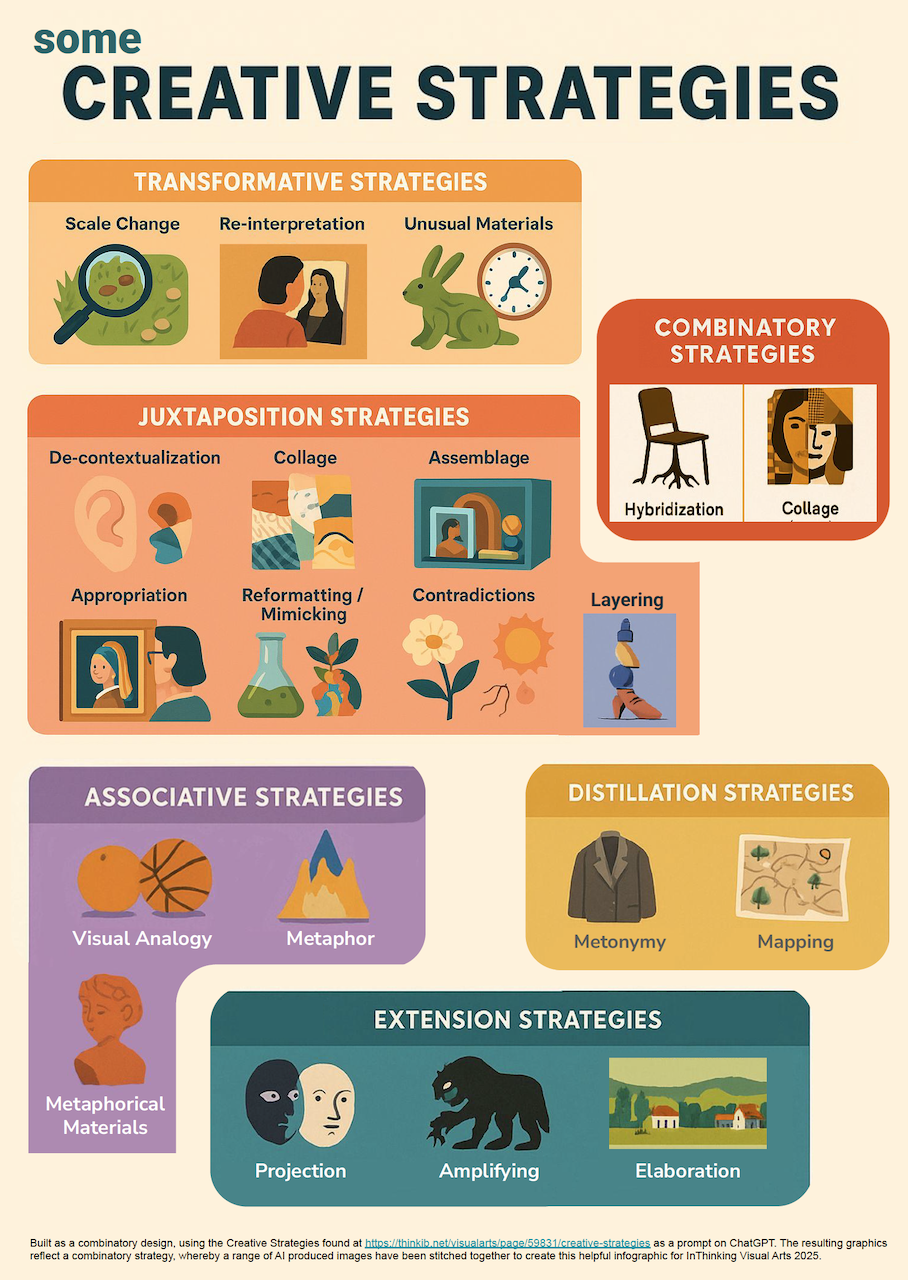
Teaching through creative strategies
We have linked each of these six strategies to art-making and looking activities from our art seed bank with Inquiry Questions to stimulate critical thinking.
Transformative Strategies
including
Scale Change: Make an object or image larger or smaller or change your point of view. The Seed: Under your Feet explores a detailed zoomed in view.
Re-interpreting a known artwork in a different medium or style: such as Seed: Modern Miniatures. Try reinterpreting your self with Seed: Self-Transformation
Unusual Materials: Constructing out of surprising materials. Try the magical Seed: Disappearing Act or use Seed: Found Frottage technique to create unusual imagery.
The effects of time or natural forces on an artwork is also a transformative strategy: explore Seed: Deterioration and Transformation
Juxtaposition Strategies
including
De-contextualization: Changing context of an object/image, removing recognizable context as in the Maya Lin image at the top. Explore the uncanny in Seed: Abstract Body
Collage: Juxtaposing imagery to develop/reveal a concept that unites them: Discover the many sides of Collage! and try out this Seed: Cross Cultural collage
Assemblage: Juxtaposing objects to develop/reveal a concept that unites them. Seed: 23 of Me, combine with guided looking at the assemblage artist Betye Saar.
Layering: Juxtaposing meanings through layering ideas or images —explore a digital photography project in Seed:Time Machine Photo or more simply in this Seed: Overlapping Drawings
Appropriation: Using an existing image or style to play upon meaning: understand what is Artistic Appropriation then follow with Seed: Modern Miniatures
Reformatting or mimicking: Try using a format or methods from a non-art discipline, such as these artists who work between art/science do : Seed: Scientific Experiment and Seed: Photosynthesis?
Contradictions- exploring meaning through opposites and juxtaposition with Seed: Photographing Contradictions or Seed: What is Beautiful?
Combinatory Strategies
including
Hybridization: Combining elements of multiple things: introduce the concept of The Ready Made and create a precarious hybrid sculpture Seed: On the Edge or create with light and shadow Seed: Shadow Assemblage
Collage is also a combinatory strategy as in Seed: Cross Cultural collage Explore hybrid emerging media with New Video Art Visions
Extension Strategies
including
Projection: Taking things/ideas to logical or absurd conclusions, maybe even fictional or fantastic: try a forensic approach to story telling in Seed: Public and Private Selves
Amplifying/magnifying: Exaggerating a phenomenon; making it larger than life: Seed: Creepy Ink Drawing, exaggerate it and make it on a huge scale.
Elaboration: Adding detail, spinning further meaning, enriching…with the complex Seed: Patchwork Panoramic or a drawing activity Seed: Real vs Reproduced that elaborates different approaches to representation.
Distillation Strategies
including
Metonymy: substituting a part to stand for the whole or representing a concept with an image or object rather than a direct comparison as in metaphor. Explore with Seed: Memorial or Seed: Portrait with Clothing to represent the person and distill it to one article of clothing.
Mapping: Organizing ideas and things/imagery graphically. Seed: Multiples of One explores the organizing principle, and for a different kind of mapping Seed: Mapping your hand or Seed: Psycho-geographies
Associative Strategies
including
Visual Analogy: a one on one comparison, The video artist Bill Viola makes fascinating analogies between ancient and modern technologies and imagery in his Bill Viola, Electronic Renaissance
Metaphor: Casting one thing as another, using visual symbols. The activity Seed: Design a Shrine could incorporate metaphor, as could Seed: Spirit Animal Print
Metaphor of materials: Constructing an object or image out of materials that have meaning in themselves. Look at Marc Quinn's Blood Head and brainstorm your own Mad Materials
I hope you enjoy the linked activities and remember that students don't have to use all of these strategies. They are a fun way to learn to think more conceptually and maybe stumble upon new solutions. You may discover other strategies on your own, in fact, you probably use different creative strategies all the time!
Related Content
SCAMPER Ideation
As we begin teaching a new curriculum in September 2025, many teachers are puzzling how to prepare their pre-IB students for what's ahead. Art-making is central to the Visual Arts curriculum. As such,...
Art Seed Bank (new course)
The Art Seed Bank has been updated and expanded for the New Visual Arts Course to explore Creative Strategies with thought-provoking Inquiry Questions for each activity.Choose from the ever-expanding...
Footnotes
1. -Toledo Art Museum, https://toledomuseum.org/collection/art-minute/art-minute-maya-lin-silver-erie
2. Julia Marshall, Professor of Art Education, San Francisco State University