AP: Pacing Guide
Deciding when to start the Artist Project will be dependent on several local factors and school-related considerations. However, the IB clearly mandates that the task of the Artist Project takes place and concludes in Year Two. With this in mind, we share a few ideas for how to pace the Artist Project, according to the prescribed structure.
Year 1: Preparing your students
While the bulk of the Artist Project steps need to take place in Year 2, there will be many opportunities for you to scaffold the relevant skills and competencies in Year 1 of the course.
Below, we share a list of opportunities that you can embed in other learning experiences from the start of the course.
While we know some schools work in trimesters, others use quarters, we're suggesting a loose structure here based on semesters. Please adapt this as you see fit.
Year 1, Semester 1: | Year 1, Semester 2: |
| Plan a visit to a gallery or museum in person, so that students can see real-world examples of artworks in context. | As they become more independent, provide students with opportunities to propose their ideas for a future artwork through writing, source images, and sketches. |
| Introduce students to a range of artists as they begin to inquire, so that they can develop their own interests in artists and art movements | Encourage more peer-feedback, with a focus on implementing feedback. Engage students in reflection activities to process the feedback they've received. |
| Give students a sketchbook task or discussion opportunity to think about artists, artworks, and their relationship to context. | Set up an opportunity for students to learn how to document artworks using video. Take time to consider various formats and editing possibilities. |
| Conduct a peer-feedback session. Check out our sticky note critique activity. | Dedicate time for students to think about who they are as artists and makers. Who am I as an Artist? is a good place to start. |
By the end of Year 1… plant the 🌱 seeds 🌱 for the Artist Project:
- Explore and tease apart some of the major ideas, such as situating and context.
- Give students a chance to brainstorm and think about local places where they can envision future artworks. Use our page Locating the Artist Project with students to think through these ideas.
TIP: While the Artist Project should take place in Year 2, it is possible for students to develop their proposals in Year 1. This break in the summer months might afford students the necessary time to think through their ideas and/or research more information about their site prospects for future artworks.
Year 2: Structuring the AP
Many factors will influence when the Artist Project can launch in your specific classrooms across the globe. Class field trips, weeks without walls, cultural or religious holidays, or mid-term holidays may shift or shape the way you decide to lay out this project. However, because the AP is an external assessment worth 30%, it will need time. We recommend you build in 10-12 weeks for this. If you start introducing the AP and the proposal at the end of Year 1, you may find that balancing the workload in Year 2 is a bit more manageable for students.
While it is not required or even stipulated that students should make outdoor artworks, to give students ample opportunities to pick and choose what locations will best suit their work, seasonality will play a role. For example, the monsoon season in Thailand, which lasts until October, might feel prohibitive for a teacher who is excited for students to make artwork outdoors. On the other hand, Nordic countries may prioritise fitting in the AP before the days shorten and the temperatures drop. If you happen to live near the Equator, then lucky you!
With this in mind, the model below is only loosely structured to afford you flexibility to determine the relevant timing that best fits your local environment and calendar.
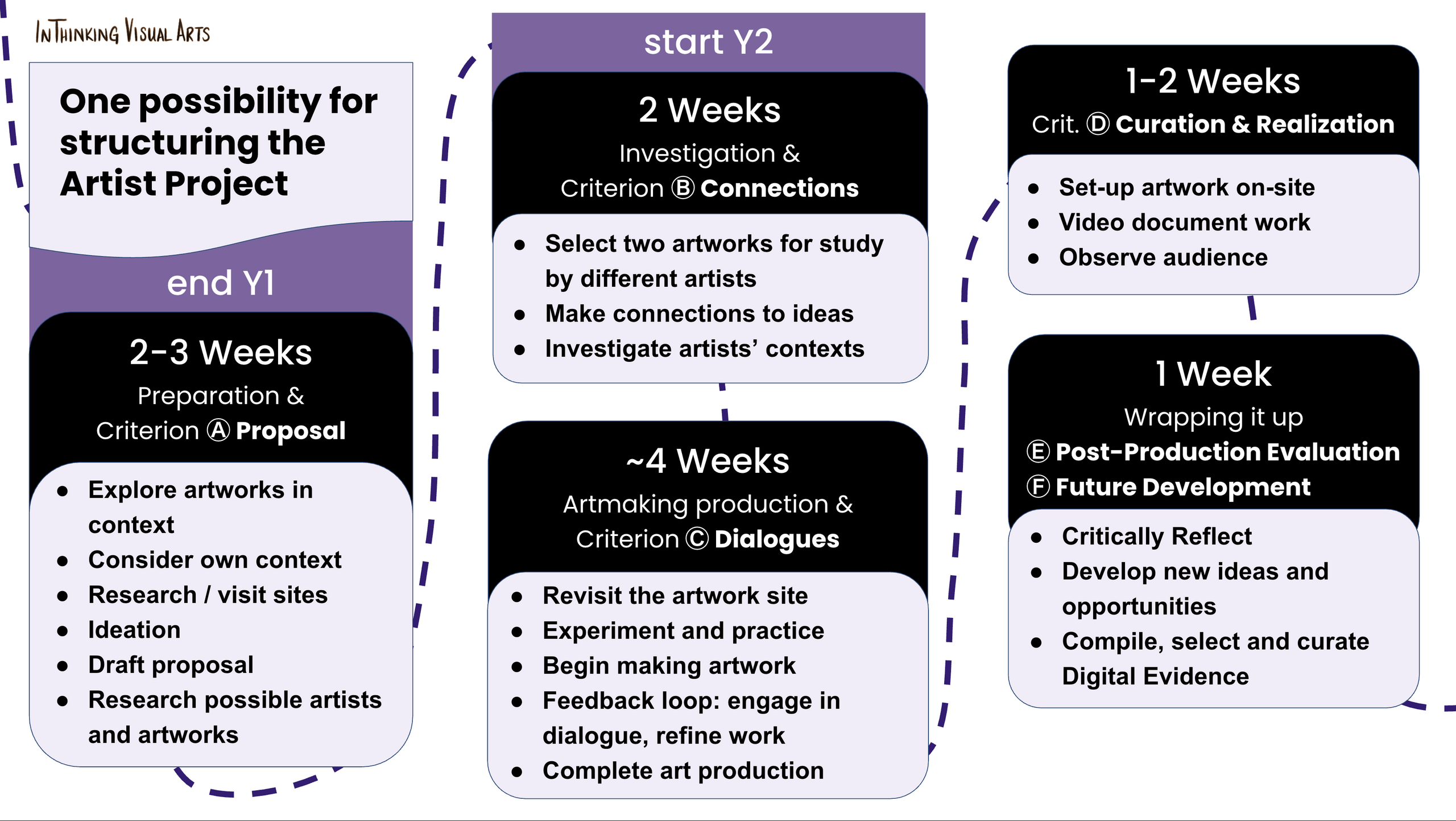
As the course progresses and we receive feedback from teachers who are implementing the Artist Project, we will update this page to reflect other possibilities and models. We look forward to hearing how you decide to structure the AP for your students and which scaffolds best supported your students to tackle this task!
Additional resources to consider include:
Situating the Artist Project
Where do we find art? How do place and time shape the way we experience, understand and interpret artworks? And how does art change the way we see the world around us? In this section, we break down key...
Locating the Artist Project
Where, oh where, can the Artist Project go? What spaces are accessible to students in your local surroundings? These are the questions many teachers ask as they anticipate teaching the higher level Artist...
Who am I as an Artist?
The Artist Project (AP) will challenge you to think intentionally about your own artistic contexts. How you think about yourself as a maker today, in your current location, is a fundamental part of the...
Critiques and Dialogues
Facilitating critiques and encouraging dialogue is part of a contemporary art education and critiques play an important role in the new course. “Dialogues” (criterion C for the The Artist Project...
Visiting an Exhibition
Visiting an exhibition is a fantastic way for students to experience the power of art in person, not on a screen and Learn to Connect to the Art-World. The right exhibition may provide the spark to drive...
References:
Balla, Giacomo. 1912. Dynamism of a Dog on a Leash [Oil on Canvas]. Albright–Knox Art Gallery, New York. https://en.wikipedia.org/wiki/Dynamism_of_a_Dog_on_a_Leash#/media/File:Giacomo_Balla,_1912,_Dynamism_of_a_Dog_on_a_Leash,_oil_on_canvas,_89.8_x_109.8_cm,_Albright-Knox_Art_Gallery.jpg