Approaches to Teaching
“Making and teaching art is a varied, complex and evolving practice.”1
In this section, we look at ways to approach teaching art to young people, and the philosophical and pedagogical underpinnings of art education. The Approaches to Teaching pages are especially helpful to new teachers, but are interesting and relevant for anyone involved in the fine art of teaching art.
We explore the kind of thinking and practical solutions that support a vital and dynamic teaching environment: the challenges of teaching students with a range of abilities and experience, managing the studio classroom, critiques and dialogues, art trips and activities.
Teaching art is also teaching vital modes of seeing, imagining, inventing, and thinking.
Visual Arts Teachers are Innovators
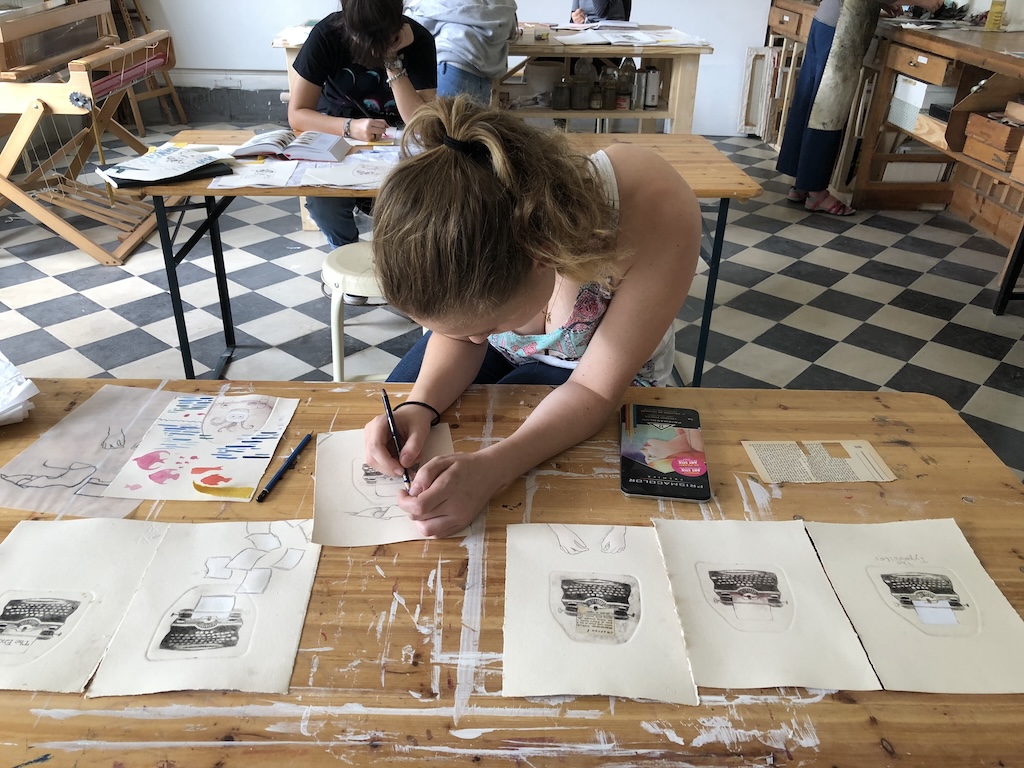
Unlike other areas of the curriculum, where content is often prescribed by the curriculum, visual arts teaching requires a greater degree of flexibility and spontaneity to allow for intuitive processes to take place. IB art teachers may refer to a structured lesson plan or unit to scaffold their teaching in year 1, but remain open to the unexpected connections that arise, the discovery of an artist, the delight of a surprise result, a re-purposing of a technique, an exhibition visit opportunity, and reshape their lessons to accommodate.
As IB art teachers we most often engage in personalized teaching: we work with individuals rather than the group as a whole, especially as students begin to develop personal direction and their own visual language in year 2. There is no one-size -fits-all solution to studio teaching: In a typical studio classroom, students will all be working on different projects, using different art materials, solving different kinds of problems, exploring different artists.
Sound like chaos? No! This is dynamic, productive, evolving studio learning.
Explore relevant topics
- Demonstrating techniques and tools in workshop sessions
- Setting up a studio classroom
- Critiques and Dialogues
- Visiting Artists, in school and out
- Exhibition Visits with students
The Studio Classroom
The art room, or studio classroom, is different from the rooms where other subjects are taught in a school. It is a place that feels warm and welcoming, with a sense of freedom that is conducive to independent...
Workshop Sessions
The Art Making Forms in the Inquiry Portfolio requirement is fairly minimal, 2 or more, but most students need to explore different techniques in order to discover what to focus on for their Resolved...
Critiques and Dialogues
Facilitating critiques and encouraging dialogue is part of a contemporary art education and critiques play an important role in the new course. “Dialogues” (criterion C for the The Artist Project...
Visiting Artists
There are artists working in every community, city, town, village, and remote mountainside, no matter where you live.Widen your definition of artist to include artisans working in local traditions and...
Visiting an Exhibition
Visiting an exhibition is a fantastic way for students to experience the power of art in person, not on a screen and Learn to Connect to the Art-World. The right exhibition may provide the spark to drive...
other pages are in the works…
Personalized Teaching- getting to know your students and responding individually to help each one along their path of development
Developing Craft
Student Exhibitions: the value of having exhibitions, exhibition by choice, exhibition solutions
New Studio Habits of the Mind
Footnotes
1. Studio Thinking 3-The Real Benefits of Visual Arts Education
Kimberly M. Sheridan, Shirley Veenema, Ellen Winner, Lois Hetland
Foreword by: Mario R. Rossero
Publication Date: June 3, 2022