Course Planning
The IB Visual Arts guide (first exams 2027) defines the structure of the new course with a clearer focus on objectives in the first year, saving key assessment tasks for the second year. The guide urges teachers to dedicate time in the first year to explicitly teach key concepts to support student's artistic development through inquiry and skill acquisition. After ensuring students have a foundation to build upon, teachers can encourage Self Directed Art Making as the course progresses.
In this section, we'll offer options for sequencing and structuring the course, while acknowledging that each teacher's approach will vary according to student needs and competencies, class sizes, school calendar, and more.
YEAR ONE:
In the first year, students should be given opportunities to explore, taste, question, observe, and develop their interests, skills, and intentions. The first year is a chance for students to expand and grow horizontally.
While backwards planning by design is useful for structuring the course, it's important that teachers avoid “teaching to the task” and focusing on the assessments alone. Instead, in year one teachers should provide the space and guidance to ignite students' interests in the process of experimenting, using a variety of Creative Strategies, asking questions, developing their personal tastes and preferences in art, learning to critically discuss art with their peers, and sharpening their eye and understanding for the broader world of art around them. Central to this is helping students to “situate” themselves, one of the 7 assessment objectives so that they can see how their own cultural background and local context play a role in their perspectives and the production of meaning in their artworks.
The first year of the course should help students' build the necessary confidence with art materials so that they eventually have the agency and preparation to undertake the rigorous assessment tasks in the second year. Throughout the first year, as students experiment with materials and techniques, researching artists, and following one or more lines of inquiry, they will be busy developing and acquiring evidence of their artistic process and a creating a coherent body of artworks for future assessment tasks, including the Art-making Inquiries Portfolio, Resolved Artworks (SL) and Selected Resolved Artworks (HL).
Here we present the key competencies that teachers can explicitly support in the first year of IB Visual Arts. These are grouped using the three core areas of the new guide:
Connecting:
*Learning to brainstorm and ask Inquiry Questions
*Situating themselves as artists and makers within a broader context
*Discovering, researching, exploring and connecting to artists who make them tick through practical investigation
*Visiting art museums, galleries, or installations first hand
*Considering potential audiences for their work
Creating:
*Developing and sustaining “Lines of Inquiry” across multiple projects or investigations
*Experimenting with materials and techniques and acquiring skills
*Understanding the divergent starting points from which artists initiate their work and learning to (slowly) navigate and observe their own artistic process
Communicating:
*Proposing Ideas for future artworks while considering their own artistic context (HL practice for the AP)
*Engaging in peer dialogues or critique opportunities and implementing feedback by refining ideas and techniques.
*Documenting their own artwork through video (HL, at least once as practice for the AP) and photography
*Analysing and Writing about the work of other artists
*Curating and selecting evidence to share
YEAR TWO:
In the second year, students will continue to explore Lines of Inquiry while working to develop a body of cohesive artworks. The second year offers students the chance to show how they've progressed, what they've mastered, and the depth they've achieved in their work, marking this year as a time for vertical growth.
After students have accumulated enough experiences in the Visual Arts course, they will have the knowledge, understanding, and requisite evidence to tackle the assessment tasks. Because foundational experiences and development in the course objectives will be necessary for them to successfully attempt and complete the three required assessment tasks (SL or HL), the guide outlines that students will complete their assessment tasks in the final year of the course.
These tasks are:
- Art-making Inquiries Portfolio (30% HL, 40% SL)
- Connections Study (20% SL)
- Artist Project (30% HL)
- Resolved Artworks (40% SL)
Selected Resolved Artworks (40% HL)
At the moment, the IB have not released due dates for assessment tasks in 2027, however we do know that the Art-making Inquiries Portfolio will be the first required upload, with the other components to follow. It is likely that the submission deadlines will follow the same dates as the outgoing curriculum.
When to complete the tasks
While the IB Guide states that the assessment tasks should be “completed” in the second year, here are some ideas to keep in mind when mapping activities, units, and due dates:
Artist Project:
Teachers may wish to introduce the AP at the end of the first year, giving students a chance to develop their proposals, as this process may take some additional time to organise. Students would then have the summer to adapt and adjust their thinking, and can move onto the bulk of the work at the start of the second year. Placing the Artist Project at the start of the school year in temperate climates would afford better weather for outdoor in situ projects, however schools in climates with extreme heat/rainy seasons may alternatively decide upon a later start in the year. Ultimately, it's worth considering how the AP may overlap with other assessment tasks so that students aren't overwhelmed with too much at once.
Connections Study:
This should be completed in the second year after the student has produced enough work to make informed connections. Notably, students will need to select a completed, resolved artwork that allows them to contextualise their art-making practice, before commencing their CS. This artwork could be completed in year 1.
Art-making Inquiries Portfolio:
Students will need to organise and select the best pieces of evidence and curate this work into digital screens (up to 15 screens). While students could conceivably organise a handful of slides in their first year, the bulk of this work should occur in the second year of the course, after they've amassed enough quality evidence to pull from, in order to construct their portfolio. With less focus on digitising in the first year, students will have more time to engage in the creative process.
(Selected) Resolved Artworks:
Both SL and HL students will time need to document their artworks (this can happen in the first year, too). HL students will create 8 pieces, but select 5 for evaluation, and they will need time at the conclusion of the course to curate and write about their selection.
Rationale and Texts* Both HL and SL students will write a Rationale to accompany their work, but this fits best towards the end of the course, as students will need to understand how all resolved pieces work together as a coherent body.
*HL students may also write shorts texts to accompany their artworks, but they could do this throughout the course.
NOTE: While an Exhibition is not a required part of the course in the second year, finding ways to celebrate student work publicly can still be incorporated into your school's programme. Mini exhibitions, pop-up shows, public viewings of the Artist Project, digital slide shows, or a more formal school exhibition opening are just a myriad of ways that student work can be acknowledged and for the community to participate and engage with students' pieces, ideas, and efforts.
STRUCTURING THE COURSE
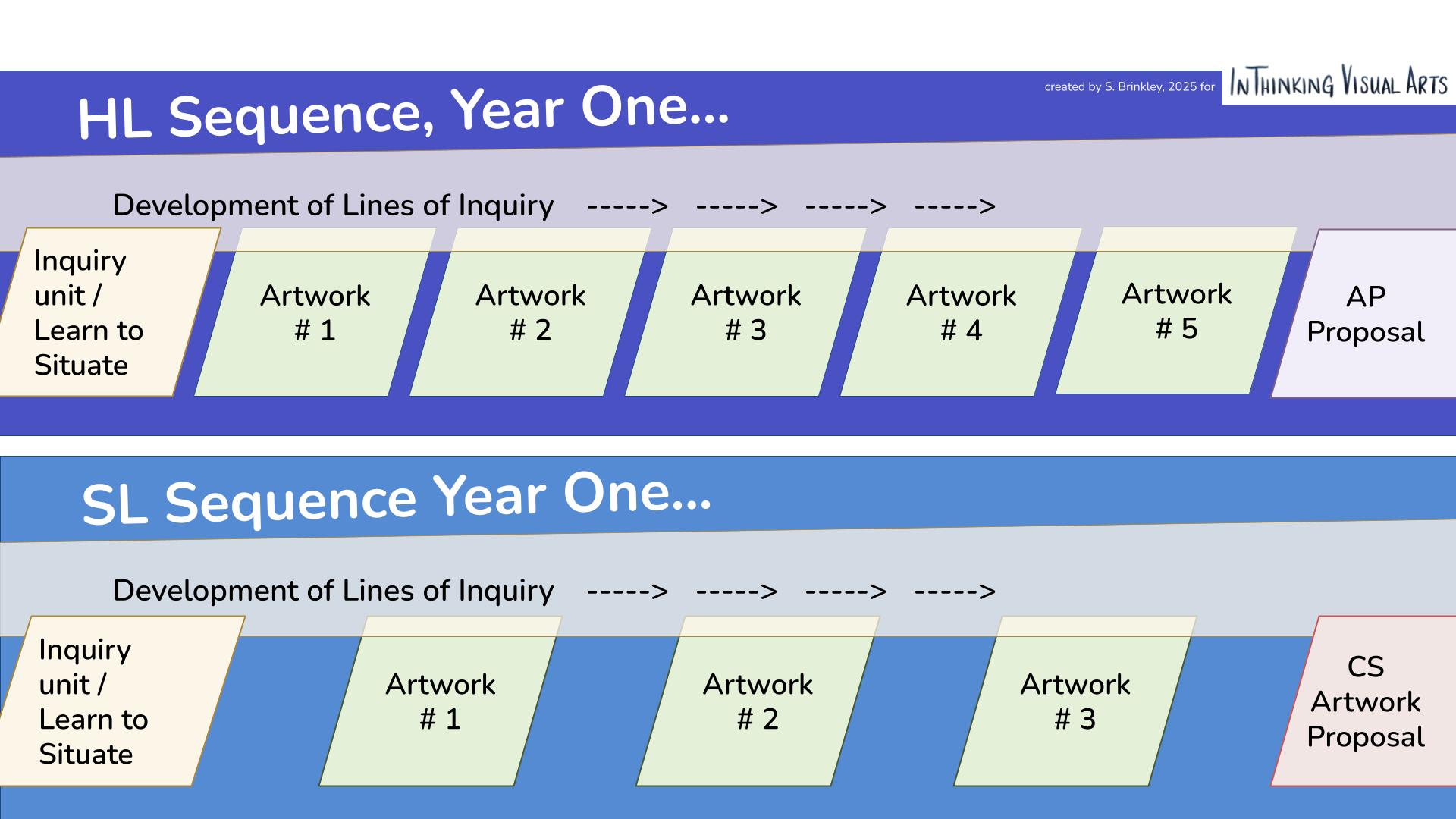
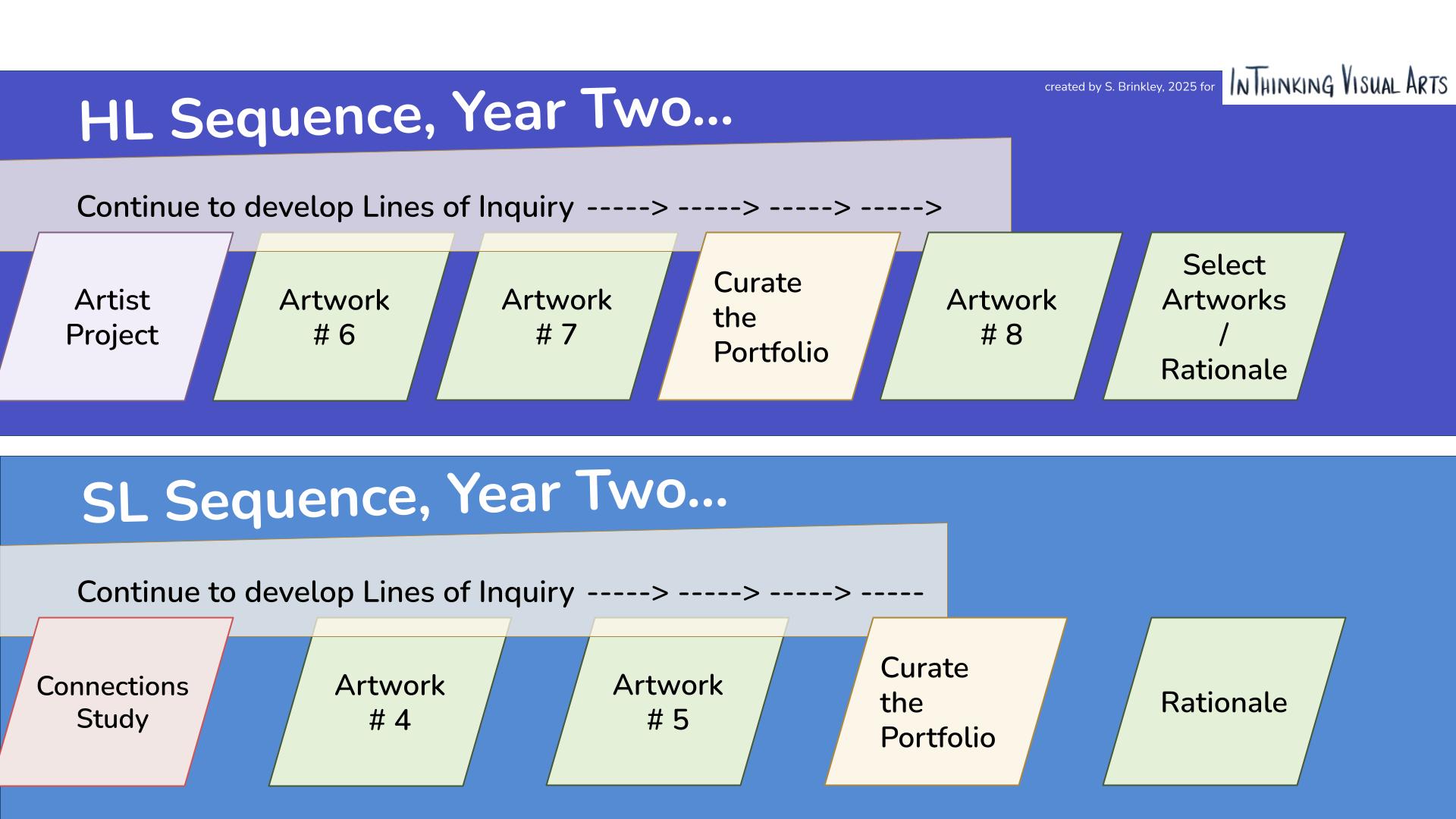
The guide does not impose nor suggest a format for structuring the course, but of course a framework is a helpful place to start. The images below offer one possibility for sequencing the course. These graphics do not quantify time, in order to offer a flexible format for teachers from a variety of institutions with consideration of calendars (trimesters, semesters, quarters), length of holidays, and unique circumstances. The range of abilities of students, class sizes, and types of studio spaces available may also impact the speed with which you're able to approach individual units. Therefore, please use these graphics merely as a starting point for your own course - take or leave what might not fit for your particular school or group of students.
YOUR TURN
We have prepared two editable/downloadable PDFs to help you 1) take stock of the resources, activities, and units you can repurpose in this curriculum and 2) to help you outline the two-year course.
Adapting Content: This has been designed for teachers who taught the previous syllabus. Use the left column to take note of what you've previously develop according to the old tasks, and use the space on the right to think about how to adjust this material for students who will be examined in 2027 and onwards.
Year Planner: Customise the top row with the months of the year your school is in session. The year planner looks different in year one from year two. Year One focuses on the three core areas of Creating, Connectiong and Communicating, while page two/Year Two addresses the assessment tasks.
We hope these PDFs can serve as a useful starting point as you prepare to teach the course in the years to come!
References:
Windows (c. 1952) by Charles Sheeler, Oil on Canvas. Hirschl and Adler Galleries, New York. https://www.artchive.com/artwork/windows-charles-sheeler-c-1952/
Overseas Highway (1940)byRalston Crawford, Lithograph. Amon Carter Museum of American Art, Fort Worth, Texas. https://www.cartermuseum.org/collection/overseas-highway-198645