Eve, Artist Project (HL)
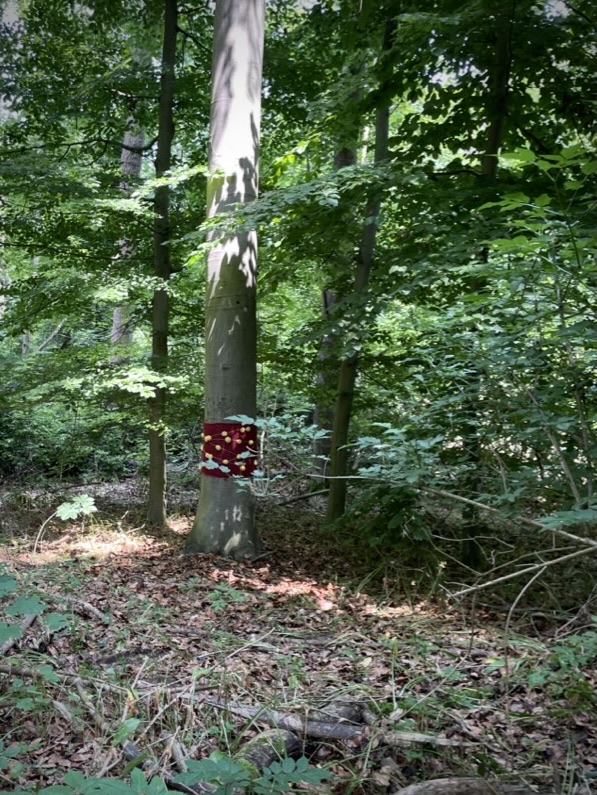
This mock sample of the Artist Project features artwork by a recent IB graduate, Eve, who undertook the task in collaboration with InThinking. To situate her artistic practice, the ecofeminism movement served as a starting point for her proposal. After making connections to two different fiber installation artists, Edith Meussnier and Cecilia Vicuña, Eve undertook peer feedback, implemented her project in a local forest, and developed ideas for future work following her project evaluation.
These sample slides were developed by Eve and InThinking authors to create a mock sample in accordance with the criteria and expectations of the new Visual Arts syllabus. Find an overview of The Artist Project here and for assessment details and rubrics go to Artist Project (HL) Assessment page.
How are the criteria addressed?
There are 6 criteria for the Artist Project, which should be addressed in distinct sections through either a slideshow or a video. Below, we will present the first slide of each section/criterion to help you understand how this looks at a glance.
A. Proposal (screens)
B. Connections (screens)
C. Dialogues (screens)
D. Curation and Realization in Context (video + text file)
E. Post-Production Evaluation (screens)
F. Future Development (screen)
Proposal, Criterion A
- up to 3 screens, 500-word maximum
Eve's previous interest in working with textiles and her interests in feminism served as a starting point for her work. In some initial research and planning, she uncovered the ecofeminism movement. This helped her to select a potential site in a local forest, after which she established both technical and conceptual intentions.
One of the aims of the proposal is for students to situate their work within their chosen context. This is not limited to just physical spaces, but should also include the time in which the artwork is developed. In a second strand of the proposal, as students develop an awareness of their chosen context, they may possibly investigate personal, local and/or global experiences, issues, memories, or settings. In the case of Eve's work, research into local politics, global women's issues, and the history and recent changes of local forest environment helped get her AP off the ground.
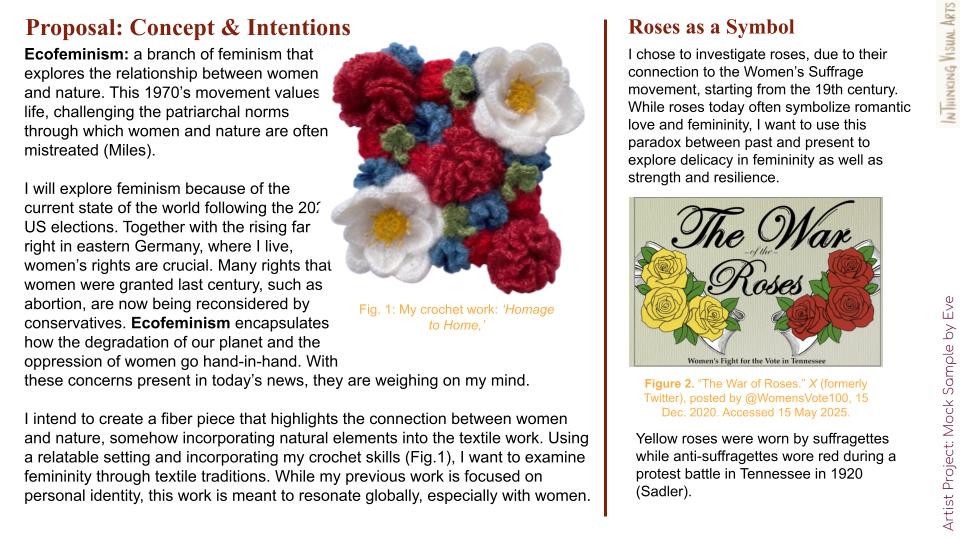
*Featured above is a snapshot from the first of three screens from Criterion A.
Connections, Criterion B
- up to 4 screens, 1,000-word maximum
The proposal set up Eve to understand which kinds of artists she'd like to research more. Prior to the Artist Project, she had researched artists like Andy Goldsworthy, Faith Wilding, and El Anatsui, but she felt these artists didn't offer enough material for her to build connections to her ideas of ecofeminism. In her quest for connecting artists, she uncovered a Yugoslovian artist, Draga Šušanj, however she quickly found there wasn't enough information about her to conduct a quality investigation. Finally, the work of two more widely known artists, Cecilia Vicuña and Edith Meusnier, spoke to Eve's interest in both fiber arts and installation art and enabled her to make meaningful connections.
With ample sources explaining and evaluating two artworks by two different artists, Eve was able to develop a thorough analysis of the artists and to better understand the cultural significance of their work.
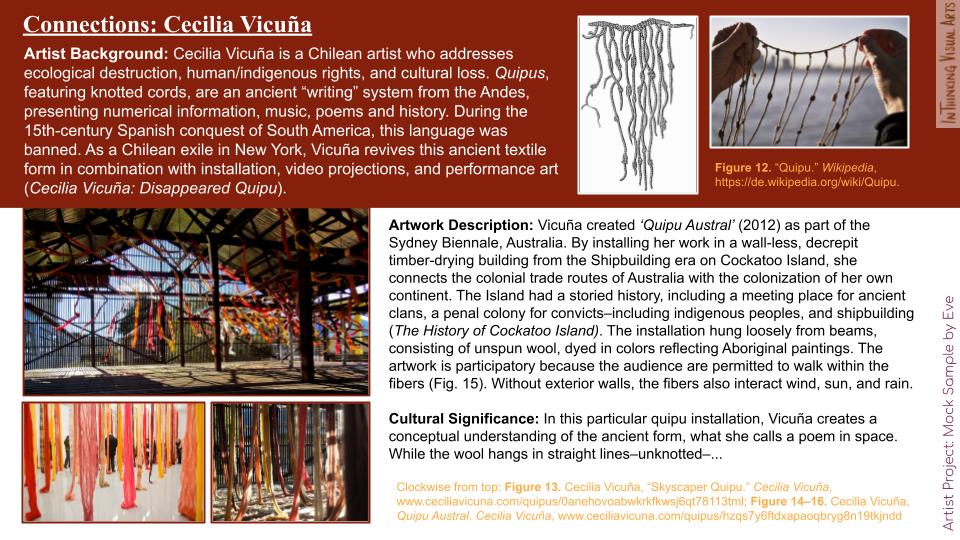
*Featured above is a snapshot from the first of 4 screens from Criterion B.
Dialogues, Criterion C
- up to 2 screens, 500-word maximum
Eve documented the questions posed and responses received following two different discussions with IB Visual Arts teachers and her art peers. She collated this data and reflected upon the answers and insights that were offered. The feedback she received from these critical dialogues enabled her to rethink her project and to adjust some of her plans in consideration of her context and audience. Visual evidence, such as process photos and new mock up sketches, enabled her to elaborate her ideas in consideration of the word limit.
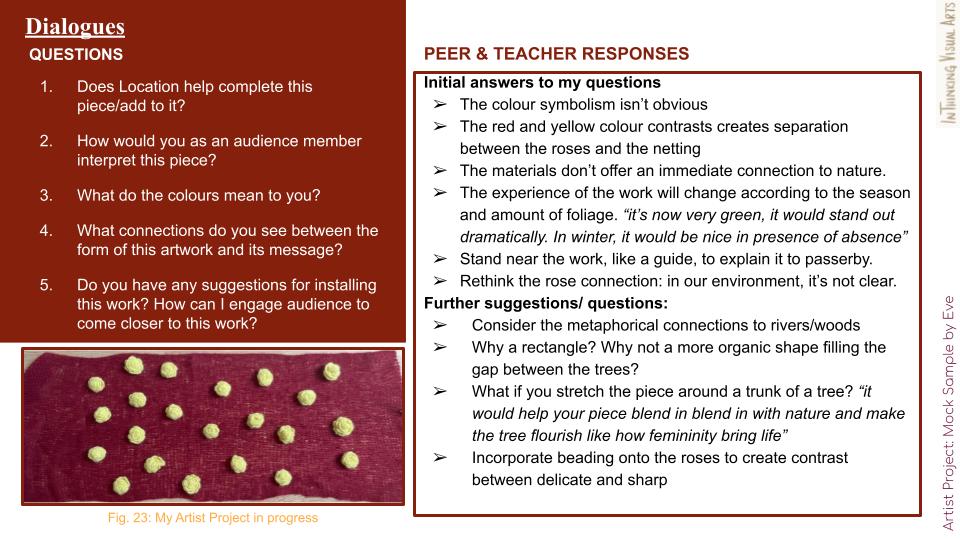
*Featured above is a snapshot from the first of 2 screens from Criterion C.
Curation & Realization in Context, Criterion D
- Video documentation of the work, 3-minute maximum
- Text file describing/situating the work, 100-word maximum
The execution of Eve's work (which she discusses later) allowed for her to realize her intentions with some consideration of context and audience. The video captures the artwork in context, and even includes the element of a viewer. The artwork starts to demonstrate how it might meaningfully communicate with audience, and there is some synthesis between concept and form, however this could be strengthened. The text also begins to address some of these ideas, but there are some gaps between the ideas shared and the work as presented.
Post-Production Evaluation, Criterion E
- up to 2 screens, 300-word maximum
The student actively evaluates aspects of the work she wishes she'd reconsidered prior to realizing her work. Namely, mentions how visiting the site once more, prior to finalizing the work, would have allowed for her to recognize some potential challenges and new ways of thinking about the work. In this evaluation, she addresses how the work was situated, the role of the audience, and how she navigated the limitations of her project's location, off the beaten path.
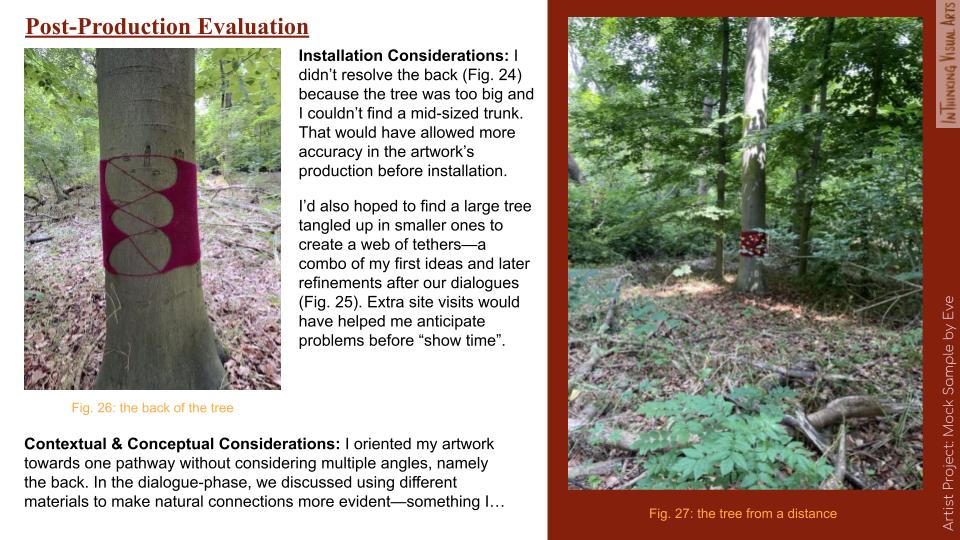
*Featured above is a snapshot from the first of two screens from Criterion E.
Future Development, Criterion F
- up to 1 screen, 200-word maximum
Eve wraps up her project with some engaging and creative new directions. What's notable is that she made clear links to the evaluation of the project (Criterion E), using her self-critique from the previous step as a starting point for new ideas. Through this final slide, Eve culminates her project, while also leaving space for this experience to inform future artistic endeavors.
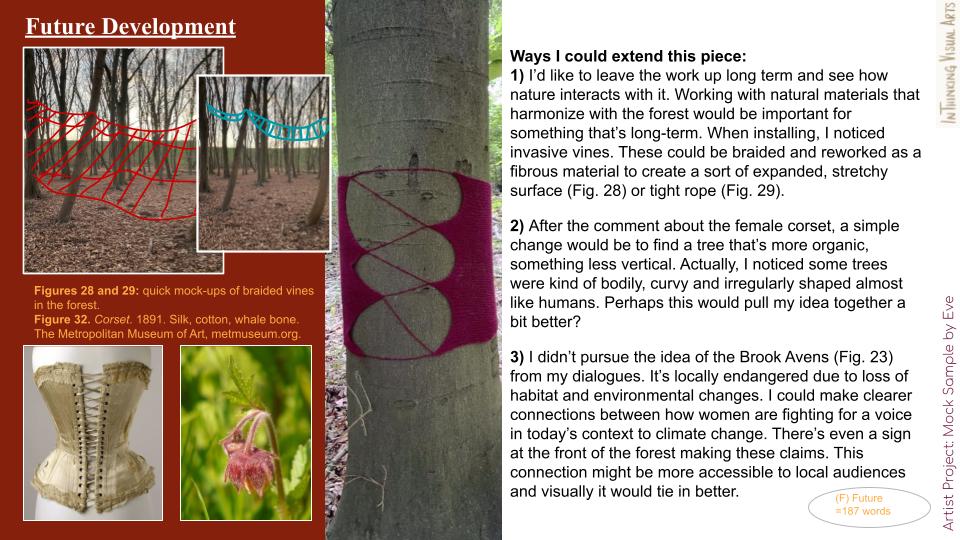
*Featured above is the only screen from Criterion F (from a 1-screen maximum).
⬇️ View a discussion of Eve's AP ⬇️ where Shannon goes through each criterion, offering feedback and insights
Insights: Eve's Sample AP
There are many insights to be gleaned from Eve's mock AP sample. Not only do we offer a behind-the-scenes view of some of her planning methods and intentions throughout the process, but we also provide...
Further Notes
About this Mock Sample: The Artist Project is a very new element in IB Visual Arts and has not previously been examined. While this sample was created to give a glimpse at what high-quality work might look like, this is a constructed sample, and the work has not been evaluated. Please keep this in mind when reviewing this sample.
Formatting & Word Counts: It is not required to list the word count on every slide; however, the student should take care to meet the word counts within each section and criteria. Artwork labels and citations are not included in the word count. The font Arial, 12 point, was used in this example.
Design: Students are not evaluated explicitly on the design of their Artist Project. However, by having a clean, simple and engaging design, students can signal and communicate their ideas more effectively. A light background with dark text gives the best contrast for reading.
Download:
- A combined PDF of the entire slideshow is available here for download: Sample Artist Project Eve.
- Criterion D text (100-word artwork statement)
- List of Works Cited
Thank you to Eve for her contributions!