Texts for HL Artworks
HL students will write short texts to accompany each of the five Selected Resolved Artworks, in addition to the Rationale. These texts are an opportunity for your to clarify your intentions and to situate individual artworks. You can explain artistic influences, as well as how materials, techniques, aesthetics, style, and concepts are utilized to communicate meaning. These texts can support and clarify visual details or conceptual choices that might not be immediately evident to the viewer.
Artwork Texts for HL students
Requirements | 1,000 maximum words total (for 5 artworks) approximately 200 words per text, but these can be distributed at your discretion |
Formatting | Submitted digitally within a screen-based document, in which you will also share your Rationale, 5 artwork images, a selection chart of the 5 “selected” pieces and 3 additional works. The individual artwork texts should accompany the information and artwork image (1 screen per 5 artworks). 12-point font recommended |
Artwork Information | Title, medium, size* per artwork (this does not have a word limit) *for durational artworks, the size is the length of the artwork (00m00s). |
Language | Use subject-specific language to assist you in being concise and specific. |
A Real World Example
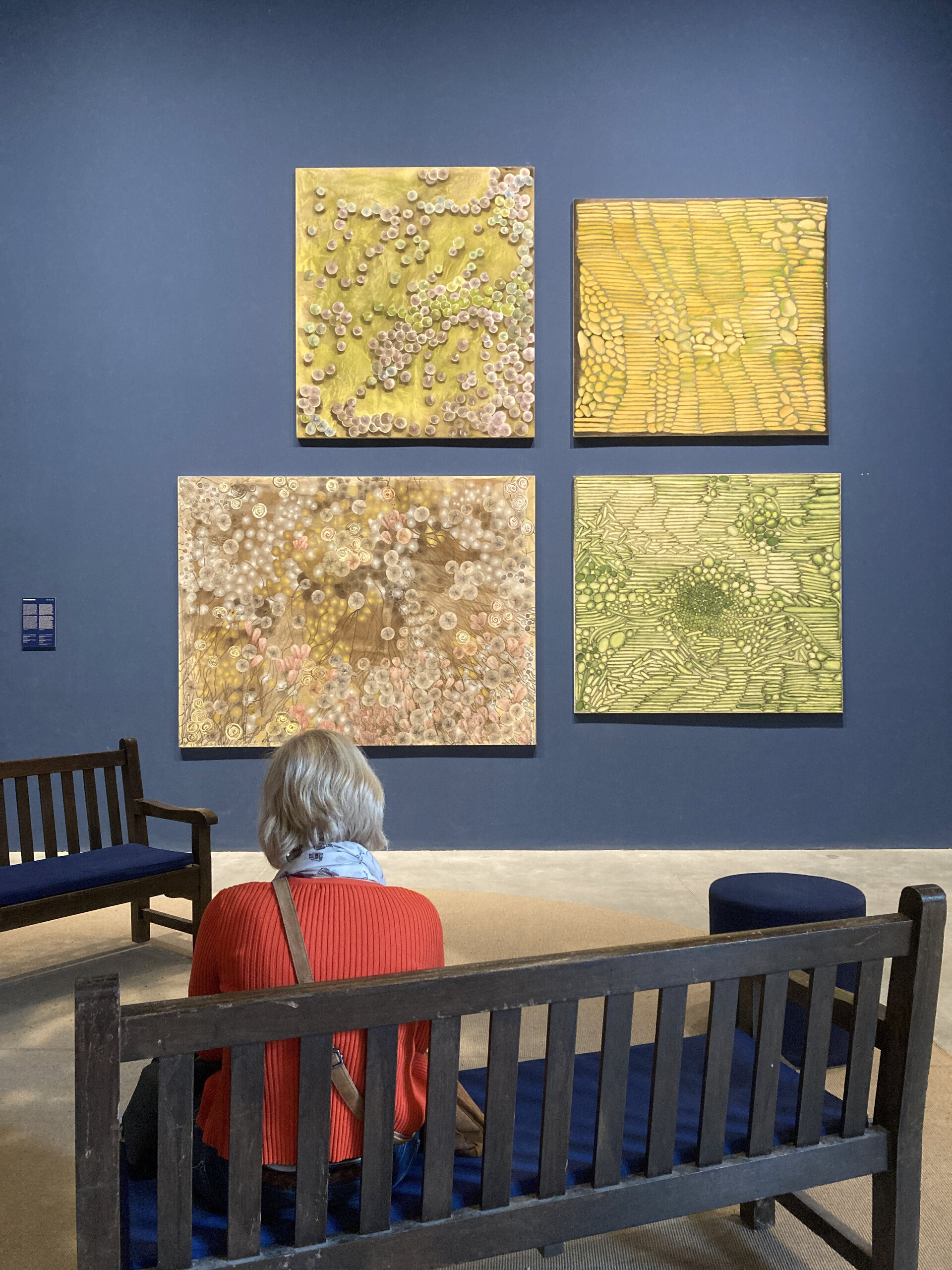
In the image to the left, you see an audience member contemplating a set of four paintings on display by Hala Schoukair at the Venice Biennale.
You'll notice a small wall text on the left, which helps to explain Schoukair's artistic intentions. The text illuminates the visual connections between her work as a fiber artist and painter, and how her childhood experiences in Lebanon's countryside were used as a premise for her botanical-inspired artworks made around the time of her return to her home country during the Covid-19 pandemic.
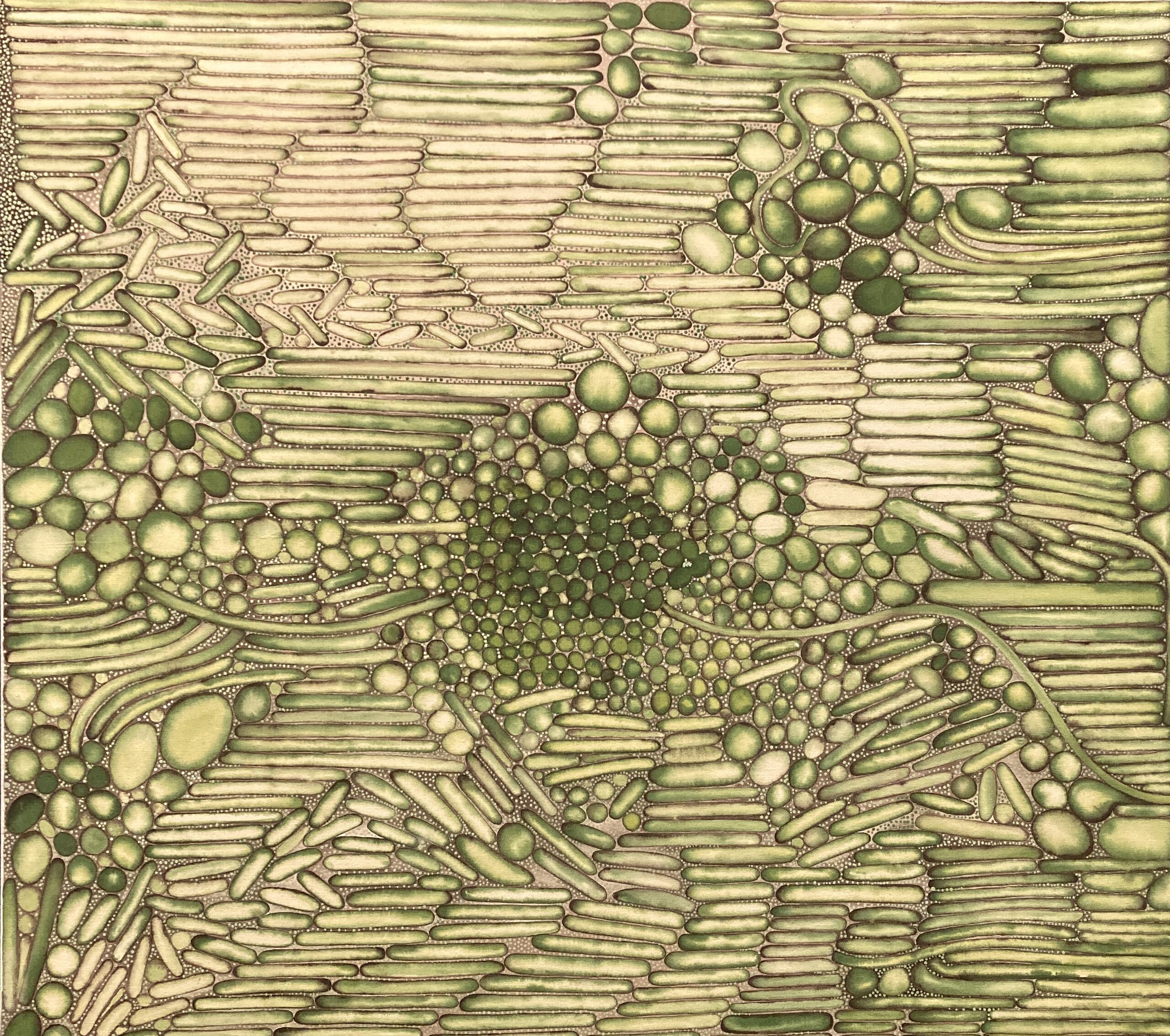
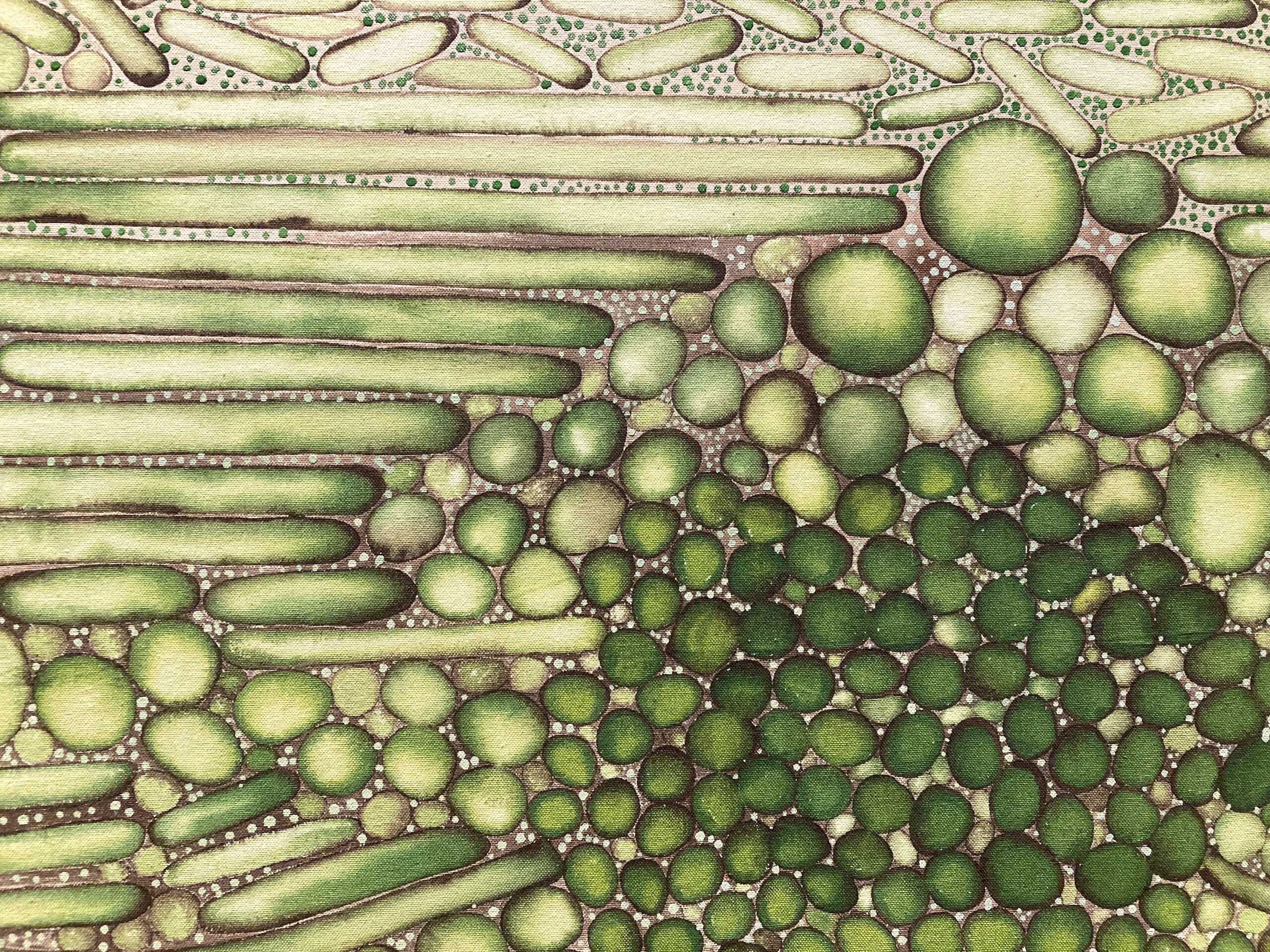
Here's a detail of her work “Untitled (from the Affirmative Happiness of a Green Dot),” 2023:
What do we mean by intentions?
Each individual artwork text can provide information that might not be readily deducible from the photograph; perhaps your intentions in creating it, any significant influences, how you've situated the work, if it is part of a series, or if there are nuanced materials or concepts that might not be easily understood by viewers and the examiner.
In relation to your Rationale…
You will use your 700-word written Rationale to tie together your selection of five pieces from a larger body of work, address how the body of work coheres across the five pieces, and to situate your artworks in relation to one another and within a broader artistic context. However, the Rationale alone does not give you enough space to fully develop your critical analysis, situate your individual artworks, or explain more specific intentions for each work. Therefore, the individual artworks texts play an important role.
Click on the + symbol to the right (above) to read more about the criteria applications.
Example 1
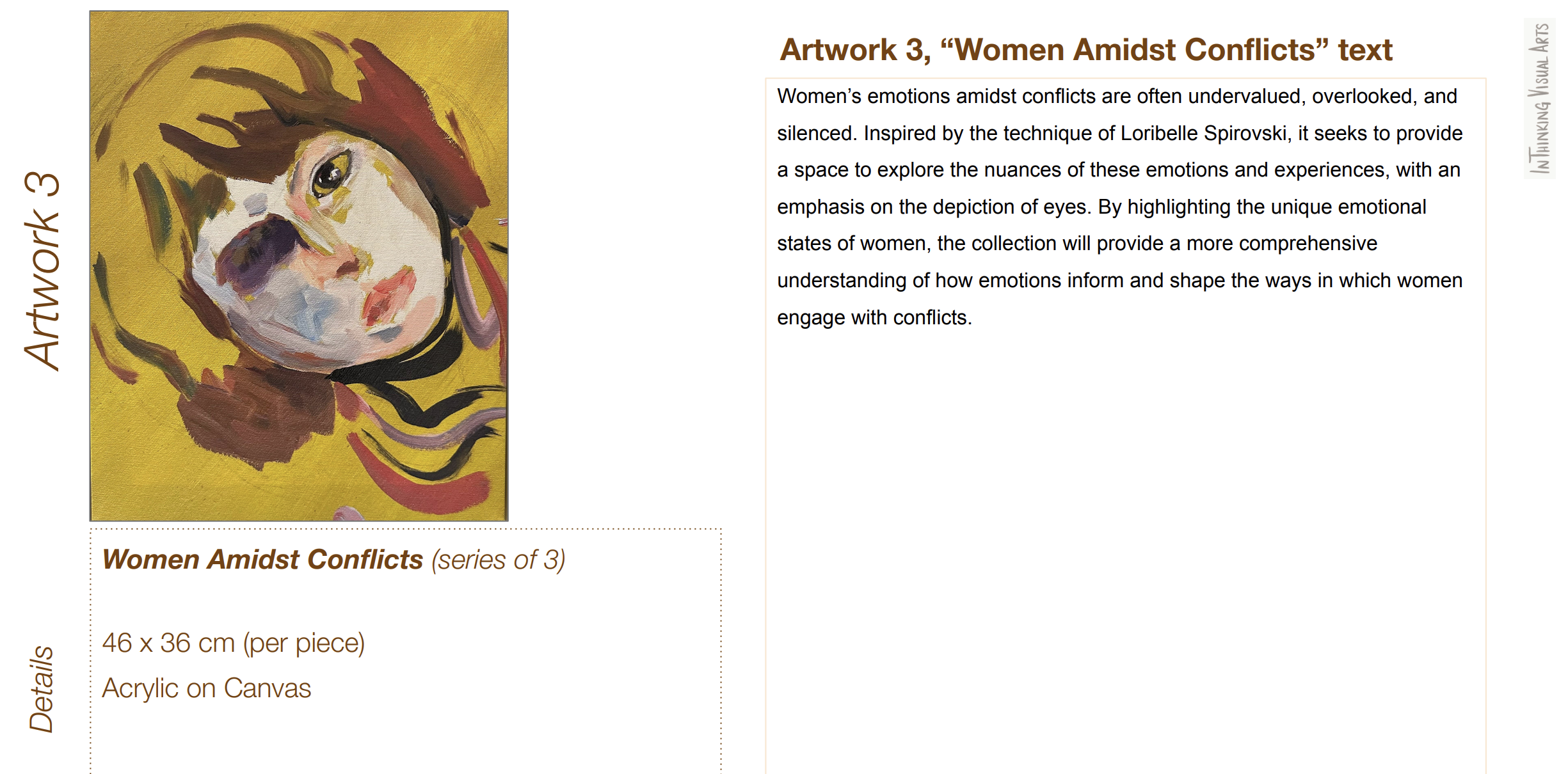
Here is one of Licca's Selected Resolved Artworks, HL Artwork texts:
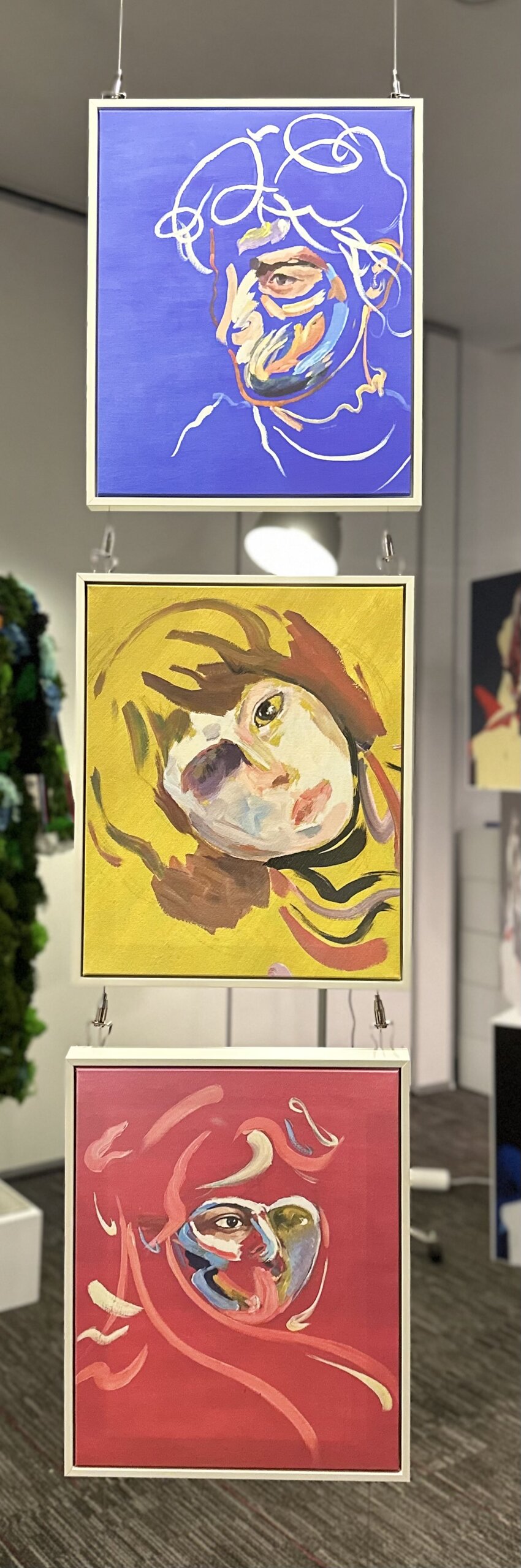
How could Licca improve her text?
Licca's text is only 70 words long, meaning that she has space to develop her text in more detail. Since she has up to 200 words to explain herself, she could go into more detail about Spirovski's technqiues and why this artist, in particular, was influential. She could also contextualize this artwork within the broader body of works she's explored.
To the left, you can see the full series of work chosen by Licca, where you can appreciate that her one artwork is a part of a three-part series. Licca could expand to provide further information as to why a series and this painterly style combine together with her conceptual interests in women, emotions, and conflict.
Guiding Questions
Some guiding questions you can keep in mind as you write your texts include:
- What is the main idea or goal behind my work?
- Were there any artistic or outside influences that impacted my idea or design?
- How did my material or technical choices help me to express my main idea?
- What visual subject matter, aesthetics or stylistic choices did I use to help me express my idea?
Your HL students are writing their text “intentions” on screen next to an image of their work. While they may have multiple images to show, within the Template IB has shared, students will include one image per slide per artwork. This allows the examiner to review the text in connection with each artwork without having to constantly flip back and forth between windows on their computer.
The examiner will be able to view the original files submitted on IBIS (one required, two optional, per artwork) in order to appreciate the artwork details in full.
Example 2
Below is an example of a piece with a resolved artwork text by Andrea. You can see how helpful the text is in communicating her intentions and in clarifying the materials used.
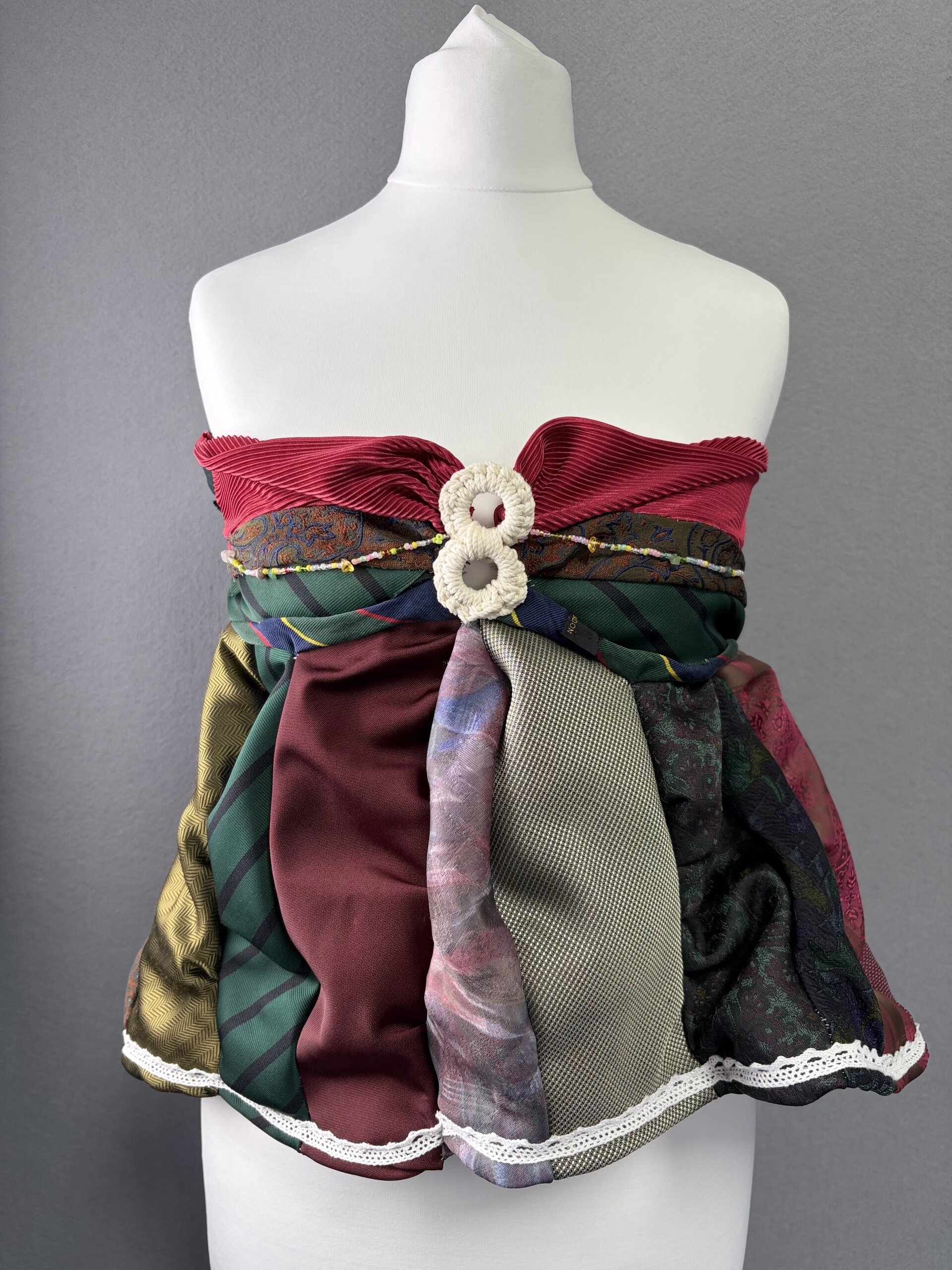
Title: Textured Tied Top
Materials: Cotton/polyester/satin ties, cotton string, wooden hoop with rope, plastic beads, and velvet felt additives
Size: 38 x 35 x 34cm
Text: Textured Tied Top up-cycles neckties to highlight the relationship between movement and volume. The open-back construction and layered ties produce different responses to airflow and body movement. The insulating ties, bordering the fluid satin opening of the back, enhance their respective textures as they visually shock when pushed by a force. Post-impressionist artists, like Van Gogh, were an important influence. Their works went beyond the classic art realism conventions, inspiring me to incorporate this concept of subverting conventions. My sub-theme of upcycling defies art conventions by referencing late 20th-century fashion, while shifting material’s perceived textures. By combining modern ties and beadwork with 18th-century construction, I push texture and the original purpose of the object, to the point that the ties are not easily unidentifiable. I want audience to identify the reused objects and realize how their original features can be completely distorted. (142 words)
How to Define “the Medium”
Have you explored more than one medium in an artwork? If so, you will need to list all of the different materials used. A classic mistake is to simply write “Mixed Media” which means that you don't share with the examiner all of the different materials you've explored and added to your work. Why not give yourself more credit?!
Describe the Medium
When labeling work, state precisely what some of these mixed media are. Alina's text below gives an excellent example, as does Andrea's text above.
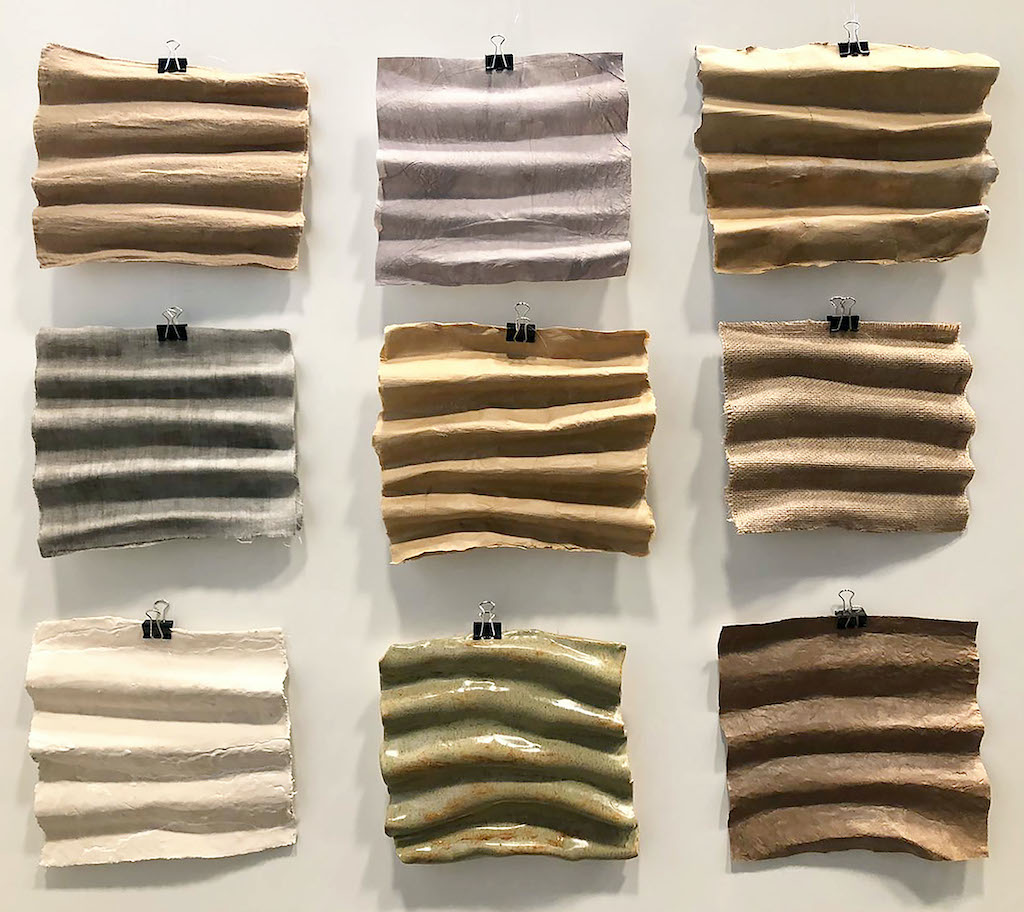
Title: Sand ripples (series)
Materials: Left to right: gauze and PVA glue; HDPE plastic bags; cardboard on watercolor paper; linen and PVA glue; packaging paper on watercolor paper; hessian and acrylic medium; plaster cloth, plaster of paris, and acrylic paint; clay and glaze; LDPE plastic grocery bags
Size: Each approx. 23 x 25 cm, 9 units total
Text: Ripples marks are an incredible form of self-organization, made by the motion of individual sand grains that accumulate into distinctive patterns. I have taken this form and replicated it multiple times each in a different material, changing how we perceive it. There are multiple possibilities of the sequence in which they can be arranged in, and there is the potential of continuing to make more. Each ripple piece can be viewed in a part/whole relationship; by itself or compared against others.
Found Objects/ Ready-mades
If you have created work made from a mix of your own constructions and found objects, then you should state whether objects are self-made, found, or purchased, under "medium" in exhibition text. Andrea's example above about repurposing ties is an excellent example.
Confused about collage?
Check out Referencing Collage Sources
Create an Artwork Gallery
As you make and resolve your artworks, it is a good idea to write the texts, measure and title the work, and document all the materials you've used. It's possible your teacher will even require this as a part of your ongoing Visual Arts projects.
Use our  HL Artworks Gallery template to align the resolved artworks with your texts. We've created it as a word document as this is easier for tracking the word count. You can repurpose these materials as part of the required IB template for submission at the end of Year 2 in the required screen-based format.
Anonymising work
For what concerns anonymising the work, the IB is asking not to include details such as the candidate name and school name on the actual work. The system links the candidate’s work to his/her name, but examiners do not see this. There will be no penalty applied if the details are shown, but the IB aims at avoiding bias as much as possible.
Further Reading
You can see more examples of Licca's five artwork texts in the first resource below:
Licca, Selected Resolved Artworks, HL
This mock sample of HL Selected Resolved Artworks explores the consequences of conflicts on individuals and communities, based on work by the student Licca. Here you will find an overview of the presentation...
HL: Structuring the Rationale
The HL Rationale supports the Selected Resolved Artworks as a justification for the choice of 5 resolved artworks from a body of 8 work. In this writing, you will discuss your intentions, sharing how...
IA Crit D: Understanding of Artistic Context HL
This page looks at the role of understanding context in the HL only Selected Resolved Artworks, and clarifies and breaks down what context means.