Curating your AIP
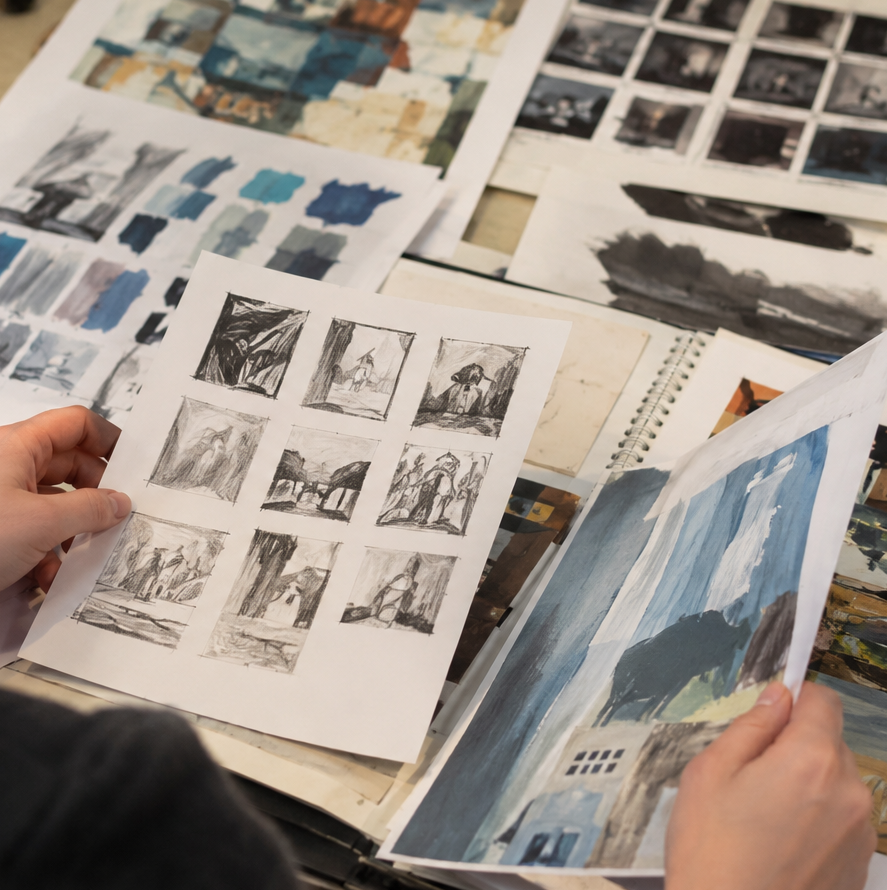
In the second year of IB, after reviewing the inquiries, explorations, investigations, and critical thinking you've developed in the course, you will curate your strongest examples of evidence to share in the Art-making Inquiries Portfolio. This page will help you to understand which evidence to prioritize, with guiding questions to help you select evidence and communicate your journey through an organized format.
The Art-making Inquiry Portfolio is a slide-based document that shares your artistic journey in Visual Arts. As such, it should be curated to present the clearest most engaging version of the path travelled.
Curating means taking care and paying attention to the selection, organization, and presentation of the material.

In the example slide seen to the left, you'll notice that there is a mixture of typed text, scanned sketchbook pages, source images, experiments, and even an artwork inspiration with a citation.
How you organize your evidence will be very specific to YOUR journey and there isn't a one-size-fits all way to do this. In the sections below, we'll call attention to some key points and some options you might consider as you begin to select and organize your evidence.
Essential requirements & recommendations:
Screens & Word Counts:
| Legibility & Design:
|
Quantity of Art-making Forms:
| |
Quantity of Projects:
| Quantity of Inquiry Questions or Statements:
|
Academic Integrity:
| Anonymize your work:
|
Step 1: Review your evidence
Look through ALL of the exploratory, process work you've created since the start of IB Visual Arts. Here's are several types of evidence you might have generated in your Visual Journal, digitally, or through hands-on experiments:
| process photos of hands-on work at different stages | screenshots of digital processes at different stages | photo contact sheets | preparatory / planning sketches | artworks you never resolved |
| brainstorms or lists | 3d maquettes | thumbnail / compositional sketches | direct copies of an artist's work to learn a technique or skill | discussions of changes in direction |
| inquiry questions | changes in direction seen in process photos/screen- shots | installation trials | generative statements | annotations synthesizing your artist investigations |
| explorations with creative strategies | explorations with style | practical investigations into an artist's concepts | experiments with various materials | short reflections evidencing refinements |
| 2d mock-ups | practice with artist's techniques, composition or style | source images (your own) | source images (others' work acknowledged) | annotations of your intentions |
Step 2: DO
Select your best and most relevant evidence
Use these guiding questions to start sorting through and selecting your materials. As you start to “answer” these questions, set these materials to the side (or make note of them) to consider for inclusion:
- Were there any inquiries that built upon one another?
- Two connected projects?
- A material that you continued to investigate over time?
- A concept that you explored more than once?
- An artist who informed multiple investigations?
- Were there specific inquiry questions or generative statements explored more than once?
- What connections do you see between different inquiries?
- Possibly, these are part of the same “line of inquiry.”
- Which examples of your explorations and experiments show development of your style?
- The IB calls this “visual language”
- Which were your most meaningful experiences with different art-making forms and creative strategies?
- Make sure that you have more than one art-making form and more than one creative strategy to showcase
- Which evidence most meaningfully expresses your intentions?
- Which evidence shows a journey of meaningful changes in direction or small, but crucial refinements?
- Which art-making projects or inquiries show substantial evidence across multiple criteria?
A further note on selecting evidence
The questions above address many elements of the assessment criteria, with a goal to connect multiple criteria at once. However, you may also find it helpful to review the AIP assessment criteria to make sure they are all addressed in the overall submission.
To review how the different criteria align to your evidence, look through our process checklist, which organizes evidence into different criteria.  Download the Visual Journal Process Checklist here..
Curating your Evidence
When choosing which evidence and projects will go in the AIP do not include everything. Select the work that is most meaningful and most important in your artistic development, and that shows your skills.
The Inquiry Portfolio is about presenting the path that you have travelled during the course and is not a post-production narrative. Breadth and depth are crucial in the AIP. This means that you will want to show some range of experiences in the Visual Arts course, while also focusing upon a few deeper investigations into a material, artist or inquiry.
Step 3: Don't
Work to modify excessive or cut irrelevant materials from your AIP
To better understand what IS strong, relevant evidence, it's sometimes helpful to also know what may not be relevant. There is a long list for you to view, so click on the EYE icon to read more below:
- Pre-IB Summer work or work from before your IB course began
- Do not include older work from before IB Art. The evidence in your AIP should be made during the 2-year course
- Some classwork may not be relevant to the task
- Teachers often incorporate foundation-building activities, helping you to: build art-specific vocabulary or art history, visit museums or galleries, improve your reflection skills, practice techniques, and more. Do not include materials unless they contributed meaningfully to your process and connect to the assessment criteria.
- Wordy mind-maps or brainstorms
- Don't include long, wordy pages; instead, select excerpts that are relevant to your project.
- Disconnected thumbnail sketches, media explorations, or artist investigations
- Don't include evidence of one-off ideas or experiences that don't meaningfully connect to other aspects of your art-making process.
- Biographical artist research and photos of the artist
- Don't include lengthy descriptions about an artist's background unless this connects to concepts (i.e. the artist explores culture in their artwork and has similar interests in identity to you).
- Photo collages or dense pages filled with inspiration images
- Don't include every image you discovered. You may have researched many images to influence your thinking, but you should curate, including only what is most relevant.
- Process photos with step-by-step instructions
- Don't include a how-to tutorial on how you made your artwork step by step. Often students create such tutorials, but this doesn't address the assessment criteria.
- Focus on including process photos that showcase defining moments (when you made decisions or changed direction) and refinements made to your work in progress (improving it) with annotations that justify these shifts and processes in connection with your artistic intentions.
- Full page reflections
- Don't include lengthy reflections. Criterion D is focused upon evidence of “decision-making and practical interventions"; therefore you should select the strongest excerpts that illuminate effective decision-making, explain interventions, and justify improvements when refining your work in connection with your artistic intentions.
Step 4: Collating & Organizing your Evidence
The best portfolios present a coherent organization, a sort of flow that is not necessarily chronological but reads as fluid. It's okay for you to rearrange your evidence to showcase projects that were connected due to similar materials, concepts, artists or inquiry connections.
How you choose to organize the work in your AIP will be VERY individual! You'll want to create pages that are legible to the examiner. They should be dynamic in showing visual evidence with brief annotations without overcrowding.
Below we share additional points to keep in mind as you call attention to your work and sources (click on the EYE underneath each heading):
Thoughtful Headings & Sub-Headings
In a few words, a heading can point to a main idea or key concept being explored within a screen. For example, at the start of a new inquiry, you might state “Inquiry into Blue” to signal the start of a new set of ideas. We recommend that you use specific subheadings, that are personal to YOUR inquiries, rather than simply using criteria. For example, the "Exploring Transformation" is much stronger than “Criterion A: Exploration & Experimentation."
In the past, students have often mislabelled their work or under-valued that a single exploration might be connected to multiple criteria. For example, a subheading called “Exploring Transformation” might show creative strategies applied to thumbnail sketches while also addressing an inquiry question at the same time. In the best work, students will often be showing work that reaches more than one criteria at a time.
Academic Honesty
Cite: Source Images, Artist Images, & Researched Ideas
Any information that is included on a slide of your AIP that is not your own should be acknowledged at the point-of-use (the page where the information is found), as well as in the bibliography. Some key points include:
- Cite the source images that inspired you, photos a friend may have taken (i.e. to help you make a self-portrait), used in collages, were directly copied in an artwork or exploration, or an inspirational artwork by an artist.
- Cite information that you looked up to help build your knowledge and understanding, such as: artist research, AI support, video tutorials, how-to pages, and books or articles.
- Artworks made by others should be referenced with an image label (title, artist, medium, date, URL).
Cite: Your Own Artworks & Images
If you include your own Resolved Artwork or took your own source images, you should state: “My Source Photo” or “My Resolved Artwork,” so that this is clear to the examiner.
Referencing in Visual Arts
How and when to reference, in text citation, image labels, list of sources and references in the assessed tasks.
Relevant Resources
Student Guide: Preparing the AIP
When you engage deliberately in IB Visual Arts, you will generate a lot of evidence! It is important to work strategically and to manage your time and the physical and digital materials that you produce....
Digitizing Evidence: Developing a Draft
During your first year, plan to keep track of your explorations and processes in one place, such as a slideshow. Here we offer some suggestions for how to effectively digitize and keep track of process-based...
Art Making Forms in the Inquiry Portfolio
SL and HL students work with (at least two) art-making forms in the Inquiry PortfolioIn the new Visual Arts curriculum, there is a minimum requirement of more than one art-making form to be addressed...
Creative Strategies
This image, Silver Eerie, by Maya Lin, is an example of an artist using de-contextualization as a creative strategy, in this case, removing recognizable geographical context to highlight pure form.
References
Student artwork page contributed by Nicola Shears at St Louis School in Milan
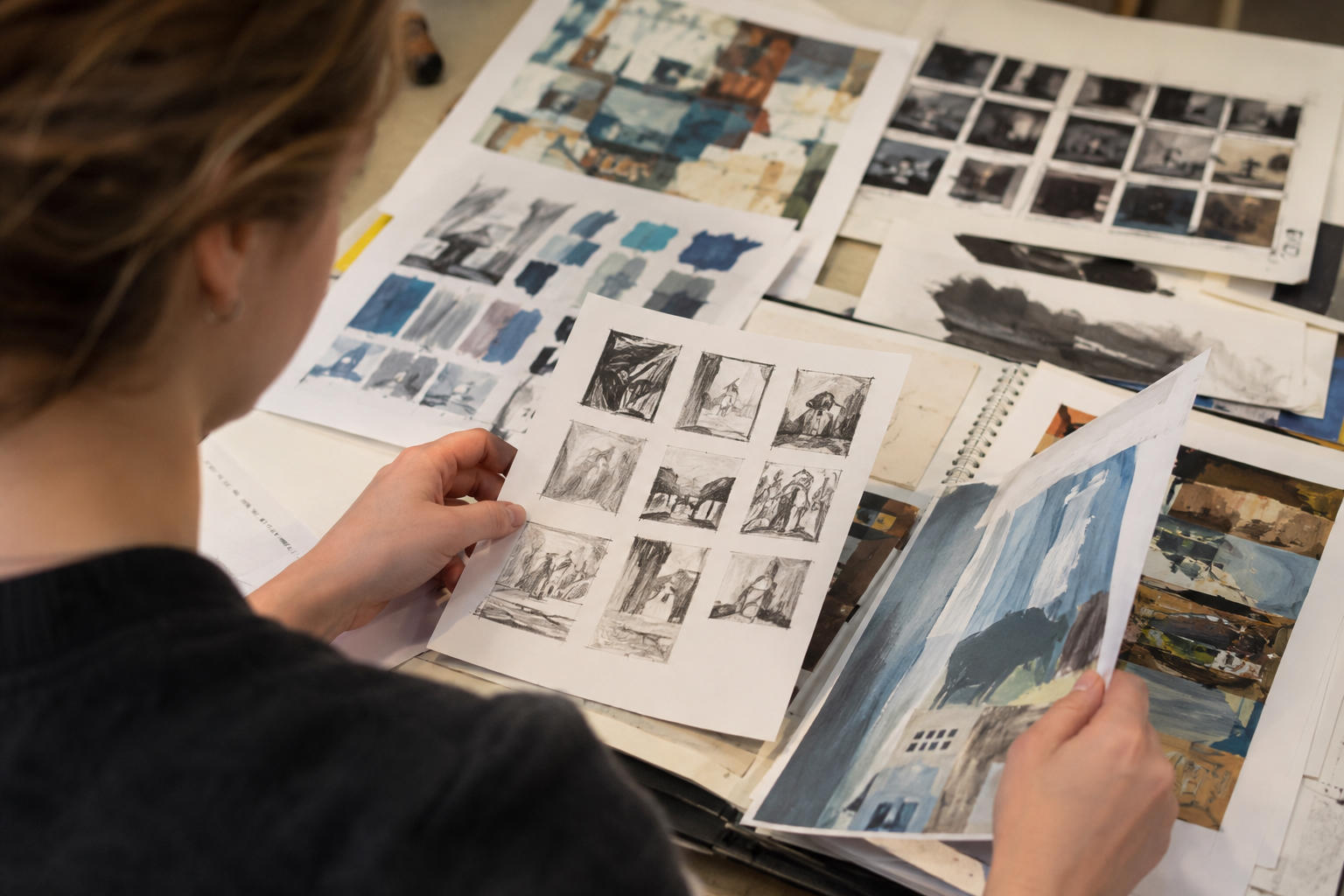
“Teenager Sorting Through Artistic Explorations.” ChatGPT, OpenAI, 6 Nov. 2026. AI-generated image.