Changes for first exams 2028

At the end of September, 2026, the IB quietly announced a minor revision to the course, including changes to the syllabus content and the data booklet. We summarize these changes here.
These changes apply for first exams 2028, which means that you should make sure students starting in Sept 2026 (but not those who started earlier) are aware of these changes. These changes are mostly small tweaks, but they do a good job of addressing small shortcomings and ambiguities in the course guide. We wouldn't be surprised to see several of these things on the examinations, eventually. Unless otherwise noted, all the changes affect both SL and HL.
Be sure to print out copies of the new data booklet (the new version is here, labelled “First examinations 2028, Version 1.0"). You can find a complete list of the changes in the appendices of the Course Guide (you may need to ask your DP coordinator for access to the Programme Resource Center on MyIB).
We get two additions to the Mathematics section of the data booklet:
- The data booklet finally has the equation for the area of a sphere, A=4\pi r^2.
- There is a set of equations for the percentage change, difference, error, and uncertainty. It's probably useful to be able to be able to use these terms precisely.
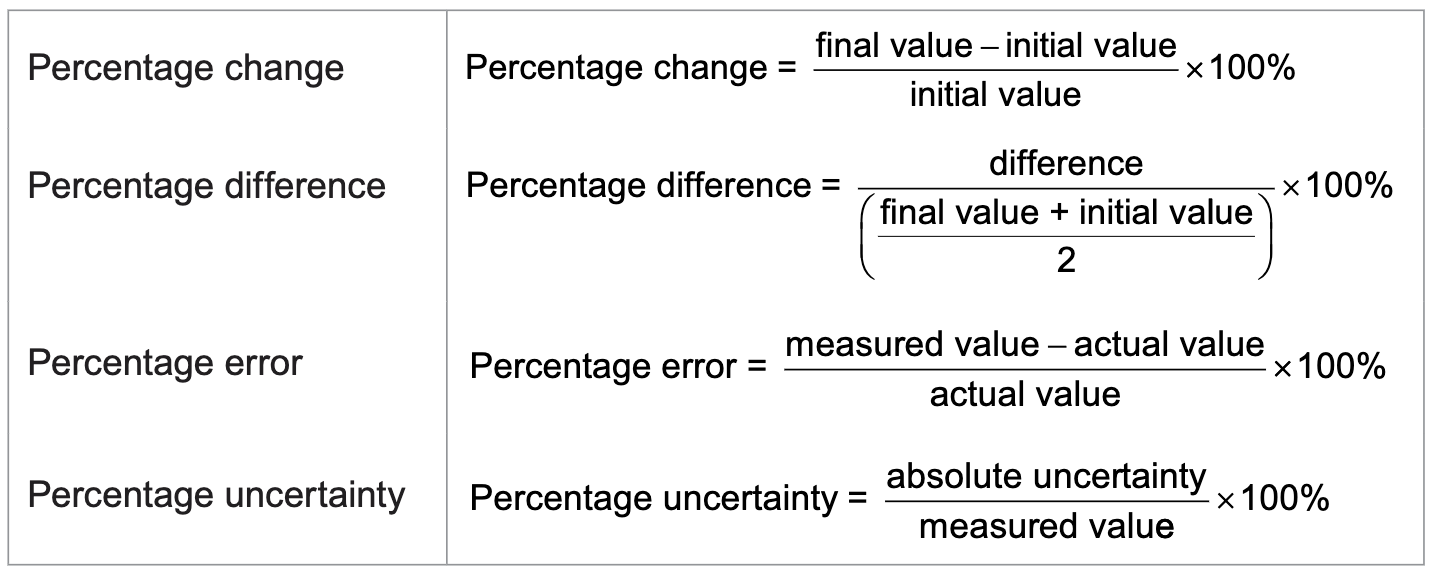
There are a few small changes in the syllabus content for Theme A, but nothing new.
- Motion with non-constant acceleration should be addressed qualitatively and graphically.
- Two edits for technical correctness: angular velocity is related to linear velocity (not speed) by v=\omega r, and work is equal to the change in kinetic energy (not total energy).
- Clarification that energy density is the energy per unit volume (i.e., J m-3).
There's a bit more here. Nothing outrageous, but a few new details that students will need to understand.
- The equation \overline{E_k}\,=\,\frac{3}{2}k_{B}\,T for the average kinetic energy of a molecule is specified only to apply to monatomic ideal gases. Students may need to include the word “monatomic” in exam answers, but it doesn't appear that they need to know any other applications (e.g., that the factor 5/3 is only for monatomic species in PV5/3 = constant).
- The term Intensity (symbol I, units W m-2, definition I=\frac{P}{A} in the data booklet) is introduced formally. It has the same meaning as brightness. Likewise, luminosity and radiated power are stated to be synonyms.
- The equation P=\frac13\rho v^2 is replaced with P=\frac13\rho v_{rms}^2, which is more accurate. In an ideal gas, the particles will have a distribution of velocities so what we want is a representative velocity, which is what the root mean squared (rms) velocity gives us. The average velocity is 0, since the particles will be moving in all directions.
We see two changes in waves, relating to the intensity-amplitude relationship and to standing waves. These seem motivated by exam-setting.
- Students must understand that the intensity of a wave is proportional to the square of the amplitude (I\propto A^2, this is not in the data booklet). This gives us a useful vertical axis for one- and two-slit interference pattern graphs. More poignantly for students, it may mean they will need to do some proportional reasoning when solving wave interference problems (e.g., waves with intensity I and 4I interfere, resulting in constructive interference with intensity 9A).
- For a half-open pipe, constructive interference is on the 1st, 3rd, 5th, etc harmonics. This is the definition of “harmonic” that follows from the math, where \lambda=\frac{4L}{n} where n=1,3,5\ldots, rather than the definition of “harmonic” that follows from enumerating the wavelengths that produced constructive interference.
Two additions, and one HL-only deletion (the only HL-only item that we've spotted). The additions give more scope for algebra-based exam problems.
- Students explicitly need to be able to deduce Kepler's 3rd Law using a force analysis. This is a pretty straightforward derivation, so probably helpful for students to be clear that they may need to reproduce it.
- The addition of a new formula, which closes a hole in the syllabus: the formula for the magnetic field strength near an infinite wire B=\frac{\mu_0 I}{2 \pi r}. This feels like an accidental omission from the 2025 syllabus, especially since we have the formula for the force between two parallel wires, which relies on this formula to derive. This is probably the most substantial addition, and we'll be making sure that our students see and study this relationship.
- [HL only] The concept of self-inductance has been removed. Its inclusion was likely a mistake, as it doesn't fit with the rest of the syllabus content.
There are three small additions here, usually already addressed by most of us, I would imagine.
- Students need to know about the existence of an attractive force that acts on protons and neutrons (the strong nuclear force). This force balances electrostatic repulsion between protons in nuclei, and has a short range of about 10-15 m. Apparently, only HL students need to know the specific number for the range.
- Students will need to explicitly calculate mass differences when they determine the energy released in nuclear processes. That's always an intermediate step, so I guess this is just saying that we should prepare to see exam questions about mass differences.
- Students need to understand the role of the Chandrasekhar and Oppenheimer-Volkoff limits in stellar evolution.