The joy of scientific exploration
My (Danny) DP2 students have completed their Scientific Investigation (the Internal Assessment, or IA) work, and I had meetings with them this past week to go over their draft reports. Some of the students opted for relatively standard apparatus (flying pig, friction of sandpaper, marble on a track), but others pulled together some things that felt fresh and creative:
- One student used laser diffraction pattern to measure the thickness of fishing line under different loads, and used that to estimate young's modulus for the fishing line.
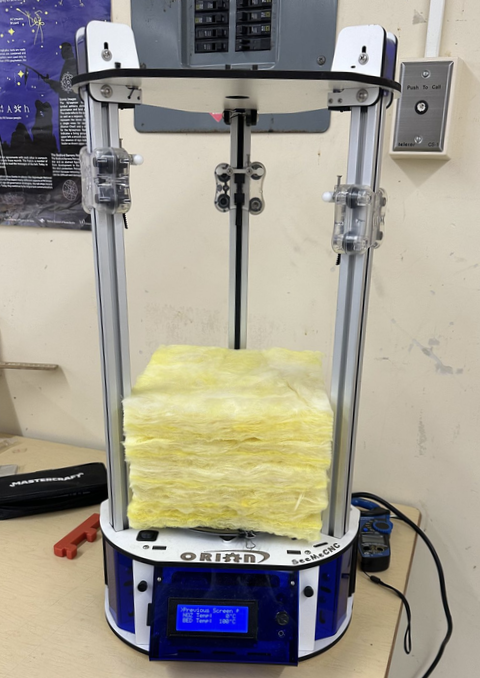
- Another student salvaged an old 3D printer with a heated print-bed (left), and investigated thermal energy transfers through layers of fibreglass insulation.
If you are starting your IAs soon, the Scientific investigation page for teachers and the Scientific Investigation page for students may be useful. I've recently created some new pages for Conclusions practice and Evaluation practice for students, too, since that often seems to be a challenge for them.
The AI models these days are very good about suggesting a comprehensive experimental procedure given limited prompting (from which range of variables to measure to how to linearize the graph), so in an effort to avoid some of the temptation to rely on those tools, I had my students design and conduct their experiments in class under tight supervision during class time. Since we did a practice run the previous week, and I gave them a generic checklist to follow (make a list of your variables; figure how to measure them; determine suitable range/repeats; etc), things went pretty smoothly in the lab.
Next up for these young physicists is a mad dash through themes D, E, and A.5, so you'll see some improvements made in the eBook and the Teach pages for those in the coming months.