Vera C. Rubin
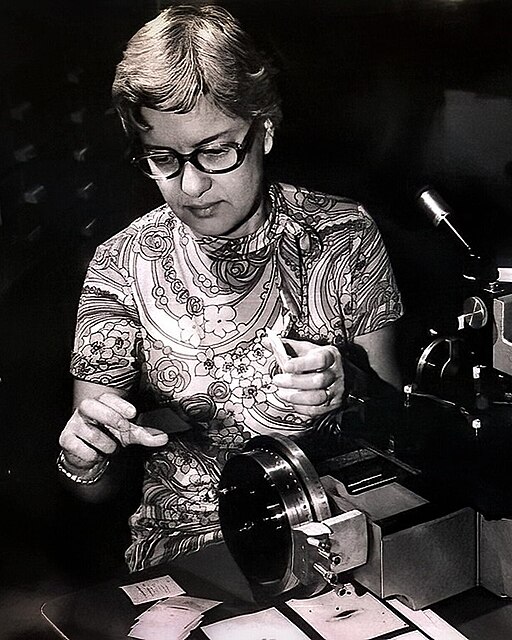
It's highly likely that you will have noticed remarkable new astronomical images from the recently inaugurated Vera C. Rubin Observatory appearing in the printed news media and online. This facility is named in recognition of one of the foremost astronomers of the last century, whose contribution to our understanding of the Universe has been compared to Copernicus in its profoundness.
Rubin was born in Philadelphia in 1928 to a family of Eastern European descent. Having moved to Washington, D.C. at a young age, where she developed an early interest in the night sky, she would go on to apply to study astronomy at university. Unfortunately, Princeton, her first port of call, proved rather fruitless on account of her being female. She eventually completed her undergraduate studies at Cornell under the guidance of luminaries such as Hans Bethe and Richard Feynman - an illustrious pattern in her tutelage that was to continue as her PhD at Georgetown was mentored by none other than George Gamow!
At Georgetown, she began research using the McDonald Observatory’s 82” telescope - something of a step up from the cardboard instrument she made with her father's assistance, as a child. Rubin ultimately joined the Carnegie Institute, where she became the first female astronomer to be “allowed” to use the famous Mount Palomar Observatory, after allegedly sticking a cardboard skirt onto the male figure on the door of the only toilet in the facility!
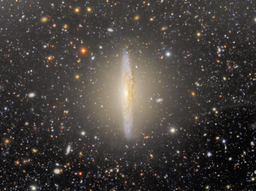
It was at the Carnegie Institute, where, using imaging techniques with much-improved sensitivity developed by her collaborator, the instrument maker Kent Ford, that she began her visible spectroscopic study of the rotation curves of galaxies. Back in the 1930s, the Swiss-American astronomer Fritz Zwicky, whilst applying the virial theorem (which relates the kinetic energy to the gravitational potential energy of a system) to clusters of galaxies, noticed a disparity between the amount of visible matter and their measured mass - most of which appeared to be missing! This “dark matter”, as it came to be known, was somewhat left on the “cosmological shelf” until Vera Rubin came along and questioned the hitherto assumption that the stuff orbiting around the centres of galaxies behaved according to the conventional Keplerian wisdom (i.e. that in a differentially rotating system, like a planetary system, celestial bodies orbit the centre of mass more slowly with increasing radial distance).
In a gravitational system where the origin of a centripetal force, of mass M, far exceeds that of an orbiting body separated by distance r, it can be shown that:
v = ✓(GM/r),
where v is the speed of a body in uniform circular motion and G is the universal gravitational constant. However, when Rubin came to plot the rotation curves (orbital speed as a function of radial distance) of a selection of spiral galaxies, like our own Milky Way and our relatively near neighbour the Andromeda Galaxy, she discovered that far from the orbital speed of the outermost stars dropping away, the curve remained flat, more reminiscent of “partially-rigid body” rotation. A vast halo of unseen matter provides the necessary centripetal force to hold the respective galaxies together. This is in accordance with the source of the net gravitational force on a point mass at some radius in a spherically symmetrical system originating within that radius. In fact, Rubin's investigations lead to the conclusion that the vast majority of galaxies are typically composed of matter where the non-luminous component far exceeds the visible "normal” matter.
Further investigation of galactic rotation curves by astronomers using radio telescopes to map the distribution of atomic hydrogen confirmed Rubin's suspicions, leading historically to the understanding of the nature of dark matter being one of the main ongoing problems in cosmology.
The tenacious brilliance of Rubin went beyond her work in consolidating the existence of dark matter through her controversial discovery of large-scale peculiar motion of certain galaxies: behaviour inconsistent with the net flow due to cosmological expansion. She also demonstrated the possibility of galactic mergers by her observations of counter-orbiting material in galactic discs.
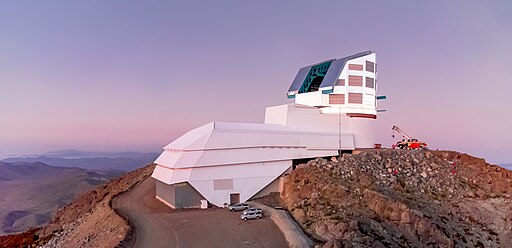
The Vera C. Rubin Observatory (formerly known as the Large Synoptic Survey Telescope) in Chile is a remarkable testament to her importance as an astronomer, featuring an 8.4 m telescope with a “car-sized” 3200 megapixel camera which will be used to survey the whole southern sky every three nights for ten years. Besides mapping the sky in unprecedented detail, the frequency of complete surveys will ultimately provide us with a decade-long “movie” of the southern sky, leading to the potential discovery of thousands of new asteroids - and maybe even the existence of that elusive so-called Planet X.
It's such a shame that, as is often the case, the person whom this remarkable facility commemorates is no longer around to share in the excitement of its coming to fruition!
Images:
- Vera C Rubin Observatory at Dawn by Rubin Observatory/NOIRLab/NSF/AURA/Y. AlSayyad, CC BY 4.0 <https://creativecommons.org/licenses/by/4.0>, via Wikimedia Commons
- NGC 4343 imaged by the Vera C. Rubin Observatory by RubinObs/NOIRLab/SLAC/NSF/DOE/AURA, CC BY 4.0 <https://creativecommons.org/licenses/by/4.0>, via Wikimedia Commons
- Vera Rubin measuring spectra by NOIRLab/NSF/AURA, CC BY 4.0 <https://creativecommons.org/licenses/by/4.0>, via Wikimedia Commons