Recent posts View all
Home of real teaching & learning
  • Full support for teachers
  • Focus on critical thinking
  • Engaging classroom activities
  • Integrated student eBook
  • Assessed tasks / qBank
  • Practice exam questions

The InThinking Guarantee: Our sites are written by expert practitioners and not by AI

See our AI policy

Disclaimer: InThinking subject sites are neither endorsed by nor connected with the International Baccalaureate Organisation.

Don't miss out, find out!
IB Approved Workshops
Physics
IB DP Category 1

Paris, France, 13 - 15 November 2026

Find out more
Physics: A focus on the experimental programme
IB DP Category 3

Paris, France, 19 - 21 February 2027

Find out more
Physics
IB DP Category 2

Berlin, Germany, 26 - 28 February 2027

Find out more
Virtual Think-Ins

Find all InThinking events at
inthinking.net

Single slit distraction

This one took some doing. The line graph is simply plotted from the equation for single slit diffraction.
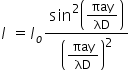
I space equals I subscript o fraction numerator sin squared open parentheses πay over λD close parentheses over denominator open parentheses πay over λD close parentheses squared end fraction

If you run the animation you can see where that equation comes from, It's the square of the resultant amplitude found by adding the amplitudes from a large number of point sources. If you show resultant2 you will see a series of blue dots that represent the intensity, these dots are calculated from the rotating vectors not the equation (honest). To get the two lines to match wasn't easy. Note that there are no units on the values and the diagram is not to scale but it should help to visualise the concept.

Help