Back to mechanics
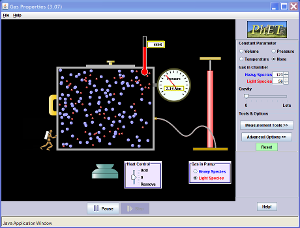
 This week I’ve been dealing with gases with my first year classes. At SL all that is require is an understanding of how the kinetic theory explains the relationship between PV and T. As usual I was using the gas properties applet by PHET and was compressing the gas to show how the compression caused the temperature to rise (I know this is AHL material but it’s worth knowing anyway). One of the students (Emma) asked if the temperature would get higher if the piston was moved faster. Well, if the work done is the same than the increase in KE will be the same so it wouldn’t make a difference, but will the work done be the same? To be honest my quick answer was that I thought that the temp. change would be the same. However, I also knew that when you use a pump in reality the temperature is greater when you pump faster, but is that just dues to less time to lose heat? The simulation showed a greater increase in temp but why? To try to explain this I realised that I’d have to go back to basics
1. What happens when a molecule hits a moving wall?
Consider a small perfectly elastic ball traveling at 4ms-1 making a collision with a heavy object (wall) as shown below. Because the wall is much heavier than the ball the ball bounces off with the almost the same KE and hence speed as before. This is a consequence of conservation of KE and momentum but I’m not going to go into that here.
Now consider the wall moving towards the ball at a speed of 1ms-1.
To make this simpler we can consider this from the view point of someone sat on the moving wall, they will see the ball moving towards the wall at a speed of 5ms-1 and as before, after collision the ball will be travelling away from the wall at a speed of 5ms-1.
But, for someone seeing this relative to the ground, the ball will now be travelling at 6ms-1. So relative to that person the ball has gained KE. The faster the wall moves the more KE the ball will gain.
2. But what about the gas?
As the piston is pushed in it’s like the block hitting the ball, the faster it goes the more KE is given. This will make the pressure greater which in turn will make the force required to push it in greater. Bigger force means that more work will be done. So, pushing the piston faster results in a higher temperature. Unless of course the pressure is kept constant (by removing heat) in which case the work done would be the same no matter how fast the piston was moved. This can be represented on a PV diagram. Getting too much into AHL territory now. Anyway, don’t take my word for it, try it for yourself.