Radiation in my background
As I prepare and trial new materials for the forthcoming Atoms and Nuclei unit (watch this site!) I have been reflecting on the use of radioactive sources and on my teaching of radioactivity over the years. I'm pleasantly surprised that there is still a little buzz of excitement when I get out the (relatively low-tech) GM tube and counter equipment and students start hearing the beep-beef-beep of detections taking place, usually followed by a barrage of social-media inspired questions.
Attitudes to use of ‘live’ sources vary from place to place. In some places I worked, there simply wasn't the possibility of obtaining the sources. In others, regulation standards were far more relaxed than I was used to. I remember when I arrived as Head of Department for one school in a European country, I did an audit of departmental inventory and discovered we had sources - but no documentation regarding radiological inspections. When I called in the local authority radiological inspector, the first question they asked was “so, how much Plutonium are you holding?” I thought they were joking. When I told them ‘none’ they simply shrugged and asked me why, then, I had called them in…
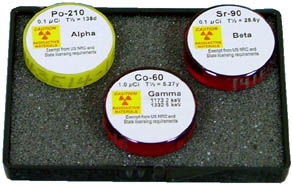
Even after all these years I am still a little wary about handling even low-level, school laboratory sources. I think as a younger teacher I enjoyed showing off a little to students about the element of ‘danger.' Now I'm older - and have experienced the consequences of cancer in people close to me - I am rather less blasé. Still, I think the real-life experience of radioactive sources is important for students, rather than online simulations, even if only as a carefully managed class demonstration.
When teaching in the UK some years ago, our radiological inspector was a retired oncology researcher from a major London research hospital. As he carried out his wipe-tests and whatnot he introduced me to the (now fairly extensive) oncological research that shows that cells can be ‘primed’ through exposure to low levels of radiation, and this initial exposure then increases their tolerance to the higher doses subsequently used in radiotherapy[1]. He shared data with me from his research. There has also been significant research showing how organisms can adapt to even quite high levels of background radiation[2].
There is valuable learning here for physics educators. While it is appropriate that we continue to highlight the noxious effects of ionising radiations on cellular organisms, the message that background radiation is a part of our environment is equally important. Indeed, without it we would likely not be here - as evolution is driven by mutation. It's a useful case-in-point where critical thinking about the evidence can offset widespread public misconceptions - perfect material for a criterion D task to come…
Footnotes
1. See for example A restatement of the natural science evidence base concerning the health effects of low-level ionizing radiation | Proceedings B | The Royal Society ; The scientific basis for the use of the linear no-threshold (LNT) model at low doses and dose rates in radiological protection - IOPscience ; (PDF) Molecular mechanisms of low dose ionizing radiation-induced hormesis, adaptive responses, radioresistance, bystander effects, and genomic instability
2. See for example Biological and cellular responses of humans to high-level natural radiation: A clarion call for a fresh perspective on the linear no-threshold paradigm - ScienceDirect