A Thomson's electron beam
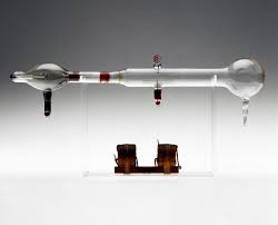
In this activity you will use a simulation to explore how J.J. Thomson measured the properties of electrons using a CRT.

Criterion A: Knowing and Understanding

Critical thinking skills > Recognise and evaluate propositions
MYP 4-5 inquiry questions: What are atoms made from? What are ‘fundamental’ particles? Which particles are fundamental?
This activity links to 5.5.2 What's in an atom? from the student e-course.
Before you begin…
Review 5.5.2 What's in an atom? to make sure you understand how the Cathode Ray Tube (CRT) works!
Method
Look at the simulator below.
The simulator allows you to control
- the electric field between the plate electrodes
- the magnetic field through the coils
On the ‘screen’ you can observe the deflection of the cathode ray.
Switch the heater on and watch the cathode. When it is hot enough, it gives off electrons. The anode is positive, so it pulls the electrons towards it, and they shoot through its hole as a narrow beam.
Switch the heater off, then on again.
A1. Describe what happens to the beam? Suggest what this tells you about where the electrons come from.
Set a plate voltage but keep the coil current at zero.
Which plate does the beam bend towards? Reverse the voltage.
[3 marks]
A2. Deduce what this tells you about the charge on an electron.
[3 marks]
Increase the plate voltage slowly.
A3. Describe how the amount of bending changes. What happens if you go too far?
[3 marks]
With the plate voltage fixed, change the accelerating voltage.
A4. Are fast or slow electrons easier to bend? Suggest why.
[3 marks]
Set the plate voltage back to zero and switch on a coil current.
A5. Describe the shape of the beam's path in the magnetic field. What changes when you reverse the current?
[3 marks]
Now use both fields together. Set a plate voltage, then adjust the coil current until the spot moves back to the centre of the screen.
A6. Suggest what must be true about the electric and magnetic forces when this happens.
[3 marks]
A7. Thomson found that cathode rays bend in both electric and magnetic fields. Explain how this supports the idea that the rays are made of charged particles.
Using the CRT, Thomson found a value for the ratio \frac{e}{m_{e}}, where e = charge on the electron and m_{e}= mass of the electron. His measured value was \frac{e}{m_{e}}=1.76\times10^{11}C/kg.
In a later experiment, Robert A. Millikan measured the charge of the electron as e=1.6\times10^{-19}C
Calculate a value for the mass of the electron m_{e}.
[2 marks]
Prompt for students to reflect on their work using the assessment objectives, e.g.
When you have finished, check your work against the assessment objectives (i- v) for criterion .
Criterion A: Knowing and Understanding
At the end of year 5, students should be able to:
i. explain scientific knowledge
ii. apply scientific knowledge and understanding to solve problems set in familiar and unfamiliar situations
iii. analyse and evaluate information to make scientifically supported judgments.
In your work, highlight an example of where you have done each of the objectives.
 Teacher only box
Teaching notes for the activity, including links to assessment notes / task-adapted criteria: A Thomson's electron beam ATTL
and links to downloadable student reflection sheet for criterion A.
Tags: atomic, nuclear, e/m, cathode ray, CRT