Core 2025

New CP Core 2025
In essence, the same four components remain, albeit with two name changes; also the updates range from enhancements and widening student choice to much larger revisions. All of it is designed with intentional connections between all elements of the core. Here is an overview of the main changes to implement for first teaching in September 2025 with links to further pages and blogs. All these components will be supported with brand new resources.
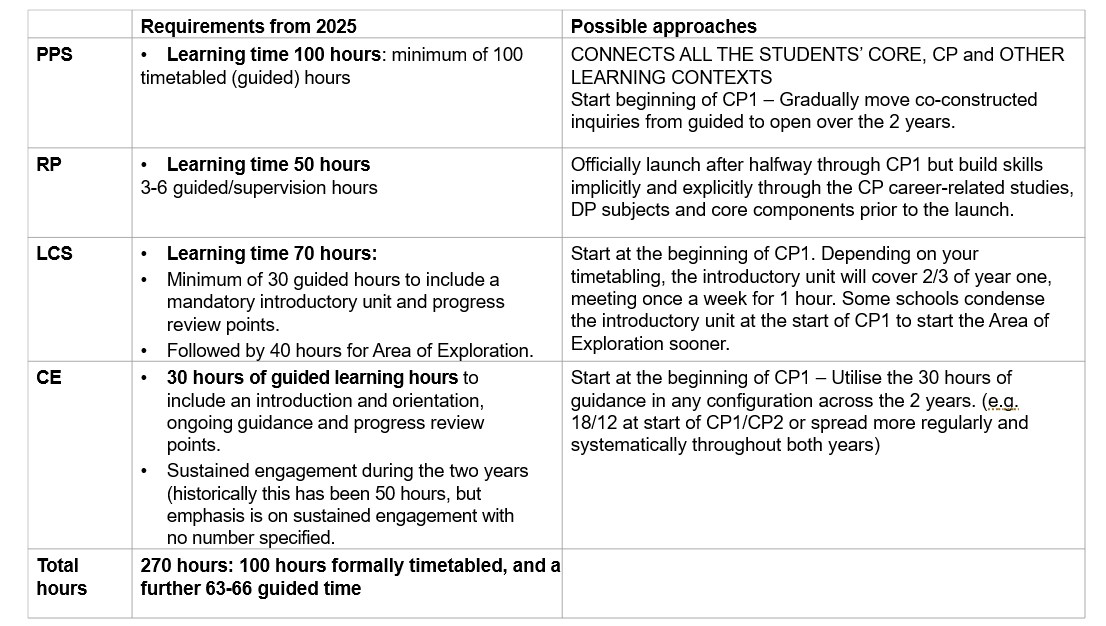
Core hours at a glance
Build, build, build
When you look at the four components of the core, it's a good idea to follow the example from LCS and CE with the initial guided phase. What this means, is have the big picture of the two year course in mind and recognise that students will have to build up skills gradually over the course of the two years and this includes the level of independence they can demonstrate. It is expected that students will co-construct inquiries with their teachers in PPS and this will lead eventually to building their own inquiries. In Reflective Project, students will need to explicitly build up skills of ethical, reflective and critical thinking not to mention how to give and receive feedback successfully.
Have a look at this Sample core overview which will give you an idea of how the old components relate to the new but also how they all connect to each other. Thinking specifically of PPS, do look at How to build a PPS inquiry (link below as well).
Core 2 year overview
Even if you are reworking and reimagining your core provision, one component at a time, it's good to see how they can all fit together. Here we have reworked a CP school's current CP core overview to...
How to build a PPS inquiry
Constructing PPS inquiriesPPS inquiries are co-constructed between teachers and their students; through such collaborative modelling, students come to construct their own open inquiries according to their...
Inquiry: Identity and Self-awareness
Focus: How can self-awareness help me achieve my goals as a learner?One of the transversal skills in the Intrapersonal skill domain is ‘self-awareness’. Here you are going to think about what makes...
In Personal and Professional Skills ...
- The course is now designed with building blocks of Concepts, Contexts, Content and Skills. This means schools, teacher and students can build inquiries truly bespoke to their interests and needs.
- There are six concepts which means students can explore what really interests them in contexts ranging from all elements of their CP course to their personal life and informal learning from other interests they have. And to do all this they explore and develop transversal personal and professional skills. The school, students and teachers decide the content which means you can really consider what works in your specific context.
- You don't have to explore all 6 concepts or all the contexts and skills but there are minimum requirements for the amount of Concepts, Context and Skills. You will undoubtedly find opportunities to do far more than the minimum.
- One aspect of note is that you will find 'ethical thinking' appears twice in the skill domains which serves two purposes; one it is to demonstrate how important ethics is to the entire core and second to give you the opportunity that has always existed in PPS to give students a background in ethical thinking that they will need to navigate the reflective project.
- This course is 100 hours which brings it in line with TOK on the DP. This takes place across the two years.
- Completion of the course is decided by the students meeting the learning outcomes.
- Students keep a portfolio throughout the course but to complete the course, they must curate their portfolio to demonstrate their completion of the learning outcomes. Create and Curate.
Personal & Professional Skills
Don't reinvent the wheel for courses starting in 2025The first principle of ‘removing barriers to learning’ in the IB philosophy is to build on prior learning so it's a good idea to do exactly that...
How to build a PPS inquiry
Constructing PPS inquiriesPPS inquiries are co-constructed between teachers and their students; through such collaborative modelling, students come to construct their own open inquiries according to their...
In Community Engagement ...
- The change in name solidifies what schools successful in Service learning already know; this is a process about reciprocity with the community/communities. Service Learning has unsavoury historical connotations and a new name sets the tone for this course.
- More than just a change in name, this is a course that is designed for a sharper learning journey for students as the think critically and ethically about engagement in a variety of contexts.
- A welcome addition and helpful for other elements of the core, is an emphasis on ethics and ethical thinking when in collaboration with the community.
- There are three key principles of CE: dialogue, reciprocity, reflection and reflexivity.
- Students go through stages of exploring and preparing, relating and acting and evaluating and sharing.
- Students keep a learning journal and have three review points. This will provide the evidence for meeting the official learning outcomes. Again the emphasis here is on process.
Guided hours: minimum 32
Total learning hours: Sustained engagement over the two years (total not specified)
Community Engagement
Community Engagement overviewMost schools already engage in great community activity. What is the shape of the Community Engagement course from 2025? Here are the basics of course content, structure,...
LCS expert perspective
Perspectives from the experiencedCreating a fully contextualised Language and Cultural Studies course for your students demands a fresh perspective, especially if you are used to the Language Development...
Language and Cultural Studies
In Language and Cultural Studies...
- Your starting point is the student and what they discover about themselves and the direction they want to take rather than the mode of delivery, as it has been in the past (eg self-directed, direct instruction, duo lingo, external agent).
- The focus is on language and culture: by this we mean developing both linguistic and cultural repertoires.
- A repertoire refers to the tools and resources students develop that enable their understanding of language and culture.
- Whereas in Language Development there was no syllabus outline, in LCS there is a syllabus with an emphasis on inquiry. This is an important distinction to make with emphasis very much being about the process (a common thread in the core)
- Students must take part in an introductory unit, choose one of three areas of exploration and, like other elements of the core, the rest of the course is determined by students and teachers working together through inquiry.
- the learning outcomes are focused on expanding repertoires and the learning process rather than communicative processes as we had in LD.
- All CP students must take LCS with no exceptions - it cannot be fulfilled through taking a language acquisition course as was the way with LD.
- Students keep a learning journal and have three review points. This will provide the evidence for meeting the official learning outcomes.
Guided hours: minimum 30 (school can adapt depending on needs of students)
Total learning hours: minimum 70 sustained over the two years.
Language & Cultural Studies
Language and Cultural Studies overviewThe LCS course places emphasis on curiosity and inquiry into one's own unique relationship with language and culture. This is a deeply flexible and developmental...
LCS expert perspective
Perspectives from the experiencedCreating a fully contextualised Language and Cultural Studies course for your students demands a fresh perspective, especially if you are used to the Language Development...
LCS resources & inspiration
What is the potential of this course in your school? Lots of ideas here which we will continue to add to; thank you to the LCS specialist Susan Stewart for such great suggestions and for her generosity...
In the Reflective Project...
- Students still explore an ethical dilemma but this can be inspired either by their career-related studies or a career field they are interested in (which could be connected to their DP subjects or they might not necessarily study at all right now).
- Keeping a learning journal is not assessed but it is mandatory now. It is fundamental to students demonstrating the work is their own and is indispensable for the final written reflection.
- Supervisor support is now 3-6 hours.
- There is a distinct learning journey of five phases to support students through the process with additions of peer feedback, a presentation and a viva voce. Preparation and Planning, Research and Analysis, Development, Presentation of findings, Completion and submission
- Students can respond in four modes of written, visual, audio or audio-visual. This widens out the opportunities for students and the ability to choose communication styles directly related to their career field. For example, a budding journalist might choose to write newspaper or magazine feature exploring an ethical dilemma or a podcast; a student with an interest in advertising and marketing, might choose a presentation or report. There is no end to the ideas here and it is going to be exciting for students to think what could be truly useful for a prospective career and form part of their portfolio. Obviously essays are still possible but just one of many options.
- Whilst there are specific requirements depending on the format you choose, the general rule is the equivalent of 4000 words including up to 1000 word reflection. This is not divided into 3 reflections like the RPPF. The students use their learning journal to help them to put together their final reflection.
- The reflective project is externally assessed now by the IB rather than internally assessed and externally moderated.
Do anticipate how students will learn how to give feedback to each other as well as be able to respond to feedback.
Students are expected to take about 50 hours with this process at least.
Reflective project 2025
Creating an independent position on an ethical dilemmaThe reflective project keeps the ethical dilemma as central to the process but is now externally assessed. There are structural enhancements to create...
Utilise the CP for the RP 2025
Draw upon the CP experiencePreparing students for the RP includes the long term preparation and planning of research, self-management, communication and thinking skills utilising all aspects of the CP,...
RP 2025 perspective
Perspective from the experiencedWhat do experienced RP educators make of the 2025 enhancements? It was a privilege to speak with Habel Amolo from Le Bocage International School, Mauritius. He is not only...
Process
You will notice a common thread throughout the core is the continuity of process throughout the CP core. The emphasis here is vital as it brings an equity and balance to every element - all four elements are designed so process is central. Especially important to consider in terms of the reflective project where this balance was easily skewed in the past.
Evidencing
It's all about porfolios and journals. A 'learning journal' supports all elements of the core. In PPS this is called a portfolio and emphasis is on not merely creating it but also curating the evidence in there to demonstrate the student's learning journey.
Reflection and Reflexivity
You will notice a far deeper focus on reflection throughout the core culminating in the reflective project. Students embark on self and critical reflection as well as self and critical reflexivity. The key distinction is between reflecting on process and experience and being reflexive about one's values and influences changing and/or developing and the impact on oneself and the world around you.
That is a very brief summary but the key here to understanding this is you can structure reflective and reflexive experiences so students can really develop an understanding of what they do, the actions they take and the impact their values have in the real world. No more vague, plodding reflections.
Reflective & reflexive tools
Creating a reflective and reflexive toolboxThe requirement to be reflective and reflexive is present in all four elements of the core; this is something that takes time to build up. Let's start with just...
Practical starting points for CP teams
Coordinating curricula developmentYou've rested, you've read the guides, you've looked at existing good practice that you want to keep. Are you ready to get building inquiries? As a CP coordinator, it...
How not to worry about next term
Where to start? You already have.If you are reading this then I hope you are enjoying or, at least, anticipating, your well-earned rest. I know from talking to colleagues that the new specifications are...