Inquiry 1: Identity & Self-awareness

Teaching Identity (Student Section - Inquiry 1: Who am I?)
One of the transversal skills in the Intrapersonal skill domain is ‘self-awareness’. Here you are going to think about what makes you … you and how that knowledge can help us grow as learners in lots of different settings. Over the following activities, you can explore what it means to be self-aware, how if we can identify our own strengths and areas for growth, we can manage change as well. Focus: How can self-awareness help me achieve my goals as a learner?
Enjoying the site? Why not look at our wide range of Think-Ins happening over the coming months!
Think-Ins
Think-Ins are 3 hour seminars on specific topics of CP education (non-IB certified PD). Full of discussion, practical tips and strategies, these are a focused, efficient and productive use of 3 hours....
INQUIRIES can be a mixture of ….
| Directed ⇆ | Guided ⇆ | Open |
Teacher-led Appropriate in the early stages of the CP and PPS course as students come to understand the course and the process. Also really supportive when addressing specific learning outcomes | Shared After the initial direction of the inquiry is established, students have more choice to shape its direction. The idea of co-construction comes into play with students and teachers in dialogue to decide the direction. Scaffolding required but students working towards accountability. | Student-led Students choose every stage of their inquiry. There might be natural opportunities for this later on in the course in CP2 as well as after a more teacher-led/guided inquiry as students use that as the foundation and model for design |

Within the structure of a PPS inquiry, as a teacher adapts to the needs of the class and individual students, there will undoubtedly be a necessary mix of directed, guided and open. This is not about making a linear progression from directed to open over the course.
Student section Inquiry 1: Who am I? - Here is the link to the student version of this teacher page.
Inquiry 1: Who am I?
Focus: How can self-awareness help me achieve my goals as a learner?One of the transversal skills in the Intrapersonal skill domain is ‘self-awareness’. Here you are going to think about what makes...
| Learning outcome | Concepts | Contexts | Content | Skill domain: Intrapersonal skills |
| LO1—Develop and apply intrapersonal skills in a variety of contexts. | Change Connections Identities Perspectives Systems Well-being | Potentially 1 or many! Personal life | Exploring how creating a vision board can deepen a sense of identity and self-awareness which can create aspiration and goals. | Reflection and Reflexivity Resilience Self-advocacy Self-awareness Self-management |

 For this inquiry students need access to their portfolio as well as a partner/group/class to chat to where appropriate.
| Skill domain | Transversal skills |
| Intrapersonal skills encompass self-awareness and understanding of our emotions and how to regulate them. When you explore your own characteristics, feelings, behaviours and understand what you can really do in terms of abilities, you start to become far more self-aware about your interests, goals, strengths and, perhaps even more importantly, a resilience in identifying areas for improvement and acting upon it. | Reflection and Reflexivity Resilience Self-advocacy Self-awareness: conscious knowledge of one's own character and feelings[1] Self-management |
 Students can consider the transversal skills here and how familiar they are with them. They can discuss with a partner their ideas to the following questions.
Are they words you have come across already? Why might they help you with your studies and working in different contexts in the future? Which ones are most important to you? Which ones do you most want to work on?
 Focus: How can self-awareness help me achieve my goals as a learner?
To get the most out of your CP course, you do need a system that threads through the entirety of your course and not just limited to an introductory topic. So whatever you develop here can be used throughout your course.
In this inquiry we are going to start by considering 'who am I?' - what are you really about? This will lead us to our focus on ‘How can self-awareness help me achieve my goals as a learner?’
The inquiry is inspired by and adapted from The A Level Mindset by Steve Oakes and Martin Griffin. The authors make use of their bespoke VESPA system to develop growth mindset in teenagers aged 16-18. Through targeting Vision, Effort, Systems, Preferences and Attitude, you are able to weather successfully the stresses and strains of a challenging sixth form course.
 This presentation is aimed directly at the student. Use this presentation to accompany your lesson/s through the inquiry stages of FOCUS, EXPLORE, ACT, REFLECT, SHARE. The slides are also embedded throughout this page for reference.
Let's explore what we mean by a vision board.
Remember you can use this powerpoint to accompany you through the Explore, Act, Reflect and Share stages
 Step 1. Vision board: Work in progress
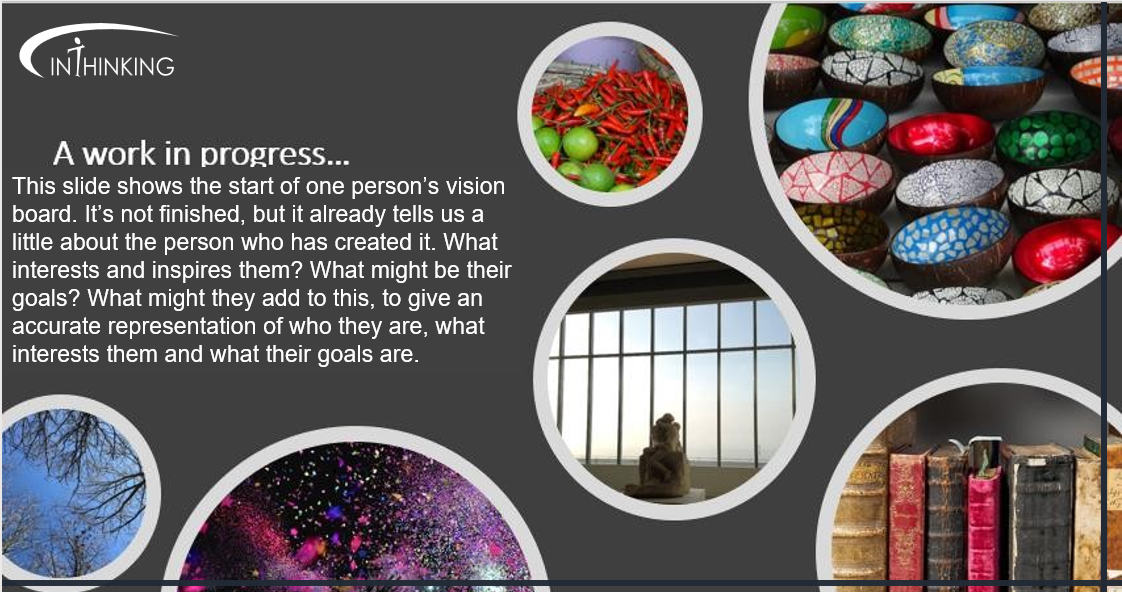
Below is the early stages of a vision board created by a student.
Consider this image and the accompanying questions.
Vision Board
Create a 'vision board' of your likes and dislikes as a good way not only of finding centre and identity but also bypasses questions such as 'what do you want to be?' or 'what is your goal?' You need time to develop your goals - maybe to find some aspirations but also time to have the confidence to acknowledge ambitions you might have. These exercises can be completed as a visual journal, a large piece of wall art, a prezi, powerpoint presentation, card+scissors+glue, ... as long as it is visual, and easily accessed and seen, you can experiment with different modes. As an extension you can also play about with AI prompts to see if it is possible to generate art that captures your vision! Don't forget to evaluate it afterwards!
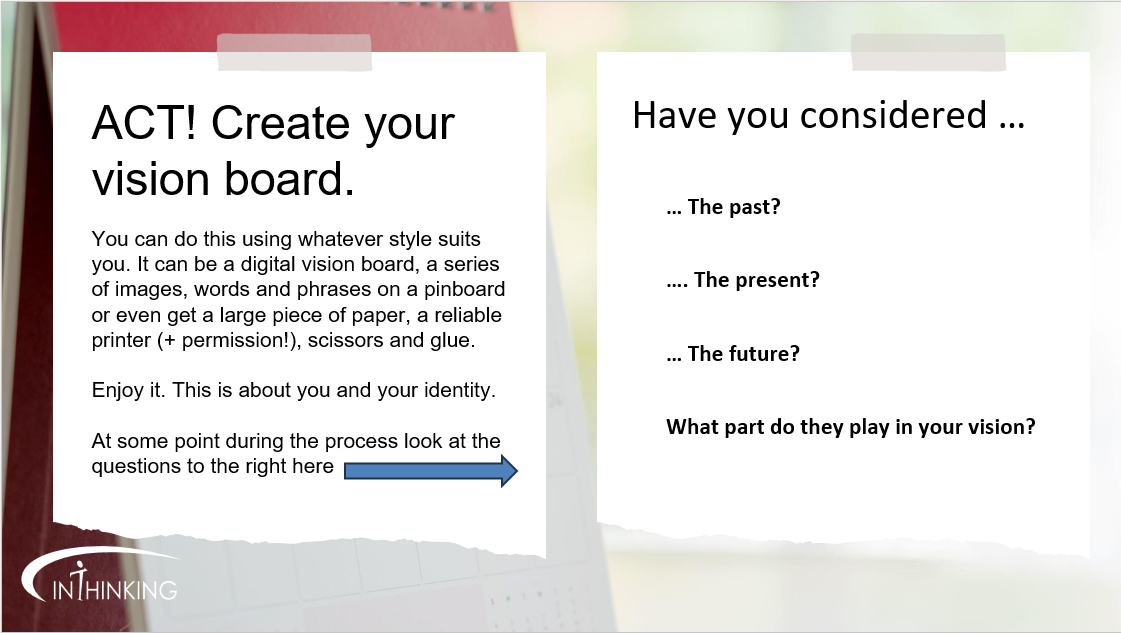
Portfolio
This is a great opportunity to start as you mean to go on and create a visual journal to accompany your PPS portfolio as well as the journals for the other core elements. This can be a physical or digital journal that you feel comfortable using. Expressing and developing your ideas does not = writing lots. You can use images, voice notes, sticky notes, art, music ... whatever works for you. The first exercise will get you to try this out so give it a go.
 Reflect - Questions to delve deeper
REFLECT: Being able to reflect and be reflexive involves thinking critically, and here we will see how questions can make you curious about your identity and help you recognise something about yourself you may not have considered before. Keep at the heart of this, how do I act? What do I believe? What are my values?
Using the questions on the slides or here on the webpage, make a brief note of how you would respond. Feel free to skim over the questions and pick the ones that really speak to you! When you have finished, think about whether it changes anything for your vision board?
- Name five things that make you smile.
- If you could only take one subject, what would it be?
- What do you find it easy to do? Think both work and in home life
- What jobs do you avoid doing? Think both work and in home life
- What are you doing when time flies?
- What job would you do for free?
- You suddenly have a free afternoon on your hands: what do you choose to do with it?
- If you were given an afternoon off to work at home, what subject would you choose to do?
- Do you leave some work until the last minute? Think of the last piece that you did this way and finish the sentence 'I left it until the last minute because ...'
- Name five things that make you sigh.
- What would you try to do if you were guaranteed to succeed? Why?
- List the first words that come into your head when you hear the word 'happiness'.
- List the first words that come into your head when you hear the word 'stress'.
- If you could start a company, what would it be for?
- What do you talk about with friends? Is there anything you would like to talk about with friends but you don't?
- When was the last time you dismissed doing or trying something new? Explain that choice. What if you had done it?
- When does time fly and time drag?
- Name five things that make you cry.
- Who would play you in the film of your life and why?
- What is guaranteed to distract you?

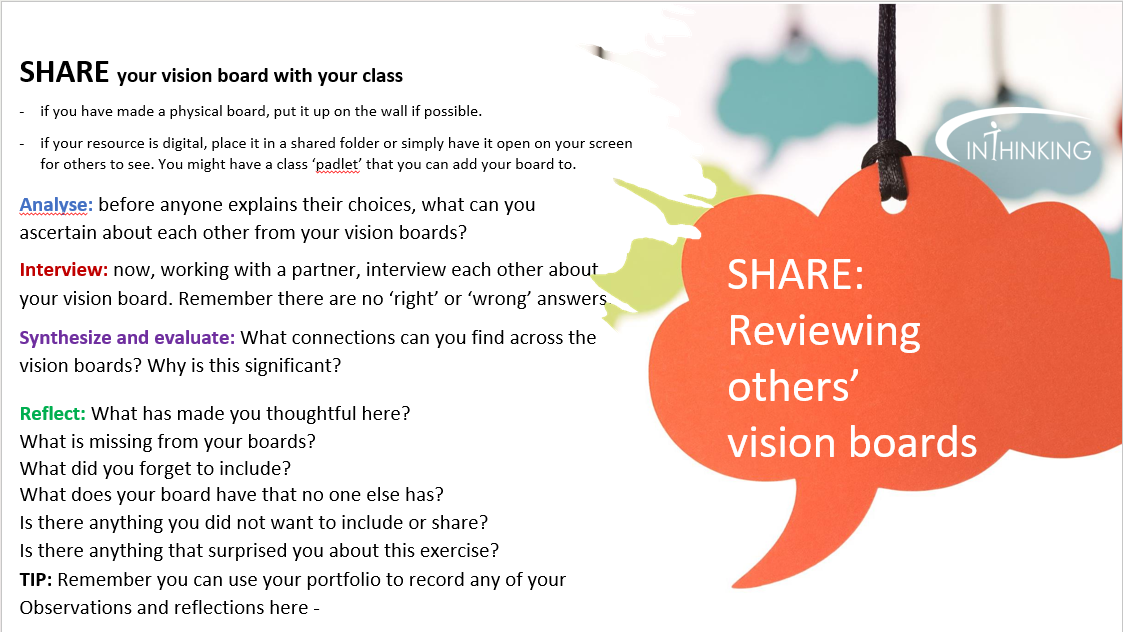
Part 2: Final reflection: Let's go back to the beginning and our original focus
How can self-awareness help me achieve my goals as a learner?
Looking at your vision board, what have you learnt about yourself? What did your learn about yourself and your peers in Part 1: Reflection?
How would you answer the question now ‘How can self-awareness help me achieve my goals as a learner?’
Are there any other transversal skills you explored here during this inquiry?
| Skill domain | Transversal intrapersonal skills |
| Intrapersonal skills encompass self-awareness and understanding of our emotions and how to regulate them. When you explore your own characteristics, feelings, behaviours and understand what you can really do in terms of abilities, you start to become far more self-aware about your interests, goals, strengths and, perhaps even more importantly, a resilience in identifying areas for improvement and acting upon it. | Reflection and Reflexivity Resilience Self-advocacy Self-awareness Self-management |
Subscribing to CP ThinkIB? Join our WhatsApp CP Community, bringing together amazing CP schools from around the world.
Share any questions, problem-solving and, most of all, successes.
One chat for all things CP.
Footnotes
1. https://languages.oup.com/google-dictionary-en/
Footnotes
1. https://languages.oup.com/google-dictionary-en/