The IB and the IBCP

Welcome to the ThinkIB CP Website
Access free teaching ideas, resources and advice on the reflective project. Whether you are new to the CP or are an experienced centre, join in and help make this a really supportive, open-minded and creative community. It has been fantastic to know this is starting to help teachers support the CP in their school. Fantastic to see the subscriptions growing and thank you for the positive feedback
Subscribing to CP ThinkIB? Join our WhatsApp CP Community, bringing together amazing CP schools from around the world.
Share any questions, problem-solving and, most of all, successes.
One chat for all things CP.
Let's start at the beginning.
You may well be familiar with the first diagram here, which shows the three key elements of the CP and the basic requirements, but are you aware of just how flexible this framework is? Like all IB programmes, all the elements are connected by Approaches to Teaching and Learning, International-mindedness and the Learner Profile.
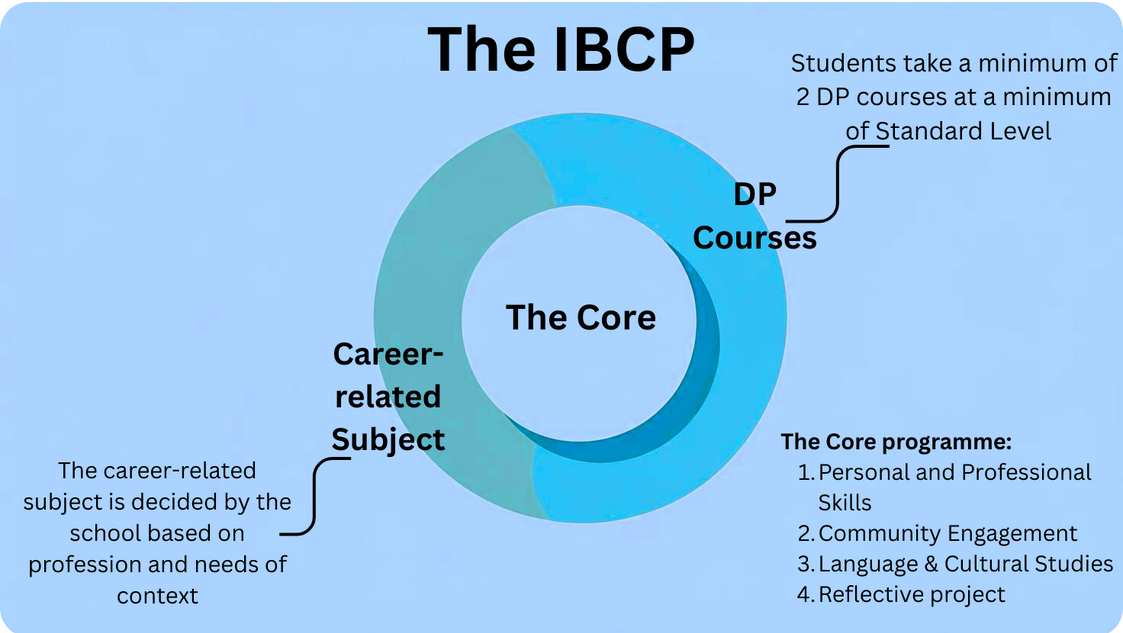
This is a fixed and flexible framework, and, depending on what the school can timetable and offer, programmes can vary from student to student.
What is fixed is a career-related element, completion of the core hours, learning journals and PPS portfolio, Reflective project, and at least 2 DP subjects at Standard Level.
What IS flexible is the size of the career-related studies and the DP subjects, which can be offered in greater numbers and also at HL.
A CP course that meets the basic requirements, might look like:


A small-to-medium-sized CP course might look like:

Larger CP courses might look like the following:

 Why is this important?
When you start seeing the sheer diversity in CP courses that schools around the world have been offering, you realise that this is a course that really can be moulded to the student and their interests and skills. This is one of the reasons why there has been such an impressive variety of destinations for CP students globally, and no 'textbook' CP student. Some focus more on career-related elements, whereas others really focus on the academic DP subject areas in depth, with a smaller CRS.
Depending on where you are in the world ...
... you will be starting a new term with different priorities. Depending on the time of the year, your focus will be varied. It may be the start of the new school year or your are over half way through. Students might be brand new to the IB; students may be fully immersed in their reflective project research or draft; students may be building up leading up to their final IB exams. Have a scroll to find resources here clustered by CP curriculum matters. You'll find resources here to meet your needs including specific suggestions for starting PPS for the first time which are detailed below.
Newest pages
On our homepage you will immediately see the most recent pages added to our library. However, here are a taster below of some of the newest resources.
PPS Inquiry for RP: The ethical and critical researcher
We could argue that the most important skill students can all leave school with, is not how much they can recall from our memories but how well they can discern what is true and what is not. In a world...
CE: How do we create a CE project?
The objective of this inquiry is for students to brainstorm, present and pitch CE projects for the whole class to take part in. The class will discuss all of the options and select one as their class...
Inquiry 3: How, where and why might I apply ethical thinking?
The IB's mission statement refers to the importance of appreciating how 'other people, with their differences, can also be right'; this is key to being a critical and ethical thinker. With 'ethical decision-making'...
Inquiry 5.2: What is my relationship with language and culture?
Language and Cultural Studies is founded on the fact that everyone has an individual relationship with language learning. Whether you are multilingual or monolingual, the aim of LCS is not about how good...
Inquiry: Introducing Power
... all connect to the concept of Power in relation to language and culture. Students must explore all four concepts of Communication, Identities, Perspectives and Power within the LCS course as they...
Are you starting out with PPS?
 How do I start PPS lessons?
NEW: Check out this new page with simple, step by step suggestions on getting going with your new CP cohort and those important first few weeks.
PPS 2025
The first principle of ‘removing barriers to learning’ in the IB philosophy is to build on prior learning so it's a good idea to do exactly that with all elements of the core, starting with the Personal...
How to build a PPS inquiry
PPS inquiries are co-constructed between teachers and their students; through such collaborative modelling, students come to construct their own open inquiries according to their particular personal and...
Top tip for starting out on PPS
Remember that the PPS 2025 area is supported by the Student section where students can embark on increasingly independent work and gives you that flexibility of delivery.
The key to establishing Personal and Professional Skills is utilising the first few weeks for students to start getting a real sense of identity - identity of who they are culturally and personally in a broad sense but also specifically in terms of where they are with their subjects and where their skills are at right at the start of the course. Take your time with this, building up a collaborative and open learning space so students can feel confident to make 3-5 SMART targets to take them through this first term.
Inquiry 1: Identity & Self-awareness
One of the transversal skills in the Intrapersonal skill domain is ‘self-awareness’. Here you are going to think about what makes you … you and how that knowledge can help us grow as learners in...
Inquiry 1.1 Developing adaptable mindsets
These teacher notes relate directly to student section Module ‘Who am I?’ with Inquiry 1.1 How can my mindset impact how I respond to change? The thesis we are exploring here is that being able to...
Inquiry 1.2 Reflective and Reflexive learning
This inquiry can be used systematically throughout the CP course to develop reflective and reflexive thinking as it is full of processes to support preparation and delivery of the Reflective Project and...
Inquiry 2: Cultural connection & understanding
This is the teacher page for Student Section Inquiry 2: Who am I with others?. What role does culture play in our lives? How do you connect what is happening directly around you with what is happening...
… to find great exercises to get your students going. These exercises below increase metacognitive awareness but also introduce students to Approaches to Teaching and Learning too in an accessible and authentic way. The lesson plans and activities on this page can be delivered to include implicit and explicit reference to a range of Approaches to Teaching and Learning. The key to students being able to identify and use skills in a range of situations is to teach the skill explicitly before incorporating it implicitly across contexts.
Approaches to Learning: Self-management
Key skills area: Self-motivation, Mindfulness awareness, Emotional management
Introduction: How to shift your mindset and choose your future: Thinking routine 'I used to think ... Now I ... and this means that'
Step 1. Setting your vision: 'All about Me'
Step 2. Giving feedback ...
Step 3. Questions to delve deeper
Plenary: You must meet ...
Plenary: Understanding key capabilities
Students can be brilliant critical thinkers and with excellent modelling and collaboration, research shows they can get steadily better throughout their school experience. These new resources explore critical thinking in more depth beyond a skill for the reflective project by breaking it down further through values of inquiry. Ultimately, critical thinking is for every subject and is everybody's business - the more teachers on board the better.
More on Critical Thinking
We all know that critical thinking is an essential part of the reflective project process and mark allocation. Students are brilliant critical thinkers and with excellent modelling and collaboration,...
Starting the RP process
The Reflective project process has 5 clear phases: Preparation and Planning, Research and Analysis, Development, Presentation of findings and Completion and Submission. The learning journal supports this throughout. If the ethical dilemma is the backbone of the project, then the learning journal is the circulatory system that keeps it alive and developing. Here are just some of the resources available to get students on the right path.
Learning journal introduction
By the time the students get to the RP process they should have some decent self-management and thinking skills to tap into for the mandatory RP Learning journal. This could be reflexive thinking practices...
Ethical thinking in the RP process + criteria
Ethics and ethical thinking is a common thread throughout the CP core. At the heart of ethical thinking is the ability to consider the dynamics of people, actions and consequences in varied contexts in...
PPS Inquiry for RP: The ethical and critical researcher
We could argue that the most important skill students can all leave school with, is not how much they can recall from our memories but how well they can discern what is true and what is not. In a world...
PPS Inquiry for RP Reflective & Reflexive learning
Inquiry 1.2 Reflective and Reflexive learning is purposefully in the RP section as not only can it be used systematically throughout the CP course to develop reflective and reflexive thinking, its context...
PPS Inquiry for RP: Teaching ethical thinking
Teacher page for stThe IB's mission statement refers to the importance of appreciating how 'other people, with their differences, can also be right'; this is key to being a critical and ethical thinker....
Bias: what, where, why and how
This is another example of a word that can lose meaning in its overuse. Furthermore, students can underestimate the reach of bias, not understand there are different types of bias and also remain unaware...
Creating a course that joins the dots
The Core from 2025 has been designed specifically so whilst each element has a discrete place in the timetable, they all interconnect.
As we all know, our courses are alwas a work in progress and always something we can develop, refine and extend.
With this in mind, designing the PPS course to make far more explicit and deliberate connections between the career-related studies, the DP courses and the core elements. It is not about designing a framework that makes the connections for students but creating a framework that allows them to make connections themselves. Included are some perspectives from experienced CP coordinators on what has worked, not worked but also what has surprised them and presented challenges for them.
Designing a collaborative core through PPS
The CP core is what makes this programme stand out, made up of unique elements. The Personal and Professional Skills course is the lens through which students can consciously understand the transversality...