Academic Integrity: How do I understand AI?
A brief history of AI
AI's presence is widely accepted, but it didn't appear overnight. In this lesson, you can start building an understanding of what AI means to you, exploring, in brief, where it has come from and how it evolved. What vocabulary is associated with AI, and what does it mean? This lays the foundation for the next steps in effectively using Generative AI throughout your studies, personal and professional life.
This inquiry explores your relationship with technology, particularly AI, and is part of a series of lessons on AI as part of exploring systems-thinking in PPS, which your teacher might deliver there Inquiry 7.4 Systems: How do I understand AI? However, it is in the ‘Making Connections’ section, as it links to all of your CP and beyond.
This inquiry is in ‘Making Connections’ section of the Student section through the lens of Academic Integrity as the students' attitude and skill with AI use will impact the whole CP and their personal and professional life. However, it is also found in the PPS section Inquiry 7.4 Systems: How do I understand AI? as a series of lessons on AI use as part of Systems-thinking in PPS. This placement is to give you flexibility at how you approach this topic.

Read first: Use the presentation to support your exploration through this inquiry independently or together with your teacher and class. You will find it useful to have a peer to compare your thoughts with, so if you are exploring this independently, initially, be sure to take notes in your learning journal/portfolio space to bring to your next discussion with your class.
Start here: Check out the success criteria below and the focus of this inquiry. How well do you think you can already perform these success criteria already?
 Powerpoint: AI - How do I understand it?
SLIDE: Four Corners activity
This lesson starts with a Four Corners activity to help you identify where you stand on AI use.
- AI Resistant: Sceptical of AI's role and hesitant to adopt new technologies.
- AI Curious: Interested in exploring AI tools, but cautious about implementation.
- AI Embracing: Open to integrating AI into learning and actively seeking opportunities to use it.
AI Leading: A champion of AI in learning, actively seeking innovative AI-powered strategies.
… should there be more corners? If so, what? How would you describe this attitude? For example is it possible to be enthusiastic about technology but sceptical of AI?

REFLEXIVITY: Before exploring AI, it's important to check in with our own biases, fears, and assumptions about how we approach technology. Students can discuss with those who feel similarly or completely differently to them. All responses are welcome; this is safe environment for sharing views.
SLIDE: AI Checker
The lesson then moves from you reflecting about your own attitudes to AI to seeing if your mindsets align with your actual useage.
SLIDE: A brief history of AI - It has been around for a while!
Let's establish how AI has developed across three paradigms: Machine Learning, Deep Learning and Generative AI.
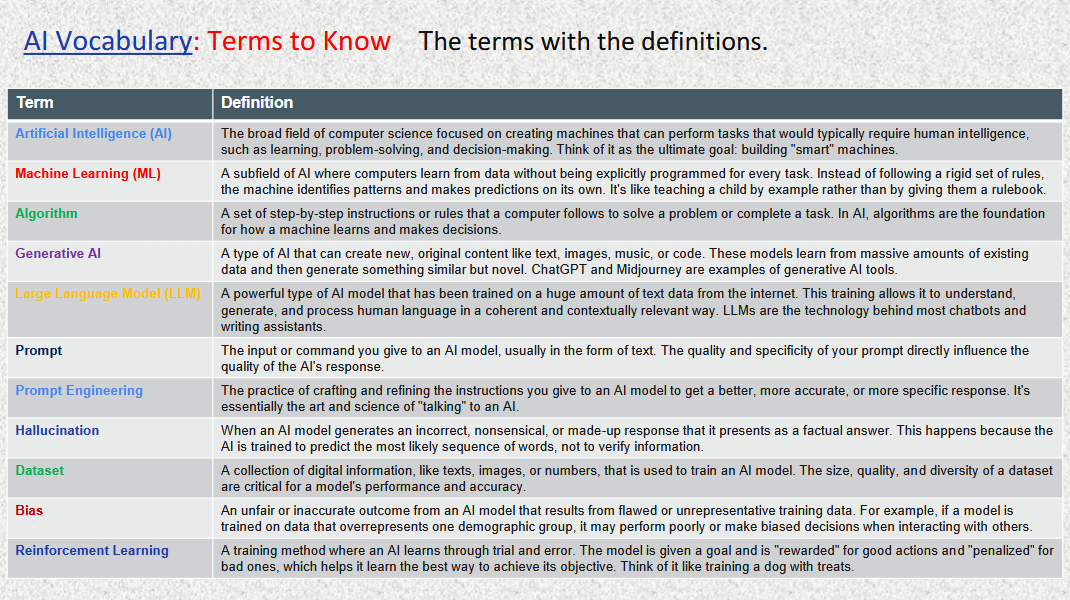
SLIDE: How many terms do you know?
The presentation has three slides that ask you to consider the terms first, match words to definitions before showing the matched up slides. Do not move on from the first slide until you have attempted the activity; then look at the answers in the hidden box below.
SLIDE: Can you identify different uses of AI?
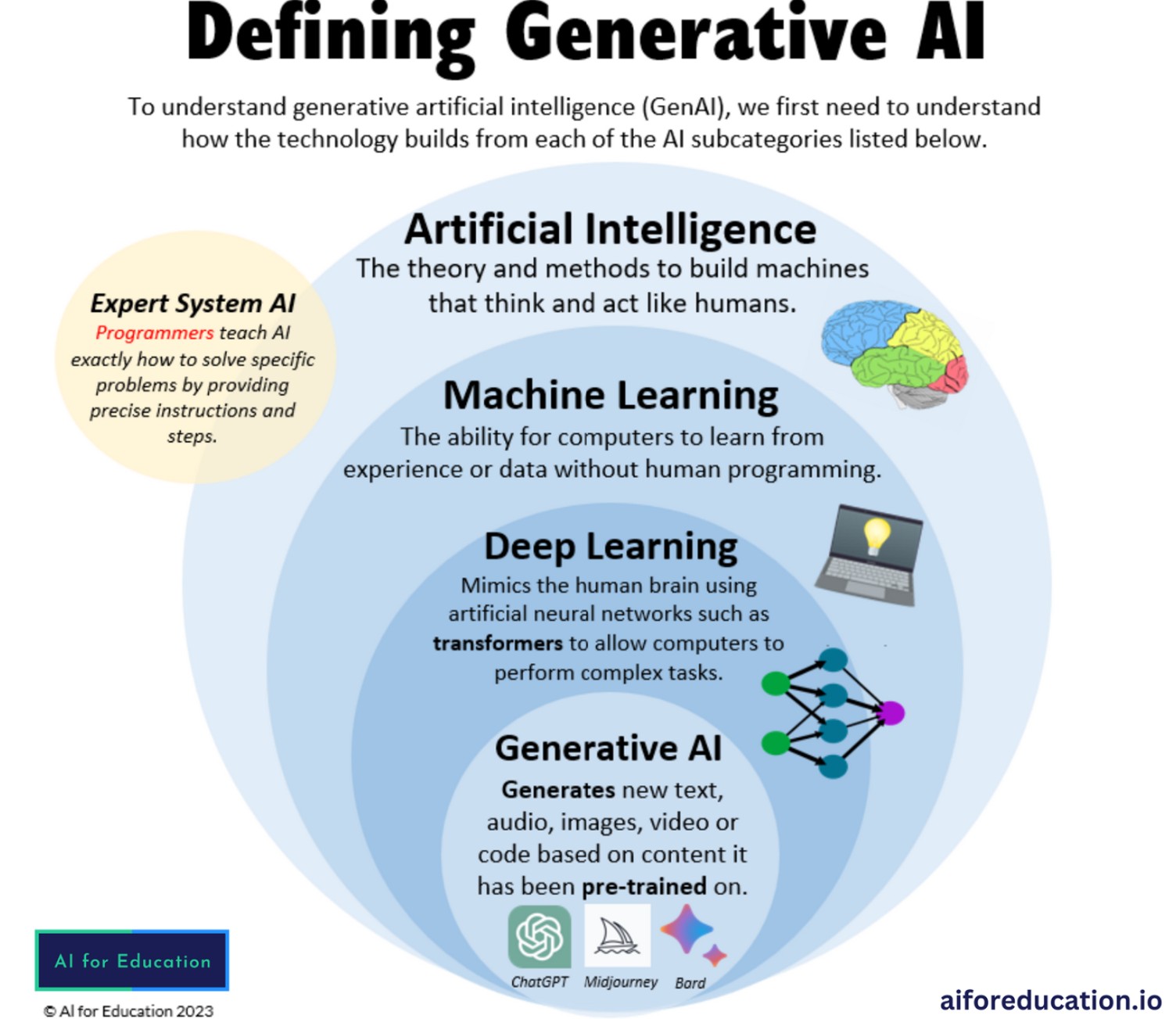 Categorising different AI Using the image below from the excellent 'AI for Education', use the flashcards to discuss and identify different uses of AI in every day use.
SLIDE: Multiple uses of different systems
Permitted AI use for activity: none initially then some
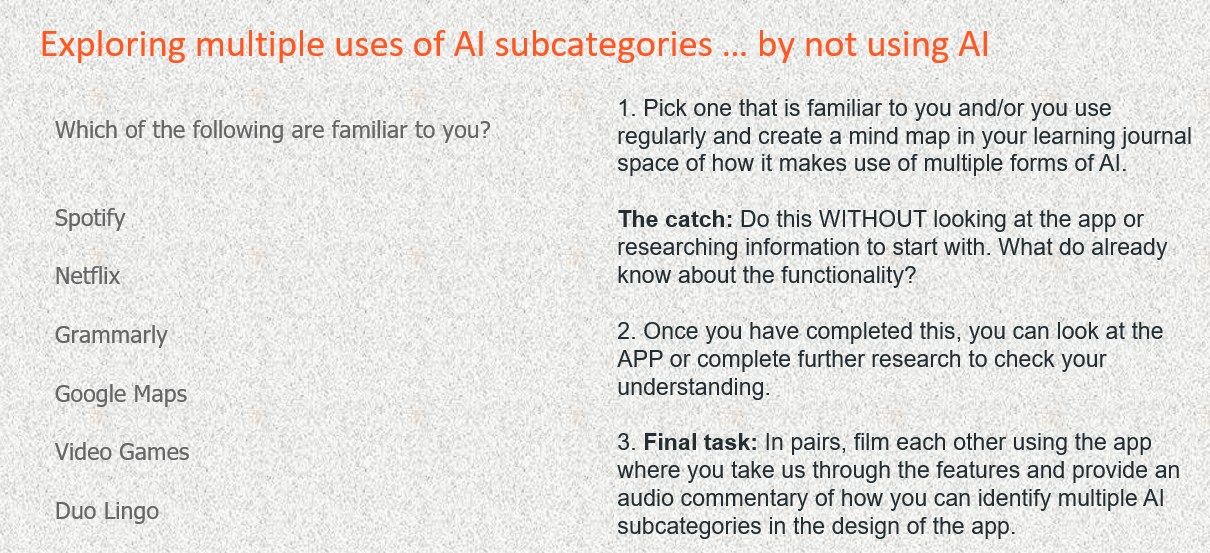 Activity 2: Multi-use of AI
This activity calls on you to think deeply about what you, already and consciously, consider familiar settings through a new lens. Present your commentary to the class when you are ready
SLIDE: How we understand the successful ethical use of AI, depends on how comfortable we are with the following connected areas:
- Prompt Engineering
- AI’s limitations (and caution)
- Acceptable Use of AI:
In the core, especially the Reflective Project
In DP and CRS courses - Proper ways to cite AI usage in your work
In your student's reflective space, consider the relationship with these areas and how confident they feel using AI.
The following image was created using the short list above in Gemini to create a ‘competency web’ for self-assessment. The prompt was relatively simple at this stage, with no rubric for you to compare
SLIDE: You may have gained new understandings here, but it is not simply a matter of sharing this information. An interesting discussion can arise from considering with whom you feel this information could have the most impact and why. Furthermore, if you were to share any new understandings, how would you do this?
With whom would you share your new understanding? How would you share it?