PPS 2025

Don't reinvent the wheel for courses starting in 2025
The first principle of ‘removing barriers to learning’ in the IB philosophy is to build on prior learning so it's a good idea to do exactly that with all elements of the core, starting with the Personal and Professional Skills course. The IB have taken the approach with each element of the core to build in the best examples of practice in these particular elements over the years, and make this centre stage. So the best starting point when making planning the new core delivery, is to work out what you already do before moving onto the exciting possibilities of what you could do.
 Join our Think-Ins for further discussion, resources and practical advice.
Keys to Success: Getting Started with the CP Core (Click to book 16th Sept 9am or 17th Sept 2pm)
Keys to Success: How to build PPS Inquiries (Click to book 29th Sept 9am or 30th Sept 2pm)
More info:
Wednesday 16th September 9am CEST
Thursday 17th September 2pm CEST
Keys to Success: Getting Started with the CP Core
Facilitator: Rebecca Pickard
This Think-In, for CP coordinators and core teachers (new and experienced), focuses on how to launch a connected and cohesive core programme that will sustain student engagement over two years.
Session 1: The scope and sequence of the whole programme and what this means for the first term of CP
Session 2: Connecting your core; Ethics, reflection, reflexivity and the portfolio/learning journal.
Tuesday 29th September 9am CEST
Wednesday 30th September 2pm CEST
Keys to Success: How to build PPS Inquiries
Facilitator: Rebecca Pickard
This Think-in for CP educators will focus on practical approaches using the new PPS framework. Through concepts, contexts, content and skills, we will look in detail at how to build inquiries with your students and the best ways for them to demonstrate learning outcomes
Session 1: Approaches to co-constructing inquiries with your students. Establishing and exploring a focus.
Session 2: Taking action, reflecting and sharing. How students can demonstrate learning outcomes.
Learning Outcomes
The learning outcomes for PPS have not changed significantly, but you will notice a precise reframing with a direct link to the skill domains and the skills surrounding ethical thinking. This captures the central idea that this is not just about skill development but about the transversal nature of skills- how do the skills work when they move around? What does that mean for the student? Their PPS course allows them to explore not only how to develop skills but to evaluate what happens when they use those same skills in different contexts.
'LO1—Develop and apply intrapersonal skills in a variety of contexts.
LO2—Develop and apply communication and interpersonal skills in a variety of contexts.
LO3—Develop and apply thinking skills in a variety of contexts.
LO4—Develop and apply intercultural understanding in a variety of contexts.
LO5—Demonstrate an awareness of the ethical implications of one’s choices and actions on self and others.
PPS Guide for teaching 2025, IBO, February 2025
Concepts, Contexts, Content and Skills
Like other recent IB courses, the PPS 2025 course is structured around inquiry; with inquiries built through Concepts, Contexts, Content, and Skills.
- Teachers and students collaborate to develop inquiries that build skills in the relevant skill domains.
- In any given inquiry, you will explore the interplay between Concepts, Contexts, Content, Skills, and the interplay between Concepts, Contexts, Content, Skills and the learning outcomes.
- Skills are the vehicle by which we can explore different concepts, contexts and content.
Concepts
Change
Connections
Identities
Perspectives
Systems
Well-being
Contexts
Career-related study
Community engagement
Diploma Programme courses
Informal learning
Language and Cultural Studies
Personal life
Professional life
Reflective project
Content
The students and teachers decide the content for their inquiries which can be contextualised to their personal and professional needs and curiosities.
Skills
4 Skill domains:
Intrapersonal skills: Developing your sense of self through knowing your own habits, personality traits, emotional responses and abilities means you have the self awareness and confidence to develop interests and goals as well identify strengths and areas for improvement.
Interpersonal skills: Through communication, collaboration and teamwork you can learn how to interact with others and be confident doing so. More than that, you can develop skills to lead, manage and respond in multiple settings, ideal preparation for the world outside school.
Thinking skills: involve cognitive processes that we use to solve problems, make decisions, ask questions, plan, organize and create. Critical and creative thinking, problem-solving and information literacy skills consistently top the list of skills necessary to successfully navigate our ever-changing world in a variety of contexts’.
Intercultural Understanding: involves knowledge and understanding of our own culture, other cultures and the similarities and differences between cultures. It relies on a variety of interpersonal and intrapersonal skills, such as ethics, values and collaboration across cultures, as well as the social awareness and responsibility required to be an effective global citizen. These skills enable students to be effective and ethical participants in diverse settings
Portfolio
Schools set their own assessment for the PPS course, just like before.
Alongside co-constructing inquiries with their teacher as well as constructing their own, students create a portfolio throughout the 2 year course and then curate their portfolio to demonstrate they have met the requirements of the course
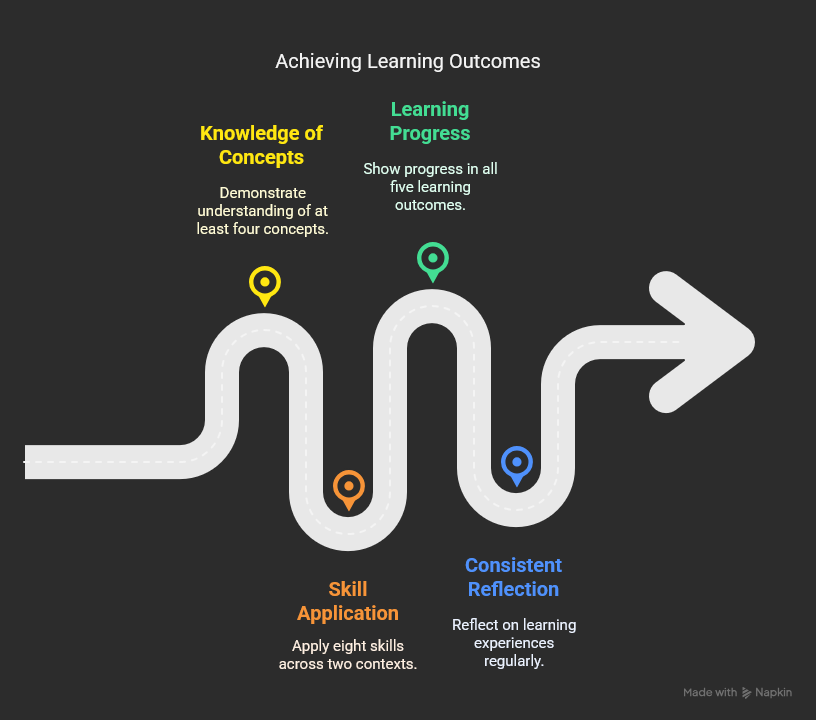
What does a successful portfolio look like?
A student should answer yes to these questions:
- Have you shown knowledge and understanding of a minimum of four concepts?
- Have you developed and applied a minimum of two skills from each skill domain (eight skills in total), in a minimum of two contexts over the course?
- Have you shown progress in learning in relation to all five learning outcomes?
- Have you consistently reflected on your learning?
Formative assessment
As you are getting your head around the new course, do look at the transversal skills in the 4 skill domains and think about how you are already exploring this in your existing core. A few points:
- This is not about making an absolute match; this is about recognising how much the new course complements existing good practice.
- What drives the new course is skill development rather than the themes.
- There are opportunities here to innovate through co-constructing inquiries with students as well as keep existing projects - perhaps with the view to reframing them so students take more agency in their development.
| Skill Domain | Transversal skills | Contexts ways these skills connect to the new core, CRS and DP courses. | Linking existing IB practice and old guide to new skill domains. |
| Intrapersonal skills: Know yourself! Developing your sense of self through knowing your own habits, personality traits, emotional responses and abilities means you have the self awareness and confidence to develop interests and goals as well identify strengths and areas for improvement. | Reflection and Reflexivity Resilience Self-advocacy Self-awareness Self-management | Resilience, self-advocacy, self-awareness and self-management develop through each core component and the programme courses across the 2 year course. Explicitly, reflection and reflexivity runs throughout LCS, CE, and, of course, Reflective Project. | Personal Development focuses on the self-awareness and developing goals and key to developing these transversal skills. Part of personal development leans clearly into becoming an effective communicator, thinking processes that support development and one's own ethical framework ATL: Self-management also connects here but also is clearly also one of the 5 ATL skills areas. Intrapersonal skills also connects clearly to Thinking skills as students learn how to develop the self. |
Interpersonal skills: Through communication, collaboration and teamwork you can learn how to interact with others and be confident doing so. More than that, you can develop skills to lead, manage and respond in multiple settings, ideal preparation for the world outside school. | Change management & conflict mediation Collaboration and networking Communication Leadership | Change management & conflict mediation, collaboration and networking, communication and leadership: these can play a role in CE projects working in teams and different contexts; Career-related Studies when navigating internship and new contexts; collaboration is important in the reflective project during peer feedback stages. | Effective Communication explicitly stands out as a link to Interpersonal Skills domain as students learn ways to work with others in different contexts. An outcome of this therefore is developing intercultural understanding and thinking processes to support communication skills. This also can be seen as an opportunity to explore applied ethics in context through communication skills such as debate. ATL: Communication and Social skills and the ATT of using teamwork and collaboration clearly link to the development of interpersonal skills. |
Thinking skills: Create a toolbox for diverse thinking involve cognitive processes that we use to solve problems, make decisions, ask questions, plan, organize and create. Critical and creative thinking, problem-solving and information literacy skills consistently top the list of skills necessary to successfully navigate our ever-changing world in a variety of contexts’. | Critical thinking Creative thinking Ethical decision-making Information literacy Problem-solving Reflection and reflexivity Systems thinking | Critical thinking, creative thinking, ethical decision-making, information literacy, problem-solving, reflection and reflexivity, systems thinking all play a role in the reflective project process from Criteria A, B, C, D and E. Ethics and ethical decision-making run as a thread throughout the core components alongside reflection and reflexivity. Critical and creative thinking as well as problem-solving apply in contexts such as CE as students use processes to work in different contexts. These same skills move knowledge to understanding in DP and CRS areas. | Thinking Processes explicitly link to the Thinking skills domain. However this, in context, is closely connected to Applied Ethics with ethical decision-making. An outcome of developing research and thinking skills is the development of intercultural understanding. ATL: Thinking skills and Research skills are somewhat interchangeable here. |
Intercultural understanding: Be an effective local and global citizen involves knowledge and understanding of our own culture, other cultures and the similarities and differences between cultures. It relies on a variety of interpersonal and intrapersonal skills, such as ethics, values and collaboration across cultures, as well as the social awareness and responsibility required to be an effective global citizen. These skills enable students to be effective and ethical participants in diverse settings | Civic and social responsibility Empathy Ethics and personal values Reflection and reflexivity Self-efficacy Social awareness | A skill domain that combines intrapersonal, interpersonal and thinking skills, LCS and CE provide contexts for students to explore their own culture and others developing civic and social responsibility, empathy, ethics and personal values, reflection and reflexivity, self-efficacy and social awareness. All these skills that form a sense of self and others' beliefs forms the centre of reflective and reflexive skills at the centre of forming a personal position in the reflective project. | Clearly, Intercultural Understanding explicitly links to this skill domain! However, as this skill domain draws on the other three skill domains, this also draws together intrapersonal, interpersonal and thinking skills so links to Personal Development, Effective Communication, Thinking Processes and Applied Ethics can be connected here. ATL: Thinking (eg reflection and reflexivity) Social (eg empathy, social awareness) Self-management (eg. self-efficacy) all play a part. |
Build reflective and reflexive practice in across the core
Reflective & reflexive tools
Creating a reflective and reflexive toolboxThe requirement to be reflective and reflexive is present in all four elements of the core; this is something that takes time to build up. Let's start with just...
From the student section
Inquiry 1: Who am I?
Focus: How can self-awareness help me achieve my goals as a learner?One of the transversal skills in the Intrapersonal skill domain is ‘self-awareness’. Here you are going to think about what makes...
Inquiry 2: Who am I with others?
The world in which I liveWhat role does culture play in your life? How do you connect what is happening directly around you with what is happening globally? Here we start to explore the significance of...
Supporting Teacher pages
Inquiry 1: Identity & Self-awareness
Focus: How can self-awareness help me achieve my goals as a learner?One of the transversal skills in the Intrapersonal skill domain is ‘self-awareness’. Here you are going to think about what makes...
Inquiry 2: Cultural connection & understanding
The world in which we liveWhat role does culture play in our lives? How do you connect what is happening directly around you with what is happening globally? Here we start to explore the significance...