Inquiry 7: How can thinking be part of success?

How can thinking skills help me throughout my CP?
The transversal nature of skills across becomes more understandable when we talk about thinking skills. In this set of inquiries, we explore thinking skills how they might work transversally across your core elements, DP courses, career-related subject/s as well as personal, professional and informal learning. Thinking routines really do work - they help you own what you are doing, create habits that build your understanding over time and avoid overwhelm.
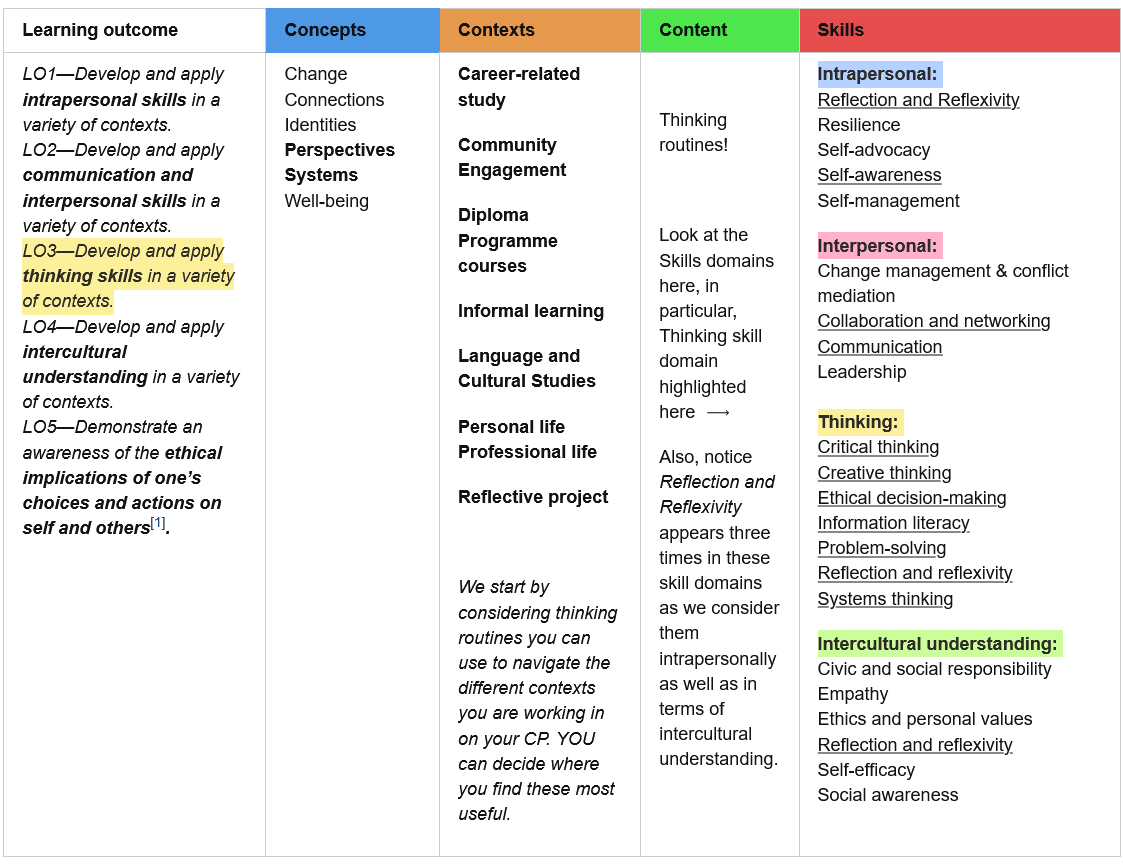
This Inquiry takes you through different ways thinking skills can develop any number of transversal skills across the PPS Skill Domains and allows you to consider where you might find these skills useful throughout your CP.
For this inquiry, we are going to explore a range of REFLECTIVE AND REFLEXIVE TOOLS which you can use across your CP, personal, professional and informal learning contexts. Doing this means we can activate the following types of thinking:
Metacognitive reflection: examine your thinking and its effects
Process reflection: explore the effect of actions
Critical reflection: think critically about the ‘why’ of actions and effects
Self-reflexivity: consider the effect of belief on yourself and others
Critical reflexivity: think critically about how & why beliefs come about, and how & why they have the impact they do
Intrapersonal Skills
What do Reflection and Reflexivity mean in the skill domain of Intrapersonal Skills? This routine is closely linked with creating a sense of self-awareness.
Who am I? Explore, Connect, Identify, Belong
This routine uses questioning and close observation to identify assumptions, bias and potential problems which also connects Intrapersonal Skills with the Thinking Skill of Information Literacy as well.
- This thinking routine invites you to go beyond superficial judgements and labelling that can occur regarding people, systems, objects or ideas.
- It encourages you to take a moment to consider what they really think rather than rushing into making a decision.
- You can continue to build your ideas over time and notice how your sense of who you are has changed and matured.
Think about who you are and then about someone else. Consider how you have become who you are, where you belong and what that can mean in our changing world.
Explore: Who am I? How has my identity developed?
Connect: eg I am connected to my parents, their parents and my brother and sister, and I'm in the basketball team. Who else and what else am I connected to? What else shapes my identity?
Identify: If I wanted others to know who I am, what would identify me? Do we have more than one identity?
Belong: Where do I think I belong? Do I have a sense of belonging to more than one group, more than one place?
 Reflect on what this thinking routine revealed about your identity and your sense of belonging. Were you surprised by any of your answers?

Where else might this routine be relevant?


You may have already explored this sort of thinking in Language and Cultural Studies and Community Engagement. As you build your understanding of the ethical dilemma at the heart of your Reflective Project, you will also develop a self-reflexive understanding of where you stand in relation to it.
Interpersonal Skills.
Here we can explore why Interpersonal Skills are needed when applying thinking skills as part of our skillset when working with others.
Sticking Points
 Skills development: Evaluating evidence and arguments
It can be hard to get to grips with complexities and controversies, especially in a classroom context where a debate is being encouraged.
- This thinking routine allows to consider different viewpoints on a big issue that opens up communication and the ability to collaborate.
- You can divide up into teams to follow this process. Use any of the debates and issues from the week to utilise this thinking process.
Look at the big issue in hand and consider it from four facets:
Facts: What facts do people differ on? What facts do they agree on?
Values: What values do people differ on? What values do they agree on?
Interests: What practical interests do people differ on? (consider investments, land, loyalties etc...)
Policies: What policies (ie general actions to take) to people differ on? What policies do they agree on?
Extend: Reflect after you have completed this on how it allowed you to communicate and collaborate effectively?
Where else might this thinking routine be relevant?

In your Career-related Studies, you will consistently use content, case studies and scenarios to explore different career-related contexts related to your studies. The same in your Diploma Programme Studies. You may have already explored this sort of thinking in Community Engagement as you explore ethical issues in the community context. You will also be asked to explore ethical issues not just in terms of the personal and relational dimension of community but also the wider systems at play As you build your understanding of the ethical dilemma at the heart of your Reflective Project, you will also develop a self-reflexive understanding of where you stand in relation to it but then critical reflexivity also plays a part as you think about the wider implications of this to society. In short, ‘so what’?
Intercultural Understanding
Now let's link our thoughts there to Reflection and Reflexivity in the skill domain of Intercultural Understanding
This skills domain also includes transversal skills: Civic and social responsibility, Empathy, Ethics and personal values, Self-efficacy and Social awareness so developing your reflective and reflexive skills from an intercultural understanding perspective will open up your development of these skills too.
'I used to think ... Now I think … and this means that'
 This is a really useful routine for showing the change in your own thought processes over time and what the implications of this are- great for the reflective project.
- A routine for reflecting on how and why thinking and beliefs about a cultural issue or ethical dilemma might have changed over time as your research develops.
 You could be studying a wide range of concepts in different subjects and this is useful for monitoring your changing ideas.
Write a response to the simple statements:
I used to think .... Now I think .... And this means that …
Extend: How does this process allow me to value cultural understanding and appreciate diversity in this context?
Where else might this thinking routine be relevant?
As you develop your language and cultural portrait, your self-reflexivity skills surrounding culture, beliefs and values will strengthen, sharpening your ability to observe how you and your thinking have changed. This is a skill you can take directly into the Reflective Project.
Intrapersonal Skills, Interpersonal Skills, Thinking Skills, Intercultural Understanding
↓ ↓ ↓ ↓
Know yourself + Work well with others + Question and problem-solve = Depth of knowledge and
understanding of cultures, ethics,
values and responsibility
Using 3-2-1 reflection to take responsibility for one's actions in academic, personal and professional situations
At the end of a lesson/event/internship/interview/study session, reflect on:
3 Things I have learnt or 3 Things I have learnt about myself
2 Questions I still have or 3 Questions I still have about myself
1 Challenge I face or 1 Challenge I personally face
Extend: How can this help me further in other academic, personal and professional situations?

This routine is a great thinking habit to use in your learning journal for LCS, CE and Reflective Project. It's another way to chart your progress and thinking over time.
Considering multiple perspectives is an important step in understanding how the world is complex and not straightforward.
It also means being open to challenging assumptions and bias to make fair and balanced decisions. This is very much part of the Thinking skill domain, particularly ethical decision-making. However, these skills also impact Intercultural Understanding skill development, such as Civic and social responsibility, Empathy, Ethics and personal values, Self-efficacy, Social awareness
Same and Different
A contradiction in terms, complexities in the world around us can often be accepted at face value. Being able to explore complexities can start with just a picture and a question. This can lead to a thorough and deep understanding from multiple perspectives which, in turn, can lead to independent, informed opinions and solutions.
Choose a current debate, incident, or object in which opposing views are clearly apparent, or images that look different but are grouped together. Alternatively, consider the gallery pictures below which are all on the subject of Protest.
Notice: Often judgements can be made at first glance. What was the first impression you had about this?
Perspective taking: From what other points of view could this be perceived? What would one say from those points of view?
Same and Different: What are the similarities? Differences? How is this case the same and different at the same time?


Share your work here with a peer and compare and contrast your response. Notice how you feel when you think the same as someone else as well as when you think differently. Are you willing to stand by your position you hold? Committing to your perspective and backing them with evidence is a crucial skill to develop over time for the Reflective Project.