CE: What is active engagement?
This inquiry enables students (and supervisors!) to understand what contributing to community really means using Community Engagement's Principles of Engagement. Students will be able to define what active engagement in the community is and be able to define and use the terms of dialogue, reciprocity and reflexivity. They will be able to apply these principles of engagement to considering their own projects. The accompanying resources enable both teacher-ledor student- directed learning. Thank you to Becky Duffy and Mary Rems for supporting resources here
What is active engagement?
Students will be able to define what active engagement in the community is and be able to define and use the terms of dialogue, reciprocity and reflexivity. They will be able to apply these principles of engagement to considering their own projects.
Dimensions of Community: Personal, Relational, Systems
Principles of engagement: Dialogue, Reciprocity, Reflection and Reflexivity
Process: Explore and Prepare, Relate and Act, Evaluate and Share
Learning outcomes: Reciprocal engagement, Systems awareness, Ethical thinking & action, Reflecting & reflective practice
You will find each Community Engagement page puts the building blocks of CE into action.
Whatever the topic, the process of ‘Explore and Prepare, Relate and Act, Evaluate and Share’ is used to embed these habits of dialogue, ethical, reflective and reflexive thinking in students that they can take into designing their own CE experiences independently.

Here are the resources to support this presentation.This inquiry can be whole class teacher led, group led, individual reflection or a mix of all three (the best!) The ppt and pdf should support whatever method you choose. Below this, there are detailed notes taking you through the supporting resources structured in the framework of a Community Engagement inquiry: Explore and Prepare, Relate and Act, Evaluate and Share.
 CE: What is active engagement? PPT
Explore and prepare: We gather the understanding and curiosity for community engagement opportunities by exploring the systems at play and what ethical action could look like. Through collaboration, we understand that goals must work for everyone in the community we are working with and not just individuals/one group.
Going global: what does community engagement look like around the world?
Researching what community engagement might look like requires being very specific and be prepared to go down many avenues as you collate examples. Where to start? One way is to pick an organisation wellknown for working with communities with clear aims such as the World Health Organisation and look for the commonalities in their projects. This can lead us to a greater understanding of what working in the community can look like.
Look at this headline[1]
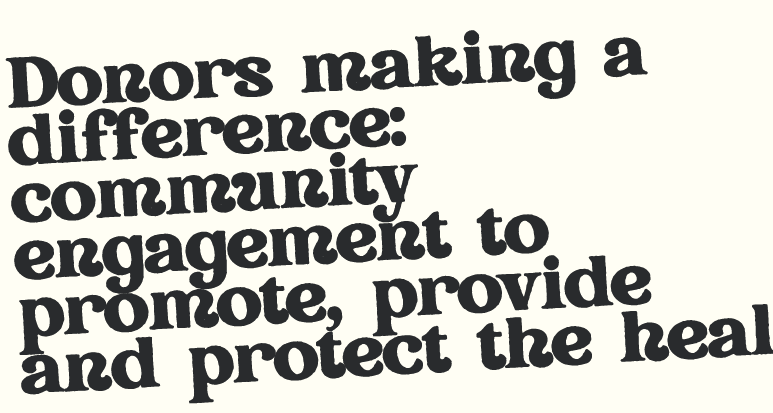

What does this suggest about the different factors involved in community engagement? What perspectives might people hold about how to contribute to society?
This is an interesting headline as it captures multiple attitudes towards community engagement. The first clause - ‘donors making a difference’ - might prompt suggestions of fundraising being an important factor in community work and this can open up interesting discussions about service learning and quite an individualistic approach to community work. You might also have comments about the purpose of the projects being clear and multi-faceted in how they address real concerns in a community. The simple answer to what community engagement is … is actually engaging the community you are working with.
What makes success in community engagement?
- Pick a subheading from the article and consider how you think this community project became successful. What action would you take in these scenarios to engage the community?
- Now look at a few examples in the article itself. Who benefits in each of the projects and how do they benefit? What role does communication play? Who holds the power?
Uganda trains district health workers on community-based approach to Ebola
Community engagement for access to health services in Lao PDR
Côte d'Ivoire community radios boost public awareness on mpox outbreak
Bolivia strengthens social participation in health for indigenous population
Weaving hope in Honduras: the community wisdom that saves lives
Grassroots heroes in Cambodia
Bolstering public awareness to help curb mpox spread in Uganda
Combating measles: a comprehensive community-centred approach in Ethiopia
WHO races to contain malaria resurgence in southeastern Iran
Mali: screening for malnutrition in affected children to avoid complications
Effective community engagement saving lives in Tanzania during cholera outbreak
Connect to the learning outcomes
You have looked at some global examples of impactful projects which starts to give you an idea of what active community-driven engagement can look like. Now discuss what the learning outcomes suggest about what community engagement is all about.
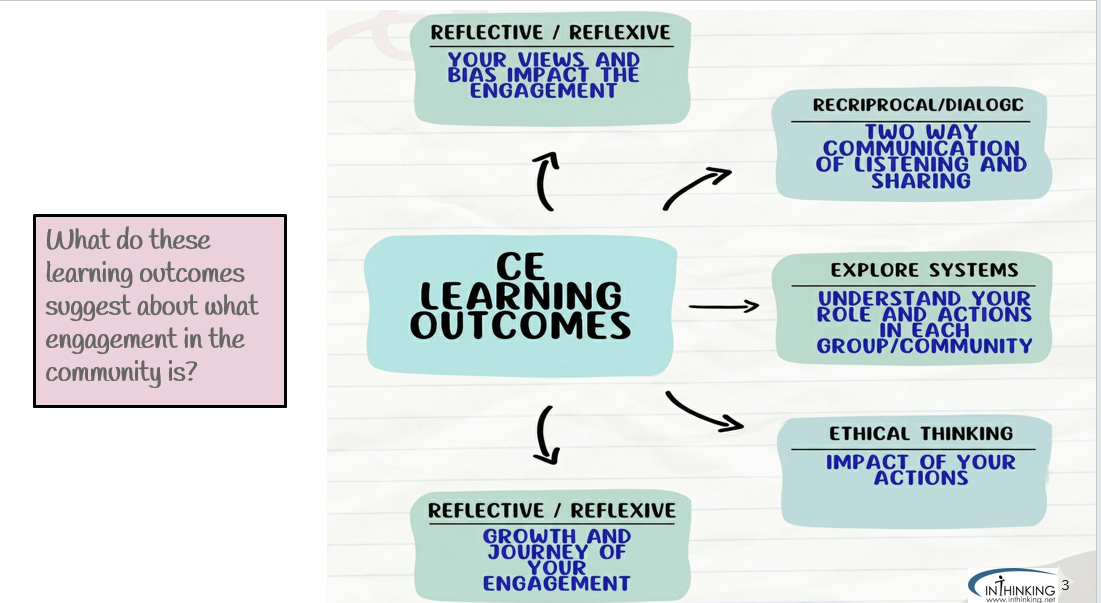
Relate and Act: We get involved, we think deeply and we are not alone! Dialogue means a two-way communication process, collaboration means working with others and there is an understood and communicated mutual benefit of doing this. This is the place to consider how are actions are ethical so we make deliberate choices that are aligned with our and the community's values.

Going local: How can I connect this to my experiences?
This relates to slides 7 and 8 Before you look below, consider how you would define Reciprocity, Dialogue, Reflection, Reflexivity? See how your definitions compare to the definitions below. Then take time exploring slides 10-16, picking out the words and phrases that are most meaningful to you.
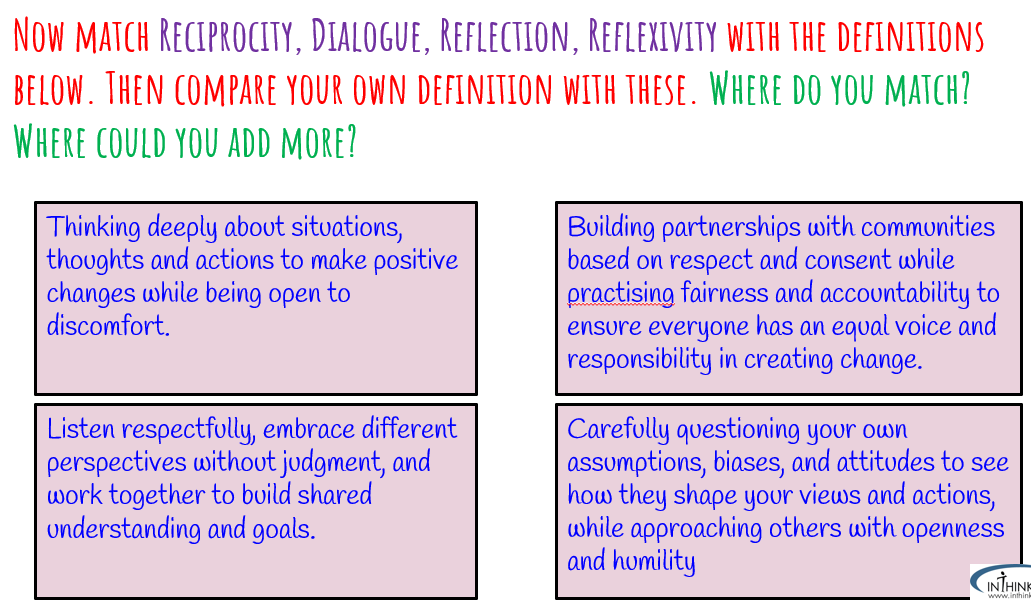
Answers:
Top left: Reflection
Top right: Reciprocity
Bottom left: Dialogue
Bottom right: Reflexivity
Take action
You can refer directly to slide 17 in the presentation or the details here. Download the attachment here for Community Engagement Brainstorming:
●identify 3 communities
●explain your ideas for engagement
●make notes on how you can foster reciprocal and dialogic engagement with them.
Evaluate and Share: Reviewing and reflecting upon your CE experiences enables us to connect to other experiences, learning, the learning outcomes and take us to a deeper understanding of concepts: the big picture! We share our experiences as an essential part of a social process that connects us as human
Using your Community Engagement Brainstorming activity from above, discuss your ideas with a partner/group and give feedback to each other on what is great and ‘glows’ and what could develop further and ‘grow’
TIP: Remember you can always use the ladder of feedback[2] to help you structure your thoughts.
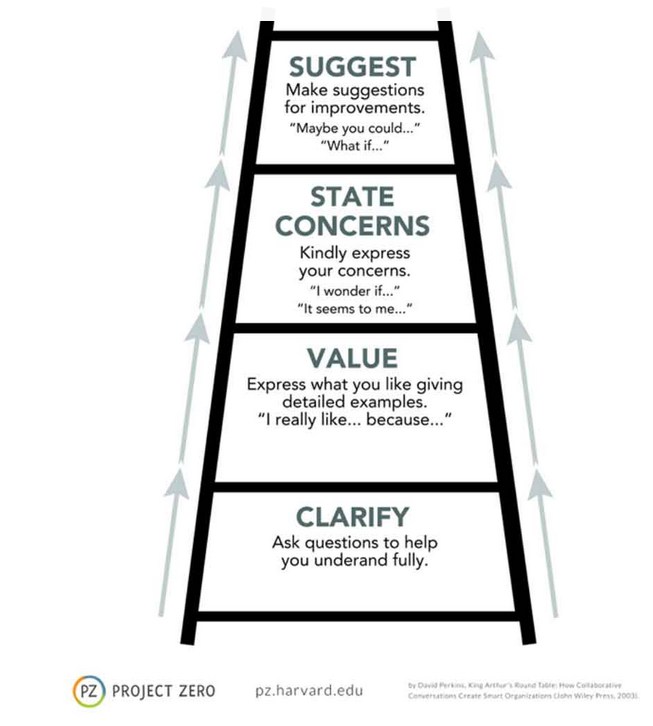
Come full circle: Revisit the article from the first stage of this inquiry. Now you have explored what dialogue, reciprocity, reflection and reflexivity mean in active community engagement, where can you see these playing a part in the examples given here.
World Health Organisation projects article
Can you find further examples?
Footnotes
1. The World Health Organisation, https://www.who.int/news-room/feature-stories/detail/donors-making-a-difference--community-engagement-to-promote--provide-and-protect-the-health-and-well-being-of-all 28th February 2025, accessed 7th April 2026
2. Harvard Project Zero, Ladder of Feedback