Inquiry 6: Recognising and reflecting on growth

Lifelong learners = Works-in-progress!
This inquiry supports the student inquiry Inquiry 6: Who am I becoming? which ideally could be used when students have been doing the CP for a while. They will have experiences from career-related studies, DP subjects, Community Engagement, Language and Cultural Studies, and possibly halfway through starting the Reflective Project. Additionally, they will have had experiences in personal and professional contexts with a wide range of people. How do all these add up to how they are developing as a person? How can you support this reflection of how they are developing and what does this mean to them?
The why

 In the very first inquiry you asked Inquiry 1: Who am I? as an introduction to the topic of 'Self-awareness' and 'Self-management' in the intrapersonal skill domain*. We also looked into how we respond to change and become an effective reflective learner.
Looking to be a polished, finished product? Perfectionism is a tough, anxiety-ridden pathway. Let's embrace being a lifelong learner and realise it's more productive to ask, 'Who am I becoming?'; we recognise we are all a work in progress and developing all the time. However, we have to work at this self-awareness business and commitment to lifelong learning. It's likely that you are looking at this inquiry, partway through your course, so it's a good time to do a stock-take of how far you have come and where you want to go.
*A quick reminder that throughout this course, we might use specific learning outcomes, concepts, contexts, transversal skills and skill domains as starting points/lenses/'ways in' to explore the interconnected nature of all the learning outcomes, concepts, contexts, and skills.
Building on the why

Teacher notes: Setting the tone here for how we look at development must start with embracing failure as part of growth. This short video from Michael Jordan is not new! However it is a still such a great way to shift away thinking from a linear path of continued success. Is there a way to recognise or even celebrate the bumps along the way?
Then lead the students into considering the PPS learning outcomes, concepts, contexts, skill domains and transversal skills here and consider how familiar they are with them now. They can make a note or discuss with a partner how they have come up in your life within and outside of the CP.
With the following questions, encourage students to think about not just the answer to the question but why it matters. A reflexive routine of: why does this matter to me? Why does this matter to the people around me? Why does this matter to the world? can invite interesting conversations - all answers are valid, especially if students cannot see the relevance and question a skill's importance. Embrace those conversations.
Which learning outcomes, concepts, contexts, skill domains and transversal skills jump out at you as areas you feel you are regularly exploring?
Which ones do you feel you are really progressing in?
Which ones are you struggling with? Are there some areas where you struggle with it more than others?
Are there any you do not feel you have accessed at all yet?

 Consider the learning outcomes, concepts, contexts, skill domains and transversal skills here and consider how familiar you are with them now. Make a note or discuss with a partner how they have come up in your life within and outside of the CP.
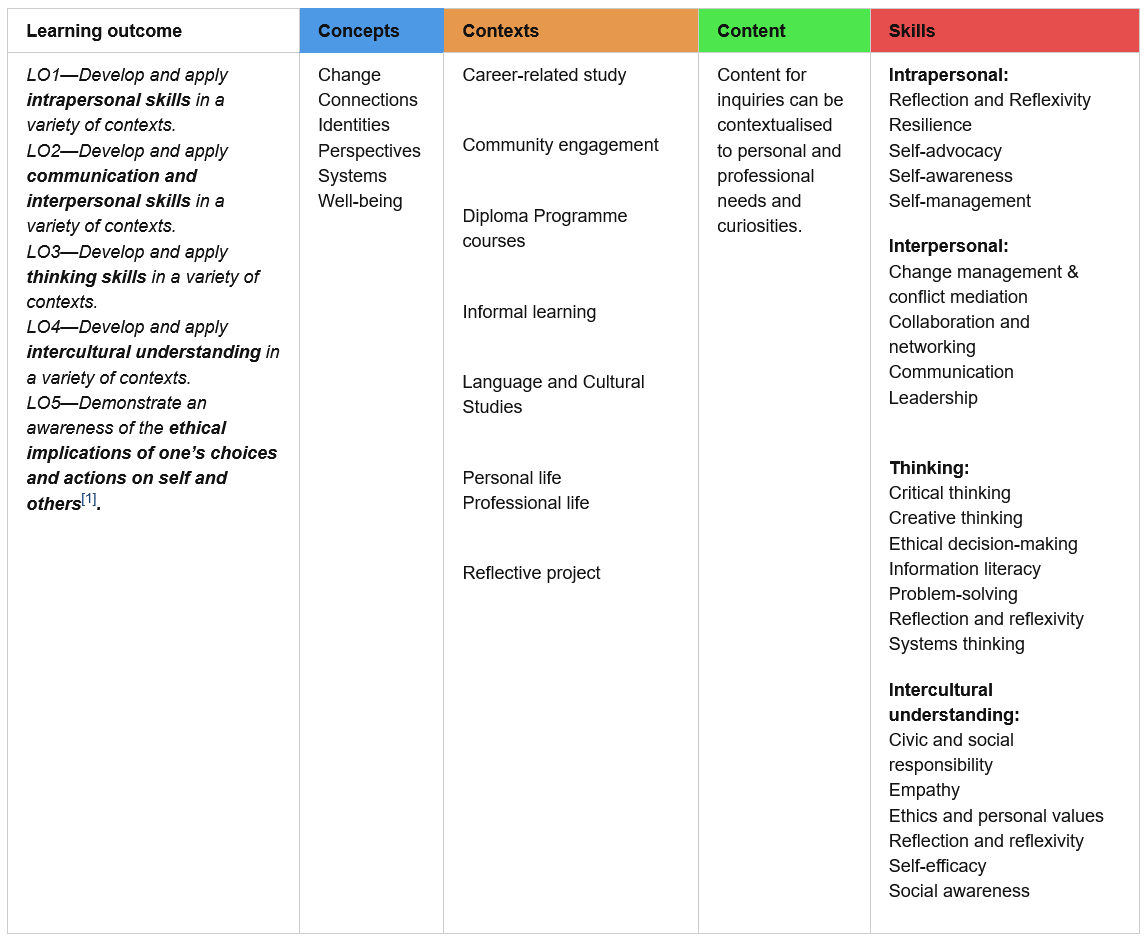
Which learning outcomes, concepts, contexts, skill domains and transversal skills jump out at you as areas you feel you are regularly exploring?
Which ones do you feel you are really progressing in?
Which ones are you struggling with? Are there some areas where you struggle with it more than others?
Are there any you do not feel you have accessed at all yet?
Teacher notes:
This part of the inquiry asks students to reflect on their initial vision board when they started the course in Inquiry 1: Who am I?. You can extend this activity to students looking at their initial development in multiple areas of the core; Language and Cultural Studies and their Language and Cultural Portrait would make a great basis for discussion as well. Do note the extension to the familiar thinking routine of ‘I used to think … but now I think … and that might mean’ to encourage students to consider the impact of their development. You can change this easily to ‘…and the impact of that is …’ or ‘this matters because…’.
Communicating who I am becoming. Remember your Vision board: All about me? from Inquiry 1: Who am I? Here is a little visual to remind you.

 Where did your focus lie? How would you add to it now? Could you extend your vision board to capture your past, present and future? Have any of your priorities changed?
Pick someone you feel comfortable talking to about your vision board review. Use the thinking routine 'I used to think ... but now I think...' as a way of structuring your thoughts about who you are becoming and how you think you are changing.
Teacher notes: It’s important to lead students to go beyond shallow judgements and labels about people, systems, objects, or ideas. Remind students that to do this, we need:
•Time: take a moment to consider what you really think and not rush to make a decision.
•Scaffold: You can keep building your ideas over time and notice how your ideas about who you are change and mature.
Identifying strengths and areas for growth
Who am I? Explore, Connect, Identify, Belong
 This thinking routine invites you to go beyond shallow judgements and labelling that can happen in relation to people, systems, objects or ideas. It encourages you to take a moment to consider what you really think and not rush to make a decision. The nature of this thinking routine means that you can continue building your ideas over an extended period of time and notice how your ideas about who you are have changed and matured.

In your learning journal, think about who you are and then about someone else.
Explore: Who am I? How has my identity developed?
Connect: eg I am connected to my parents, their parents and my brother and sister and I'm in the basketball team. Who else and what else am I connected to? What else shapes my identity?
Identify: If I wanted other to know who I am, what would identify me? Do we have more than one identity?
Belong: Where do I think i belong? Do I have a sense of belonging to more that one group, more than on place?
Reflect: How does this exercise consider your strengths and areas for growth?
Consider how you have become who you are, where you belong and what that can mean in our changing world. You can reflect on your work from the previous modules in the student section, with particular attention to Inquiries 1 and 2.
Inquiry 1: Who am I?
Inquiry 1.1 How can my mindset impact how I respond to change?
Inquiry 1.2 How can I be a reflective and reflexive learner?
Inquiry 2: Who am I with others?
Inquiry 2.2 How can intercultural understanding develop empathy?
Inquiry 2.3 How can I develop skills in the community?
Teacher notes: You might like students to explore the questions here first or choose the ones they feel are most relevant to them. Then use the Learner Profile attributes as a way students can articulate the growth they have experienced. The powerpoint gives you this option.
Look back on all your responses from this page and use the IB Learner Profile as a reflection tool. How are you developing those attributes?
Balanced Risk-taker Reflective Communicator
Open-minded Caring Knowledgeable Principled Inquirer Thinker
Reflect on the last year and consider your answers to the following tasks and questions
1. If you could pick 5 words to describe the last year, what would they be?
2. When did you feel most comfortable and at ease over the last year?
3. What are you most grateful for?
4. What were the hardest challenges in the last year?
5. What have you learnt about your values? Have they changed? Have you become more aware of what they are?
6. What relationships have been the most important to you? Have you forged new ones?
7. Who uplifts and inspires you? Why?
8. What could you have done this last year differently?
9. Name three things that make you happy?
10. Finish this sentence: this time next year, I hope to feel ...
Teacher notes: This point of the inquiry is an opportunity not just for students to reflect on the PPS learning outcomes but also to explore alternative communication formats that can come in useful for their Reflective Project; whether they choose a format that they might be considering developing in their RP or using a presentation which will enable them to grow in confidence ahead of the presentation in Phase 4 of the RP. You really are flexible how you choose to mark this moment in the students' development but this could be a good moment for celebration and a formal assessment point. At least a significant self assessment point.
This inquiry is deeply reflective so you will have generated lots of thinking to shape and curate now.
Using the learning outcomes as your lens, create a presentation in any format entitled ‘Who I am becoming’.
LO1—Develop and apply intrapersonal skills in a variety of contexts.
LO2—Develop and apply communication and interpersonal skills in a variety of context
LO3 – Develop and apply thinking skills in a variety of contexts
LO4—Develop and apply intercultural understanding in a variety of contexts.
LO5 - Demonstrate an awareness of the ethical implications of one’s choices and actions on self and others
How will you share your findings from this inquiry?
Consider a written, visual, audio, or audio-visual format you would like to communicate your progress in and define the purpose, audience, language and structure you will use.