Internal Assessment

 Your internal assessment in mathematics is called The Mathematics Exploration, it is an extended piece of work that you are required to complete during the course. The Exploration provides you with the opportunity to engage in an independent investigation and explore a mathematical topic of your choice. The pages in this section are here to help you with this task. You will learn all you need to know to gain the best possible mark, as well as choose a personal exploration that interests you. The process can be rather daunting. Don't worry, after going through these pages, all will be illuminated!
What is it?
Your internal assessment in mathematics is an individual mathematical exploration: a written project based on a topic or question that you choose. It gives you the opportunity to investigate an area of mathematics that interests you and to demonstrate your understanding of mathematics from the course.
Unlike an examination, you have time to develop an idea, try different approaches, use technology where appropriate and think about what your results mean. Your exploration might involve modelling, an investigation, an application of mathematics, data analysis or a more theoretical mathematical idea. Whatever you choose, the main focus should be on the mathematics.
Why do we do it?
The exploration gives you the opportunity to work more independently as a mathematician. You can ask your own questions, make mathematical decisions, investigate ideas over an extended period and reflect on what you discover.
The aim is not simply to complete a long piece of coursework, but to give you an opportunity to experience some of the creativity, usefulness and power of mathematics.
How long?
The exploration should normally be approximately 12 to 20 pages in length, using double spacing and including graphs, tables and diagrams. The bibliography is not included in this page count.
However, there is no prize for reaching 20 pages! The quality of your mathematical writing is much more important than the length. A focused 13-page exploration can be much better than a repetitive 20-page one.
How much time will I spend on it?
The IB recommends approximately 10 to 15 hours of teaching time for the exploration. This includes time to understand the requirements, work on your investigation, discuss your progress with your teacher and receive feedback. In practice, the whole process from choosing an idea to submitting your final exploration will take place over several weeks or months.
What is it worth?
The exploration is marked out of 20 and counts for 20% of your final Mathematics grade at both SL and HL.
How will it be graded?
Your teacher will grade your exploration and the IB will then moderate a sample of work from your school to check that the marking is consistent with IB standards.
You are assessed using five criteria:
Presentation (4 marks)
Mathematical communication (4 marks)
Personal engagement (3 marks)
Reflection (3 marks)
Use of mathematics (6 marks)
The first four criteria are the same for SL and HL. The expectations for Use of mathematics are different for SL and HL because the mathematics should be appropriate to the level of the course you are studying.
There is a complete page dedicated to understanding the assessment criteria so that you can give yourself the best possible chance of scoring highly. How to Score Well on Your Mathematical Exploration
Am I allowed help?
Yes. You are encouraged to discuss ideas with your classmates and you can work collaboratively when generating ideas, selecting possible topics, finding useful sources and giving each other feedback.
You should also discuss your exploration with your teacher throughout the process. Your teacher can help you identify productive directions, suggest useful sources and point out problems with your work. Your teacher is allowed to give you feedback on one draft, but cannot rewrite or correct the exploration for you.
The final exploration must be your own work. The writing, calculations, mathematical arguments and conclusions that you submit must be yours, and any material or ideas taken from another source must be properly referenced.
Can I use Artificial Intelligence tools like ChatGPT?
AI tools can be useful during the process, for example when brainstorming possible directions or helping you identify things that you might want to research further. However, the exploration that you submit must demonstrate your own mathematical thinking and understanding.
You should not use AI to produce mathematical explanations, analysis or written sections and then present them as your own work. Any material generated by AI that is included in your final exploration must be acknowledged appropriately, just like material taken from any other external source.
More importantly, remember what you are being assessed on: your mathematical choices, your understanding, your reflection and your engagement with the mathematics. Having somebody, or something, do these things for you rather defeats the purpose of the exploration.
How do I come up with an idea?
This is often the most difficult part! A good starting point is to think about something that genuinely interests you and then ask yourself whether there is an interesting mathematical question hidden inside it.
You might start with a sport, a game, music, economics, architecture, science, technology or another subject that interests you. You might instead begin with a piece of mathematics from the course that you would like to investigate further.
Looking at previous exploration titles and completed examples can help you understand the type and scope of investigation that works well. AI tools may also help you brainstorm possibilities, but the final choice and development of the idea should be yours.
There is a complete page dedicated to coming up with Exploration Ideas.
Do I have to use difficult mathematics to get a good mark?
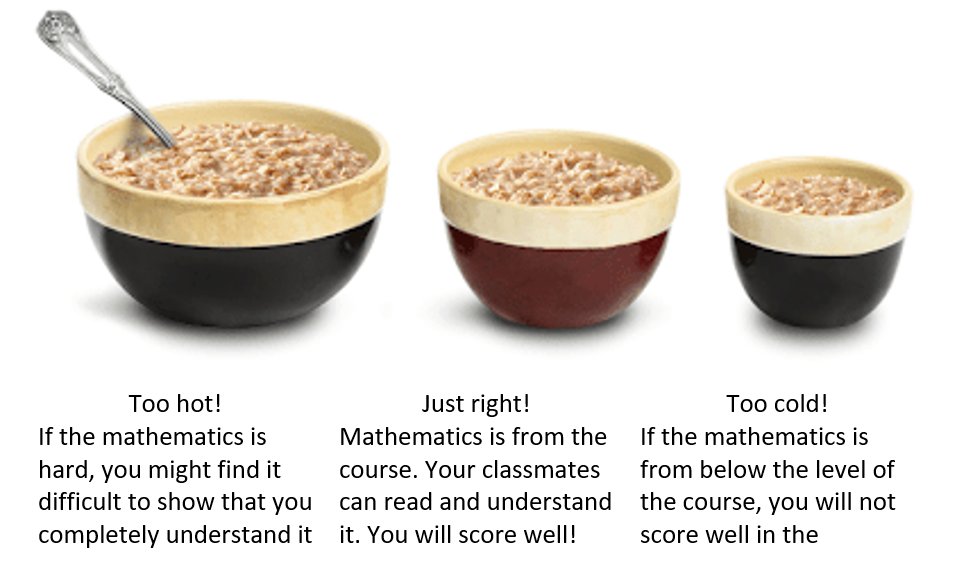
No, definitely not! You should use mathematics that is appropriate to the level of the course you are studying and, most importantly, mathematics that you understand.
If you are an SL student, the mathematics should normally be at approximately SL level. If you are an HL student, you should use mathematics appropriate to HL. Neither SL nor HL students are required to learn complicated mathematics beyond the syllabus simply to impress the examiner.
In fact, students who choose very advanced mathematics that they do not properly understand often score less well. It is usually much better to use slightly simpler mathematics and explain it, apply it and understand it really well.
Think of it a little like the porridge in Goldilocks and the Three Bears: the mathematics should not be too simple, and it certainly does not need to be unnecessarily complicated. You are looking for mathematics that is just right for you and your course.