Home of real teaching & learning
  • Full support for teachers
  • Focus on critical thinking
  • Engaging classroom activities
  • Integrated student eBook
  • Assessed tasks / qBank
  • Practice exam questions

The InThinking Guarantee: Our sites are written by expert practitioners and not by AI

See our AI policy

Disclaimer: InThinking subject sites are neither endorsed by nor connected with the International Baccalaureate Organisation.

Don't miss out, find out!

Arithmetic Sequences


HL SL An arithmetic sequence is a sequence in which the same value, called the common difference, is added to each term to obtain the next term. For example, the sequence 1,5,9,\ldots has common difference 4. There are formulae in the formula booklet to help with this topic, but it is useful to understand how they are constructed and when to use them. Exam questions often connect arithmetic sequences and series with other areas of mathematics, and this page provides practice with these ideas.


Key Concepts

On this page, you should learn to

  • Use the formula for the nth term of an arithmetic sequence
  • Use formulae for the sum of the first n terms of an arithmetic series
  • Use \sum notation for sums

Essentials

The following videos will help you understand all the concepts on this page.

Arithmetic sequence: nth term

In the following video, we will see where the formula for the nth term of an arithmetic sequence comes from.

Notes from the video

Print from here

Arithmetic sequences: finding terms

In the following video, we look at a typical exam-style question about arithmetic sequences. We do not have to be too reliant on the formula for the nth term to be able to find terms in a sequence.

The 5th term of an arithmetic sequence is 35 and the 10th term is 85.

What is the 20th term?

Notes from the video

Print from here

Arithmetic sequences: problem solving

In the following video, we will look at a typical exam-style question. We can use the information in the question to set up and solve two equations. We are going to concentrate on how we can make the equations easier to solve.

Three numbers are consecutive terms in an arithmetic sequence.

They add to give 45 and when they are multiplied together we get 2640.

What are the three numbers?

Notes from the video

Print from here

Arithmetic Series

When we add terms of a sequence together, we call it a series:

arithmetic sequence 1 , 4 , 7 , 10

arithmetic series 1 + 4 + 7 + 10

There are two useful formulae for the sum of the first n terms of an arithmetic series.

{ S }_{ n }=\dfrac { n }{ 2 } ( { U }_{ 1 }+{ U }_{ n } )

{ S }_{ n }=\dfrac { n }{ 2 } ( { 2U }_{ 1 }+(n-1)d )


In the following video, we look at a typical exam-style question which involves the sum of an arithmetic series.

The sum of the first 11 terms of an arithmetic series is 3 times the sum of the first 5 terms.

The 8th term is 53. Find the common difference.

Notes from the video

Print from here

How many terms?

In the following video, we look at a typical exam-style question which involves the sum of an arithmetic series.

For the following sequence 28 , 25 , 22 ,...

  1. Which is the first negative term of the sequence?
  2. Which is the first term of the series that makes the sum of the series become negative?

Notes from the video

Print from here

Summary

Arithmetic Sequences 

An arithmetic sequence has a common difference
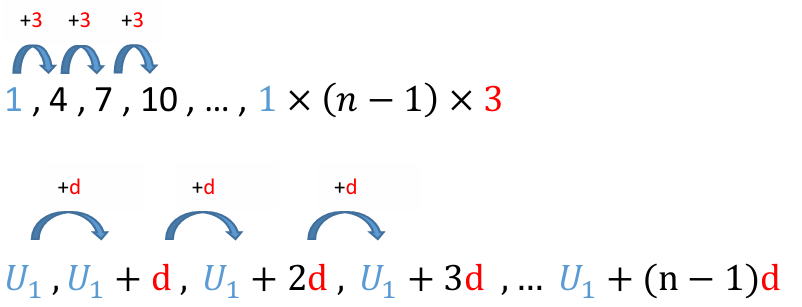
Arithmetic sequence notation and the nth-term formula

The nth term of an arithmetic sequence is U_n=\color{#4F81BD}{U_1}+(n-1)\color{red}{d}

Arithmetic Series 

A series is formed when the terms of a sequence are added: 1+4+7+10.

S_n=\dfrac{n}{2}(U_1+U_n). This is useful when we know U_n

S_n=\dfrac{n}{2}(2U_1+(n-1)d). This is useful when we do not know U_n

Solving Problems with GDC 

You can make good use of your graphical calculator to find out how many terms there are in a sequence. The table function is particularly useful:
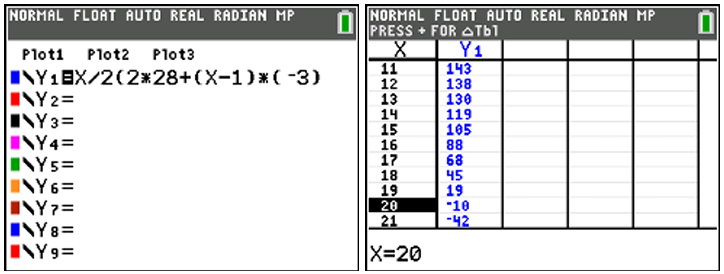
Graphical calculator table used with an arithmetic sequence

Test Yourself

Here is a quiz that practises the skills from this page.

Quiz Arithmetic Sequences Quiz

Exam-style Questions

Question 1

HL easy SL easy No calculator

In an arithmetic sequence, the first term is 4 and the third term is 16.

a) Find the common difference.

b) Find the eighth term.

c) Find the sum of the first eight terms.

Hint

a) How many differences are there between the first and the third term?

c) { S }_{ n }=\dfrac { n }{ 2 } ( { U }_{ 1 }+{ U }_{ n} )

Full Solution

a)

\displaystyle 4,\ U_2,\ 16

\displaystyle 16=4+2d

\displaystyle 12=2d

\displaystyle d=6

First term is 4.

Third term is 16.

There are two common-difference intervals between the first and third terms.

b)

\displaystyle U_8=U_1+7d

\displaystyle U_8=4+7\times6

\displaystyle U_8=4+42

\displaystyle U_8=46

Find the eighth term.

c)

\displaystyle S_n=\dfrac{n}{2}\bigl(2U_1+(n-1)d\bigr)

\displaystyle S_8=\dfrac{8}{2}\bigl(2\times4+(8-1)\times6\bigr)

\displaystyle S_8=4(8+7\times6)

\displaystyle S_8=4(8+42)

\displaystyle S_8=4(50)

\displaystyle S_8=200

Find the sum of the first eight terms.

\displaystyle S_n=\dfrac{n}{2}(U_1+U_n)

\displaystyle S_8=\dfrac{8}{2}(U_1+U_8)

\displaystyle S_8=4(4+46)

\displaystyle S_8=4(50)

\displaystyle S_8=200

Alternatively, use this formula.

Question 2

HL easy SL moderate No calculator

Three consecutive terms of an arithmetic sequence are x-3,\ 12,\ 3x-5.

Find x.

Hint

d=U_2-U_1

d=U_3-U_2

Full Solution

Find x

Find the common difference

\[ \begin{aligned} U_2-U_1 &= 12-(x-3)\\ &= 15-x \end{aligned} \]

\[ \begin{aligned} U_3-U_2 &= 3x-5-12\\ &= 3x-17 \end{aligned} \]

\[ \begin{aligned} 3x-17 &= 15-x\\ 4x &= 32\\ x &= 8 \end{aligned} \]

\[ x-3,\ 12,\ 3x-5 \]

\[ 5,\ 12,\ 19 \]

Check that the result makes sense.
Substitute into the original expressions.

Arithmetic sequence with d=7

Question 3

HL easy SL moderate Calculator

The 2nd term of an arithmetic sequence is 19 and the 5th term is 37.

a) Find the tenth term.

b) The sum of the first n terms of this sequence exceeds 1000. Find the least value of n.

Hint

a) Find d by considering how many common-difference intervals there are between the second and fifth terms.

b) You can solve this algebraically or you could make good use of the table function on your graphical calculator.

Full Solution
U_1,\ 19,\ U_3,\ U_4,\ 37,\ldots

37=19+3d

18=3d

6=d

U_1=13

U_{10}=U_1+9d

U_{10}=13+9\times6

U_{10}=13+54

U_{10}=67

2nd term is 19

5th term is 37

There are three common-difference intervals from the second to the fifth term.

b)

S_n=\dfrac{n}{2}(2U_1+(n-1)d)

S_n=\dfrac{n}{2}(2\times13+(n-1)\times6)

S_n=\dfrac{n}{2}(26+6n-6)

S_n=\dfrac{n}{2}(20+6n)

S_n=10n+3n^2

sum of the first n terms

10n+3n^2>1000

sum of the first n terms of this sequence exceeds 1000

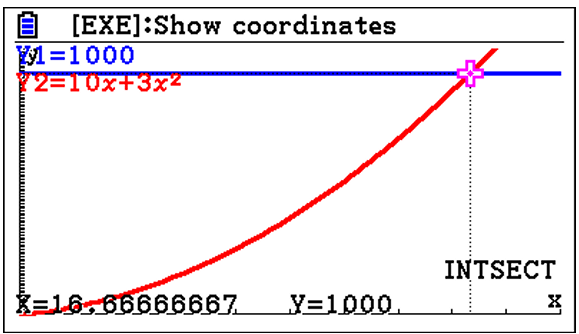
Graphical solution of the inequality for the number of terms

\begin{aligned} &\text{Our graphical calculator can help}\\ &\text{Plot } y=3x^2+10x\\ &\text{And } y=1000 \end{aligned}

Therefore, the least value is n=17.

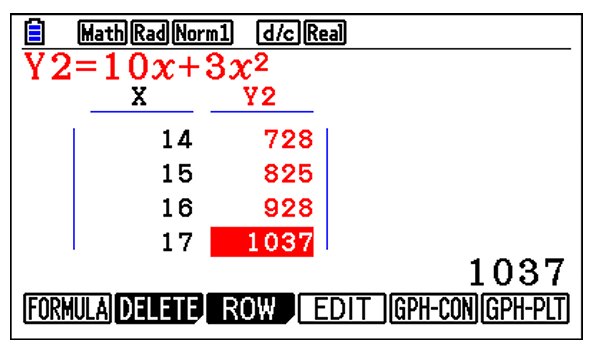
S_{16}=928

S_{17}=1037

We can also use the table function:

Calculator table showing the least number of terms

Question 4

HL easy SL moderate Calculator

Find the sum of all the integers between 100 and 1000 that are divisible by 9.

Hint

The challenge is to recognise that this is a question that requires finding the sum of an arithmetic series.

What is the first integer after 100 that is divisible by 9?

What is the last integer before 1000 that is divisible by 9?

Full Solution

U_1=108

The first integer after 100 divisible by 9 = 108

U_n=999

The last integer before 1000 divisible by 9 = 999

The common difference = 9
How many terms in the sequence?

\[ \begin{aligned} U_n &= U_1+(n-1)d\\ 999 &= 108+9(n-1)\\ 891 &= 9(n-1)\\ 99 &= n-1\\ n &= 100 \end{aligned} \]

Find the sum of the first 100 terms.

\[ \begin{aligned} S_n &= \dfrac{n}{2}\bigl(2U_1+(n-1)d\bigr)\\[6pt] S_{100} &= \dfrac{100}{2}\bigl(2\times108+99\times9\bigr)\\[6pt] S_{100} &= 55\,350 \end{aligned} \]

Question 5

HL moderate SL difficult No calculator

An arithmetic sequence has first term U_1 and common difference d. The sum of the first 17 terms is 136.

a) Show that U_1+8d=8.

The sum of the 2nd and the 3rd terms is 42.

b) Find d.

The nth term of the sequence is U_n.

c) Find the value of \displaystyle \sum_{r=4}^{17}U_r.

Hint

a) S_n=\dfrac{n}{2}\bigl(2U_1+(n-1)d\bigr)

b) U_2+U_3=(U_1+d)+(U_1+2d)

c) sum of the first 17 terms - sum of the first 3 terms

Full Solution

a)

The sum of the first 17 terms is 136.

\displaystyle S_n=\dfrac{n}{2}(2U_1+(n-1)d)

\displaystyle 136=\dfrac{17}{2}(2U_1+(17-1)d)

\displaystyle 136=\dfrac{17}{2}(2U_1+16d)

\displaystyle 136=17(U_1+8d)

\displaystyle \dfrac{136}{17}=U_1+8d

\displaystyle 8=U_1+8d

b)

The sum of the 2nd and the 3rd terms is 42.

U_2 + U_3 =42

U_1+d {}+{} U_1+2d {}=42

2U_1+3d=42

Solve the simultaneous equations

U_1+8d=8

2U_1+3d=42

Eliminate U_1

2U_1+16d=16

2U_1+3d=42

13d=-26

d=-2

c) Find the value of

\displaystyle \sum_{r=4}^{17}U_r

This is

sum of the first 17 terms - sum of the first 3 terms

\displaystyle \sum_{r=1}^{17}U_r=136

Sum of first 17 terms = 136

\displaystyle \sum_{r=1}^{3}U_r=U_1+U_2+U_3

Sum of first 3 terms = U_1+U_2+U_3

The sum of the 2nd and the 3rd terms is 42.

Sum of first 3 terms = U_1+42

Find U_1

8=U_1+8d

8=U_1+8(-2)

24=U_1

Sum of first 3 terms = 24+42=66

\displaystyle \sum_{r=4}^{17}U_r=136-66=\mathbf{70}

Question 6

HL moderate SL difficult No calculator

In an arithmetic sequence, the 9th term is 4 times the 5th term. The sum of the first 2 terms is -13.

Find the tenth term.

Hint

Set up and solve two simultaneous equations using the information given.

U_9=4U_5 and S_2=-13

There is no need to use the full formula for the information about the sum since S_2=U_1+U_2

Full Solution

Find the 9th term and the 5th term

U_9=U_1+8d

U_5=U_1+4d

the 9th term is 4 times the 5th term

U_1+8d=4(U_1+4d)

U_1+8d=4U_1+16d

0=3U_1+8d

The sum of the first 2 terms is -13

U_1+U_2=-13

U_1+U_1+d=-13

2U_1+d=-13

Solve the simultaneous equations

3U_1+8d=0

2U_1+d=-13

6U_1+16d=0

6U_1+3d=-39

Eliminate U_1

13d=39

d=3

Substitute into one of the equations.

2U_1+d=-13

2U_1+3=-13

2U_1=-16

U_1=-8

Find U_{10}

U_{10}=U_1+9d

U_{10}=-8+9\times3

U_{10}=19

Question 7

HL moderate SL difficult No calculator

The first terms of a sequence are \log_3x,\ \log_3x^2,\ \log_3x^3,\ldots, where x>0.

Find x if the sum of the first nine terms is 135.

Hint

  • The terms in this sequence are arithmetic.
  • This question requires a good knowledge of the laws of logarithms.

\log_c a+\log_c b=\log_c(ab)

\log_c a-\log_c b=\log_c\bigl(\dfrac{a}{b}\bigr)

  • Find an expression for the common difference and then use the arithmetic-series formula.

Full Solution

\log_3 x,\ \log_3 x^2,\ \log_3 x^3,\ldots

The terms in this sequence are arithmetic.
Since logarithms are defined, x>0.
Consider the first two terms.

d=\log_3\)\(x^2\) \(-\log_3\)\(x\)

Use log laws to simplify:

\log_c a-\log_c b=\log_c(\dfrac{a}{b})

d=\log_3 ( \dfrac{\color{#008fd5}{x^2}} {\color{#00a651}{x}} ) =\log_3 x

Check with 2nd and 3rd terms

d=\log_3\)\(x^3\) \(-\log_3\)\(x^2\) \(=\log_3 ( \dfrac{\color{#008fd5}{x^3}} {\color{#00a651}{x^2}} ) =\log_3 x

Common difference = \log_3 x

We are told that the sum of the first 9 terms is 135
We know

d=\log_3 x

U_1=\log_3 x

\color{#008fd5}{S_n} =\dfrac{n}{2} (2U_1+(n-1)\color{#ed1c24}{d})

\color{#008fd5}{135} =\dfrac{9}{2} ( \color{#7f3fbf}{2\log_3 x} +(9-1)\color{#ed1c24}{\log_3 x} )

135=\dfrac{9}{2}(2\log_3 x+8\log_3 x)

135=\dfrac{9}{2}(10\log_3 x)

135=45\log_3 x

\dfrac{135}{45}=\log_3 x

3 =\log_3 x

x=3^{\color{#008fd5}{3}}

x=27

Substitute value back into the question to check...

\log_3 x,\ \log_3 x^2,\ \log_3 x^3,\ldots

\log_3 27,\ \log_3 27^2,\ \log_3 27^3,\ldots

3,6,9,\ldots

3+6+9+\ldots+27=135


Tags: common difference, linear, sum, nth term

All materials on this website are for the exclusive use of teachers and students at subscribing schools for the period of their subscription. Any unauthorised copying or posting of materials on other platforms is an infringement of our copyright and could result in your account being blocked and legal action being taken against you.

Help