Double Angle Formulae HL
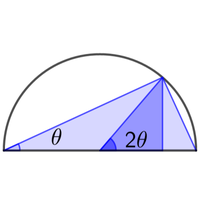
 On this page, we will learn about the double angle formulae used in trigonometry. It is quite rare that exam questions are solely about these identities, but it is essential that you can use and manipulate them confidently because they are used in many different parts of the course. You will learn what they are and how to use them.
All of these identities can be found in the formula booklet
\sin 2\theta\equiv2\sin\theta\cos\theta
\cos 2\theta\equiv\cos^2\theta-\sin^2\theta\equiv2\cos^2\theta-1\equiv1-2\sin^2\theta
\tan2\theta\equiv\dfrac{2\tan\theta}{1-\tan^2\theta}
We can derive these formulae from using the Compound Angle Formulae . This is a useful technique, since we can re-use this idea to find \sin3\theta, \sin4\theta, etc
For sine:
\sin(A+B)\equiv\sin A\cos B+\cos A\sin B
\sin(\theta+\theta)\equiv\sin\theta\cos\theta+\cos\theta\sin\theta
\sin 2\theta\equiv2\sin\theta\cos\theta
For cosine:
\cos(A+B)\equiv\cos A\cos B-\sin A\sin B
\cos(\theta+\theta)\equiv\cos\theta\cos\theta-\sin\theta\sin\theta
\cos 2\theta\equiv\cos^2\theta-\sin^2\theta
For tangent:
\tan(A+B)\equiv\dfrac{\tan A+\tan B}{1-\tan A\tan B}
\tan(\theta+\theta)\equiv\dfrac{\tan\theta+\tan\theta}{1-\tan\theta\tan\theta}
\tan 2\theta\equiv\dfrac{2\tan\theta}{1-\tan^2\theta}
The formula for cosine can be re-written depending on what we want to use it for
We can use Pythagorean Identities to write \cos{2\theta}in terms of \cos^2\theta
\cos 2\theta\equiv\cos^2\theta-\sin^2\theta
\cos 2\theta\equiv\cos^2\theta-\left(1-\cos^2\theta\right)
\cos 2\theta\equiv2\cos^2\theta-1
We can also use Pythagorean Identities to write \cos{2\theta}in terms of \sin^2\theta
\cos 2\theta\equiv\cos^2\theta-\sin^2\theta
\cos 2\theta\equiv1-\sin^2\theta-\sin^2\theta
\cos 2\theta\equiv1-2\sin^2\theta
This quiz is about the double angle formulae for \sin2x and \cos2x.
 Double Angle Quiz 1
This is a short quiz about the double angle formula for \tan2x.



Let f(x)=(\cos(2x)-\sin(2x))^2.
a) Show that f(x) can be expressed as 1-\sin(4x).
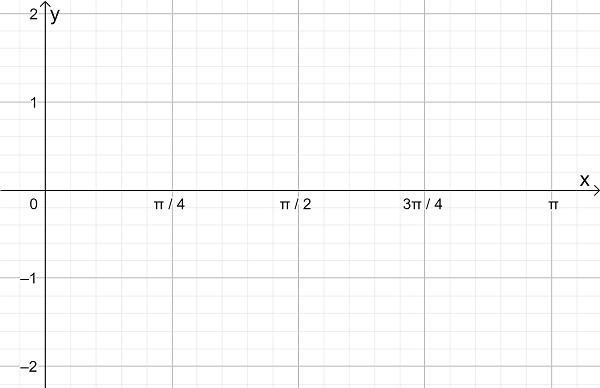
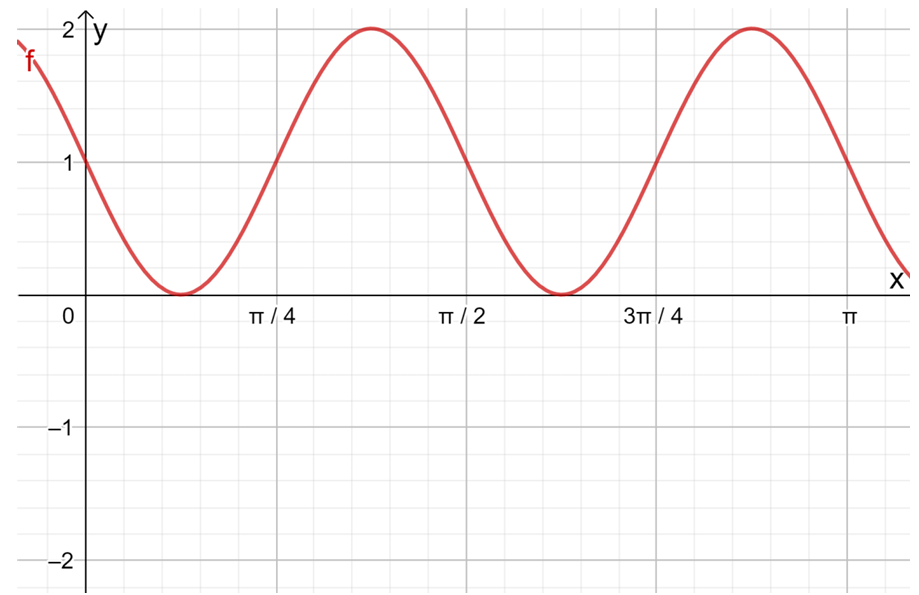
b) Let f(x)=1-\sin(4x). Sketch the graph of f for 0\le x\le\pi
Hint
a) Expand the brackets
Consider the following identities \cos^2\theta+\sin^2\theta\equiv1
\sin 2\theta\equiv2\sin\theta\cos\theta
b) In order to sketch this function, consider the transformations from the graph of y=\sin x.
Full Solution
a)
f(x)=(\cos 2x-\sin 2x)^2
f\left(x\right)=(\cos 2x-\sin 2x)(\cos 2x-\sin 2x)
f\left(x\right)={\color{#FF0000}\cos^2 2x}-2\cos 2x\sin 2x+{\color{#FF0000}\sin^2 2x}
\cos^2\theta+\sin^2\theta\equiv1
{\color{#FF0000}\cos^2 2x+\sin^2 2x\equiv1}
f\left(x\right)={\color{#FF0000}1}-2\cos 2x\sin 2x
\sin 2\theta\equiv2\sin\theta\cos\theta
\sin 4x\equiv2\sin 2x\cos 2x
f\left(x\right)={\color{#FF0000}1}-\sin 4x
b)
Consider the graph y=\sin x
Stretch by a factor of \dfrac{1}{4} in the x direction
Reflect in the xaxis
Translate up 1 unit

Solve \cos 2\theta=\sin\theta for 0\le\theta\le2\pi.
Hint
Use the identity \cos 2\theta\equiv1-2\sin^2\theta
Full Solution
{\color{#FF0000}\cos 2\theta}=\sin\theta
{\color{#FF0000}\cos 2\theta\equiv1-2\sin^2\theta}
{\color{#FF0000}1-2\sin^2\theta}=\sin\theta
2\sin^2\theta+\sin\theta-1=0
(2\sin\theta-1)(\sin\theta+1)=0
\sin\theta=\dfrac{1}{2},\qquad \sin\theta=-1
\arcsin\left(\dfrac{1}{2}\right)=\dfrac{\pi}{6}
0\leq\theta\leq 2\pi
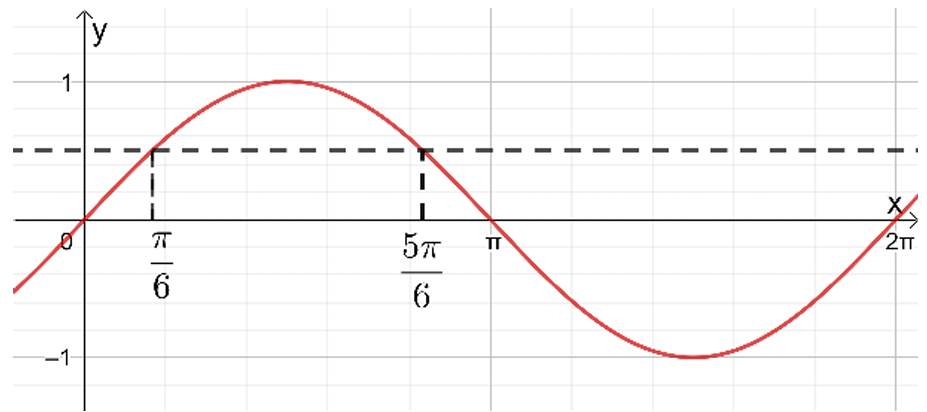
\theta=\dfrac{\pi}{6},\dfrac{5\pi}{6}
\sin\theta=-1\Rightarrow\theta=\dfrac{3\pi}{2}
Hence, \theta=\dfrac{\pi}{6},\dfrac{5\pi}{6},\dfrac{3\pi}{2}
a) Show that \cos 2\theta-3\cos\theta+2\equiv2\cos^2\theta-3\cos\theta+1
b) Hence, solve \cos 2\theta-3\cos\theta+2=0 for 0\le\theta\le2\pi.
Hint
a) Use the following identity \cos 2\theta\equiv2\cos^2\theta-1
Full Solution
a)
{\color{#FF0000}\cos 2\theta}-3\cos\theta+2
{\color{#FF0000}\cos 2\theta\equiv2\cos^2\theta-1}
{\color{#FF0000}\cos 2\theta}-3\cos\theta+2 \equiv {\color{#FF0000}2\cos^2\theta-1}-3\cos\theta+2
\cos 2\theta-3\cos\theta+2\equiv2\cos^2\theta-3\cos\theta+1
b)
\cos 2\theta-3\cos\theta+2=0
2\cos^2\theta-3\cos\theta+1=0
(2\cos\theta-1)(\cos\theta-1)=0
\cos\theta=\dfrac{1}{2},\qquad \cos\theta=1
\arccos\left(\dfrac{1}{2}\right)=\dfrac{\pi}{3}
0\leq\theta\leq 2\pi
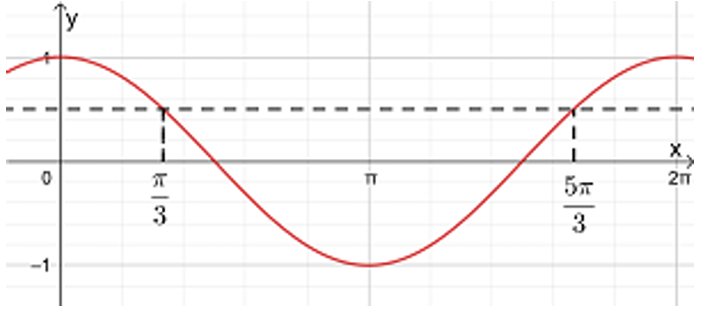
\theta=\dfrac{\pi}{3},\dfrac{5\pi}{3}
\arccos(1)=0
0\leq\theta\leq 2\pi
\theta=0,2\pi
Hence, \theta=0,\dfrac{\pi}{3},\dfrac{5\pi}{3},2\pi

Let \cos\theta=\dfrac{2}{3}, where 0\le\theta\le\dfrac{\pi}{2}.
Find the value of
a) \sin\theta
b) \sin 2\theta
c) \sin 4\theta
Hint
a) Draw a triangle and work out \sin\theta
c) Work out \cos 2\theta first. 2\theta is obtuse.
Full Solution
a)
\cos\theta=\dfrac{2}{3},\text{ where }0\leq\theta\leq\dfrac{\pi}{2}
We can find the opposite side in the right angled triangle using Pythagoras’ Theorem
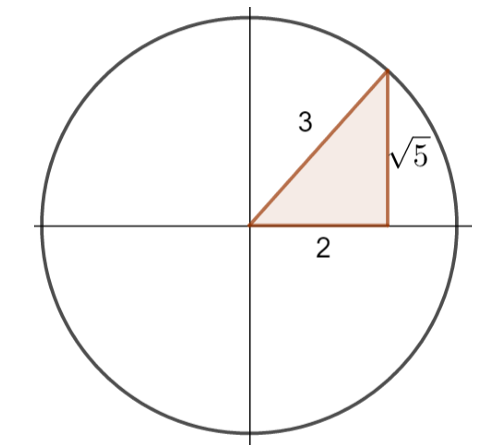
\sin\theta=\dfrac{\sqrt{5}}{3}
b)
\sin 2\theta\equiv2\sin\theta\cos\theta
\sin 2\theta=2\cdot\dfrac{\sqrt{5}}{3}\cdot\dfrac{2}{3}
\sin 2\theta=\dfrac{4\sqrt{5}}{9}
c)
In order to find \sin 4\theta, we need to find \cos 2\theta
\cos 2\theta=2\cos^2\theta-1
\cos 2\theta=2\left(\dfrac{2}{3}\right)^2-1
\cos 2\theta=-\dfrac{1}{9}
Since 0\leq 2\theta\leq\pi and \cos 2\theta<0, 2\theta is an obtuse angle
\sin 2\theta\equiv2\sin\theta\cos\theta
\sin 4\theta\equiv2\sin 2\theta\cos 2\theta
\sin 4\theta=2\left(\dfrac{4\sqrt{5}}{9}\right)\left(-\dfrac{1}{9}\right)
\sin 4\theta=-\dfrac{8\sqrt{5}}{81}
a) Show that \tan 2x\cot x\equiv\dfrac{2}{1-\tan^2 x}.
b) Hence, solve \tan 2x\cot x=3 for -\dfrac{\pi}{2}<x<\dfrac{\pi}{2}.
Hint
a) Use the double angle formula for \tan 2x.
Full Solution
a) From the formula booklet, we know that
\tan 2\theta\equiv\dfrac{2\tan\theta}{1-\tan^2\theta}
Hence,
\tan 2x\cot x\equiv\dfrac{2\tan x}{1-\tan^2 x}\cot x
Recall that
\cot x\equiv\dfrac{1}{\tan x}
\tan 2x\cot x\equiv\dfrac{2\tan x}{1-\tan^2 x}\cdot\dfrac{1}{\tan x}
\tan 2x\cot x\equiv\dfrac{2}{1-\tan^2 x}
b)
\tan 2x\cot x=3
Use the proof from part a)
\dfrac{2}{1-\tan^2 x}=3
2=3(1-\tan^2 x)
2=3-3\tan^2 x
3\tan^2 x=1
\tan^2 x=\dfrac{1}{3}
\tan x=\pm\dfrac{1}{\sqrt{3}}
\tan x=\pm\dfrac{\sqrt{3}}{3}
\arctan\left(\dfrac{\sqrt{3}}{3}\right)=\dfrac{\pi}{6}
-\dfrac{\pi}{2}<x<\dfrac{\pi}{2}
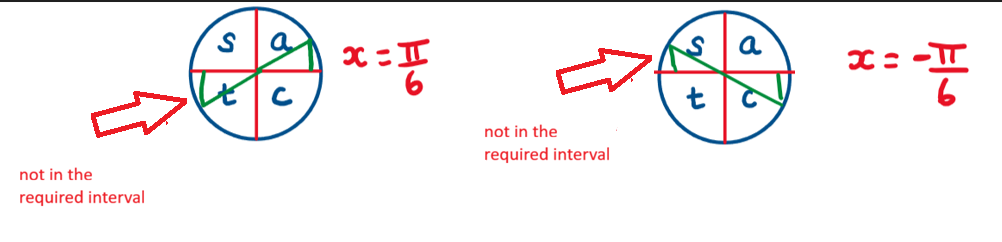
x=-\dfrac{\pi}{6},\dfrac{\pi}{6}