RP: formats, dialogue and a good analogy
20/11/2026 I have been spending a lot of quality time recently with the Reflective Project. Have I finally got bored of this component? Turns out, there’s not a chance.
Here is a snapshot of takeaways from virtual F2F and Online workshops, community seminars, new collaboration groups, WhatsApp chats, and not to mention resource development over the past few weeks, all centred on the Reflective Project. When it comes to be an RP educator, whatever our means or modes of communication, the power of dialogue to problem-solve and strengthen one's understanding and voice, is a reassuring and essential part of our development. If that process sounds strangely like the students’ RP learning journey, then that is no mistake.
The Face-to-Face Workshop
How do we realise the potential of other formats to essays?
I have been wondering for a while whether there are more overt opportunities, beyond essays, for students to develop a more acute awareness of process. At InThinking's most recent Cat 2 Reflective Project workshop, a walk around the Montparnasse neighbourhood with two of my great participants revealed opportunities to reframe and reimagine traditional formats such as letters. What if we broadened the concept of the written letter to embrace both formality and informality, incorporating multiple audiences? In response to an ethical dilemma, a student could embark on a correspondence-based learning journey, inviting responses from different stakeholders over an extended period. It struck us how much easier a student might find reflecting on process and project with such an interactive creative process. Equally, the ability to demonstrate growth in understanding and strengthen one's voice and position over time also seems an overwhelming benefit of written formats such as a blog. A format we could easily overlook as too simplistic. Understanding the formats students could explore takes time, patience and a willingness to ask ‘What if…?' of our students without knowing the answers ourselves.
Whatsapp chats
What happens when a student picks an incredibly provocative topic?
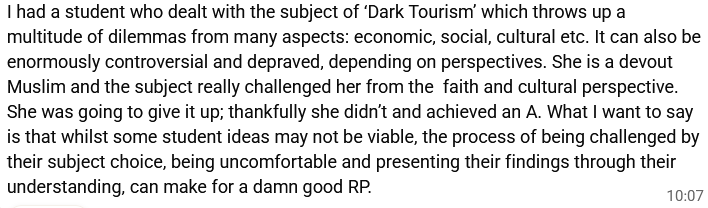
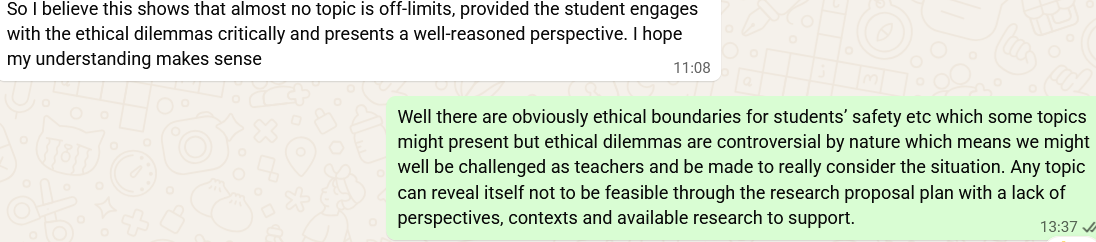
There is no doubt that the very nature of an ethical dilemma means they can be steeped in controversy, and thus we will be challenged as educators at times. On the WhatsApp groups this week, one CP coordinator cleverly turned to the CP community to ask how they should approach a student who had settled on ‘cannibalism’ as their RP ethical issue and how they could put them off. Out of habit, I asked how it related to a career field or ethical dilemma, which might seem a little flippant, but there is a good point here; ethical dilemmas are controversial by nature, which means, as educators, we will be challenged by our students' ideas. We have to lean on the guidelines to check viability, our local context’s requirements and, of course, the ethical ramifications for embarking on such a research journey. Nicky, a hugely innovative and experienced CP educator, summed it up best in her response to this dilemma and she has kindly said I can share her words. I have also included my own conclusion.
Seminar: The Reflective Project as a puzzle
How do you create autonomy within a structured framework?
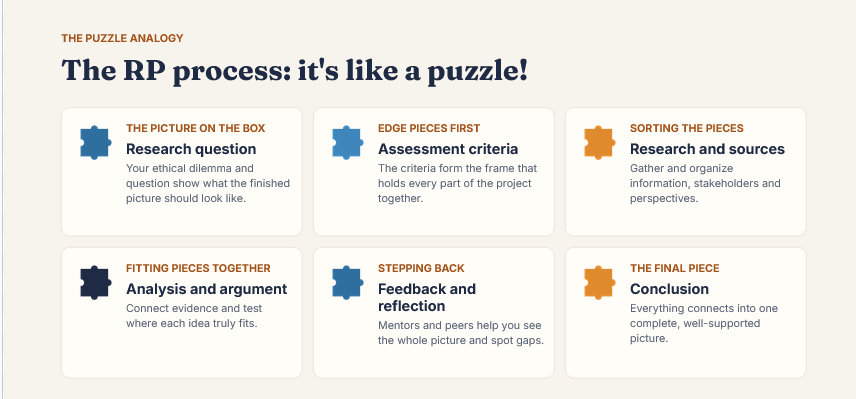
In the final part of the week, I was lucky enough to chair an excellent seminar from IBSCA: ‘Practical Strategies for using assessment criteria for the RP process’ delivered by Becky Duffy and Brian Adams from Plymouth Whitemarsh High School near Philadelphia (delivered for UK schools and associate IBSCA members). So many ideas forthcoming and practical pedagogy to think about and work on over the coming months. However, as an English teacher, I am always a fan of a fully developed analogy and Becky and Brian's use of the jigsaw puzzle, both literally and conceptually with their students,the process and project through such an interactive, creative approach is brilliant. Yes, their students literally do a jigsaw puzzle to simulate the RP process and return to it at times to identify how and where they might refocus or problem-solve. We can often use a good analogy to launch a process, but do we keep coming back to it and using it as a clear scaffold for students to hang their understanding on as their experience grows? More than that, it gives students a place to return to when self-assessing and problem-solving with their peers. It also helps clarify the component parts students are juggling in the RP and demystifies the IB talk, which can seem inaccessible at times.
Looking forward to seeing what the next weeks hold! As always, I love working in the community I do so thank you to all for the continuous rich conversations.
Becky