Inquiry 3: How, where and why might I apply ethical thinking?

How is ethical thinking important to my own life?
The IB's mission statement refers to the importance of appreciating how 'other people, with their differences, can also be right'; this is key to being a critical and ethical thinker. With 'ethical decision-making' and ‘ethics and personal values’ being just some of the transversal skills in PPS, not to mention your Community Engagement, Language and Cultural Studies and Reflective project courses, you have the opportunity throughout your CP to explore what ethics means to you.
| Learning outcome | Concepts | Contexts | Content | Skill domains |
| LO5 - Demonstrate an awareness of the ethical implications of one’s choices and actions on self and others | Change Connections Identities Perspectives Systems Well-being | Personal life Informal learning Professional life CRS and DP courses Community engagement Language and Cultural Studies Reflective Project | Defining ethics and the Trolley dilemma. | Thinking skills Intercultural Understanding Civic and social responsibility |
The Why
 ... our Career-related subjects both in school and professional settings

... multiple service learning settings and experiences
 ... the reflective project which focuses on an ethical dilemma connected to your CRS
Where do I start with ethical thinking?
Let's start with ethical dilemmas. A dilemma is a problem with no clear answer and exploring them is great for identifying what . There is no clear pathway and a clash of different viable options. However a course of action needs to be taken. Essentially an ethical dilemma occurs when you encounter a conflict among values, duties, rights and obligations.
 Watch this! It is a classic ethical dilemma. Write down how you would act straight after watching it and do not share with anyone yet. When you do share, you may be surprised by the different responses.
 Ways you could respond to this:
- Decision based on the person: What do I want? How should I be? What does my character tell me to do? What is good for me?
- Decision based on the action: What is the right action? What does reason and moral law tell me is the right thing to do? Are my motives good?
- Decision based on the consequence: What would be the best outcome? What would be the best for the most number of people? What would be best for the good of society?
- Decision based on situations as they arise: In this situation, what does my love of God and of people tell me to do? What will be the moral consequence of my action/s?
 Did you make a decision initially in any of these ways? Did you change your course at all?
What are ethics?
Ethics are about the moral principles that govern, shape or guide the behaviour of a particular 'culture'. Ethics and morals can be terms used interchangeably but, at its simplest: ethics refer to rules provided by an external source and morals refer to an individual's own principles regarding right and wrong.
Find out what you think: develop multiple perspectives on ethical dilemmas
Same and Different
This is a set of questions you can use with any debate, incident or object in which opposing views are clearly apparent or images that look different but are grouped together.
 This is great for critical thinking skills as it helps you go beyond what you inititally think. With ethical dimensions, issues and dilemmas, it's not taking sides or seeing things in black and white - often the truth is murky and grey with subtleties and degrees of difference.
We are going to use the following video with 6 ethical dilemmas in it.
1. First glance: What was the first impression you had about this?
2. Perspective Taking: From what other points of view could this be perceived? What would one say from those points of view?
3. Same and Different: What are the similarities of perspectives? Differences? How is this case the same and different at the same time?'
How will we use ethics, frameworks and dilemmas in the CP?
You may not have started your course in the reflective project yet but it's good to know how your studies in ethical thinking will be assessed during your CP.
For the reflective project, which you will start part way through your CP, you are going to draw upon the skills, ideas and content you have explored across your subjects, CP core and life outside of school. You are going to take an ethical dilemma related to a career field you are interested in and explore it using the skills you have been developing across your CP core, CRS + DP subjects. You will find all the PPS skill domains are relevant, especially Thinking skills and Intercultural Understanding.
In terms of the reflective project, an ethical issue worth exploring must have a controversial angle and arise from a career field you are interested in. There must be disagreement or conflict ...
... which leads to the ethical dilemma. For a dilemma to be viable, there must be a clash of principles without an obvious solution. With an obvious solution, there is no dilemma.
Therefore the reflective project to explore an ethical dilemma, it must have the opportunity to: analyse different perspectives; contextualise the dilemma with local or global examples; consider the impact of the ethical dilemma on community or communities; consider the impact of cultural influences
How can culture play a part in ethical perspectives and decisions?
Read these definitions connected with how we view culture and understand diversity. Make a note of what you need to keep in mind when you explore local and global ethics and ethical perspectives.
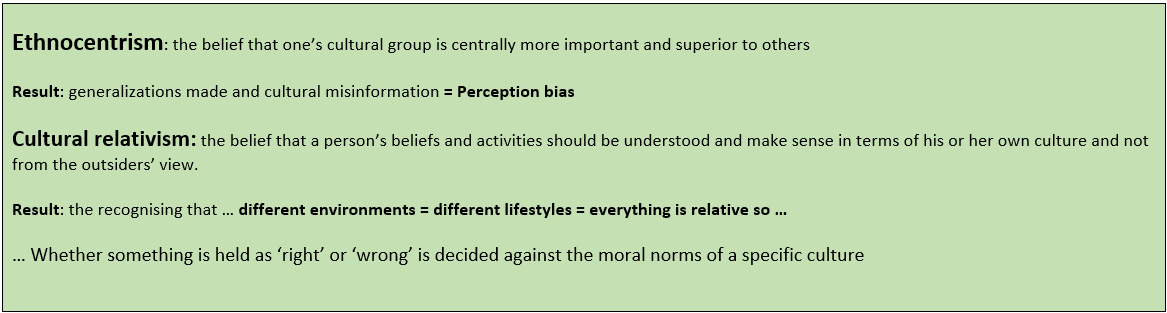
Reflect on the impact of both ethnocentrism and cultural relativism and find examples to back up your thoughts.
Why and how do we make ethical choices?
Now go back to your original responses to the questions you were given earlier to explore the Trolley Dilemma.
Discuss with your partner/class where you stand now. And what do they tell you about the frameworks humans tend to use to make ethical decisions?
- Decision based on the person: What do I want? How should I be? What does my character tell me to do? What is good for me?
- Decision based on the action: What is the right action? What does reason and moral law tell me is the right thing to do? Are my motives good?
- Decision based on the consequence: What would be the best outcome? What would be the best for the most number of people? What would be best for the good of society?
- Decision based on situations as they arise: In this situation, what does my love of God and of people tell me to do? What will be the moral consequence of my action/s