Ethics of AI use

Here are some interesting activities that flow from a project by the Asia-Europe foundation (ASEF) ClassNet18 collaboration in which Barbara was a collaborator. They concern the ethics of building AI systems, their training and subsequent use from an ecological perspective. They consist of a number of scenarios that are designed to promote student thinking about the ethics of generative AI use.
This project was created as a part of the Asia-Europe Foundation (ASEF) ClassNet18 collaboration, creating the Innovative Teaching Practice (ITP) entitled “AI & Ethics: A Global, Interdisciplinary Inquiry”. It was co-created by Barbara Ostrowska, Pengfei Jiang (China) and Dovilė Šertvytienė (Lithuania) under the mentoring of Staycie Domzalski (UK).
Learning Outcomes:
By the end of this lesson, students will be able to:
- evaluate the potential impacts of AI on society, focusing on ethical, environmental, and political dimensions.
- critically engage with ethical questions related to AI, business responsibility, and environmental impact.
- understand different viewpoints (e.g., from local farmers to tech CEOs) and use these perspectives to inform decision-making.
- work effectively in teams to answer questions, react to other teams’ responses, and contribute to a class-wide debate.
- debate ethical and political choices related to AI's influence on resources, energy, and geopolitics.
- propose potential solutions to prevent crises like those depicted in the future scenario.
Activity 1 - Scenario analysis
Split into smaller groups (2-3 people). You will be assigned one or more cards that describe a possible scenario in the near future.
Welcome to the year 3030. AI has transformed everything — from how people learn and vote to how water and electricity are used. When eating breakfast in the morning, you open your favourite social media site and see the news:
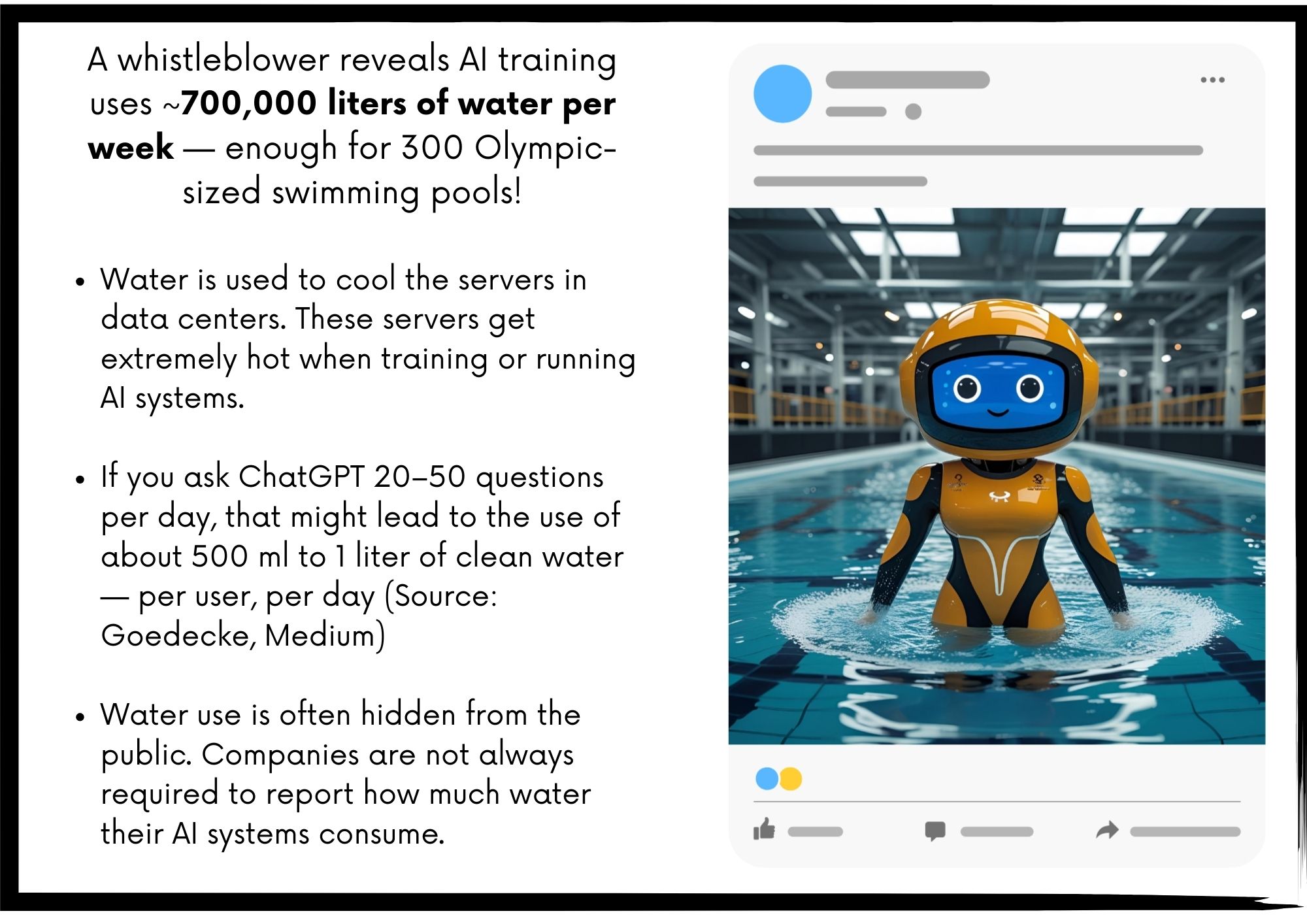
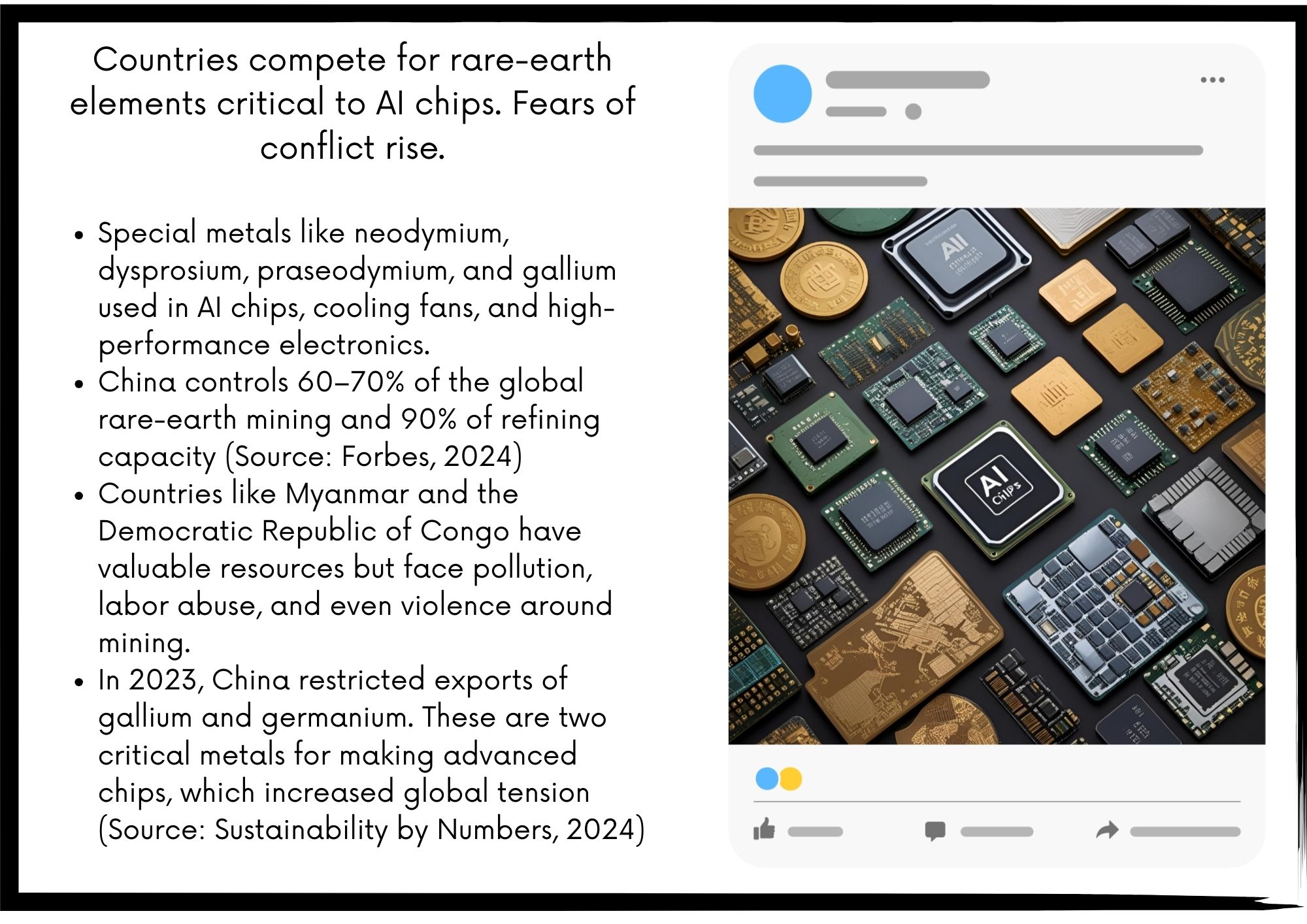
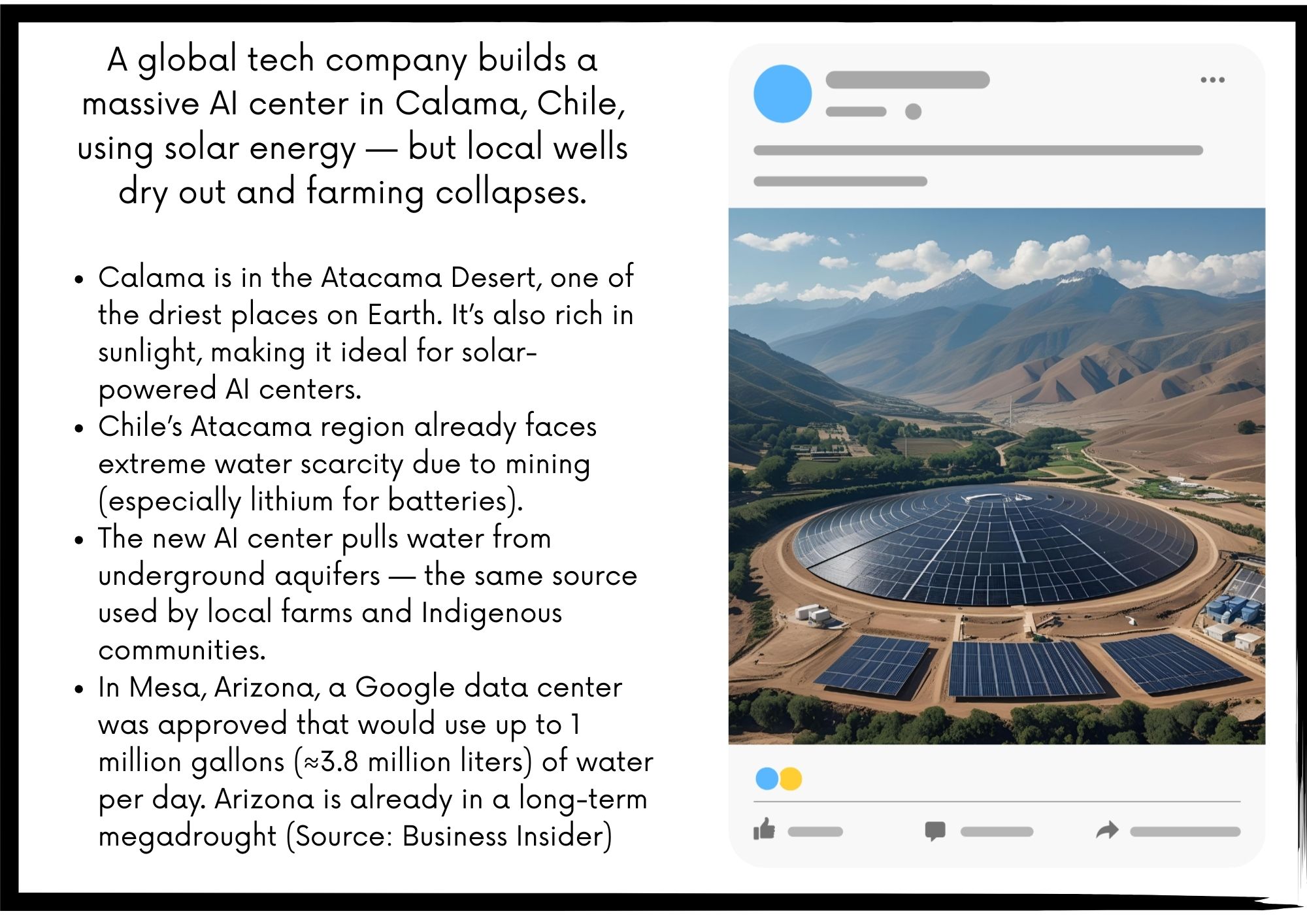
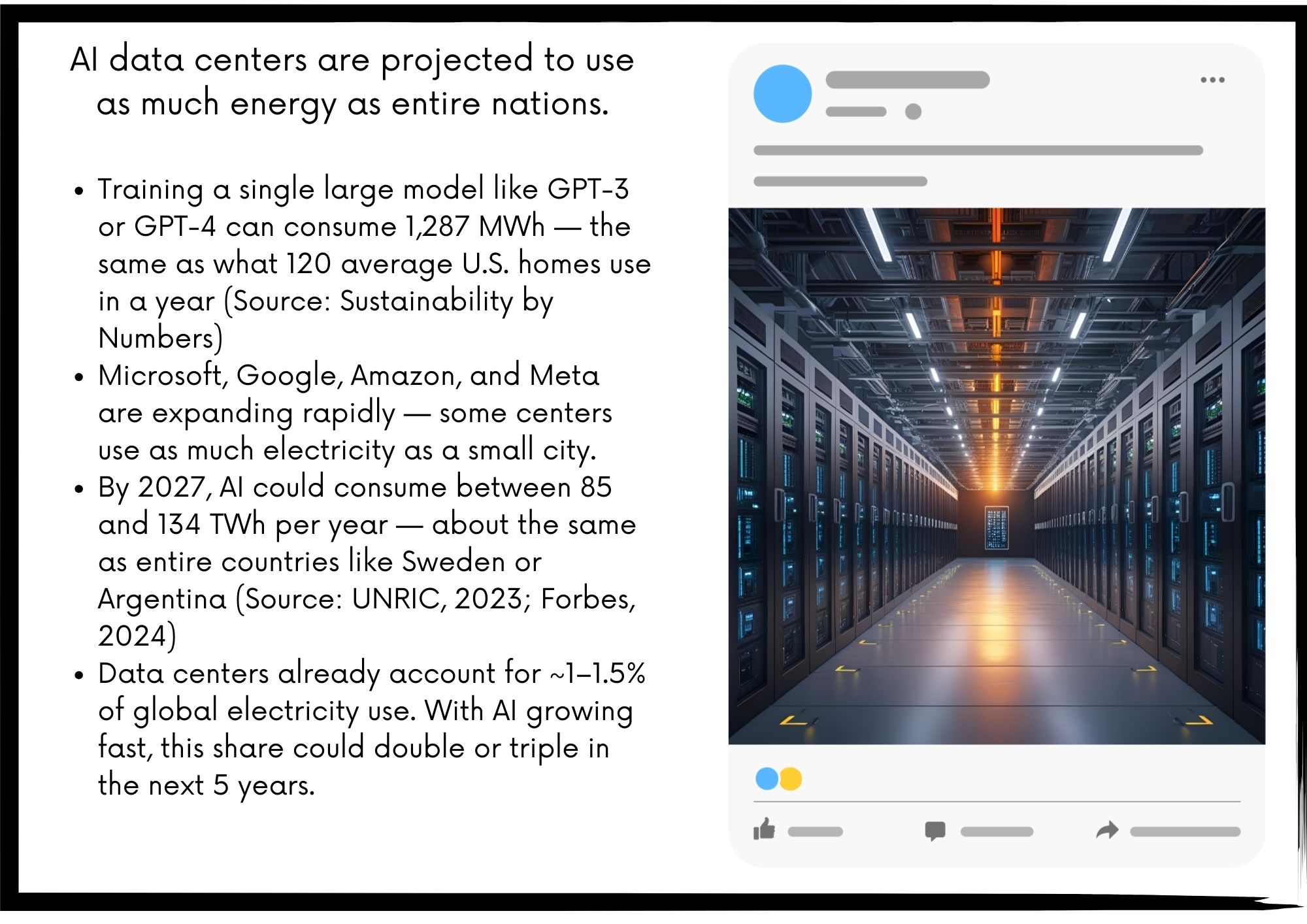
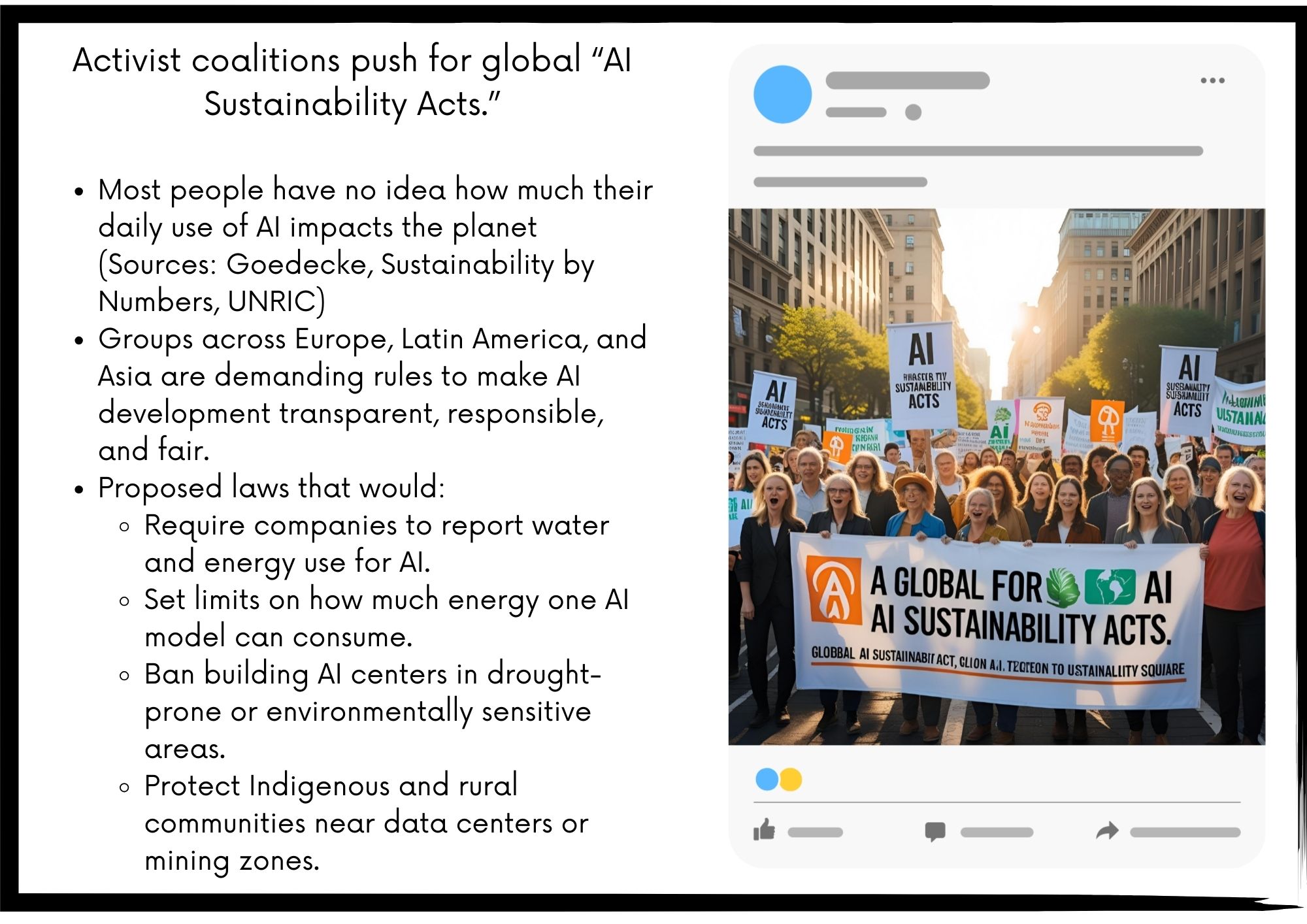
To download the pdf with the scenarios, click here.
- Read a future scenario and discuss the possible consequences of this situation (10-15 minutes)
- Work in small teams to answer key questions, draft your answers in a shared document.
Environmental ethics:
Discuss (10-20 minutes):
- Who should decide where AI data centres are built — the company, the government, or the local people? Why? What should the local government do when people are losing water and farms are failing?
- If a popular AI app you use every day was wasting enough water to supply 50,000 families, would you stop using it? Why or why not?
- What would people like politicians, local farmers, tech companies, and activists say about this problem?
Look at the questions from the following perspectives:
🧑🌾 Local Farmer
🧑💼 Tech Company CEO
🧕 Indigenous Community Leader
🧒 Teen Activist
🧓 Mayor of Calama
👩🏫 Student from another country
Business Responsibility
Discuss (10-20 minutes):
- What are the ethical responsibilities of AI companies when disasters and blackouts happen? Who benefits and who loses economically?
- What are the economic consequences for the countries mining for rare resources? How should smaller countries with rare resources protect themselves from becoming battlegrounds in AI geopolitics?
- In a world where energy and minerals drive AI dominance, is digital colonialism a valid concern?
Look at the questions from the following perspectives:
⚡ AI Company Executive
🏚️ Resident of a Town with Frequent Blackouts
🌍 President of a Small Country with Rare Minerals
🤝 Diplomat from the UN
📱 Teen AI User from a Rich Country
✊ Environmental Activist
3. Swap your answers with another team by sharing it with them. Read their answers. Add your own reactions, questions, or disagreements as comments to the document.
4. Debate the ethical and political choices that must be made.
- What ethical issues stand out most?
- What would be the fairest or smartest decision?
- How might the world prevent a real crisis like this?
Reflection:
Write a short news headline for 3035 based on the discussions you had.
Reflect: Is it the future or is it something that is happening now?