What counts as art?

An investigation into knowledge in the arts already faces a challenge in that there is a huge diversity of different artistic practices - from architecture through dance to music, painting, sculpture, literature, film, and even cuisine. It is unlikely that we shall find a neat definition that covers all and only those activities we consider artistic. In ToK it may be more important to explore the interesting features of the arts with respect to the kinds of knowledge it involves. Of course, there is also the tricky question of the purpose or function of the arts. Read on...
Essential understandings:
- The arts are diverse and disciplines of the arts differ significantly in their methods, materials and modes of performance or display.
- Most, if not all, art situations involve different stakeholders: an artist (or artists), an artwork, an audience, and the art world.
- The main theories of artistic value and meaning can be arranged into three groups: art as imitation, art as expression and art as a form.
- What counts as art could be decided by a certain privileged group - the Art World - this is the institutional theory.
- Art could be defined by its function in society - functionalism. One function could be criticising social or political arrangements.
- One view of art is that it is a human creation whose purpose is to understand or even transform reality.
In most areas of knowledge, we don't get hung up on a definition. In the natural sciences, we accept fairly quickly that the target of study is the world around us, which is usually broken down into smaller happenings called phenomena. In History, we accept, sometimes after a bit of argument, that the target of study is written traces of the past. In the human sciences, we accept that the target of study is the human being as an individual in a society. In mathematics, we have more trouble (see Mathematics: Scope and origins), but we can usually get started doing ToK in this area of knowledge without having a real deep understanding of what makes something mathematical. But in the arts, we get hung up on the definition. And the risk is that we spend all our time worrying about what art is instead of looking at its relation to knowledge. On this page, instead of finding necessary and sufficient conditions for an object being art, we shall concentrate more on the kinds of features art has.
Let us start at the beginning. As we saw from the table above, most real art situations possess some basic common features. There is usually a creator of the art - the artist. There is usually something created: a painting, building, performance, image, set of sounds. There is usually an audience: people visiting a museum, people using a building, people witnessing the performance, people viewing the image or people listening to the sounds. There is also a third group of people that we might loosely call the art world: the gallery curator, the architectural expert, the critic, the musicologist or the expert in the history of art, film, music and so on. Each of these groups of people possesses different kinds of knowledge with respect to the artwork. We shall explore this knowledge in more detail in the section Perspectives: Stakeholders in the arts. The artwork has a meaning that is the result of the interactions of the artist through the artwork with the audience under the longer-term influence of the art world. We can say that meaning in art is co-created by these stakeholders. Here we shall note that the artist - artwork - audience - artworld structure can be found across the arts and is somewhat different from other knowledge areas.

The artist, the audience, and the art world, all interact to give the artwork meaning. We say that meaning in art is co-created by these stakeholders.
People who think a lot about the arts, philosophers of art, scholars of aesthetics, and social theorists, have evolved many theories that attempt to unearth the special features of the arts that other areas of knowledge do not have. In this unit we shall just focus on three main groups of theory: art as imitation - mimetic theories, art as expression - expressionist theories, and art as having a particular form - formalist or significant form theories. According to the first group, art should imitate the world; according to the second, art should be an expression of certain ideas or emotions; and according to the third, the artwork should have certain special qualities that produce the appropriate response in the audience.
Art as an imitation of reality

The mimesis theory of art originates in ancient Greece. It is often a theory that we instinctively apply when making everyday artistic judgments: 'that is such a good portrait - it is a really good likeness'. It is to be found in the sculptures of ancient Greece and Rome, but it took rather a long time to come to Western Europe, only really appearing in painting after the Golden Age of Dutch painting at the end of the 16th Century. We could argue that ancient tragedies like Antigona and Renaissance artists like Michelangelo, who decorated the Sistine Chapel ceiling, art is quite realistic - it represents selected aspects of the world as the author viewed it. It does not always portray the natural world as it can also be a representation of a supernatural world (heaven, gods), but there is an attempt at imitating something. The paintings of the realists of the 19th century, such as John Constable, are perhaps the highpoint of work that fits this theory nicely. Drama was supposed to mimic human interactions realistically, realistic novels were supposed to portray plausible human behaviour in a made up world, likewise early film. Perhaps some of today's hyper-realistic art belongs to this category.
But this theory runs into a lot of trouble. Even in painting, there are huge swathes of history in which the theory does not work. Egyptian art, for example, is not intended to be realistic. Think of typical depictions of the body in Egyptian stone carving. Each part of the body was presented in its most typical aspect, meaning that the whole was simply not physically possible. Painting throughout history up to the late 16th century and from the beginning of the 20th century to the present day was not intended to imitate. Think of 14th-century Czech icon painting, for example. Here, there was no attempt at realism - but it was portrayed as a symbol that meant something to those who professed the orthodox faith. Think of the abstract works of Kandinsky, Rothko, Jackson Pollock, there is little that can be called imitation here. The theory gets into really big trouble in stylised art forms such as music and dance. Handel's water music does a very bad job of imitating any kind of river or stream, and most musical works do not aim at imitating anything. We even given a special name to pieces in music that reference the world at all - we call them programme music. What sort of imitation applies to dance - people do not typically carry out everyday conversations in the second position! The mimesis theory, like many theories of art, applies well to some examples but cannot handle others. As the novelist Virginia Woolf puts it: "Art is not a copy of the real world; one of the damn things is enough".
Can mimetic art allow us to know some aspects of reality that we cannot know otherwise? If so how?
The expressionist theory of art
The second theory considers art as an expression of some kind of inner state such as emotions - it became important during the Romantic movement and holds true until today. It claims that the intention of art is to evoke emotions in the audience. Expression is not fully spontaneous and uncontrollable - it needs to be guided by the author, who combines the pre-existing elements into new forms (sounds into music, words into literature), evoking emotions in the audience. The author might aim to express her own emotions and hope that the audience will latch on to them through the artwork, but she may also seek to express the ideas and emotions of a wider community or culture. Of course, this theory raises some questions: Does all art evoke a certain reaction? Is it even intended to do so?

Beware the intentional fallacy in art, which assumes that the meaning of the work is the artist's intention.
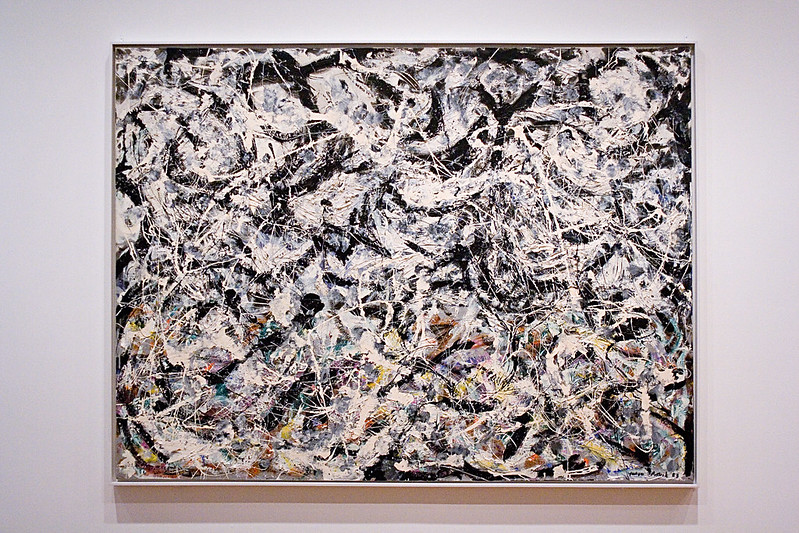
This theory can address some of the problems of mimesis theory. We can see that Jackson Pollock, as well as ancient Egyptian art, can produce emotional reactions in the audience. Moreover, it fits with the first reaction of many people confronted with an artwork 'I like that' or 'I don't like that'. But there are some deep problems with this - not least that it should be possible for us to dislike work but that it is neverheless good. Then there is a worry that it casts the net too widely but, at the same time, does not fit some works accepted by many as good art. Many things in the world produce emotions in us, not just art. We can have emotional reactions to great science or to reading a historical narrative. Does that make Science and History into art? If we say that it has to do with the intentions of the artist to produce emotions, then the problem is, as with all these intentional theories, how on earth do we know the intentions of the artist? Are we to reserve judgment in interpreting a work of art until we have done enough research on the artist's intentions? At the same time, the theory does not seem to fit quite a lot of what we might reasonably consider art. I very much doubt that in ancient Egypt, the carver at work on the tomb of Tutankhamun was thinking about the emotions of his audience. What are the emotions that a complex work like Pride and Prejudice intended to convey? Furthermore, if the work is supposed to represent an expression of the emotions of the artist, what about the sixth symphony of Mahler with its cataclysmically tragic ending written during a particularly happy period of Mahler's life just after the birth of his daughter?
Students often assume that all art fits the expressionist theory.
Not all art is an expression of the emotions of an artist!
While the expressionist theory of art may have some merits, it contains hidden dangers for the ToK student. There is a tendency in the ToK world to think that art is about the communication of a message from the artist to the audience. This message could be an emotion or an idea. This is what I call the 'message theory of art'. Sending the message is sometimes taken to be the artist's intention. When students say this to me, I ask them why the artist did not just write the message and do away with the bother of making the artwork. To reduce an artwork to its 'message' is, in a sense, to ignore the artwork. So, while it might be useful to start with the overall impression of an artwork as the first stage in understanding it, this is not to say that the meaning of the artwork is some kind of message. Mahler's sixth symphony may be described as 'tragic', but this surely does not do justice to the meaning of such a complex work, which is scored for over 100 musicians and lasts for nearly one-and-a-half hours. Students often assume the message theory of art in their essays without giving any justification. This is something to avoid.
Is it true that all works of art carry a 'hidden message' from artist to audience? If you agree, you will need to find evidence for this view rather than assume it. Perhaps the audience plays a more active role in the creation of the meaning of a work of art.
The formalist theory of art
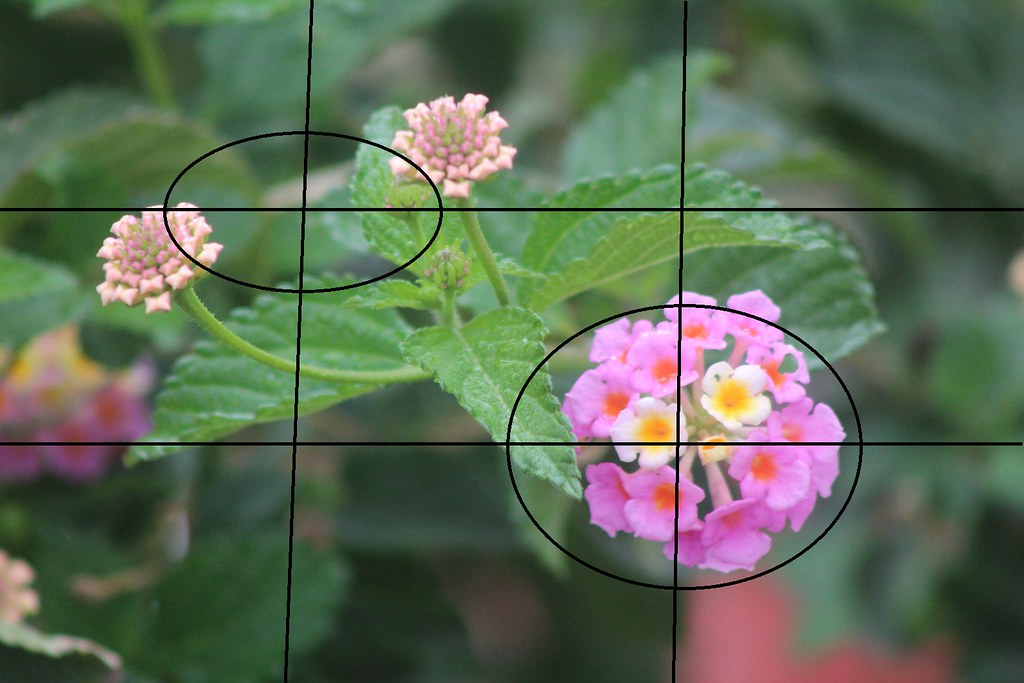
The third theory discussed here takes artistic value and meaning to be determined by the formal features of the work. Formal features are things like the proportions of the work in space and time, colour palette, composition, structure and so on. When we go to painting class, we learn how to compose a painting or construct a colour palette. We learn rules such as lighter colours are further away, or in photography, 'use the rule of thirds' to place important details of the scene. In music, formal notions are structures like the form of the piece - whether it is sonata or rondo form. The form is about the kind of narration and the structure of the plot in a novel or the metre and rhyme scheme in poetry. What is special about formalist theories is that they depend only on the artwork itself, not on any feature outside its borders, unlike the mimetic and expressionist theories.
A narrow version of this approach, significant form theory, was proposed by the art critic Clive Bell in the early 20th Century. Bell wanted to link the structure of the artwork to the emotions experienced by a suitably sensitive viewer. He said that if the artist got it right, then the significant form of the artwork produced 'aesthetic emotions' in the viewer. Therefore, there was an objective component to artistic value (for more on subjectivity and objectivity, see Core theme: Scope 2 - Knowledge concepts - What knowledge is at stake?).
This view leverages our intuitions that the physical structure of the artwork must make a difference to our appreciation of it and justifies placing importance on the actual technical mastery of certain skills by the artist - the kind of thing that is missed when we hear 'my little sister could have done that!' as an exclamation at the art museum. Moreover, it assumes that not every member of the audience has the right sensitivity to these formal features of the artwork. The reactions of some audience members should be taken more seriously than others, namely those who are sensitive to significant form. This does fit with our intuition that musicians can hear more in a piece of music than non-musicians or that a photographer can see more in a photograph than someone who is untrained.
Formalists do not deny that art can both express feelings and imitate reality, but they consider art's purpose to be art itself. "Art for the art's sake". In their opinion, art is to amuse and be enjoyed, to appreciate the creative nature of it. In art, they appreciate the organic unity, complexity or diversity, motif, evolution and balance, among others, not the truth it portrays or the representation it is.
But problems arise when we ask exactly what are these special talents that make us sensitive to significant forms. The answer often is that 'aesthetic emotions' are produced in these talented audience members. And if we ask what is significant form, the answer is that it produces aesthetic emotions in the rightly sensitive viewer - in other words, we have a circular argument - or that the answer begs the question. Worse still, there is obviously a category of artworks that do not possess special formal features because they incorporate everyday 'found' objects. We can think of Tracey Emin's bed, or Marcel Duchamps' urinal, Damien Hirst's shark, Robert Rachenberg's goat, John Cage's 4'33", Andy Warhol's soup cans, and so on.
Begging the question - a circular argument which assumes as a premise what it sets out to prove.
Do not confuse 'begging the question', which is creating a circular argument - so it is about logic, with raising the question - which is about, er... raising questions.
Other theories of art
There are other theories of art that are not included in the three groups above. For example, the institutional theory of art takes art to be defined by the third group of stakeholders: the art world. Anything could be art in principle, but what makes it art is that it is accepted by the right group of people: those critics, gallery owners, experts, reviewers, and so on who act as gatekeepers for the arts. In a sense, this theory shies away from proposing a definition of art at all and simply points to the role played by power. Aesthetic functionalism is a bit like the significant form theory and suggests that a work is art if it provides the right function to society. The significant form is a functionalist theory, although a narrow one because artwork has the function of creating aesthetic emotions in suitable audience members.
Berys Gaut suggested that art was a 'cluster concept' - that there were not necessary and sufficient conditions but rather that an artwork satisfied some but not necessarily all of a larger group of conditions. Concepts like these are called family resemblances because, just like in a family, there is no one characteristic that everyone has but rather, there are characteristics in common between some members but not others, and that every member of the family shares some characteristic with someone else in the family.
For Gaut X is an artwork if and only if it satisfies some, if not all, of the following conditions:
- x is intended to be an artwork
- X is identifiable as an artwork
- X falls easily under an established art category
- X possesses aesthetic, formal, expressive, or representational properties
- X has the capacity to communicate complex meanings
- The production of X requires skill
- The production of X requires creative imagination
- X invites the emotional and cognitive response of the audience

There are some feminist thinkers who push back against the idea that art has a definition at all. Part of the reason is that any reductive definition or theory of art that is clear-cut or definitive will freeze in unequal power relations between men and women. Since men are inevitably in positions of power, men will define art in a way that disenfranchises women and women's forms of doing art. The obvious examples here are the distinctions between sewing or needlecraft done mainly by women and haute couture (fashion creation) done mainly by men, cooking done mainly by women, and haute cuisine done mainly by men. This argument parallels Michel Foucault's comment that any distinction empowers one group of people and disenfranchises another. A theory or definition of art is no exception.
Perhaps it is better to characterise art in broader terms by looking at what it does in society or what it should do. As with the functionalists mentioned above, the key question is, what is the function of art? According to Leon Botstein, a Swiss-American conductor and educator, "art is something that transforms the everyday, it transfigures the ordinary". He argues that art is an artefact - something that does not naturally exist in the world but that is created by human beings but that has the power to transform reality through imagination. Art creates an illusion of reality, although it is completely fictive. This fits nicely with Picasso's statement that "Art is a lie that makes us realize truth at least the truth that is given us to understand". When we immerse in art (like literature or film), it allows us to live the experiences and feelings of the characters, giving us a simplified or artificial version of complex life and, therefore, helping us to understand it. In this sense, an artwork is like a model - a simplified version of reality. What we see in a piece of art - be it a film or a painting - feels real, although it is not. It depicts a situation that is not real but that tells us something about ourselves. A film involves a limited number of characters and takes place literally over a few hours. What it depicts are human situations that may involve vast numbers of people and take place over a lifetime. As Nietzsche said about Greek Tragedy, the arts are a way of making life bearable. They portray aspects of life in miniature in order that we can get to understand them and not get lost in the despair of the real thing. Art is not reality but it models it.
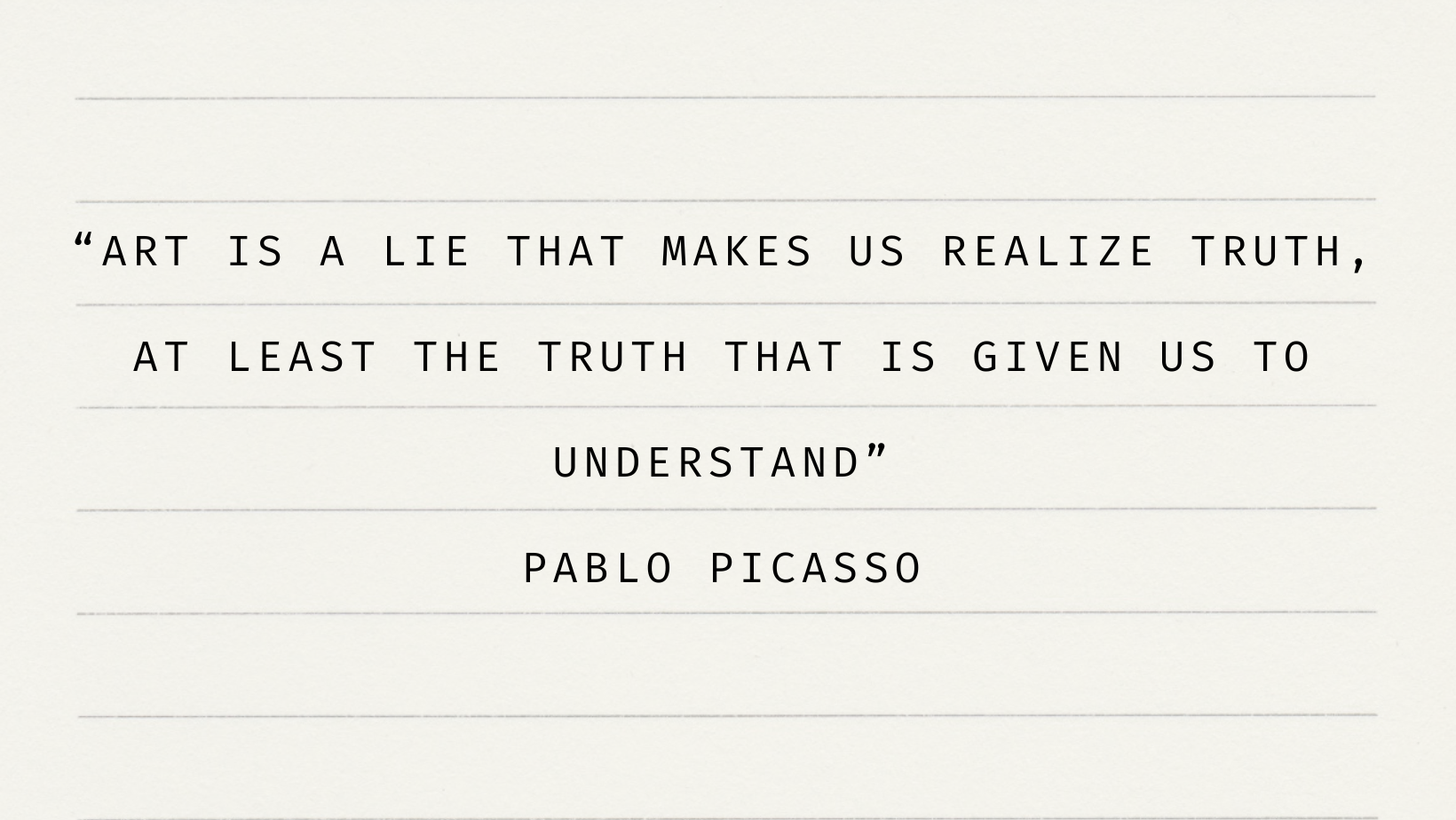
On this view, what differentiates art from non-art is the intention - the artist plans and predicts the outcome of her creative process; it is not serendipitous. People may, perhaps unfairly, compare some modern art with a child's experiments with paint or clay - splashing paint on the canvas in an uncontrollable manner. But what differentiates modern art from a child's painting is the way artists pre-plan and organise their creation - it has little to do with randomness and lack of control. It is the intention of an artist to create art in a certain manner. You can clearly see it in the words of the abstract painter Mark Rothko: "I’m interested only in expressing basic human emotions - tragedy, ecstasy, doom, and so on. And the fact that a lot of people break down and cry when confronted with my pictures shows that I can communicate those basic human emotions" (MoMA).
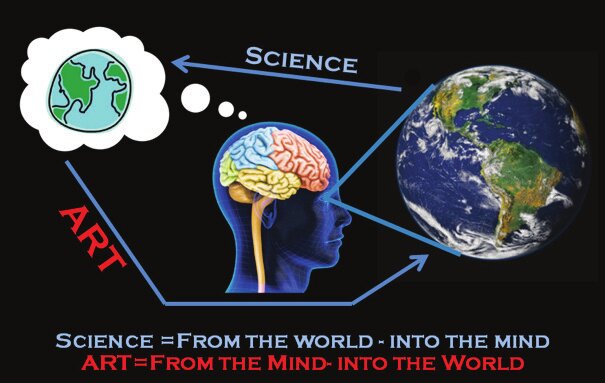
Perhaps it is useful to compare art with science and look at the correspondence between the world and the mind of the knower - the scientist or the artist. Jeffrey LeMieux, a professor of Fine Arts, echoes the much earlier thoughts of the philosopher Elizabeth Anscombe when he points out that the direction of fit between the world and the mind of the knower is opposite for the scientist and the artist. The scientist changes their mind depending on how the world is. It is, in the words of Anscombe, a 'mind-to-world direction' of fit. The artist, on the other hand, changes the world according to her inner vision of the artwork. She creates something in the world according to her inner vision. It is a 'world-to-mind' direction of fit. This is also something that we come across in subjects like Design Technology or Computer Science where we try to change the world in specific ways according to our designs or programs.
Art, therefore, may serve as a medium through which we externalize our internal thoughts, emotions, and ideas. It allows us to express abstract concepts and complex inner experiences in tangible forms that others can perceive and understand. They can be visual, auditory, or tactile experiences that we can apprehend through our senses. LeMieux emphasizes the role of art in facilitating empathy between people. Remember, we spoke above of the co-creation of meaning in terms of the artwork, the artist, the audience, and the Art World. Through experiencing art, individuals can gain insights into the perspectives, emotions, and experiences of others across diverse cultures and backgrounds. These ideas link with the function of art, which is social critique, resistance to oppression, and effecting social change (see the page Art and power).
So, let's get to the core of the matter: why do we create art? Why do we listen to music or go to the cinema or gallery to appreciate art? There is no single answer to this question. Art has a variety of purposes depending on the context of the artist and the audience:
- art can give us pleasure - it might make us laugh or stand in admiration in contemplation of the combination of colours, sounds or tastes
- art can make us stop and rethink something, offer a completely new way of looking at things - it can lead to a deeper understanding of an issue or ourselves
- art can allow us to escape the limitations of reality through the creative use of imagination - in art everything is possible
- art can help us understand and appreciate moral values
- art can allow us to criticise aspects of our social arrangements
- art can be a way of expressing feelings and emotions, a relief
- art can be a reflection of uniqueness of particular author
- art can be a tool for transmission of ideas and ideologies (social, political, religious, etc.)
- art can be a source of hope in the time of despair
- art can be a form of protest against oppression
- art can portray values of culture and communities it belongs to
- etc.
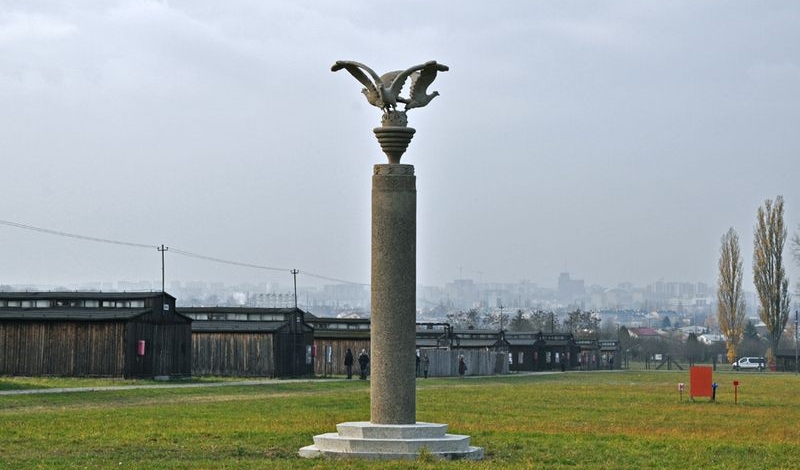
In the Majdanek concentration camp in Lublin, Poland, there is a statue titled "The Column of three Eagles". Originally, it was created by the prisoners of the camp according to the idea of Albin Maria Boniecki, a Polish artist who was imprisoned there. In 1943, when the International Red Cross was planning to visit the concentration camp, the authorities started to embellish the facility to create an illusion of a normal life. This is when Boniecki took advantage of the situation and proposed creating a special ornament in field III – a monumental column conveying specific symbols and meanings and providing consolation and hope to exhausted prisoners. The column was capped with an urn-shaped head finished with laurel, from which three half-pigeons and half-eagles sprung to flight. The laurel represented triumph, while the birds represented freedom, power, struggle, and fraternity. They were also a personification of a man, a woman, and a child guarding the Earth's globe on which they supported one another. Boniecki placed the tin tobacco box filled with the ashes of prisoners inside the column to commemorate those who lost their lives in the camp. The sculpture became a symbol of hope and was the first mausoleum to honour the memory of the victims of Nazi crime.
However, the process of creating the sculpture also had another purpose. Boniecki asked for help in creating the monument. Together with two other prisoners, he identified the people who needed to rest from exhaustion, convincing the authorities that they were necessary in the construction of the sculpture. As Boniecki's workshop was under the roof and there was only light work, they could finally relax and recuperate there.