What are the Human Sciences?

The human sciences are a diverse set of disciplines, including Economics, Social and Cultural Anthropology, Sociology, and Psychology. What they have in common is that they study human beings in their social environment. This in itself introduces some complications. Can we really objectively study ourselves? And what about the science bit - are all these sciences in the same way, like Physics and Chemistry? Does it matter anyway? And why should we study the human sciences?
Essential Understandings
- The human sciences study human beings in their social environment.
- The human sciences are hugely diverse.
- It is assumed that human beings have free will, which makes it hard for them to study.
- Human behaviour may not be as lawlike as that of non-living matter.
- Human beings studying themselves may lead to problems of objectivity.
Let's just say it first off: the human sciences are immensely diverse. If we take human sciences as the study of human beings in their social environment, then a wide range of activities falls under their umbrella. This is exciting from a ToK perspective - it is always interesting to study a wide variety of different knowledges. But there are challenges that come with this variety - perhaps the most obvious being that it is unlikely that studying a single discipline will tell us much about the other disciplines in the AoK. For example, studying how Economics makes knowledge may not tell us much about how social and cultural anthropology makes knowledge. Despite both of them being human sciences they are quite different in their knowledge framework attributes - their scope is different, their methods are different, they employ different perspectives, and the ethical constraints on the production of knowledge may be different.
This leads to an issuein writing the ToK essay. There is not enough space to cover all these different disciplines in an essay about the human sciences. But taking one of them as a representative of all is also not a viable option, since they are so diverse. ToK teachers and examiners are aware of this problem, and it is perfectly acceptable to write something like, "I shall use Economics as a representative of the human sciences, although I am aware that what is true of Economics may not be true of other human sciences." Examiners will accept this kind of disclaimer in the essay for practical reasons. The mere fact of acknowledging the problem shows that you are aware of it.

In the ToK essay, it is a good idea to acknowledge that the human sciences are diverse, so an example taken from one of them may not tell us about how the others make knowledge.
The human sciences developed in the 19th century, with Economics leading the way, followed by Sociology, Psychology, Anthropology, Geography, Linguistics and Political Science. According to Encyclopaedia Britannica the human sciences arose as a response to two significant events: the Industrial Revolution and Darwin's view of man as being part of the natural world instead of being merely an observer (Britannica). Later on, these disciplines were joined by Cultural Studies, Gender Studies, Asian Studies, Postcolonial Studies and a whole host of interdisciplinary studies such as social linguistics or cognitive archaeology. What they have in common is that their central focus is the human individual and the societies in which such individuals live.
You might want to try to fill in the following table. We have filled in the first row for you.
| Human Science: | What does it study? |
| Economics | studies the way human beings allocate scarce resources |
| Psychology | |
| Sociology | |
| Anthropology | |
| Geography | |
| Linguistics | |
| Political Science |
Economics studies the way human beings allocate scarce resources (Sloman p.16 ).
).
Psychology studies human mental processes and links to behaviour.
Sociology is the study of social life, social change, and the social causes and consequences of human behaviour. Sociologists investigate the structure of groups, organizations, and societies, and how people interact within these contexts.
Anthropology is the comparative study of culture and human societies.
Geography studies the interactions between human individuals, societies and physical processes in time and space.
Linguistics studies the structure of human languages and the patterns of human linguistic behaviour.
Political Science studies the political structure of human societies and concepts such as power, equality, freedom and justice.

We can add to this list other IB group 3 subjects, such as Digital Society, Business Management, and Global Politics.
The IB puts History in group 3, but ToK considers History sufficiently important and distinct to have its own area of knowledge. More problematic are the group 3 subjects, World Religions and Philosophy. Neither of these seems to fit the notion of a human science particularly well, not so much from the human part but because of the science part.
Philosophy does not seem to use the techniques of science because it is not primarily concerned with making observations of the world. Instead, it is concerned with making sense of observations and results already obtained by other disciplines. In that sense philosophy and ToK cover a lot of common ground. They both take a second-order perspective.
In the human sciences, human beings are engaged in a systematic study of human beings. Explain how this might be problematic.
In the human sciences, human beings are engaged in a systematic study of human beings. Explain how this might be problematic.
It is likely that any problems can be traced to a lack of objectivity in human beings being both the investigator and the investigated. As always in ToK, there are no hard and fast answers but the following may be appropriate:
- Science is often thought to take a distanced or dispassionate view of its subject matter. It might not be possible for human beings to be dispassionate about or distanced from themselves.
- In the process of investigating themselves, investigators may be led to consider their own experiences, emotions, or reactions as being somewhat typical when they are not. For example, a psychologist may be led by her own emotions about something to assume that the subject of her investigation feels the same. This is called the psychologists' fallacy.
- Science looks for laws or patterns, but we often assume that human beings have a certain amount of freedom, so we do not obey strict laws or patterns like pieces of matter. Therefore, the project of trying to discover laws and patterns is not likely to succeed.
- Linked to the last bullet, because human beings have will, they can wilfully go against any law that is presumed to bind them.
These questions will be explored in more detail later.
Why might World Religions not qualify as a human science?
Why might World Religions not qualify as a human science?
Again, this is a complex issue, but the main idea may be that religion is not really something that is appropriate for systematic scientific investigation.
- If religion is a creation of human beings, then it is not something in the world independent of human beings and, therefore, is not an appropriate target for scientific study.
- If religion is not a creation of human beings but refers to independently existing supernatural events, then by definition, these events are beyond the reach of methods designed to investigate the natural world.
Of course, using the term 'human sciences' immediately invites a comparison with the natural sciences. A ToK investigation of the human sciences should tell us what is scientific about them. At the same time, we might want to try to work out in what respect the human sciences differ from the natural sciences. This page will explore both these facets of the human sciences.
The table below summarises some of the main differences.
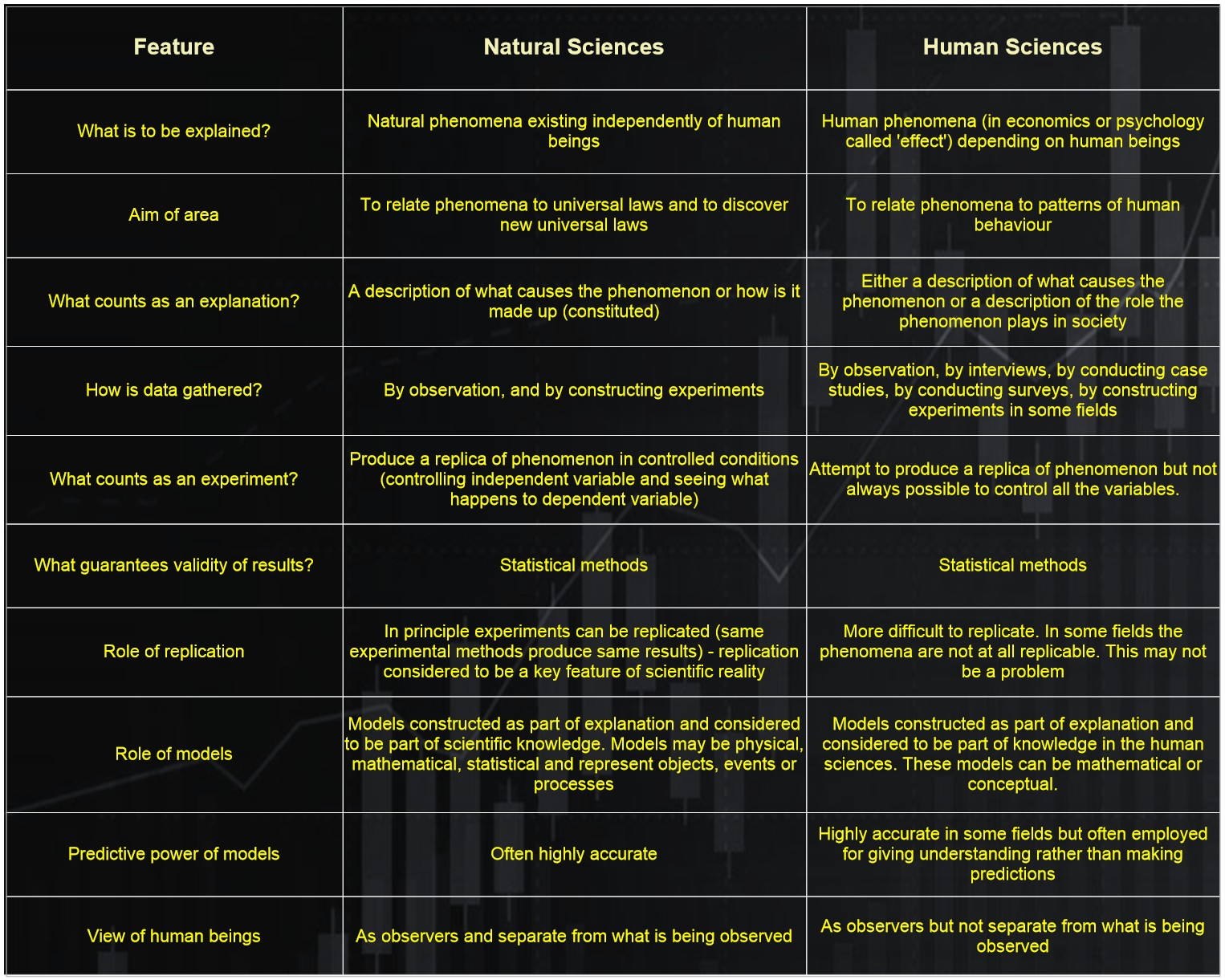

An important question to consider is why we should bother trying to understand human beings. After all, are we special? Why not just stick to studying other organisms and the non-animate world? One answer to this question could be that we humans are perhaps not as special as we suppose. We have rather a lot in common, say, with other mammals. If we understand how our fellow mammals behave, then why not apply the same kinds of questioning to ourselves?
Another answer could be that we have developed a special kind of society that is not found in the animal kingdom, which makes us worth studying. No other animal has developed a system for thinking and communicating as sophisticated as human language, for example. Moreover, understanding how human beings behave has profound practical benefits. If we want to be able to control the economy of a nation, then we need to know the factors that are responsible for driving it.

One big difference from the natural sciences is that, by their nature, human beings create facts - social facts - and these are of interest to the human sciences. An example of a social fact is the marital status of a person. Whether someone is married is not a physical fact about them. A newly married person is not physically different from the unmarried person they were a moment ago. Yet the right person saying the right thing in the right place at the right time transforms them into someone who is married. And this fact is as solid and as concrete as any fact about the physical world. It may be a little mysterious how language can create and change social facts. It is almost like magic. This performative use of language is explored in the section on the optional theme of Knowledge and Language. What is weird about social facts is that they can be created by humans. The question then is whether we can take the human sciences seriously if they study things that human beings can produce. We shall take a look at this question in a later paragraph in this page.

Language can be used performatively to create social facts like being married, or being found guilty.
The natural sciences strive for objectivity, which is the uncovering of features of nature that exist independently of anyone observing them (see Core theme: Scope 2 - Knowledge concepts - What knowledge is at stake? ). For example, physics tells us that there is matter and energy in the universe, and they behave according to certain universal laws and have always done so long before there were any humans to do science. The question is whether studying human beings can be objective. To start with, we are both the observers and the observed, so what is being observed cannot exist independently of an observer. A further worry is that, as observers, we shall affect what is being observed. For example, if we are engaged in a psychology experiment to learn about memory, how can we design the experiment so that our own experiences or expectations concerning memory do not interfere? Or when we observe the children playing with toys, wouldn't our presence interfere with their behaviour?
This problem is bigger in anthropology. How do we know that the anthropologist living as part of a group of people being studied does not affect the behaviour of the group? This is called the observer effect, which is when the act of observing the observer changes the phenomenon under investigation. This problem is by no means restricted to the human sciences. The same problem occurs in elementary particle physics, where in order to observe a particle, we have to bounce a particle of light off it, say, which changes the position and movement of the original particle. However, the problem is bigger in the human sciences because of the tendency of human beings to react to being observed.
The general term observer effect refers to the problem that in order to observe something, we need to interact with it, even if it just means bouncing light rays off it. There are different versions of this effect across disciplines in the natural and human sciences. Here are some of them:
Observer effect or 'the observer is part of the system' (physics)
In the natural sciences, especially physics, there is an operating assumption that the observer or measuring device is somehow separate from what is being observed. In particle physics, this is particularly problematic since the act of observing a system involves changing it - we can only know about the system by bouncing particles (photons) off it, which affects the state of the system.
Probe effect (physics, chemistry, biology)
In larger-scale experiments in physics, chemistry or biology, this is called the probe effect, where the device used to make measurements is necessarily in contact with the system and changes it. Imagine trying to measure the temperature of a cup of tea using a thermometer. Inserting the thermometer into the tea will change its temperature. "Ah, but can't we heat the thermometer first to the exact temperature of the tea? Wait..."
Goodhart's paradox (economics)
When an observer such as a government targets a particular economic variable as being a good indicator of some general economic state, then it ceases to be a good indicator of this state. For example, the number of windows in your house was used as a proxy for how wealthy you were in England and France in the 18th and 19th centuries as a basis for a tax. As a result people bricked up their windows and built houses with much fewer windows, and it became a poor indicator of wealth.
Observer effect (anthropology, sociology)
The presence of a participant observer as part of a study of a group in social or cultural anthropology or sociology may change the group dynamic being observed. Scenario: student teacher leading a class while being observed by a supervisor - do the students in the class act 'normally'?
Hawthorne effect (psychology)
The modification of behaviour by the subject(s) in a psychological study is brought about by the knowledge that one is being observed.
Observer expectation effect (psychology)
The modification of behaviour in psychological study is brought about by the subject(s) beliefs about the expectations of the observer - 'trying to do the right thing'. Sometimes, students do this in class or in test situations - I write X because the teacher wants me to write X (even if I do not agree). This may also be true of some situations in cultural anthropology (see the Margaret Meade controversy in Methods and Tools 2: Sociology and Anthropology, where interviewees may have made up answers according to their impressions of the expectations of the anthropologist interviewing them).
Key Concepts
Phenomenon - a feature of the world that is being investigated, such as water being composed of hydrogen and oxygen
Objectivity - a phenomenon that exists even when it is not being observed, e.g. water has always been composed of hydrogen and oxygen even before humans came along and studied Chemistry.
Universal laws - patterns of behaviour that always hold, e.g. there is always gravitational force between massive bodies.
Observer effect - the idea that an investigator observing a phenomenon changes it. For example, a class being observed by a teacher at the front may behave differently from one where no teacher is present.
Social facts - facts that human beings make to do with relations and status in society rather than a physical state of affairs. For example, being married is a social fact. A social relation makes it true that one is married, not a physical state of affairs.
1. Which of the following is not a phenomenon?
The law of gravity is a universal law it is not a particular event or feature of the world
2. Which of the following is a Human Science?
Paleontology the study of fossils might give some problems because of the study of hominid fossils. Nonetheless it is not human society that is primarily the focus but rather human or hominid physiology. The same argument goes for Medicine which is seen as an applied Natural Science. Musicology does study human beings in a musical context but it is not usually considered to be a science - although here the science/non-science becomes quite blurry. Cognitive Linguistics is a branch of Linguistics which is a Human Science.
3. Which of the following is a universal law?
Despite the name, the 'law' of demand is not a universal law because there are exceptions to it - rather a lot in fact. It is best understood as a model. There are no exceptions to the law of magnetism that states that similar magnetic poles repel and opposite ones attract.
4. Which of these is an objective phenomenon?
The feeling of water is not objective because it depends on an observer.
5. Which of the following are social facts?
Money is a classic example of a social fact. While a 1 dollar bill is physical its value and the reason we might be interested in it is social. Conventions too are social. The value of a work of art is more controversial but this value is usually described as social because it seems to be linked to particular cultures and their conventions.
6. In what respects are the Human Sciences different to the Natural Sciences?
The Human Sciences are increasingly mathematical these days. Although the Human Sciences are vulnerable to the observer effect, so are certain areas of the natural sciences, especially quantum theory, but arguably certain fields in Medicine.