Ancient wisdom to the rescue
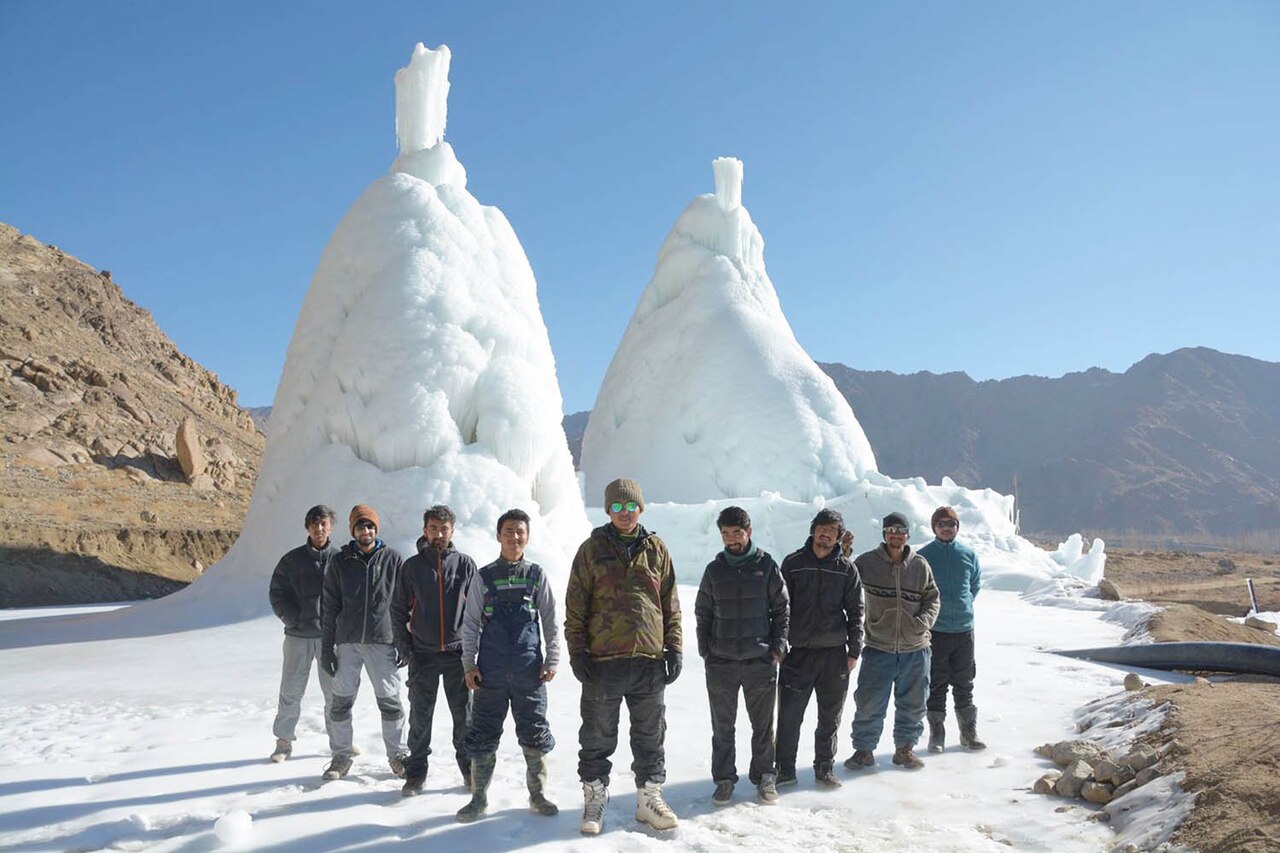
As climate crisis affects glaciers in the Himalayas, indigenous communities in Pakistan and Kashmor (India) are not just waiting for outside solutions. They use both the ancient traditions and modern engeneering to fight water scarcity in their agricultural regions. The examples show how local ecological knowledge can respond to environmental challenges and raises important questions: How do Indigenous knowledge systems compare with Western science? Can spiritual or culturally rooted practices also be valuable?
In 2025, Pakistan’s National Disaster Management Authority raised the alarm about climate-change-related risks of glacier lakes flooding the settlements below them – a phenomenon known as outburst floods. In response to glaciers melting, some residents in the higher-altitude Himalayan regions of Pakistan have reverted to a traditional technique known as glacier grafting – planting male and female ice to create new, artificial glaciers (called by locals a glacier marriage). The technique originated in the 14th century when it was used for defence purposes and was later adapted to address water scarcity. This practice was not only important environmentally but also had local spiritual and cultural significance. It is governed by a set of rules, for example, that the ice pieces need to be in constant movement from the place they were sourced to the place of grafting. These rules may be spiritual in origin but may also furnish deeply practical solutions to problems produced by the geography and ecology of the area.
This technique may not fully resolve the problems of water scarcity in Pakistan because of abnormal weather conditions and human involvement, but it is a great example of collective care and transfer of Indigenous Knowledge into modern ecological solutions (Haider and Ghani, 2026).
In the mountains of India in the agricultural and predominantly Buddhist Ladakh region of Kashmir on the other side of the border in this politically disputed region, people use a different technique called ice stupa: an ice structure shaped in the form of a heaped dome and named after the Sanskrit for the Buddha’s path to enlightenment. This technique was developed in 2013 by an engineer, Sonam Wangchuk. To make them, water is brought down from higher areas through underground pipes. When the water is sprayed into freezing air, it turns into ice and forms tall ice towers, which, thanks to a smaller evaporation surface, can hold tons of water for a long period. This water supplies farmers throughout the season and even allows them cultivate desert land. Ice stupas represent community-efforts to protect the ecosystems by the Ladakh people (The Guardian, 2025). The invention was even awarded by the 2016 Rolex Awards for Enterprise (Rolex, 2021) and led to similar techniques being used in Europe (in Val Roseg, Samedan, Pontresina; Glaciers Alive).
Discussion questions
- To what extent does this example support the idea that indigenous knowledge systems are more holistic and ‘synoptic’ than Western reductive systems of knowledge?
- Given that Western knowledge tends to be universal in its reach and indigenous knowledges tend to be more localised, what are the advantages and disadvantages of these kinds of knowledge?
- If Western science eventually confirms that glacier grafting works, does that "validate" the indigenous knowledge, or did this knowledge already possess value or truth?
- To what extent does the mystical dimension of glacier grafting (the rules around movement, the "marriage" ritual) affect its credibility as knowledge?
- What support is there for the argument that religious and other cultural practices serve to reinforce practically useful behaviours that enable the survival of the group?
- What is lost and what is gained when indigenous ecological practices are translated into the language of science and engineering for global audiences?
Commentary:
Western-style scientific knowledge tends to focus on a set of complex phenomena which it reduces to the interaction of simpler components a process we call reductionism (see Comparing the Human and Natural Sciences, Reductive vs holistic explanations in the human sciences and Explanation in the Natural Sciences). Reductionism is a bit like understanding the world through a patchwork quilt of knowledge made up of many separate pieces each of which is consistent and coherent but that are stitched awkwardly together often displaying gaps. On the other hand, indigenous knowledge systems often integrate their knowledge into a single coherent framework that combines both religious and spiritual aspects through an overarching cosmology, governs social behaviour, and informs practices such as agriculture and architecture (see Knowledge and Indigenous Societies: Scope 2 - Characteristics of Indigenous Knowledge and Knowledge and Indigenous Societies: Scope 1 - What are Indigenous Societies?). It is plausible that the examples given here support the latter kind of knowledge structure.
The interesting feature of Western scientific knowledge is that despite it being a patchwork quilt of explanations and theories that fit poorly together, these theories do a good job of applying across many different situations. They are universal. However, the downside is that we need to do a lot of work to apply this knowledge to local situations. I might know about the laws of physics, but it is difficult to apply these laws when my computer microphone is not working properly. Western science needs to be supplemented to work at the local level – we need to bring in local knowledge – for example that there is a bad connection in the microphone and tapping it gently will solve it.
Local knowledges on the other hand have the advantage that they are pragmatic. They work in the local circumstances in which they are applied. They have worked well in the past and they will work long into the future provided these local circumstances do not change substantially. Local knowledges have the opposite problem to global knowledges: while they apply to the local situation like a hand in a glove – quite unlike scientific knowledge, they often do not travel well. Applying these knowledges to other locations even those that are relatively close by, causes difficulties.
While some students might insist that local knowledges need to be ‘validated’ by Western scientific knowledge the analysis for question 1 and 2 suggests that local and universal knowledge systems are different beasts that do quite different things. In some sense it would be a mistake to expect one to ‘validate’ the other. Nonetheless, students may argue that universal scientific knowledge should at least be compatible with local knowledges – that using systematic practices of gathering and interpreting data and analysing them in terms of models and larger theories should tell us why local knowledges get things right. This may be so, but it may well turn out that local circumstances are so special that the universal laws just need so much extra local detail to make them work that the local knowledges turn out to be simpler and more elegant. It is not clear whether this is the case with glaciers and water storage. Maybe all glaciers are roughly the same and the same management methods can apply to all of them – that would be supported if the methods that work in the Himalayas also work in the Alps. But it seems more likely that local circumstances play a major role. Perhaps we should guard against making Western scientific knowledge the supreme form of knowledge in our ToK lessons (you may want to search for an article Towards Local Knowledge by Ric Sims published in the ToK print magazine Forum on this topic in 1996).
This more balanced approach might help think about questions 4 and 5. From a Western point of view, talk about spirits or gendered ice or marriage of ice might be dismissed as mere superstition and not related to a scientific worldview. However, narratives such as these may be part of practices that are pragmatically useful and allow such local societies to survive (Henrich, 2016). Rituals, such as ensuring constant movement of ice, may transmit important practices discovered through trial and error and preserved through these narratives. Spiritual aspects often serve as knowledge transmission systems to make sure important practical knowledge is passed down through generations. The narratives also show how indigenous people understand what can be explained by physics or chemistry today. The mystical element also often underlines indigenous peoples' sense of ownership and responsibility for the upkeeping of the ecosystems they live in (see Knowledge and Indigenous Societies: Methods and tools).
We can learn much from the wisdom of indigenous peoples today. Firstly, we recognize that ancient practices give us guidance to the problems of sustainable living and preserving a fragile ecosystem. Our ancestors faced similar problems years ago, and thanks to their wisdom and culturally transmitted practices, we can sustain current-day ecosystems. Learning about indigenous practices and highlighting them can also simplify access to funding and institutional resources these practices require to become widespread. While we might want to ‘validate’ these practices by applying universal knowledge systems such as those of the natural sciences and engineering, we risk losing the local picture, the wisdom that has accumulated through centuries of ever-more-refined practice, and transmitted through a holistic knowledge system that is local to the environment and its special features. According to the latter view, glacier marriage remains so and is not just a grafting technique. What often happens is that also indigenous communities do not get acknowledged for their knowledge and practices - when Western experts "adopt" local knowledge usually by superimposing a universalist knowledge system. Then indigenous practitioners can be sidelined in decisions about their own environment (see Knowledge and Indigenous Societies: Perspectives).
We recommend watching the TEDx Talk by the botanist, writer, and member of the Citizen Potawatomi Nation Robin Wall Kimmerer focusing on her book Brading Sweetgrass:
References:
GlaciersAlive (2025). Ice Stupas. https://glaciersalive.ch/en/projekt-ice-stupa/
Haider, I., Ghani, F. (2026). Glacier grafting: How an Indigenous art is countering water scarcity. https://www.aljazeera.com/news/2026/2/17/glacier-grafting-how-an-indigenous-art-is-countering-water-scarcity
Henrich, J. P. (2016) The secret of our success: how culture is driving human evolution, domesticating our species, and making us smarter. Princeton: Princeton University Press.
Rolex (2021). The engineer helping Himalayan farmers by creating artificial glaciers. https://www.rolex.org/partnerships/el-pais-semanal/sonam-wangchuk
The Guardian. (2025). Ice stupas of the Ladakh desert: an ingenious solution to water scarcity – a picture essay. https://www.theguardian.com/global-development/2025/jan/27/ice-stupas-of-the-ladakh-desert-an-ingenious-solution-to-water-scarcity-a-picture-essay