3D map of a faraway planet’s atmosphere
How do we use material tools in the production of knowledge in the sciences? Do they allow for the direct observation? What happens if the conclusions reached are only inferences? Is it still knowledge? This case allows you to discuss these questions and many more!
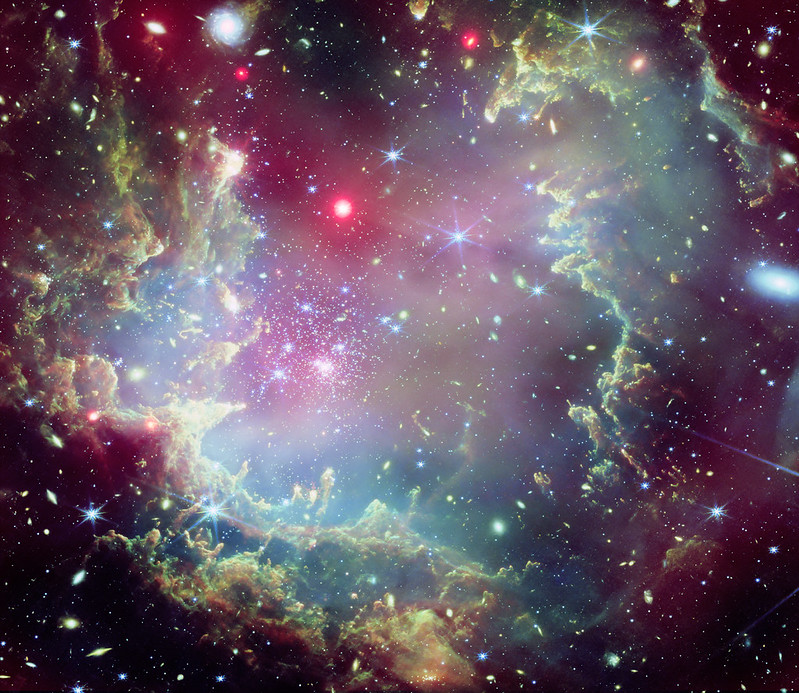
Thanks to the James Webb Space Telescope, scientists created the first 3D map of the exoplanet WASP-18b, a gas giant located about 400 light-years from Earth. Using the technique called eclipse mapping, which takes advantage of changes in light reflection, researchers turned small brightness changes into a 3D temperature map. It allowed them to map temperature across different regions and altitudes of the planet's atmosphere. This technique can help map the atmospheres of other faraway planets (Ware, 2025).
Discussion questions:
- How important are material tools in the production of knowledge?
- How do scientists use data from different sources to ‘triangulate’ their findings?
- Are we justified in being more confident of claims about the existence of things that we can directly observe (this is called empiricism) rather than those that we can only infer? Should we be more confident of the existence of a tree that we can see with our own eyes rather than that of the wind blowing a distant leaf around? Can we think of scientific instruments like the telescope as being an extension of the human sensory apparatus – in the sense that we are still directly observing the phenomenon? How far can we go with this claim – when we use an electron microscope, an x-ray machine or an MRI scanner are we still observing the world directly?
- If we need to use other scientific results in observing the world using a scientific instrument (such as using a spring to measure mass – using Hooke’s law) to what extent does this count as a direct observation of the world? What are the dangers of producing theories that are based on observations that depend on other theories being true?
- What is the role of models in the production of knowledge? How can it be that models that are, at best, simplifications of reality, at worst simply false, still be considered knowledge?
Commentary:
Material tools are very important in studying phenomena like faraway planets, which cannot be reached in any other way. However, almost everything that we see thanks to the instruments like the James Webb Space Telescope (JWST) is an inference - that means that it is not a direct observation. For a start the JWST gathers data in the mid-infrared region of the spectrum which is invisible to the human eye. Moreover, it does more than just taking infrared photographs of the cosmos including those elusive exoplanets. It gathers data about light changes: timing, brightness, and wavelength from which scientists deduce facts about the planet such as its size, chemical composition, temperature and weather systems. They use mathematical models to convert raw data about brightness changes into knowledge about the planet’s structure. These models are based on current theories of planetary structure and its effect on how planets reflect light as well as data (and further assumptions) about the kind of star that the planet is orbiting. Although such research could be described as speculative, scientists are careful to make the assumptions underlying such models clear, and they refine their methods by generating predictions that can be tested against further observations. Moreover, their models of planetary structure must also fit with what is already known about related questions to do with planet formation and the chemistry of planetary bodies. Scientists are very rarely working on questions that are independent of other questions and the knowledge of these related questions can help to narrow down the kinds of model used in highly speculative work such as exoplanet composition. The use of the evidence for a result from separate but related fields is called ‘triangulation’ in science.
There is a big debate in the philosophy of science as to what counts as a direct observation given that most observations involve some kind of inference. Even measuring the temperature of a liquid using a mercury thermometer requires quite a bit of inference based on the idea that the mercury expands linearly with temperature (see the wonderful book The Invention of Temperature by Hasok Chang). This is important to some theorists, called empiricists, who argue that the only phenomena that are real are those that can be observed directly. This means that, for the empiricist, a phenomenon that is inferred is not real but just a useful fiction for explaining the observations on which the inference is based. As we saw in the textbook, empiricists are ‘anti-realist’ about most scientific objects (see Theories, laws, models, and assumptions). The French philosopher Pierre Duhem and the American Willard van Orman Quine pointed out that most scientific claims are based on observations that are based on theoretical claims or assumptions and therefore the kind of direct observation beloved of he empiricists is simply not attainable in science. For the empiricist then most scientific theory is purely a way of explaining the data and not to be taken as telling us what is really there.
Models are tools for making, testing and sharing knowledge – they are like scientific metaphors that are used to make sense of a complex world. Practically speaking, they collect together sets of raw measurements into a general understanding of a phenomenon that then lends itself to making testable claims that warrant further investigation. Models, because of their general nature, allow researchers to merge evidence from a variety of sources. By explicitly stating the assumptions on which they are based, model builders also expose their reasoning process to the critical review of other researchers. Models are always wrong in some sense but hopefully they are also right in that they do the job of explaining some part of a previously mysterious phenomenon. As part of the whole knowledge process, models can be refined in the light of new observations or theoretical advances. Thanks to using standards for units of measurement and standard methods and procedures, models allow other researchers to attempt to replicate scientific results thus making peer review possible. However, all models possess limitations – like knowledge itself, they are simplified versions of reality, and usually only tell us about a small and rather specific feature of the world. Scientists must be aware of what these limitations are and, just like over-using a metaphor, they should be careful not to stretch the model too far.
Models and triangulation methods are not just used in astronomy; for example, they play a role in neuroscience or neurological medicine, Magnetic Resonance Imaging techniques (MRI or fMRI) are used to build up a 3-D picture of activity within the brain from a series of radio emissions from the protons within it. What is actually being measured is the intensity of a series of radio emissions and their timings. But these are translated by a computer into a 3-D map of the brain’s tissue, including blood flow – which is associated with brain activity (Shermer 2008). Therefore the machine is used to infer the structure of the brain rather than observing it directly. But as we wrote above, this is quite normal in science!
Reference list:
Chang, H. (2004) Inventing temperature: measurement and scientific progress. Oxford: Oxford University Press.
Duhem, P. (2013) Physical theory and experiment. In Philosophy of Science: The Central Issues (second.). New York, London: Norton.
Quine, W. van O. (1953) From a logical point of view. Cambridge, Mass.: Harvard University Press.
Shermer, M. (2008). Why you should be skeptical of brain scans. Scientific American Mind, 19(5), p. 67-71
Ware, S. (2025, November 5). James Webb telescope makes first 3D map of an alien planet’s atmosphere — and finds water being ripped apart. Live Science. https://www.livescience.com/space/astronomy/james-webb-telescope-makes-first-3d-map-of-an-alien-planets-atmosphere