Liberty or no Liberty?
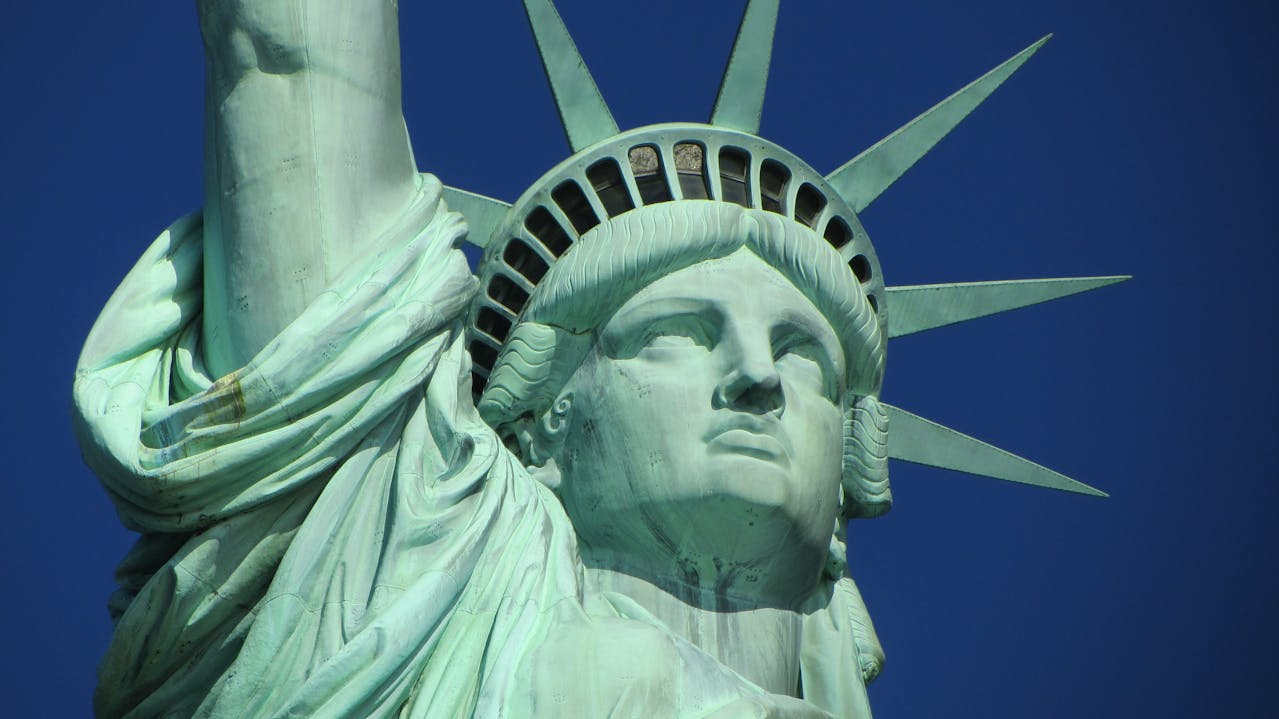
What happens when art and politics collide? Art, often valued for its freedom of expression, can also spark controversy. For example, it may challenge patriotic symbols and touch a political nerve. Such controversies raise big questions about freedom of expression, censorship, and who gets to decide what counts as acceptable art — or even whether censorship is ever necessary.
Amy Sherald, a renowned American painter, decided to cancel her exhibition at the Smithsonian’s National Portrait Gallery after claiming censorship over her art (CNN). Sherald is known for depicting African Americans in a simplified realism style. In 2018, she was commissioned (as the first painter of Black origin) by the National Portrait Gallery to paint official portraits of Michelle Obama, former First Lady of the USA (Wikipedia).
Her mid-career exhibition, Amy Sherald: American Sublime, has already toured the US. However, she withdrew a show at the National Portrait Gallery, as she was told “her painting of a transgender Statue of Liberty might be removed over fears of offending Donald Trump” (The Guardian) and was asked to remove it from the exhibition or replace it. Why is it so controversial? The contested painting depicts Arewà Basit, a black artist who identifies as non-binary trans-femme. Amy Sherman describes its purpose as “to hold space for someone whose humanity has been politicised and disregarded" (BBC), raising awareness about minority rights and visibility. Basit states that Liberty is someone “who is empowered, empowering and represents the fullness of what liberty and justice could give and what it can mean” (The Art Newspaper). However, by using this cherished national symbol of “American values”, Sherald has trodden on patriotic toes.
To view the full context, the Smithsonian has been targeted before by the Trump administration and ordered to “restore it to its rightful place as a symbol of inspiration and American greatness” (The Guardian) under the threat of limiting funding.
In August 2025, Sherald’s painting Trans Forming Liberty was featured on the cover of The New Yorker, opening a discussion about politics, art and censorship (The New Yorker).
Discussion questions:
- How can we know whose authority is most important in interpreting contested art: the artist, curator, government, or public?
- How should we decide how much weight the artist’s intent should carry compared to interpretations of the viewer or the museum (the Art World)?
- What is the role of museums in producing knowledge about art?
- How can we know where to draw the line between curatorial judgment and censorship? What criteria should determine it?
- What is the function of art in raising awareness of social issues?
- Is there a duty to showcase underrepresented perspectives even when it risks controversy or threatens continued funding?
Commentary:
Interpretation of art is a complex process. One view is that meaning is negotiated among the artist, curator, and public (see Stakeholders in the arts). However, the government can intervene in this process by restricting what can be shown or by positively promoting certain work or certain artists. This can lead to epistemic injustice when certain voices are systematically suppressed. The artist’s intent is a crucial starting point, but not the final word. According to ideas like Roland Barthes' "The Death of the Author," interpretation is shifted to the viewer (see Knowledge in the arts). Museums, on the other hand, do not simply display art; they generate knowledge through selecting artworks, arranging them, labelling them, and constructing an overall narrative around them. In an attempt to prevent accusations of censorship, their decision to display or not display a particular piece could be based on clear criteria, such as: the author's intent, who can access it, or a risk-management strategy. However, there is always the question about what criteria are appropriate – it is likely that these criteria are bound to be political because art is a form of social criticism.
Art is an excellent medium for raising awareness about social issues like liberty or identity. It highlights what might otherwise stay hidden and encourages viewers to consider perspectives they had not previously thought of. Symbols and artistic ambiguity allow for both open interpretation and guided reasoning.
There is an argument that museums should remain independent of elected politicians and strive to showcase art from individuals who are often underrepresented (such as trans or Black artists). However, there are always costs – there is no free lunch in ToK – choosing to show the work of one author means not choosing to show the work of others. These are inevitably choices that exhibit values and are, again, inherently political. An alternative to removing controversial work is to display it with contextual labelling. There is something to be said for variety and heterogeneity - if we never encounter certain viewpoints, we risk not seeing the larger picture. It is an interesting further question as to which artists deserve the chance to be recognised and heard in public culture and on what criteria. There are limited resources (and audience) so some selection is inevitable.
To read more about censorship, visit Censorship in the arts.