Unit 7 - Calculus
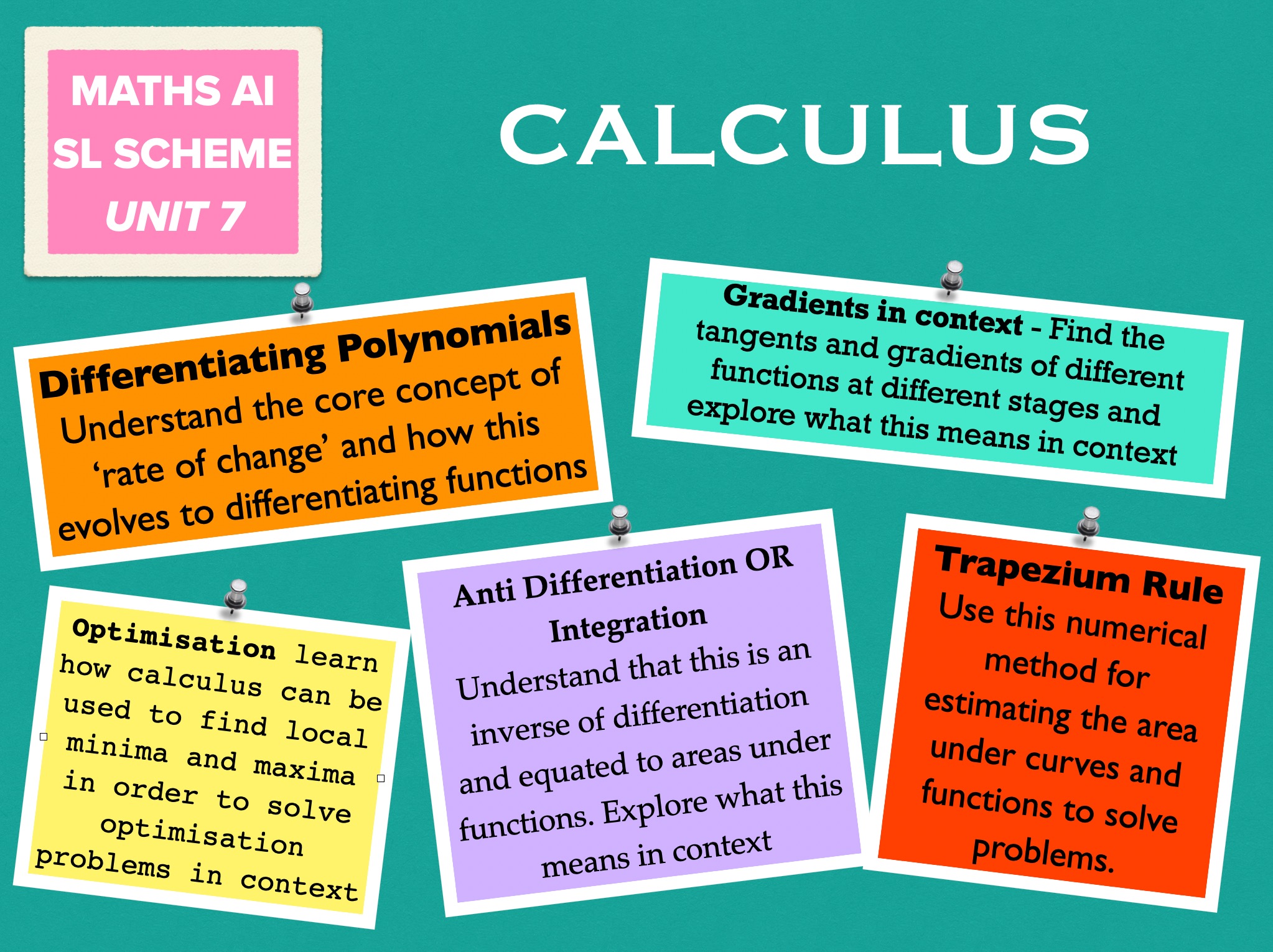
In unit 7, we are formally introduced to the great new mathematical world of calculus. It can be seen as building on the work that we have done in modelling but going to the next level where we explore the concept of rate of change and how that corresponds the the gradients of functions. Starting with contexts like distance speed and time we explore what ‘gradient’ means in context and extend our understanding to how these techniques can be sued to solve problems. In the second part, we get to the inverse operations and how that corresponds to the ‘areas under curves’ and what this too means in context. Its a great chance to see this area of mathematics and its application.
What is this unit about?
The syllabus items in this unit are addressed as follows
Part 1 - Differentiating
Find all the resources here in the SL Calculus Concept , SL Tangents & Normals and SL Optimisation topic pages.
Year 2 - Week 8 - Concept and Introduction - Start with this Distance Time Graphs activity to set the scene for understanding rates of change. If time allows then get to the Rates of Change and Classifying Sequences activities to really get the thinking going.
Year 2 - Week 9 - Differentiating Polynomials -You might make a start on this in the previous week with the Measuring Gradients activity to make the important link between the inquiry activities and the more formal idea of differentiating. Then take some time to bed down understanding of how to differentiate with positive and negative indices.
Year 2 - Week 10 - Gradients and tangents - At this point we can start looking at using the associated techniques to find gradients and tangents and sometimes normals at different points on functions and what they mean in context.
Year 2 - Week 11 -Optimisation - This is a big step up and I might start with this classic Max Box activity to dig deep on understanding these key ideas.
Year 2 - Week 12 - Revision and Unit Test - Finishing off the exam style questions and preparing for a summative assessment. At this end of the course, this might need to remain flexible. If there is time then great, otherwise I might choose to use all the time for practise.
Part 2 - Anti-Differentiating
Find all the resources here in the SL Integration + Trapezium rule page.
Year 2 - Week 15 - Definite Integrals and areas under curves - The context of distance time graphs is a good way to explore this and give some concrete meaning. Look at areas under graphs and use the GDC to show how technology is doing the same thing
Year 2 - Week 16 - Trapezium rule - Starting with contexts like river profiles, we will look at the idea of estimating areas and how this might get done better and better with increasingly narrower trapezia… This will lead to the derivation of the trapezium rule.
Year 2 - Week 17 - Integrating functions - The last piece in the puzzle is to look at the algebraic process of integrating functions and showing how this all fits together with the other ideas.
Year 2 - Week 18 - Revision and Unit Test - Finishing off the exam style questions and preparing for a summative assessment. At this end of the course, this might need to remain flexible. If there is time then great, otherwise I might choose to use all the time for practise.
Why does it matter?
For mathematics teachers, this hardly needs answering! I am often drawn to headlines about things being on the rise or the decline. For example, for along time there was a conflation between the ‘decline in the rate of increase’ of Facebook users and a ‘decline in the number Facebook users. This is a context that brings rate of change in to sharp refrain and begins to explain why analysing rates of change is so important. Leading on the notion of optimisation it is not difficult to be convincing. There is, however, an understandable grey area for many students here with the issue of ’if my calculator can find the maxima and minima, why do I need calculus to do it?' and I think this is a far question given the driving philosophy of the course. I am persuasive to ever varying degrees on the benefits of a little insight in to how it all works, but do think this is an important mathematical experience and one that allows us very much ‘under the hood’.
Opportunities for broader goals of education
The IB philosophy as detailed under 'Approaches to teaching and learning' (ATTL and planning) , invites is to always be thinking about the broader goals of teaching these units. It can be really hard to detail all the things that we do, big and small, planned and spontaneous, to do this, but it is important to try and reference some of them so that we get a strong sense of how we are doing against these objectives. Each of the pages and activities referenced above will also include references specific to those activities.

Each of the links above have extensive details about the nature of the tasks and the opportunities within them to address the broader goals of teaching and learning. For example..
- Distance Time Graphs is a great concrete activity to help students bridge to the abstract notion of differentiation.
- Rates of Change and Classifying Sequences are also good bridges from previous experiences and invites students to think conceptually about a function that describes how another function varies!
- Max Box is a great way in tot he notion of optimisation and brings it all together well. Its a good example of an inquiry based activity that students can work on together and can work towards a nice class display.
Help and support
Many of the tasks in the unit have different access points that should help students to engage at all levels. Students can be given access to the following topic pages with Student Access
SL Calculus Concept
This is the first of three sections on differential calculus. This is significant branch of mathematics with lots of applications. It builds very nicely on other concepts in the course and those you are...
SL Tangents & Normals
In this unit we look at find the equations of tangents and normals to curves, increasing and decreasing functions and the second derivative. All this builds on the fundamental notion that calculus tells...
SL Optimisation
In this section we look at how calculus is used to find the local maximum and minimum values of functions and, as such, how that is used to optimise. This is done both in the abstract and in context but...
SL Integration + Trapezium rule
Welcome to integration! A lot of fun is in store! It helps to remember that this topic, along with differentiation, is the best description humans have yet invented for measuring, describing and calculating...
In addition, you might want to share the following video lessons too!
5.1 & 5.3 Introduction to Calculus - video lessons
This is the first of three sections on differential calculus. This is significant branch of mathematics with lots of applications. It builds very nicely on other concepts in the course and those you are...
5.2 & 5.4 Tangents, normals and 2nd derivative - Video Lessons
In this unit we look at find the equations of tangents and normals to curves, increasing and decreasing functions and the second derivative. All this builds on the fundamental notion that calculus tells...
5.6 & 5.7 Stationary Points and Optimisation Video Lessons
This is the part where we learn about how we use calculus to solve different kinds of problems. So far we have spent a lot of time learning about how calculus helps us to work out the gradient of given...
5.5 & 5.8 Integration and Trapezoidal rule - Video Lessons
In this section of the course you will learn about an area of calculus called integration. This an be considered in multiple ways, both as the inverse of differentiation (anti-differentiation) and in...