Unit 6 - Geometry and Trigonometry
In unit 6, the focus is on angles, distance, area and volume and the way in which they are related for different shapes and spaces as well us periodic motion. It builds on much that has done before, thus allowing for a focus on how these key ideas model and explain the physical world around us!
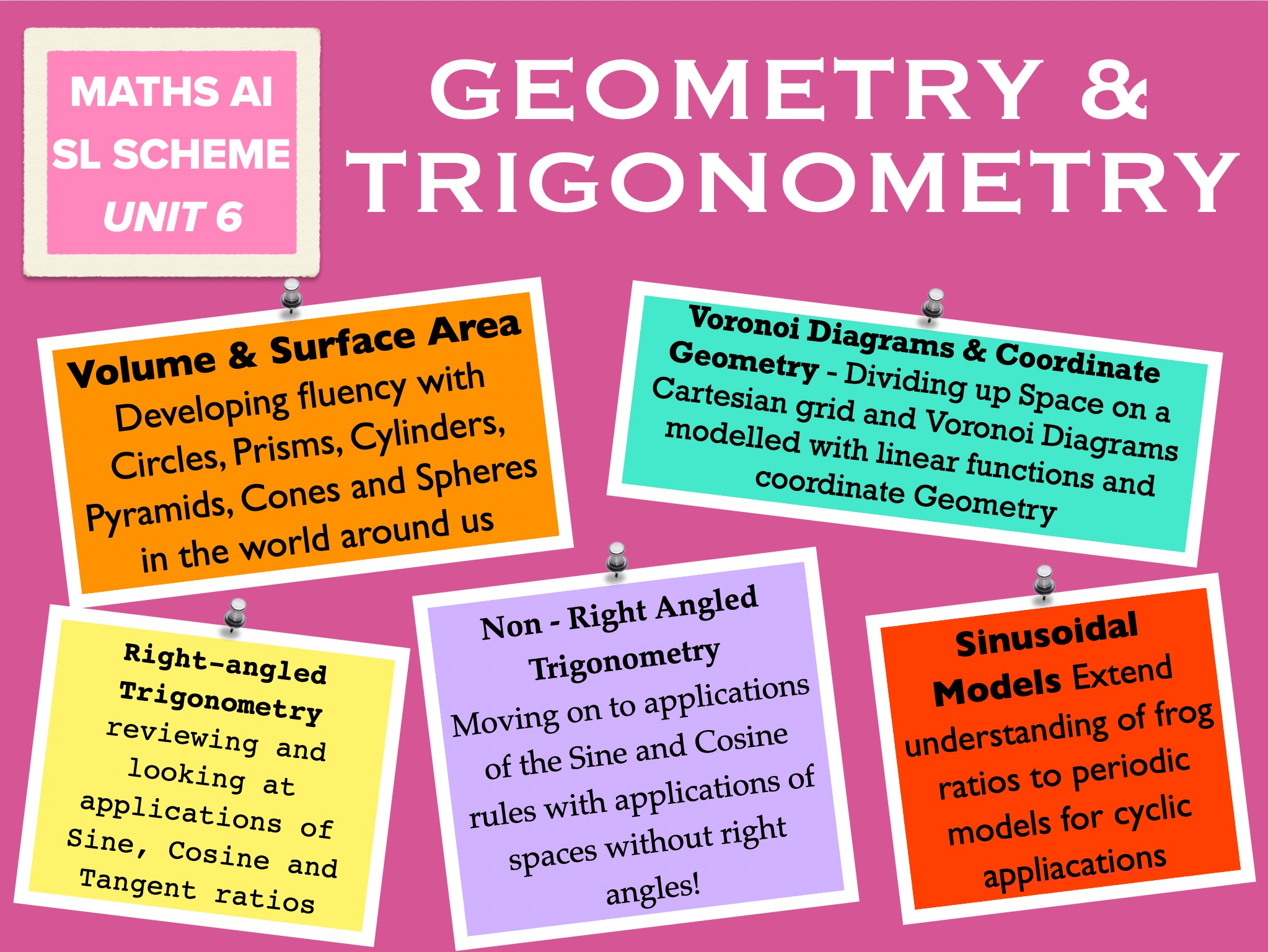
What is this unit about?
The syllabus items in this unit are addressed as follows
Week 36 - SL Volume & Surface area - This week the focus is on a bit of exploration with shapes that help thinking about where formulae come from and the relationships between the dimensions. Explore these ideas with Piece of Cake , Pyramid Volume, Making Cones
Week 37 - Volume and Surface Area - This week involves more of a focus on solving problems with SL Volume & Surface area and the key ideas that are explained in the 3.1 Volume and surface area - Video Lessons and the practise question material.
Week 38 - SL Right angled trigonometry - For many/most, this is a review of old ideas but equally important to go over as what follows is based on this. Working on Trig Calculator and Re-arranging relations supported by Right angled Trigonometry - Video Lessons and the practise exercises/
Week 39 - SL Non right angled trigonometry - Many will have done this too and this too is supported with these Non-right angled trigonometry - Video Lessons . A focus on Sine Rule can help to understand the key thinking behind the three important rules to learn and apply. These Which Rule? and Impossible Triangles activities are good contexts for some practise.
Week 40 - SL Sinusoidal models - Goes back to work on Functions, but it is nice to do it here since it builds on an understanding of the Trig Ratios and also provides a good review moment for thinking about functions and relations.
Week 41 - SL Voronoi Diagrams - This is a new area and if time allows it can be useful to spend some time exploring some of the fundamental geometry with Islamic Tile Design, Gradients and more ideas related to coordinate geometry like Mid-points and Perpendicular Bisectors building up the skills needed to solve problems with Voronoi Diagrams
Week 42 - Revision and Unit Test - Finishing off the exam style questions and preparing for a summative assessment.
Why does it matter?
Geometry is literally everywhere around us in the physical world. Understanding key concepts like angle, distance area and volume and how they are all linked is at the heart of anything structural or architectural. It describes the basics of product design and materials and is the basis of many optimisation problems that are key to economics that we will see in the Calculus units. The fundamental elements of trigonometry are a beautiful mathematical discovery with numerous applications problem solving. This all leads to the idea of circular motion and periodic models that model structures with circular elements from Helicopter rotas to wind turbines as well us tidal and temperatures cycles and waves in general. Coordinate Geometry and Voronoi diagrams are a fascinating exercise in dividing up space and associated optimisation. All told, this unit is very easily rooted in the world around us, which is very much in the spirit of the AI course.
Opportunities for broader goals of education
The IB philosophy as detailed under 'Approaches to teaching and learning' (ATTL and planning) , invites is to always be thinking about the broader goals of teaching these units. It can be really hard to detail all the things that we do, big and small, planned and spontaneous, to do this, but it is important to try and reference some of them so that we get a strong sense of how we are doing against these objectives. Each of the pages and activities referenced above will also include references specific to those activities.

Each of the links above have extensive details about the nature of the tasks and the opportunities within them to address the broader goals of teaching and learning. For example..
- The Making Cones activity is a prime example of an activity that really asks students to explore the structure of the shape and the relationship between its dimensions. It invites students to collaborate and inquire based on the existing knowledge they have and ideas they generate, giving a focus on they key concepts at hand.
- This is similarly found in Piece of Cake and Pyramid Volume and this Cuboid Challenge
- Students are given the opportunity to use tech to get to the hear of the key concept of Trigonometry using this Trig Calculator and Re-arranging relations and then evolving in to proving the Sine Rule which is a key mathematical journey that links neatly with ToK.
- The Impossible Triangles task is a nice angle on encouraging practise as students explore whether diagrams drawn and labelled might actually exist in real life.
- Looking at Coordinate Geometry, the Gradients activity invites us to think about the various ways we might define and measure ‘Steepness’. This is also a neat link with ToK.
- Exploring the geometry of Islamic Tile Design is a great opportunity to explore these cultural and mathematical treasure troves whilst getting at the heart of the ideas of dividing up space that underpin Voronoi diagrams
Help and support
Many of the tasks in the unit have different access points that should help students to engage at all levels. In addition, students have access to their text book and studyIB.net/mathapplications, where they can watch video lessons and get help and support. This is of course in addition to help from the teacher during lessons.