b) The Space Race
The Space Race
The Space Race was one of the most fascinating periods of innovation and intense competition in modern history. The growing rivalry between the USA and USSR during the Cold War drove rapid advances in space science and technology. Both nations made remarkable achievements, yet this came at the price of political tension and ethical issues that still remain unresolved today.
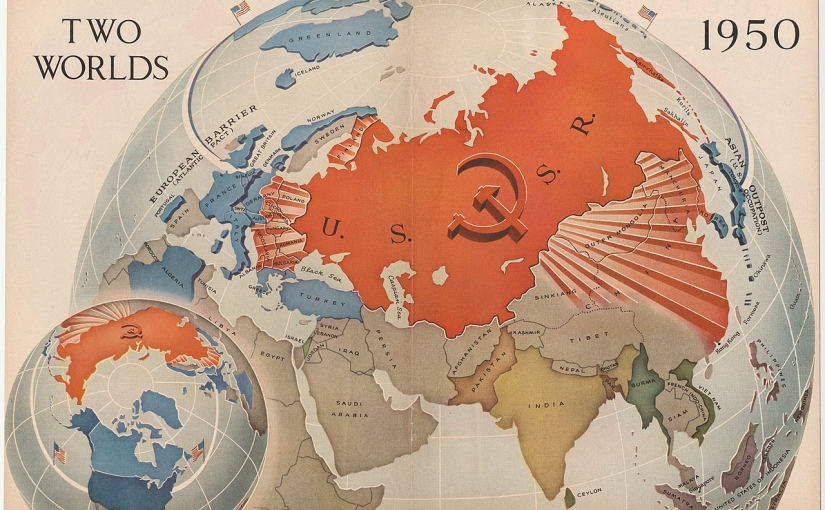
The Space Race emerged out of a period of geopolitical and military tension between the United States of America (USA) and the Union of Soviet Socialist Republics (USSR) known as the Cold War. This occurred immediately after the Second World War ended in 1945 and continued until the last decade of the twentieth century. Although both countries had been on the same side against Nazi Germany, they were fierce ideological rivals, as outlined in our unit on Superpower Rivalry and the Cold war. This is why scientific advancements, such as the Space Race, became such a contested area of competition. Success in this race would enhance superpower prestige.
 Creative Thinking Skills - Practising Flexible Thinking by Developing Historical Arguments
Like any event in history, the Space Race had multiple causes that varied in their influence. It's occurrence during the Cold War was contingent on the actions of various individuals as well as structural forces. Historians try to simplify this complexity by ranking causes. This task will help you to conduct this thinking.
Cold War Rivalry After the Second World War ended in 1945, tensions grew between the United States and the Soviet Union. Both superpowers competed for influence across Europe, Asia and the wider world. The Space Race became another arena in the wider Cold War struggle. | Fear of Nuclear Warfare During the 1950s, both nations developed intercontinental ballistic missiles (ICBMs) capable of carrying nuclear weapons across continents. After the Soviet launch of Sputnik 1 in 1957, many Americans feared the USSR could now strike the USA from space. | Competition between Ideologies The USA promoted capitalism and liberal democracy, while the USSR supported communism and one-party rule. Leaders in both countries believed success in space would prove the superiority of their political and economic system. |
National Prestige Achievements in space exploration became symbols of national power and prestige. When Soviet cosmonaut Yuri Gagarin became the first human in space in April 1961, it was celebrated around the world as a major victory for the USSR. | Scientific Curiosity Many scientists viewed space as a new frontier for discovery. Satellites launched during the Space Race helped scientists study weather systems, communication technology and the Earth from space for the first time. | Human Ambition & Exploration Throughout history, humans have explored new frontiers such as oceans, deserts and polar regions. During the 1960s, space became the next great frontier as astronauts and cosmonauts risked their lives to travel beyond Earth. |
German Rocket Technology During the Second World War, German engineer Wernher von Braun developed the V-2 rocket, the world’s first long-range guided ballistic missile. After 1945, both the USA and USSR captured German scientists and rocket technology to support future missile and space programmes. | Technological Innovation Rapid advances in rocket engineering, computing and materials science during the twentieth century made space travel increasingly possible. In 1957, the Soviet R-7 rocket became the first missile capable of launching a satellite into orbit. | Sputnik and Soviet Successes On 4 October 1957, the Soviet Union launched Sputnik 1, the first artificial satellite to orbit Earth. Further Soviet successes, including Laika the space dog (1957) and Yuri Gagarin’s space flight (1961), increased pressure on the USA to catch up. |
Task 1 - In groups, place the causes above into a diamond ranking from most important to least important. Once completed, discuss and justify your decisions using evidence from the inquiry.
Task 2 - Discuss these reflection questions as a group to help you contextualise the causes of the Space Race:
- Which factor do you think was the most important cause of the Space Race?
- Were political or scientific motivations more significant?
- Could the Space Race have happened without the Cold War?
Task 1 - There's no single correct ranking for this task. The purpose is to get students to express their historical reasoning when explaining their ranking. However you may like to nudge students into thinking about different types of causes:
- Long-term Preconditions/Underlying/Enabling Causes - German rocket technology, technological innovation, scientific curiosity, Cold War rivalry, Ideological Competition.
- Short-term Precipitants/Catalysts/Determining Causes - Nuclear fears, national prestige
- Trigger Causes - Sputnk 1, Soviet Successes
Task 2 - Indicative answers for these questions, there's no one specific answer:
- Which factor do you think was the most important cause of the Space Race? - Various could be argued although Cold War Rivalry is connected to many of the other causes and set the ideological struggle.
- Were political or scientific motivations more significant? - It depends on whether we are considering the motivations of scientists or governments. Opinions vary but consider whether governments would have invested so much without the political and strategic competition of the Cold War.
- Could the Space Race have happened without the Cold War? - The technology was there to enable space exploration but the extent to which it would develop into a race could be disputed. The speed, scale or intensity of the Space Race could also have been different. The trick here is to encourage students to think counter-factual and to ask what would have happened differently.
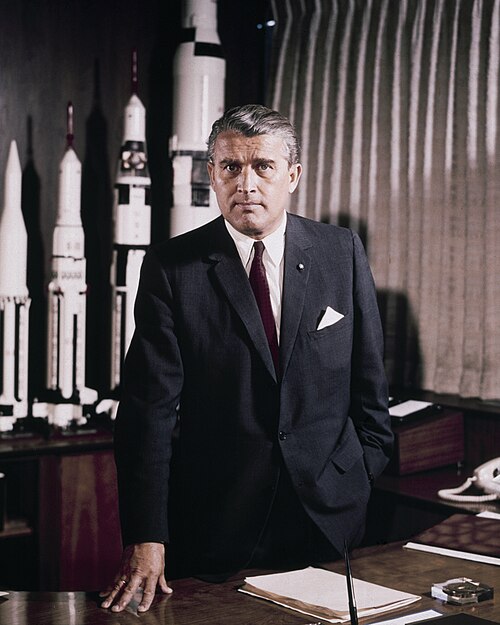
By the early 1950s, this race began in earnest. During WW2, German scientist Wernher von Braun and his team had pioneered the development of the V-2 rocket, the world's first liquid-fuel ballistic missile. It was also the first man-made object in history to enter space after it crossed the Kármán line (100km above sea level) in 1944. After the war, both the USA and USSR secretly captured and enlisted German scientists and research materials. During Operation Paperclip, the USA managed to move over 1,600 German personnel to work on its future space programme. The Soviet Union was able to capture more, with over 2,500 captured during Operation Osoaviakhim.
As a result, both nations rushed to rapidly expand their missile programmes, developing intercontinental ballistic missiles (ICBMs) that could carry nuclear weapons, satellites and humans into space. By 1957, the USA had developed the Atlas rocket and the USSR developed the R-7.
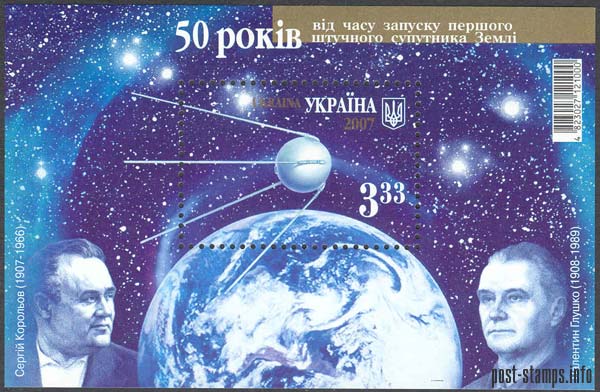
This was further accelerated in October when the USSR successfully launched Sputnik 1, the first artificial satellite to orbit Earth. The first stage of the Space Race had been won by the USSR. This caused a crisis in the USA. If a satellite could be launched into space, why not a nuclear weapon? In an attempt to catch up, the USA ploughed money into the race, creating the Advanced Research Projects Agency (DARPA) and National Aeronautics and Space Administration (NASA) in 1958.
Media Literacy Skills - Demonstrating Awareness of Historical Media Interpretations
In October 1957 the Soviet Union shocked the world by launching Sputnik 1, the first artificial satellite to orbit Earth. Many Americans feared that the USSR had gained a technological and military advantage during the Cold War. By studying political cartoons from this period, you can understand how people in the US reacted and why this triggered an acceleration of the Space Race.


Task - With a partner, select one of the American political cartoons above. For each source, try to identify:
- What message does the cartoon communicate about American reactions to Sputnik?
- How does the cartoon suggest this? What symbols or images support this inference?
- Why might Americans have felt worried or threatened after the launch of Sputnik?
- How does the cartoon connect scientific innovation to Cold War competition?
- To what extent does the cartoon suggest the USA was unprepared for the Space Race?
The four cartoons were all produced in 1957 and together they reveal many of the anxieties and perceptions Americans had about the launch of Sputnik. Specific messages of the sources could include:
- Our Technical Superiority - Cartoon criticises American complacency as the pilot presumes technological superiority, relaxed in his cockpit. The pilot then looks up noticing Sputnik, appearing shocked. This suggests the USA was caught by surprise.
- Moon Watcher - Uncle Sam representing the USA is stuck on Earth and can only watch Soviet progress via the telescope. Suggests the USA is behind the USSR which is confirmed by the sign.
- Awake at Last? - A shocked looking Uncle Sam is awakened by Sputnik, acting like an alarm clock to the ‘complacent’ USA. Suggests that Soviet superiority took the USA by surprise.
- By the Light of the Moon - Shows that Americans immediately connected satellite technology race to national security as seen by ‘defense speed-up’ headline. The light of the moon, being Sputnik, has forced the USA to realise this.
- Why might Americans have felt worried or threatened after the launch of Sputnik? - The sources and case study narrative suggests that Americans realised that satellite successes of Sputnik also demonstrated the successes of Soviet long-range missile technology. The psychological impact of this went beyond the satellite itself.
- How does the cartoon connect scientific innovation to Cold War competition? - The technological achievements of the USSR were seen as reflections of Soviet national power. American reactions saw this as a defense issue. Scientific progress thus became part of a wider superpower rivalry.
- To what extent does the cartoon suggest the USA was unprepared for the Space Race? - The word complacency is used in many of the sources as is the shocked reaction of the Uncle Sam characters. This suggests that the artists at least believed the USA was unprepared.
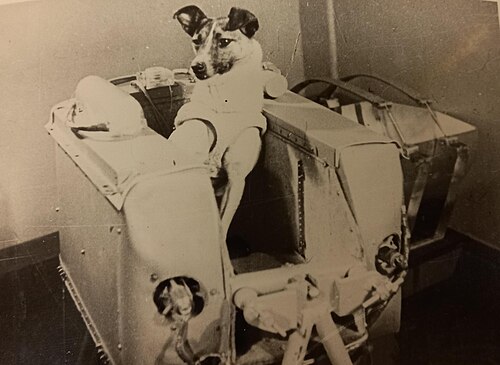
Whilst Cold War rivalry was the key underlying cause of the Space Race, human curiosity and ambition also contributed to its development. Space was not only a new field of scientific innovation and development, but also a new dimension whereby pioneers and explorers could make their mark. Yet the first living explorers were animals who were sent to ‘test’ the livability of space flight.
The USA was first, sending fruit flies in 1947, a monkey called Albert II in 1949 and a mouse in 1950 - but none, apart from the fruit flies, survived. The USSR achieved the next ‘first’ by sending the dog Laika into space, becoming the first mammal to orbit the Earth.
By 1961, the first human in space was achieved by the USSR as Yuri Gagarin became the first human to orbit the Earth in Vostok 1. This was followed by the first women in space, Valentina Tereshkova, in 1963.
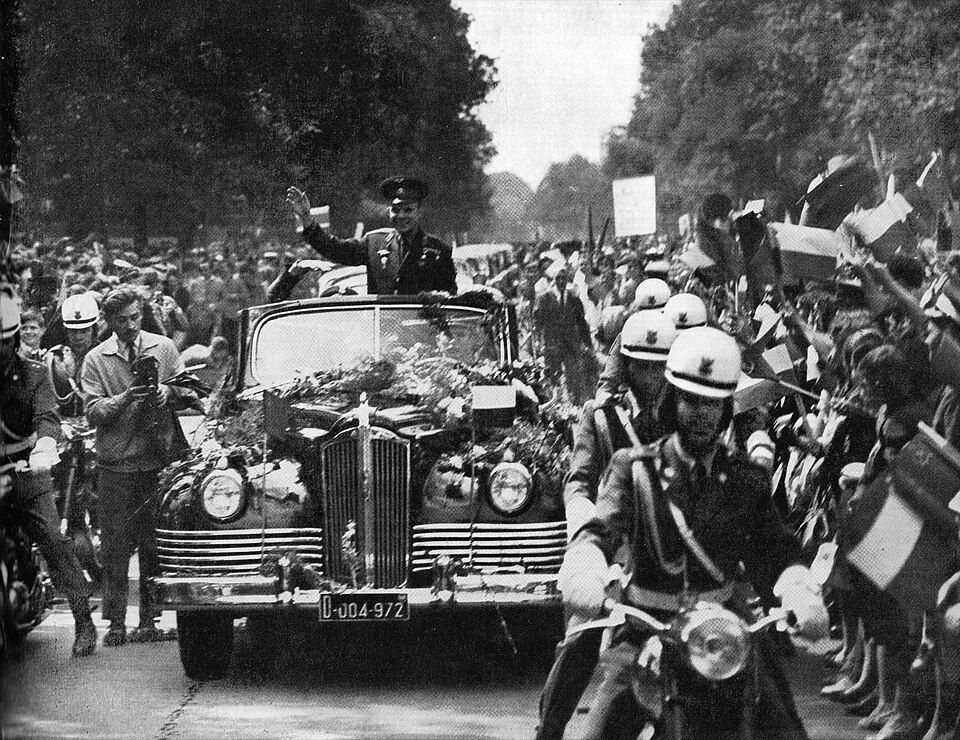
The significance of these surprise victories by the USSR spurred US President John F Kennedy into declaring his ambition for the USA to be the first to land humans on the moon with his Apollo programme. A goal once thought impossible. Achieving this goal though would require enormous collaboration between thousands of pioneers, innovators and developers. The next stage of the space race had thus begun, one that would transform the modern world.
Critical Thinking Skills - Analysing and Evaluating Historical Issues and Ideas
In May 1961 the US President John F. Kennedy delivered a speech to Congress announcing the American goal of landing a human on the Moon before the end of the decade. This task will help you to understand how the pioneering spirit of the Space Race was felt by and articulated by decision makers at the time.
Source E - Extracts from President Kennedy's Address to Joint Session of Congress May 25, 1961[1]
“...if we are to win the battle that is now going on around the world between freedom and tyranny, the dramatic achievements in space which occurred in recent weeks should have made clear to us all...”
“I believe that this nation should commit itself to achieving the goal, before this decade is out, of landing a man on the Moon and returning him safely to the Earth.”
“No single space project in this period will be more impressive to mankind, or more important for the long-range exploration of space...”
“If we are to go only half way, or reduce our sights in the face of difficulty, in my judgment it would be better not to go at all.”
Task 1 - Study the extracts from the speech above and answer the questions that follow:
- What reasons does he give for increasing American involvement in the Space Race?
- How does he connect space exploration to the Cold War?
- In what ways does he portray the USA as a pioneer in space exploration?
- Why do you think he believed a Moon landing was important for the USA?
- To what extent was this speech about scientific exploration rather than political competition?
Task 2 - Practice your source analysis skills next by trying to identify these OPVL elements in the source:
- Origin - Who delivered the speech and when and where was it given?
- Purpose - Why was the speech given?
- Value - What does the speech reveal about American attitudes during the Space Race?
- Limitation - What perspectives or information may be missing from the speech?
Task 3 - Discuss the following question as a class to reflect collectively on the value of this source to historians:
“How useful is Kennedy’s speech for understanding the causes and aims of the Space Race?”
Task 1 - Indicative answers for these questions could include:
- What reasons does he give for increasing American involvement in the Space Race? - Presents the Space Race as important for American prestige and for demonstrating US capabilities. He also outlines the contribution to science that a successful moon landing would have.
- How does he connect space exploration to the Cold War? - By claiming that there is a battle between ‘freedom and tyranny’ he sites the Space Race within the wider Cold War struggle. In this sense, he views Soviet achievements as political challenges as well as scientific successes.
- In what ways does he portray the USA as a pioneer in space exploration? - He describes the US as being committed to overcome technical difficulties and challenges in order to push boundaries and achieve an extremely ambitious goal that has never been done before.
- Why do you think he believed a Moon landing was important for the USA? - He saw it as a way to restore American prestige and demonstrate US capabilities. His understanding that this achievement would be ‘impressive to mankind’ suggests that Kennedy is aware of the impact on international perceptions.
- To what extent was this speech about scientific exploration rather than political competition? - Kennedy mentions both influences in his speech but prioritises the political competition and the wider ideological struggle. Scientific impact is mentioned as a secondary consequence.
Task 2 - Encourage students to develop their own opinions and ideas when analysing sources, but these are some indicative answers that point to the direct discussions could take:
- Origin - The speech was by US President John F. Kennedy delivered to a joint session of the US Congress on 25 May 1961.
- Purpose - To persuade Congress and the American public to support a major expansion of the US space programme, including the goal of reaching the Moon before the end of the decade.
- Value - As a contemporary presidential speech it gives direct evidence of how US leaders publicly justified the Space Race. It reveals the importance they attached to prestige and the Cold War.
- Limitation - As a persuasive political speech, Kennedy obviously has reasons to emphasise the importance of the programme for his own political goals. It also does not provide the Soviet perspective or fully reveal other considerations behind their decision-making such as re-election or pressure from the military or business community.
Task 3 - A broad range of answers should be encouraged here but the outlines of the positions are:
- Useful = Shows how Space Race was directly connected to the Cold War and the importance of national prestige and technical achievements in winning that war. Reveals his public motivations.
- Not Useful = Only represents the views of one US President at one particular time. Doesn't reveal the long-term causes of the Space Race or what other hidden motives the US may have had.
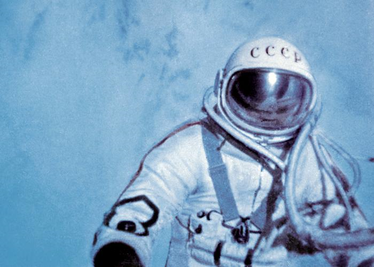
Landing a human on the moon was one of the most complex scientific and engineering problems ever encountered in human history. Today we remember the Apollo programme largely through individual Astronauts like Neil Armstrong, Buzz Aldrin and Michael Collins who took part in the successful Apollo 11 mission. Yet their actions were merely the culmination of hundreds of thousands of people across different fields of science. Scientists, engineers and mathematicians worked collaborated with technicians, computer programmers and factory workers to make space travel possible. Innovation was therefore the result of collective expertise and problem solving.
Yet certain individuals do mark themselves out for special attention. One of the most important pioneers was the controversial German rocket scientist Wernher von Braun. Brought to the USA after the Second World War, he spearheaded teams of scientists and engineers at NASA on the Apollo programme, culminating in the Saturn V rocket which would take men to the moon in 1969. Meanwhile in the Soviet Union, Sergei Korolev was lauded as the chief engineer behind many of the early Soviet successes including Sputnik 1, Yuri Gagarin's spaceflight and the first spacewalk by Alexei Leonov in 1965. Both superpowers invested vast sums into the work of these pioneers.
Critical Thinking Skills - Considering Historical Ideas from Multiple Perspectives
Wernher von Braun was one of the most important rocket engineers of the twentieth century. Yet historians continue to debate whether von Braun should be remembered as a visionary pioneer of space exploration or as a scientist connected to war crimes and unethical practices. This task will ask you to evaluate this debate.
Task 1 - First watch the video above. Can someone be both a pioneer and a villain at the same time?
Task 2 - Working in pairs, each student should choose one side of the debate to investigate. Create a table similar to the one below. As you watch and read the evidence that follows, take notes on any evidence from his life that could be used to support your perspective.
| “Should Wernher von Braun be remembered as a visionary or a villain?” | |
| Visionary | Villain |
| Gather evidence showing that Wernher von Braun should be remembered as an important pioneer, innovator and developer in the history of space exploration. | Gather evidence showing that Wernher von Braun should be criticised for his role in Nazi Germany and the V-2 rocket programme during the Second World War. |
Task 2 - First examine this opinion article by an Al Jazeera science journalist on the life of Wernher von Braun. Take notes to support your perspective.
Task 3 - Now watch these two TV interviews with Wernher von Braun. How do the interviews attempt to present Wernher von Braun as a pioneer and innovator? What do they reveal about how he wanted himself to be portrayed?
| Video 1 - British TV interview (1959) | Video 2 - Presenting on Disney's ‘Man in Space’ |
Task 4 - Now finally examine this source. According to historian Michael Neufeld, to what extent was Wernher von Braun responsible for the use of concentration camp labour in the V-2 programme?
Source F - Wernher von Braun, the SS, and Concentration Camp Labor: Questions of
Moral, Political, and Criminal Responsibility, by Michael J. Neufeld (2002), German Studies Review, 25(1), p. 67
'We must conclude that, before von Braun's arrest by the Gestapo, he had already become thoroughly acquainted with the employment of concentration camp labor at a minimum of six locations in the V-2 program, had witnessed at least some of the catastrophic conditions of working and sleeping in the tunnels at Dora, and had been drawn into the administration of slave labor in the program… On the other
hand… he was not directly responsible for initiating the exploitation of concentration-camp labor, and was even less involved in its administration. Moreover, his power to help the prisoners was, as he claimed later
in life, virtually zero.'
Task 5 - Should Wernher von Braun be remembered mainly as a pioneer of space exploration or as a controversial figure connected to war crimes? After discussing both perspectives, write a short paragraph answering this. Use evidence from the sources to support your judgement.
For this task students can collect a range of evidence from the sources provided or supplemented with your own. Generally, the main arguments can be summarised as follows. You may like to supply some groups with some of these ideas to help develop their positions:
| Visionary | Villain |
| A highly talented rocket scientist who earned his PhD in physics at only 22. (Introductory video) | Served as an SS officer during Nazi rule. (Introductory video) |
| Led the team developing the V-2, an important breakthrough in long-range rocket technology. (Introductory video) | Led the development of the V-2 as a weapon of war used against European cities. The video estimates that V-2 attacks killed nearly 3,000 people. (Introductory video) |
| The A4/V-2 became the first human-made object to reach the threshold of space in 1942. (Introductory video) | V-2 production relied heavily on concentration-camp slave labour under appalling conditions. (Introductory video and Neufeld) |
| Preserved technical documents rather than destroying them when ordered to do so as Germany collapsed. (Introductory video) | Neufeld argues that von Braun knew concentration-camp labour was being used at several locations and had personally witnessed conditions at Dora. (Neufeld) |
| After moving to the USA, became an important figure in the development of the American space programme. (Introductory video) | Neufeld states that von Braun became involved to some extent in the administration of slave labour, although he was not primarily responsible for creating the system. (Neufeld) |
| Led the team that developed the Saturn V, which enabled the Apollo missions to reach the Moon. (Introductory video) | His later claim that he had virtually no power to help prisoners raises questions about how much responsibility scientists have for the systems in which they work. (Neufeld) |
| Publicly promoted ambitious human spaceflight and argued that an organised programme could make passenger spaceflight achievable. (Disney Man in Space) | His technical ambitions were closely connected to military missile development before becoming associated with peaceful space exploration. (British interview and Introductory video) |
| Presented spaceflight as something achievable through careful step-by-step research and testing. (Disney Man in Space) | His V-2 work drew upon and developed earlier rocket research, including that of Robert Goddard, complicating the image of von Braun as a lone technological genius. (Introductory video) |
| By 1959, he stated that more than half of his team's work was devoted directly to advancing spaceflight. (British interview) | In the British interview he expresses sympathy for victims but describes their deaths within the broader statement that 'war is a dirty business' rather than discussing his own responsibility in detail. (British interview) |
| His expertise helped connect early experimental rocketry with practical human spaceflight within a few decades. (Introductory video) | His post-war career benefited from Operation Paperclip, through which the USA recruited German scientists despite their involvement with Nazi Germany. (Introductory video) |
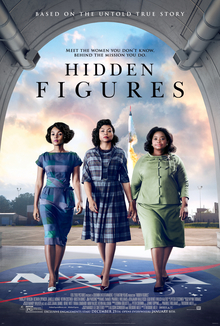
Yet whilst these public personas excited the imaginations of many, it was the work of their larger teams that put their ideas into action. At NASA, teams of hundreds of mathematicians and computer scientists calculated flight paths, launch windows and procedures for the safe re-entry into Earth's atmosphere.
Among the most significant were three African American women. Katherine Johnson, Dorothy Vaughan and Mary Jackson were pioneering mathematicians and engineers who developed many of the calculations required for the Apollo programme, despite living at a time of deep racial segregation in the USA. Their stories only became widely known in recent years.
Margaret Hamilton was another highly significant engineer. She led the team that developed onboard flight software for the Apollo missions and is even credited with coining the term 'software engineering'. These hidden figures are just some of the many thousands whose collective innovation made Space travel possible.
Information Literacy Skills - Making Connections between Various Sources of Information
Thousands worked behind the scenes to make space exploration possible. Many of these contributors received little public recognition at the time. Your task is to investigate one hidden figure from the Space Race and explain why their contribution mattered.
| Katherine Johnson | Dorothy Vaughan | Mary Jackson |
| Margaret Hamilton | Gene Kranz | John Glenn |
| Sergei Korolev | Yuri Gagarin | Valentina Tereshkova |
| Alexei Leonov | Vladimir Komarov | Mstislav Keldysh |
Task 1 - Choose one individual from the list above. Create a simple ‘Unsung Hero of the Space Race’ profile card. Your profile card should include:
- Name and role
- Key achievements
- How they contributed to the Space Race
- Why their work was important
- Why they may not be as well remembered today
- One image or symbol connected to their work
- A short quote or slogan that represents them
Task 2 - Display all profile cards around your classroom and complete a gallery walk. Examine all the cards then have a class vote. Who was the most important ‘hidden figure’ of the Space Race? Be prepared to justify your choice using historical evidence.
This task could be structured in a range of different ways. However the main focus should be on developing students' ability to make a justified judgement about historical significance. To start with, try to urge students to support their profile card with specific evidence rather than broad claims.
For Task 2, you could display the historical significance criteria that we've used in other case studies. This could help the class judge who was the most important hidden figure.
- Remarkable - Was their contribution unusual or especially impressive at the time?
- Remembered - Are they still widely recognised today or have they been overlooked?
- Resonant - Does their work still connect to science/technology or society today?
- Resulted in Change - What direct or long-term impact did their contribution have on the Space Race?
- Revealing - What does their story reveal about how the Space Race actually worked behind the scenes?
Whilst the ground teams were clearly the brains behind the development of space engineering, astronauts and cosmonauts also played vital roles. These men and women risked their lives to pilot space craft and test these new experimental technologies. Many became national heroes in the process. Yuri Gagarin and Valentina Tereshkova became famous as the first man and woman in space. The Americans soon followed with Alan Shepard in 1961 and John Glenn in 1962.
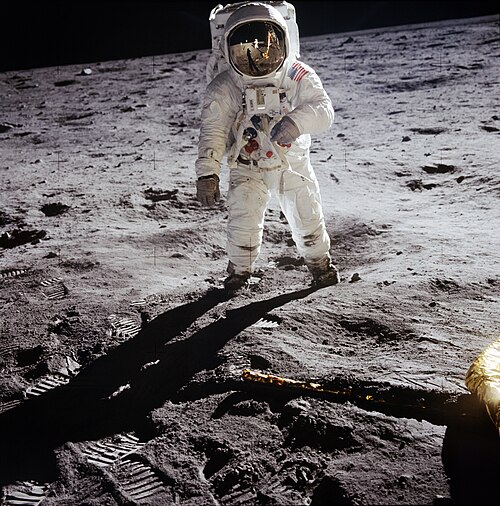
As the ‘moon race’ accelerated, more astronauts were needed to test new procedures. In 1965, Alexei Leonov on the Soviet Voskhod 2 became the first human to conduct a ‘spacewalk’. But this was the height of Soviet superiority in space. In 1969, years of collaboration and technological development paid off as NASA landed Neil Armstrong and Buzz Aldrin on the moon. Their Apollo 11 mission represented not only a triumph of exploration, but the combined effort of pioneers, innovators and developers from across the world.
Critical Thinking Skills - Analysing Complex Concepts in History
The image below shows the NASA Organisational Chart from November 1961, shortly after President John F. Kennedy announced the goal of landing a human on the Moon before the end of the decade. NASA was a massive system made up of pioneers, innovators and developers working together.
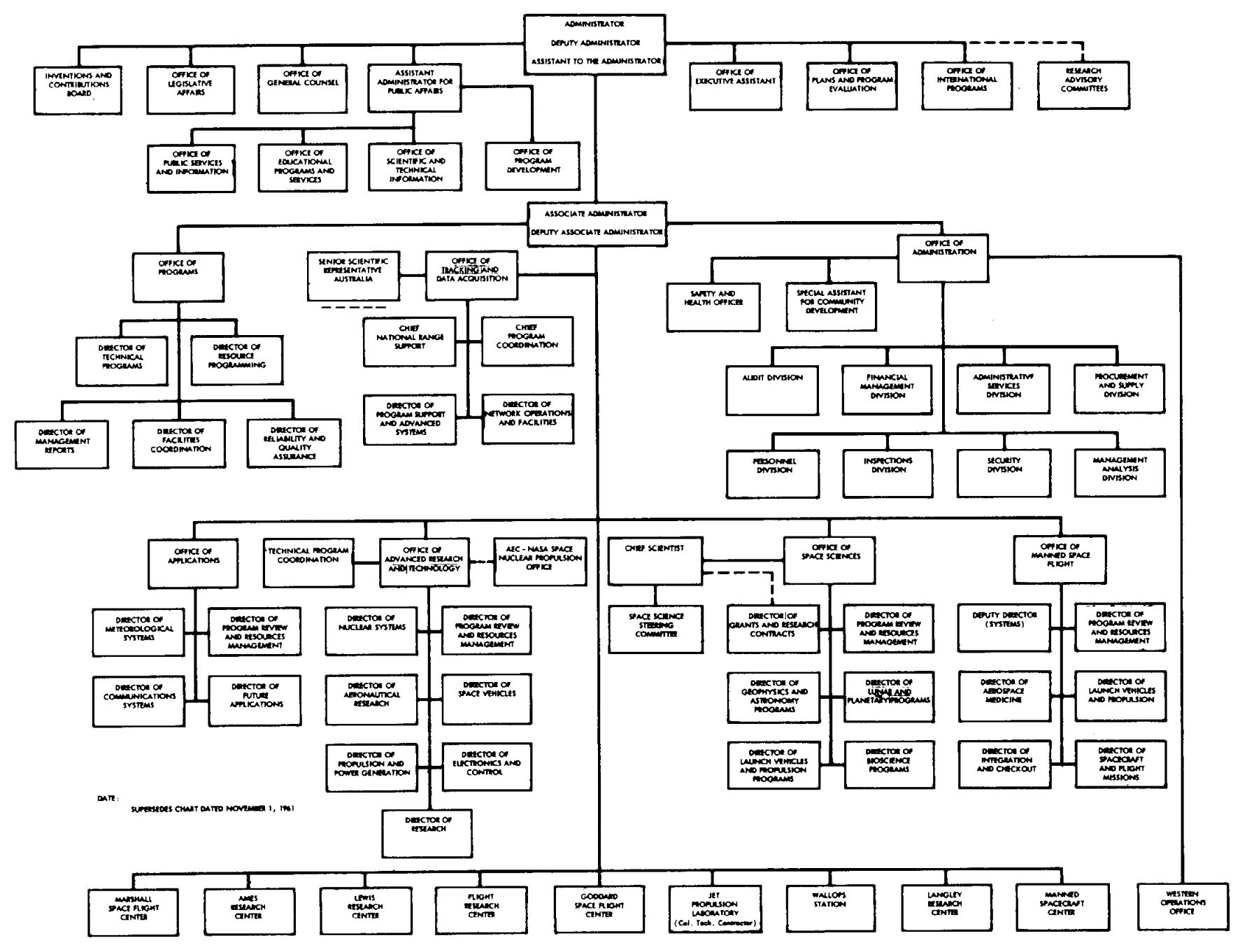
Task - Study the organisational chart carefully and answer the questions below:
- What does this chart suggest about the size and complexity of NASA in 1961?
- Identify three different departments or divisions shown in the chart. What role do you think each played?
- Why would space exploration require cooperation between so many different people?
- What does the chart reveal about the importance of systems during the Space Race?
- How does this source challenge the idea that the Moon landing was achieved only by famous astronauts?
- Which department or role do you think was most important to the success of NASA’s missions?
Indicative answers for the questions:
- What does this chart suggest about the size and complexity of NASA in 1961? - The diagram shows that by 1961, NASA was already a large and very specialised organisation. There are numerous offices, divisions, research programmes and centres. There is also a strict hierarchy. This shows that space exploration required extensive organisation as well as expertise.
- Identify three different departments or divisions shown in the chart. What role do you think each played? - Examples will vary for this question. For example the Office of Manned Space Flight oversaw programmes concerned with sending humans into space. Answers can be easily found online although this task is more about allowing students to develop their own thinking. You could set students the task of following up to research each department afterwards to see if their assumptions were correct.
- Why would space exploration require cooperation between so many different people? - A typical space mission required solutions to many interconnected problems. From launch control to communications, to keeping astronauts alive. Failure in just one part could destroy the whole mission, so clear lines of cooperation and coordination were necessary.
- What does the chart reveal about the importance of systems during the Space Race? - The diagram reveals that coordination between specialised parts of a larger system was required. You could introduce the idea of inputs, processes and outputs and that all parts of a system can be classified according to these roles. You could even introduce the idea of emergent properties and apply this to NASA.
- How does this source challenge the idea that the Moon landing was achieved only by famous astronauts? - The diagram illustrates the huge institutional support behind the astronauts for any space mission. Many of these individuals didn't become famous but were necessary parts of the system. Answers should illustrate to students the debate between individual agency vs. structures and systems in history.
- Which department or role do you think was most important to the success of NASA’s missions? - No required answer here but students should establish a criteria and justify their choices to the class.
The landing of man on the moon was not only a win for the USA in the Cold War but it also marked a major turning point in the history of science and technology. Computers, new rockets, communication systems and engineering techniques were all required to send a man to the moon. Back on Earth, these technologies would soon spread far beyond the space industry. This would help future pioneers, innovators and developers in other fields to advance.
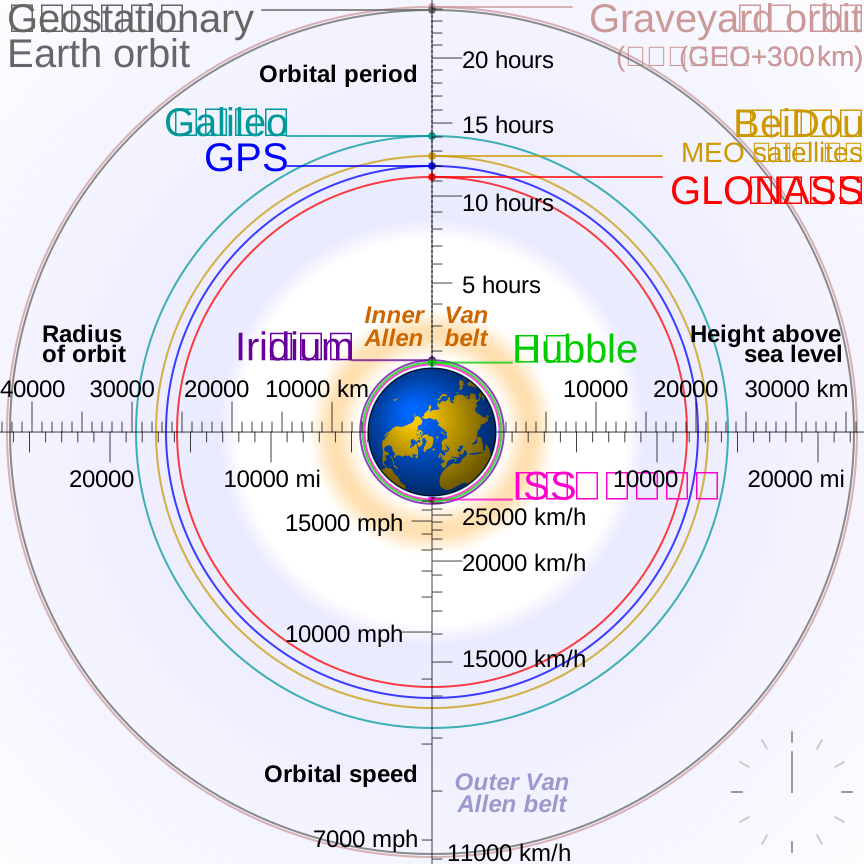
One of the most important new technologies was satellites. During the 1960s and 1970s, satellites were increasingly sent into orbit for use in communications, weather forecasting and scientific experiments. These began with Telstar in 1962 which was the world's first privately sponsored commercial communications satellite. It relayed telephone calls and TV images. Even the 1969 moon landings were shown live due to satellites. In 1973, the USA started to explore the use of satellites to aid navigation on Earth. Beginning in 1978, the American Global Positioning System (GPS) was the world's first functioning satellite navigation constellation. The USSR launched its own version known as GLONASS in 1982. Over time, these systems now support transportation, shipping, aviation and smartphones for billions of people across the world, enabling countless new forms of innovation.
Critical Thinking Skills - Evaluating History Evidence and Arguments
The Space Race helped accelerate the development of many technologies that later transformed life on Earth. However historians often debate which innovations were the most historically significant. What do you think?
Satellites (1957) 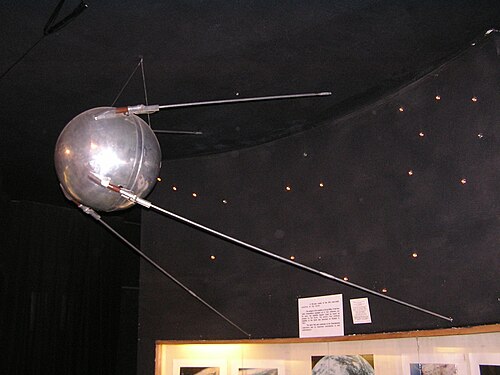 The USSR launched Sputnik 1, the first satellite, beginning the age of space communication and satellite technology. | GPS Navigation (1978) 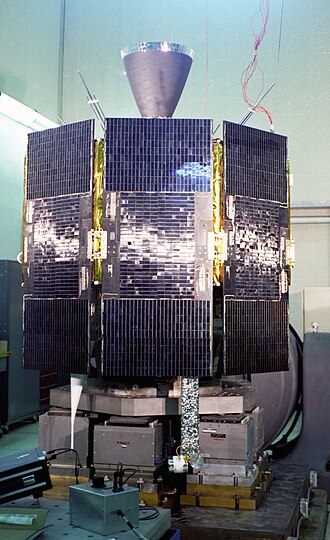 The USA launched the first GPS satellite, leading to navigation systems used in phones, transport and shipping today. | Microchips (1960s)  Apollo missions pushed the development of smaller and faster computer chips for spacecraft guidance systems. |
Global Communications (1962) 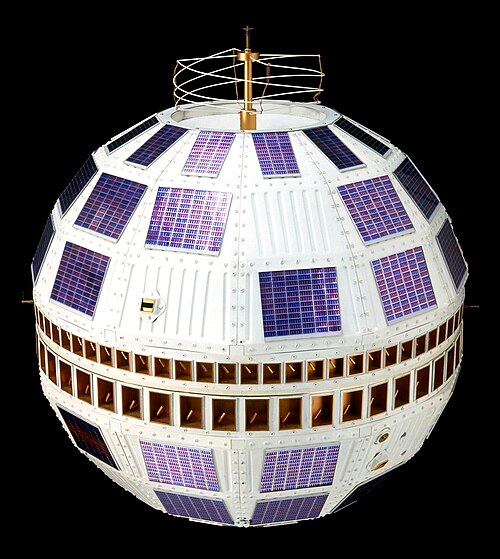 Telstar 1 allowed live television and telephone signals to be sent across the Atlantic Ocean. | Weather Forecasting (1960) 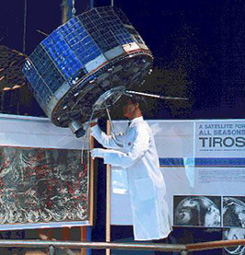 TIROS-1 became the first successful weather satellite, helping scientists track storms. | Software Engineering (1969) 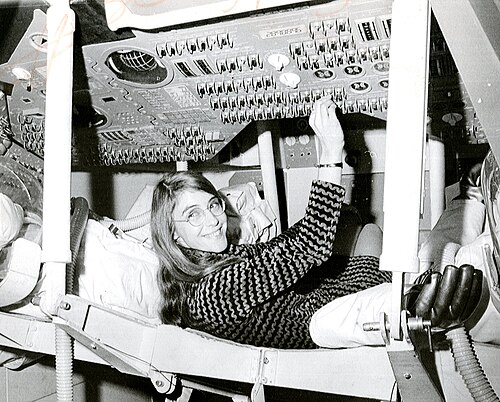 NASA developed advanced flight software for Apollo 11, helping shape modern programming. |
Digital Imaging Tech (1960s)  Space missions developed new ways to send photographs digitally from space back to Earth. | Robotic Systems (1960s) 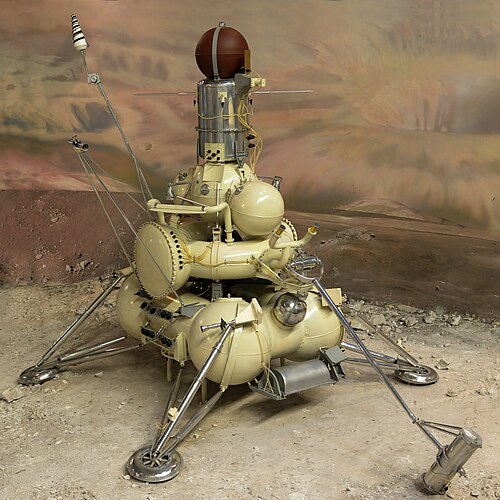 NASA created robotic probes and automated spacecraft that later influenced modern robotics. | Earth Observation (1968)  Images such as Earthrise and Blue Marble changed how people viewed Earth and environment. |
Task 1 - Select one of the space race innovations above. Research your chosen innovation and complete a short significance profile explaining how it meets each of the 5Rs criteria. You should include:
- a description of the technology
- how it connects to the Space Race
- evidence for each of the 5Rs
- images or diagrams if appropriate

- Remarkable - Was the innovation unusual, surprising or groundbreaking for its time?
- Remembered - Is the innovation still remembered or recognised today?
- Resonant - Does it connect with issues or experiences that matter to people today?
- Resulted in Change - What consequences followed from it? Did it lead to further change?
- Revealing - What does the innovation reveal about history or human progress generally?
Task 2 - As a class, now attempt to rank the class innovations. Be prepared to defend your ranking using historical evidence. Rank from:
‘most historically significant → least historically significant’
One thing to caution with this activity is that it simplifies or exaggerates the causation between a NASA development and a subsequent technological discovery. For example, microchips were not invented by NASA although Apollo became an important early purchaser and helped drive demand for integrated circuits.
You could build sophistication in their thinking by questioning each group by asking them whether the Space Race invented this technology, accelerated its development, or simply provided an important early use for it. This level of causal thinking could help students realise the complex nature of causation.
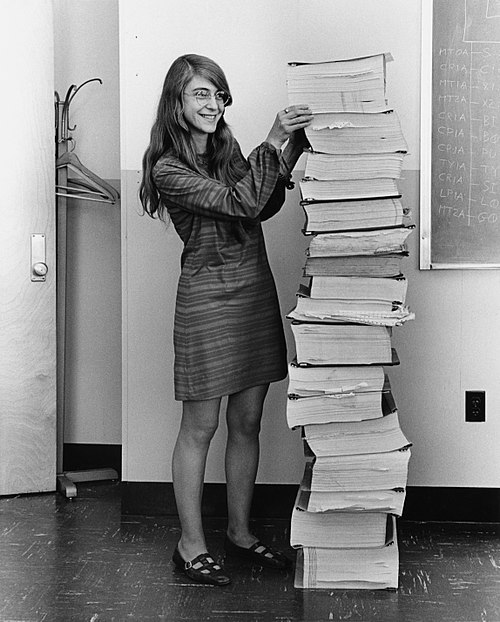
Computers and software engineering were another area of technical innovation that was accelerated by the space race. Early space launches required machines that could rapidly calculate complex maneuvers during flight. This encouraged rapid advances in programming and data processing.
Margaret Hamilton (image right) was a key pioneer responsible for developing onboard flight software for the Apollo missions. Many of these advances at NASA were used to help computers become smaller and more powerful.
For example, the Apollo Guidance Computer used in the 1969 moon landings was overtaken in processing power by the Apple II computer released to the general public in 1977. Very quickly, developers in places like Silicon Valley soon started to innovate these designs, helping new industries to thrive.
Creative Thinking Skills - Applying Existing Knowledge to Generate New Ideas and Connections.
Many technologies created during the Space Race later helped other pioneers, innovators and developers create new inventions and industries. Innovation often builds upon earlier discoveries and technologies. This task will help you to think about chains of interrelated causes and consequences in history.
Example Innovation Chain - GPS
- 1957 - Sputnik 1 Launched - First artificial satellite proves objects can orbit Earth
- 1960s–1970s - Military Satellite Systems - Satellites are developed for tracking and defence
- 1978 - GPS Satellites - The USA launches the first NAVSTAR GPS satellite
- 2000s - Everyday Navigation - GPS becomes widely used in all forms of transport by general public
- 2010s - Location-based Apps - Modern mobile phone apps rely on GPS locations for services
- 2030s? - Autonomous Transport - Self-driving cars? Drone Taxis? Smart cities?
Task 1 - Choose one space race innovation from the previous task. Your task is to create an 'Innovation Chain' showing how one Space Race development led to further innovations that transformed the modern world.
Task 2 - Create a flow chart or timeline with at least 5 linked stages. Each stage should show:
- the innovation
- how it developed from an earlier idea
- how it helped create something new
Task 3 - At the end of your innovation chain, predict what future innovation might develop next from this technology. Explain your reasoning.
Students may need some help when thinking about a five part innovation chain. What you want to avoid is just a list of five different inventions with no context. Firstly, the five stages must be linked causally in some relevant way. You could explain to students that generally, the stages could include:
- The Initial Development - The existing idea or technology that provides the starting point.
- New capability - Something new that the development now makes possible.
- Adaptation - The technology is changed or improved for a new purpose.
- Wider application - The technology begins to be used in other areas or by more people.
- Modern consequence - The longer-term impact the technology has on society today.
Once students have identified five stages of invention from their initial research, you then want them to express clearly either in writing or verbally how the stages connect. Try sharing these verbs:
- Words suggesting development - accelerated, advanced, improved, refined, expanded, adapted, transformed, built upon
- Words suggesting strong or direct connection - caused, led to, resulted in, produced, created, triggered, made possible, enabled
- Words suggesting more cautious or indirect connection - contributed to, influenced, encouraged, supported, facilitated, helped drive, provided the basis for, created the conditions for, paved the way for
You could then ask each student to explain their chains of innovation, encouraging them to use the words and phrases you've shared to help explain the causal connections.
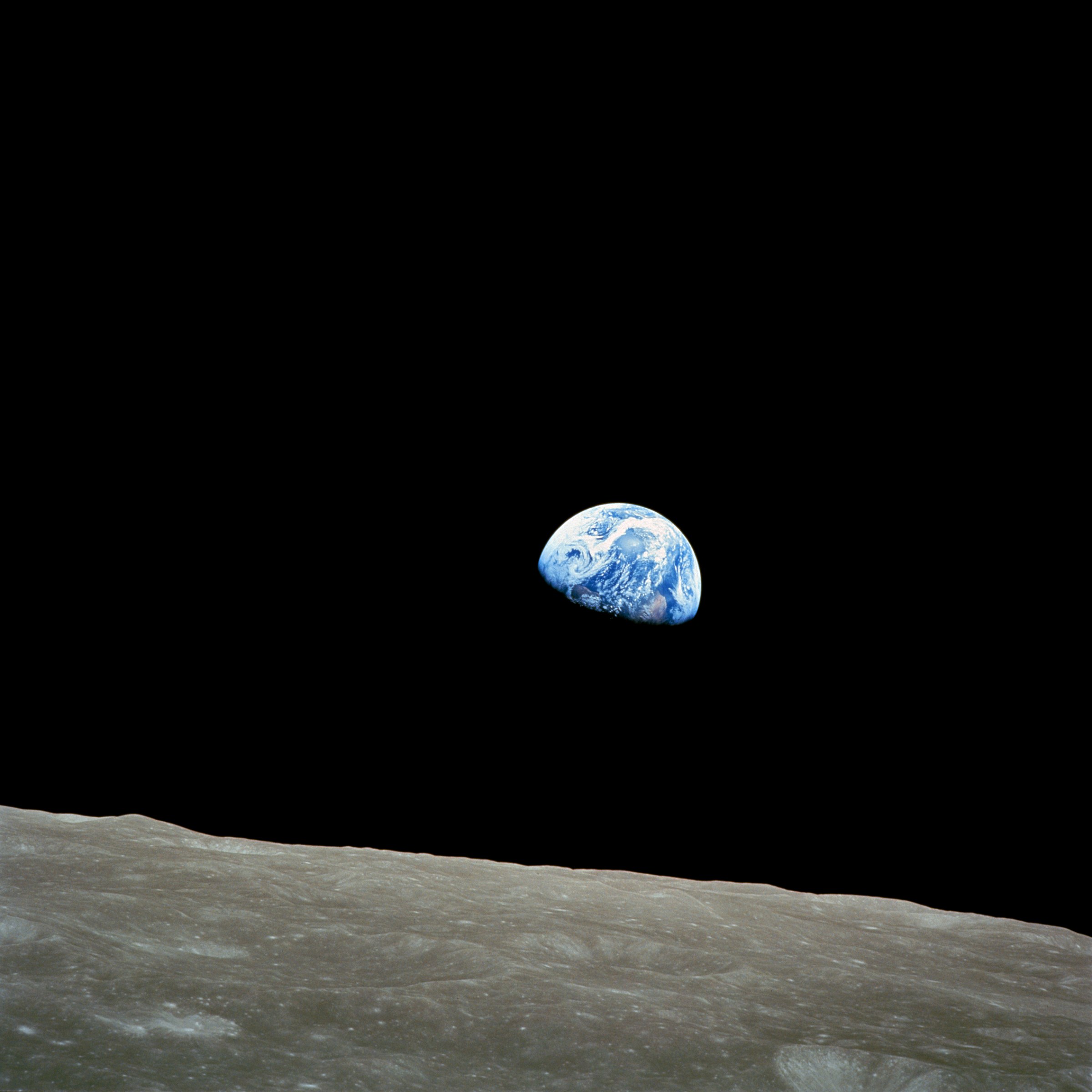
One unexpected development from the space race came from the way that humans across the world began to re-imagine their relationship with the Earth itself. In 1968 during the Apollo 8 mission, astronaut William Anders took a colour photograph of the Earth rising above the Moon’s horizon. Now known as ‘Earthrise’, this photograph revealed the Earth as small and fragile looking planet. The image was copied countless times and it inspired environmentalists around the world to launch the Earth Day movement in 1970. Since then, satellites have been used to monitor and capture changes in the Earth's environment, proving beyond doubt our human impact on the planet. The space race therefore transformed not only science and technology but our understanding of our planet and the universe.
By any count, the Space Race is clearly remembered by many as one of humanity's greatest scientific and technical achievements. Millions watched live on TV when American astronauts walked on the surface of the moon. The countless innovations required to get them there have transformed life for many. Yet alongside this progress came many unforeseen and serious problems with far ranging ethical implications.
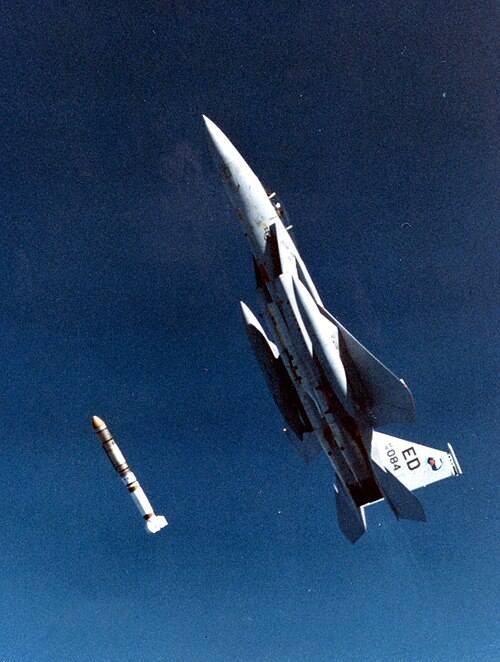
One issue was that the Space Race served to escalate military tensions between the USA and USSR. The rocket technology needed to reach space had a dual-use as these technologies could be repurposed into intercontinental ballistic missiles (ICBMs). By the 1970s these missiles could travel over 5,000 kilometres and hold multiple nuclear warheads. Their speed also meant they could bypass air defences, which in any case could now be spotted using surveillance satellites. Thus the Space Race led to new security dilemmas. Additionally, these specific scientific achievements were often lauded by both sides as evidence of the superiority of their system. The Space Race had in effect become an arms race.
Critical Thinking Skills - Using Models to Explore Complex Systems and Issues
The Space Race created technologies that transformed relations between countries. Some innovations increased fear and led to military and nuclear competition during the Cold War. Others encouraged cooperation via communications and joint scientific projects. This task will help you explore the impact of the Space Race.
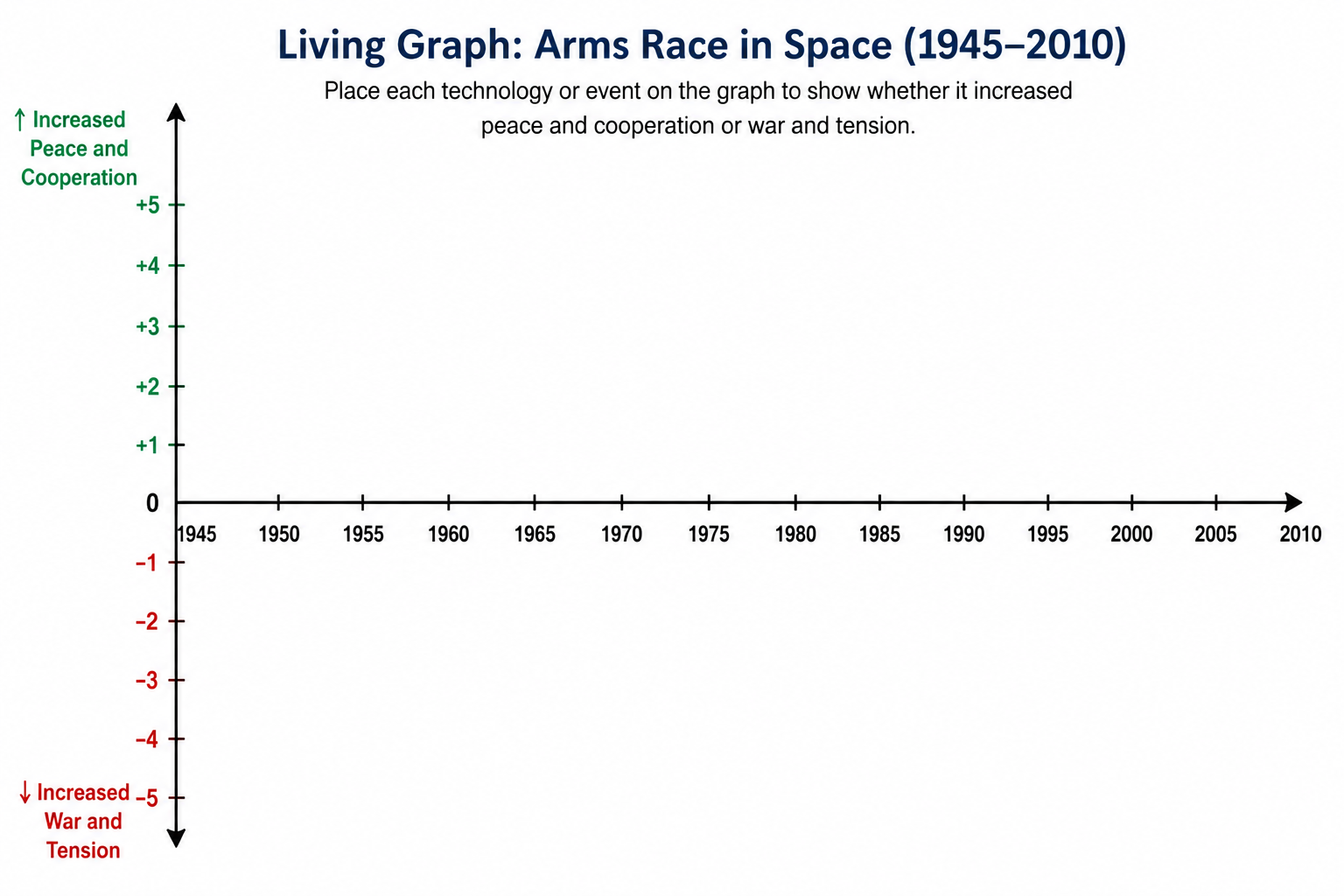
Task 1 - Work in groups to create your own living graph of the Space Race[2]. Place each of the technologies or events below onto your living graphs based on when it occurred and whether it increased conflict or cooperation:
- 1944 - V-2 Rocket - First long-range rocket capable of reaching space and carrying explosives.
- 1945 - Operation Paperclip/Osoaviakhim - US and Soviet secret recruitment of German rocket experts.
- 1949 - Soviet Atomic Bomb - The USSR successfully tests its first nuclear weapon.
- 1957 - Sputnik 1 - First artificial satellite launched into orbit by the USSR.
- 1957 - R-7 ICBM - First missile capable of delivering nuclear weapons across continents.
- 1960 - CORONA Spy Satellite - US satellites secretly photograph Soviet military sites from space.
- 1961 - Yuri Gagarin’s Flight - First human travels into space aboard Vostok 1.
- 1962 - Cuban Missile Crisis - Cold War tensions nearly lead to nuclear war.
- 1962 - Telstar 1 - Early communication satellite enabling live global broadcasts.
- 1967 - Outer Space Treaty - International agreement banning nuclear weapons in space.
- 1969 - Apollo 11 Moon Landing - First humans land on the Moon during NASA’s Apollo mission.
- 1971 - Salyut 1 Space Station - First space station launched by the USSR.
- 1975 - Apollo–Soyuz Mission - First joint US–Soviet space mission symbolising cooperation.
- 1978 - GPS Satellites - First navigation satellites launched for military positioning and tracking.
- 1979 - SALT II Treaty - USA and USSR agree to limit the production of nuclear missiles and launch systems.
- 1983 - Strategic Defense Initiative - US President Reagan proposes space-based missile defence systems.
- 1991 - GPS in Gulf War - GPS technology transforms modern warfare and navigation.
- 1991 - START I Treaty - USA and USSR agree to reduce long-range nuclear weapons after the Cold War.
- 1998 - International Space Station - Nations cooperate to build a permanent research station in space.
- 2001 - Space Tourism Begins - Dennis Tito becomes the first paying space tourist.
- 2007 - Chinese Anti-Satellite Test - China destroys a satellite, increasing fears of space warfare.
- 2010 - Private Space Companies Grow - Companies like SpaceX begin reshaping space exploration.
Task 2 - Once the graph is complete, discuss the following questions as a group:
- Which technologies increased military tension the most?
- Which developments encouraged international cooperation?
- Did the Space Race become more peaceful or more dangerous over time?
- What turning points can you identify on the graph?
Task 3 - As a class, debate the following promote to consolidate your thinking: ‘Did Space Race innovations lead to a safer and more connected world?’
For this activity lots of historical thinking can come from the discussions students have when deciding where to place each event. Plotting each event is a subjective exercise although our shared understandings of these events suggest placements on the graph might occur like this:
- Strong Conflict - Cuban Missile Crisis (1962), R-7 ICBM (1957), Soviet Atomic Bomb (1949), Strategic Defense Initiative (1983), Chinese Anti-Satellite Test (2007)
- Conflict - V-2 Rocket (1944), Operation Paperclip/Osoaviakhim (1945), CORONA Spy Satellite (1960), GPS in Gulf War (1991)
- Some Conflict - Sputnik 1 (1957), Yuri Gagarin's Flight (1961), Apollo 11 Moon Landing (1969), first GPS Satellites (1978)
- Neutral - Salyut 1 Space Station (1971), Space Tourism (2001), growth of Private Space Companies (2010s)
- Cooperation - Telstar 1 (1962), SALT II (1979)
- Strong Cooperation - Outer Space Treaty (1967), Apollo–Soyuz Mission (1975), START I (1991), International Space Station (1998)
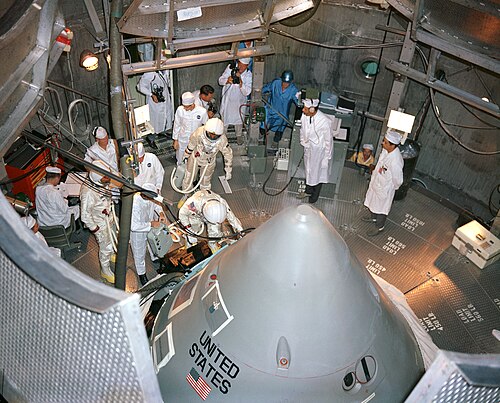
The geopolitical nature of this race meant that both sides were willing to prioritise achievement over human safety. In 1967, three American astronauts died when their command module, Apollo 1, caught fire. They were burned alive. This had been proceeded by the Soviet Soyuz 1 mission in 1967. The cosmonaut Vladimir Komarov died after the modules parachute failed to deploy upon reentry. Engineering failures would continue to plague subsequent missions, most notably the Challenger disaster in 1986 and the Columbia disaster in 2003. In both cases, all crew members died.
Reflection Skills - Consider Ethical, Cultural and Environmental Implications
On 28 January 1986, the American Space Shuttle Challenger exploded 73 seconds after launch. All seven crew members were killed instantly whilst the world watched, live on TV. The disaster shocked the world and raised serious questions about decision-making inside NASA. But was NASA really to blame? This task will ask you to explore two main perspectives:
- Perspective A - The disaster was caused by poor human decisions and ignored warnings.
- Perspective B - The disaster was caused by the risks and complexity of space technology itself.
Source A - Interview with Engineer Bob Ebeling (NPR, 2016)[3]
Focus Tip - According to engineer Bob Ebeling, what does he believe caused the disaster and could the Challenger disaster have been prevented?

The night before the launch, engineer Bob Ebeling and four other engineers at NASA contractor Morton Thiokol tried to stop the launch. The data showed that the rubber O-ring seals on the shuttle’s booster rockets might fail in the freezing temperatures expected on launch day. Despite their warnings, NASA officials approved the launch.
Reflecting on the disaster thirty years later, Ebeling explained:
“NASA ruled the launch. They had their mind set on going up and proving to the world they were right and they knew what they were doing. But they didn’t… There was more than enough [NASA officials and Thiokol managers] there to say, ‘Hey, let’s give it another day or two.’ But no one did.”
Source B - Challenger Launch Footage from CNN, 28th January 1986
Focus Tip - This is the news footage of the event and the immediate reactions of NASA. As you watch, think about how the public reaction to the disaster might have increased pressure on NASA afterwards.
Source C - Extracts from the Rogers Commission Report on the Challenger Accident (1987)[4]
Focus Tip - As you read this source, think about why NASA managers approved the Challenger launch despite repeated engineers’ warnings.
On the evening of 27 January 1986, NASA officials and engineers from Morton Thiokol held a teleconference to discuss whether the Challenger launch should proceed in freezing temperatures. Engineers warned that the shuttle’s rubber O-ring seals could fail in the cold below 53°F because the seals had never been safely tested at lower temperatures.
During the discussion, NASA managers questioned the engineers’ evidence and challenged their recommendation to delay the launch. NASA manager Lawrence Mulloy reportedly responded:
“My God, Thiokol, when do you want me to launch - next April?”
After a private management meeting, Morton Thiokol managers reversed the engineers’ recommendation and approved the launch. Engineer Roger Boisjoly later recalled:
“This was a meeting where the determination was to launch, and it was up to us to prove beyond a shadow of a doubt that it was not safe to do so. This is in total reverse to what the position usually is in a preflight conversation or a flight readiness review… I felt the tone of the meeting exactly as I summed up, that we were being put in a position to prove that we should not launch rather than being put in the position and prove that we had enough data to launch. And I felt that very real.”
The Rogers Commission later concluded:
“The decision to launch the Challenger was flawed.”
Source D - NYT review of The Challenger Launch Decision by Historian Diane Vaughan (1996)[5]
Focus Tip - As you read this review of Diane Vaughan's book, consider how she argues that NASA gradually began to see dangerous risks as acceptable:
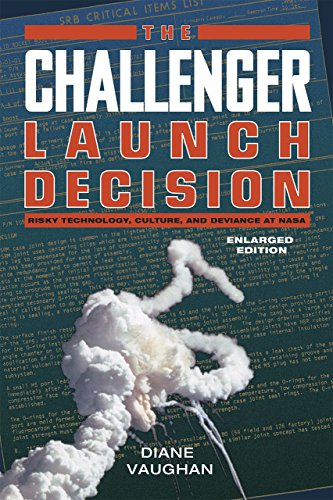
'HER account reaches back to 1977, when it was first discovered that the design of the solid-rocket-booster field joint was flawed. Using clear and effective drawings, Ms. Vaughan shows just what was wrong with the joint and why the engineers chose to accept the risk it posed rather than replace it with one of better design. Part of the answer is that the field joint was simply one of many problems threatening the shuttle. No fewer than 748 parts on Challenger were designated ''Criticality 1,'' meaning they violated NASA's redundancy criterion: if the part failed the vehicle and crew were lost. In the first 25 flights up through Challenger, 131 technical flaws proved serious enough to warrant NASA's designation of ''launch constraint.'' Of these, 66 were resolved after one flight. The others, like that for the field joint, were overridden repeatedly. The Rogers Commission and other investigations have focused on the narrow chain of events that led to Challenger; Ms. Vaughan sets this particular problem in the context of a machine that was rife with flaws.
NASA handled all these problems, Ms. Vaughan explains, by developing a cultural ''construction of risk'' that measured the danger against the contextual forces of budget, politics, production pressures and organizational behavior. Repeatedly, NASA examined the risk, conducted tests and studies, set benchmarks of performance and concluded that it was safe to proceed. As anomalies arose, as the joint deviated further and further from specifications, NASA convinced itself that it understood the problem more fully. Anomalies were explained away, or at least they were measured against the contextual forces and found insufficient to warrant interrupting production and launching. In Ms. Vaughan's terms, the organization slipped imperceptibly into ''the normalization of deviance.'''
Task 1 - In groups, study the four sources. Use a copy of the table below to firstly decide which perspective the source supports, then to record notes on what evidence is used to support that perspective.
| Source | Perspective A - The disaster was caused by poor human decisions and ignored warnings. | Perspective B - The disaster was caused by the risks and complexity of space technology itself. |
| Source A | ||
| Source B | ||
| Source C | ||
| Source D | ||
| Source ? |
Task 2 - Conclude by reviewing your evidence. Which perspective do you find more convincing?
- Perspective A - The disaster was caused by poor human decisions and ignored warnings.
- Perspective B - The disaster was caused by the risks and complexity of space technology itself.
Answer this question by writing a short response. Try to include the following in your answer:
- which perspective you agree with
- the strongest evidence
- the limitations of the other perspective
- whether the disaster could have been prevented
Extension - After the Challenger disaster the US President Ronald Reagan delivered a televised speech to the American people. As you watch the speech, consider, how does Reagan present the Challenger astronauts as pioneers, innovators and developers despite the disaster?
The source could be analysed for evidence in the following ways:
| Source | Perspective A - The disaster was caused by poor human decisions and ignored warnings. | Perspective B - The disaster was caused by the risks and complexity of space technology itself. |
| Source A | Strongly supports this perspective. Engineers warned against launching due to the cold but NASA proceeded. He believed a delay could have prevented this. | Limited support. O-ring problem demonstrated that the space shuttle had technical vulnerabilities in low temperatures. |
| Source B | Limited evidence. Shows the disaster and the response but does not explain the decisions. | Little evidence about causation but does demonstrate the catastrophic risks when a highly complex system fails. |
| Source C | Strongly supports this perspective. Engineers warned that the O-rings had not been proven safe below 53F. NASA managers challenged this advice. Commission described this decision as ‘flawed’. | Some support for this perspective. Uncertainties over O-ring performance shows that technical risks were always involved in space launches. Is it possible to test for every condition? Previous launches had survived abnormalities. |
| Source D | Subtle support for this perspective. Organisational pressures influenced how managers interpreted danger. Over time NASA had learnt to accept risks and anomalies as part of space exploration. | Supports this perspective. The shuttle contained hundreds of other critical components and unresolved technical issues. Managing risk was an unavoidable part of operational complex systems. |
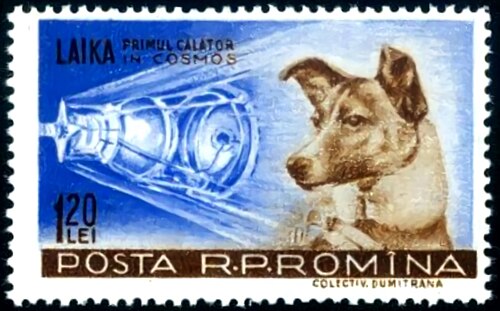
We have also seen other ethical issues arise during the development of space technologies. In the early years, many animals, most famously Laika the first dog in space in 1957, died during their missions. We've also previously mentioned the use of captured former Nazi scientists like Wernher von Braun. Their expertise was prioritised ahead of investigations into claims of slave labour and civilian casualties. These examples show that in the race to develop new space technologies, ethical dilemmas were often sidelined or only considered as an afterthought.
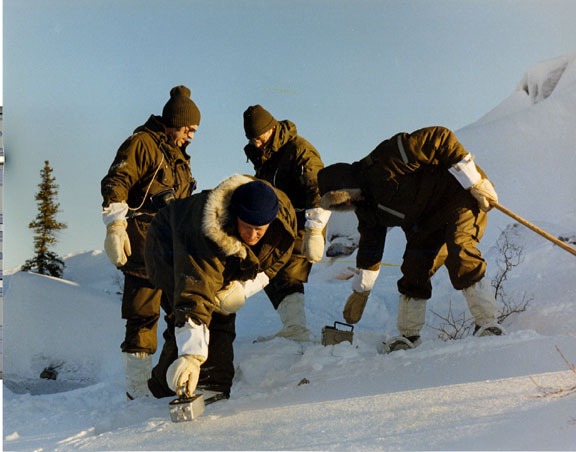
More practically, the rush to space preceded global cooperation on the rules that would govern the use of this shared planetary resource. Thousands of old satellites and debris from previous missions remains trapped in orbit. Some of those also posed a risk on reentry. In 1978, the Soviet radar satellite Kosmos 954 malfunctioned and broke up over Canada, scattering radioactive material over hundreds of kilometres. Consequently, space missions have to continually avoid collisions. This also poses a severe risk to civilian infrastructure. Modern societies are highly dependent on satellite systems for communications, transportation, navigation and military defence.
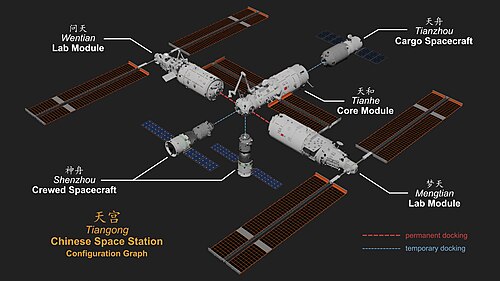
Additionally, access to advanced space technologies is highly unequal. Only wealthier nations and private companies were able to dominate space exploration initially. This began with the first manned space flights by the USA and USSR in 1961. Even China only achieved this in 2003. Other nations have been able to launch payloads into space but usually on rockets designed by others. In recent years, private companies have begun to dominate in the field of space launches. In 2020, SpaceX was the first to send a manned mission to the International Space Station (ISS). Blue Origin then reached space in 2021 followed by Virgin Galactic in the same year. The dominance of these three companies raises questions of legal oversight. Will the benefits of the commercialisation of space be shared?
Creative Thinking Skills - Practising Flexible Thinking by Developing Arguments

During the Cold War, the Space Race was contested mainly by national governments such as the USA, USSR and later China who have all launched manned space flights. Other nations have launched their own satellites. Yet since 2004, private companies spearheaded by billionaire investors like Space X (Elon Musk), Blue Origin (Jeff Bezos) and Virgin Galactic (Richard Branson) have all sought to compete in a new space race.
Supporters argue that these companies are increasing innovation and development in space technology. Competition between them will ultimately lower costs and accelerate new pioneering explorations. Critics argue that this commercialisation of space could increase inequality and environmental damage, not to mention giving uncontrolled private individuals more power in space than nations.
Is this ethical? Should we allow private companies to take the lead in space exploration? Or should nations always have oversight and control in space?
Task 1 - Watch the video above of a Space X launch from 2025. How is this an example of innovation and development in rocket design since the first Soviet R-7 and American Atlas rockets in 1957?
Task 2 - With a partner, consider what the benefits and problems are of letting private companies dominate the new space race. Make a table like below and list your ideas:
| Benefits? | Problems? |
| e.g. Faster innovation | e.g. Unequal access to space |
Task 3 - Review your table. Do the benefits outweigh the problems? Should we allow private companies to pioneer space exploration or is this too risky to allow them to dominate space?
Indicative answers could include:
Task 1 - How is this an example of innovation and development in rocket design since the first Soviet R-7 and American Atlas rockets in 1957? - Students could highlight changes in rocket design and launch process including reusable rockets, controlled landings rather than jettisoning rocket at sea or in atmosphere, greater automation, increased payload of rockets. Draw attention also to similarities in engine type (liquid fuel combustion jet engines), rocket shape, vertical takeoff and landing). Shows this has been a development over time rather than a recent innovation.
Task 2 - Benefits and problems could include:
| Benefits? | Problems? |
| Competition can encourage faster innovation. | Commercial priorities may be placed ahead of wider public interests. |
| Reusable rockets can substantially reduce launch costs. | Space activity can create environmental impacts, including emissions and space debris. |
| Private investment provides additional funding for exploration. | Wealthy individuals and corporations could gain disproportionate influence over space infrastructure. |
| Lower launch costs can make space more accessible to researchers and smaller organisations. | Access may remain unequal if it depends upon the ability to pay. |
| Companies can experiment and take risks that governments may be reluctant to accept. | Commercial pressure could encourage excessive risk-taking or weaker safety cultures. |
| Private launch providers can support government scientific missions. | Governments may become dependent upon a small number of private providers for important infrastructure. |
| Commercial development could enable new industries and services. | Ownership and exploitation of resources in space raise difficult legal and ethical questions. |
Task 3 - Review your table. Do the benefits outweigh the problems? Should we allow private companies to pioneer space exploration or is this too risky to allow them to dominate space? - You may like to establish some criteria to help stimulate thinking in this debate. Essentially, it is a debate between private vs public control of space exploration. You could get students to think about innovation and who best can develop new technologies. The role of equity is also important in terms of who pays for and who gets the benefits of space. Accountability is important in thinking about who is to blame when things go wrong. Sustainability and public interest could also be used to form arguments. Some students might like to consider a middle position, letting private companies take the lead but with strong public oversight. Encouraging students to challenge the question could lead them to get to this position.
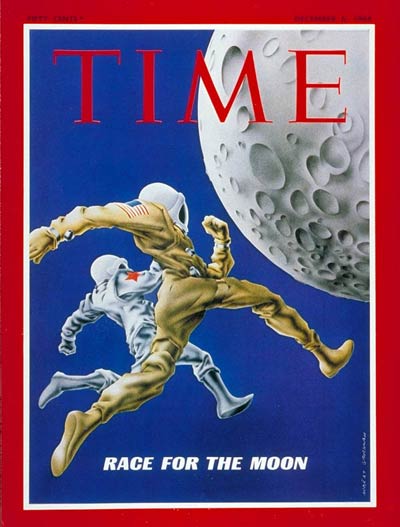
The Space Race was clearly one of the greatest periods of innovation and pioneering discovery in modern history. It led to major scientific achievements and technological firsts. The rivalry between the superpowers led to remarkable new technologies like satellites and ICBMs as well as feats of explorations like landing man on the moon in 1969. This competition accelerated investments in science across the world, with pioneers, innovators and developers working under immense pressure to succeed in this geopolitical conflict. It's no wonder that many historians claim that that competition was a positive that drove this golden age of technological progress.
Yet on the other hand, the Space Race was also marked by periods of intense fear and tension. These new technologies led to new weapons such as nuclear-tipped ICBMs and space-based surveillance. It's no wonder that fears of existential survival seeped into mainstream culture, exemplified in the rise of exciting science fiction movies, post-apocalyptic horror, or even fears of UFO invasion. These fears were countered by the heavy use of propaganda by both nations, using success in the Space Race as vindication of the superiority of capitalism or communism. Each development was sold as an advance to national prestige, which conversely encouraged risky decision-making and enormous government spending. Critics therefore rightly argue that the competition of the Space Race had many unintended consequences.
Interdisciplinary Connections - History and the Arts
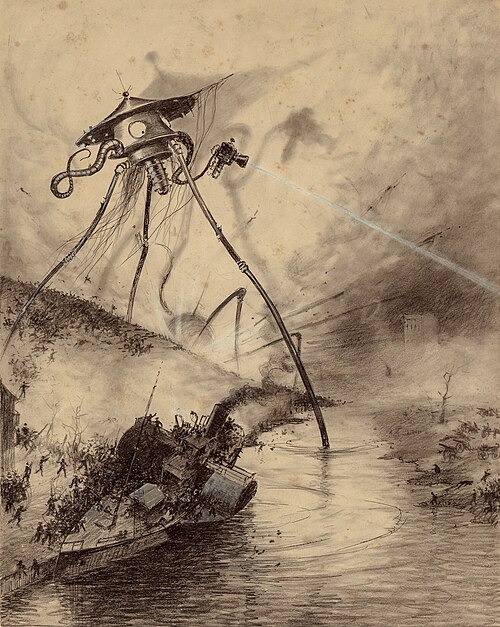
The Cold War Space Race transformed popular culture during the twentieth century. Even before the Space Race, science fiction (sci-fi) as a genre had developed in the nineteenth century as a reflection on how human beings were reacting to developments in science and technology. Writers like Mary Shelley, Jules Verne and H.G. Wells developed many of the tropes of sci-fi we recognise today such as extraterrestrial life, time travel, space exploration and dystopian societies.
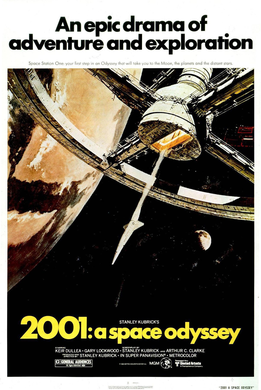
In the 20th century, the world wars only excited fears of global catastrophe and new technology such as radio, cinema and TV created ready audiences. In 1938, the American actors and filmmaker Orson Welles created a nationwide panic in the USA with his live radio adaptation of H.G. Well's ‘War of the World's. Try listening to it here from 9-10 minutes. Imagine what an average American would have thought if they had just tuned in!
The Space Race reignited the imaginations of many and sci-fi literature boomed during this period. Yet it was in the flourishing world of cinema where science fiction really took off. Historians can use films as cultural evidence to better understand how societies reacted to the Space Race. Significant films from this period include:
- 1950 - Destination Moon - Scientists attempt humanity’s first mission to the Moon.
- 1951 - The Day the Earth Stood Still - Alien visitor warns humanity against nuclear warfare.
- 1956 - Invasion of the Body Snatchers - Aliens secretly replace humans in paranoid Cold War society.
- 1956 - Forbidden Planet - Explorers discover dangerous technology on a distant alien planet.
- 1964 - First Men in the Moon - Victorian explorers travel to the Moon before modern astronauts.
- 1968 - 2001: A Space Odyssey - Humanity encounters artificial intelligence and mysterious aliens.
- 1972 - Silent Running - Lone astronaut protects Earth’s last surviving forests in space.
- 1972 - Solaris - Scientists confront memory and isolation aboard mysterious space station.
- 1976 - Star Wars - Rebels battle authoritarian empire across technologically advanced galaxy.
- 1979 - Alien - Space crew hunted by deadly extraterrestrial creature aboard spaceship.
- 1982 - Blade Runner - Detective hunts artificial humans in dystopian technological future.
- 1984 - Dune - Rival powers fight for control of vital desert planet.
- 1995 - Apollo 13 - Astronauts struggle to survive catastrophic Moon mission failure.
- 2013 - Gravity - Astronaut stranded in orbit fights desperately for survival.
- 2015 - The Martian - Abandoned astronaut uses science to survive on Mars.
- 2018 - First Man - Neil Armstrong’s journey toward humanity’s first Moon landing.
Task 1 - As a class, each person should choose a movie from the list. Watch the trailer, then consider:
- What hopes or fears about the future are presented?
- How is space exploration represented?
- Does the trailer present pioneers, innovators and developers as heroes, dangers or something more complex?
Task 2 - Share your answers to the questions as a class. Are there any changes in how space exploration is presented over time? What might account for these changes?
Over time, both superpowers sought ways to manage these tensions before they escalated beyond a point of no return. From the late 1960s, a period of detente (relaxation) emerged as the USA and USSR created new forms of international cooperation. The 1967 Outer Space Treaty saw both sides attempting to limit the militarisation of space. This cooperation culminated in 1975 with the successful Apollo-Soyuz Mission. Later projects such as the International Space Station in 2000 brought together five space agencies to work collaboratively in space. These developments all show how despite conflict, exploration and innovation could unite countries rather than divide them.
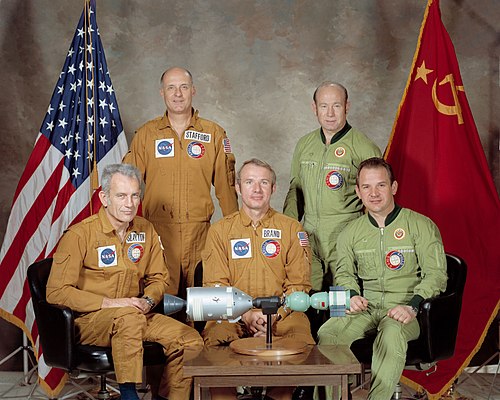
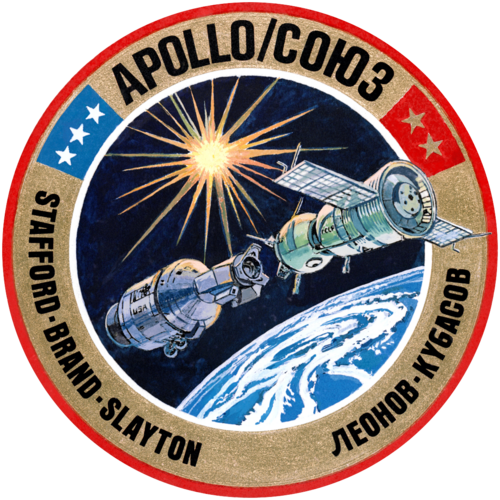
Nevertheless, the debate over whether the Space Race was mainly a triumph of cooperation or competition continues today. Some argue that without Cold War rivalries, humanity would never have stepped foot upon the moon. Others argue that the opportunity cost of this competition was the many wasted years of possible scientific cooperation. If only nations could work together, then future space explorations could be achieved. Today's world shows that this debate remains unresolved. Private companies have launched a fresh competition for space, once again revealing the need for global cooperation and monitoring.
The Space Race thus reveals that pioneers, innovators and developers do not work alone. They are part of larger systems which themselves are subject to conflict and cooperation, both of which can serve to forward the march of historical change.
Critical Thinking Skills - Evaluating Historical Evidence and Arguments
A key skill in History is being able to review what historians argue and then developing your own perspective about that debate. The significance of the Space Race is a great case study to practice this. Was the Space Race driven mainly by Cold War rivalry and competition or is cooperation and shared scientific progress its most important legacy? Or is the truth somewhere in-between?
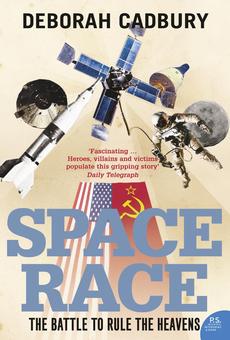
Perspective A - The Space Race was driven by Competition and Rivalry
‘As the two great superpowers, America and the Soviet Union, confronted each other during the Cold War, the race to the moon became a defining part of the struggle for global supremacy… Above all, the space race became an open contest between capitalism and communism. Victory was not just a matter of pride. National security and global stability were at stake.’
Cadbury, Deborah. (2012). Space Race: The Battle to Rule the Heavens. Harper Perennial.
Perspective B - The Space Race was driven by Cooperation and Shared Progress
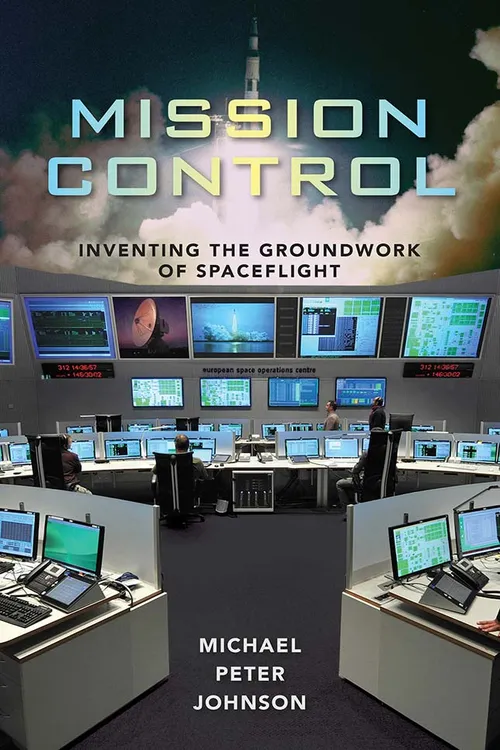
‘NASA even had moments of cooperation with its fiercest competitor, the Soviet Union, during the Cold War. By spurring each other to grow, space agencies create better partners… As the Cold War dragged on, and as space budgets were steadily reduced, space agencies found it increasingly important to seek partners in completing their missions. This culminated in the largest peacetime international effort in world history: the International Space Station…’
Johnson, Michael Peter. (2015). Mission Control. University Press of Florida.
Perspective C - Competition and Cooperation Worked Together
‘Apollo-Soyuz offered hope, at least symbolically, that the two states could cooperate for the betterment of humankind… Simultaneously, however, it did offer signs that space would be a more competitive environment, leaving open the question of whether space would remain a sanctuary or be open for international competition…’
Whitman-Cobb, Wendy and Frazier, Derrick. (2024). Space Policy for the Twenty-First Century. University of Florida Press
Task 1 - Read the three historical interpretations above. Then complete the table below by first identifying their main argument, then listing evidence from the Space Race case study that would support their interpretation:
| Interpretation | Main Argument | Evidence from the Space Race |
| Interpretation A | ||
| Interpretation B | ||
| Interpretation C |
Task 2 - Now try to evaluate their arguments. Discuss the following questions with a partner:
- Which interpretation do you find most convincing?
- Which events from the Space Race best support each interpretation?
- Do you think the Space Race changed over time from competition to cooperation?
- Can competition and cooperation exist at the same time?
Task 3 - Now conduct a class vote. Was the Space Race a triumph of cooperation or competition, or both?
Indicative answers for Task 1 could include:
| Interpretation | Main Argument | Evidence from the Space Race |
| Interpretation A - Mostly competition | The Space Race was primarily an extension of the Cold War struggle for technological superiority and ideological prestige. Security concerns became paramount. | Sputnik 1 (1957) increased fears, R-7 demonstrated ICBM capabilities, Gagarin flight major prestige victory, Kennedy linked moon to struggle between freedom and tyranny, Apollo 11 was a highly celebrated victory |
| Interpretation B - Mostly cooperation | Space exploration increasingly encouraged countries to share expertise and resources. It produced scientific progress that transcended Cold War rivalry. | Outer-Space Treaty (1967), Apollo-Soyuz (1975), cooperation increased as budgets declined, worked together on ISS (1998) |
| Interpretation C - Was both | Rivalry and cooperation existed alongside one another. Competition could stimulate innovation while shared interests encouraged states to cooperate. | Despite Apollo-Soyuz illustrating detente, military spending in space continued. Arms control agreements alongside new missile technology and SDI. ISS was cooperation but national space programmes continued. |
For Task 2, students may identify a broad pattern in the Space Race:
- 1950s - 1960s - Competition was particularly intense driven by Cold War rivalry and Soviet successes.
- 1960s - 1970s - Competition continued but agreements such as the Outer Space Treaty and Apollo–Soyuz provide increasing evidence of cooperation.
- 1990s+ - Projects such as the ISS demonstrate much deeper institutional cooperation although strategic competition did not disappear.
Footnotes
2. The idea of a living graph was first popularised by the British history teacher Ian Dawson. He has written extensively about how this strategy can be used to develop evaluative thinking about historical events. AI has been used to generate an example of what a living graph might look like adapted for this topic. Use the following Chicago citation to cite: ChatGPT/DALL·E. Living Graph: Arms Race in Space (1945–2010). AI-generated image. 2026.
5. https://archive.nytimes.com/www.nytimes.com/books/97/04/13/nnp/19074.html