b) Anarchism

Anarchism
On this page, you will find information about the case study - anarchism. This includes its intellectual origins, an exploration of their core beliefs, exploring the key thinkers who helped develop anarchism as well as deep dive into the role of anarchism during the Spanish Civil War. We finish by applying what we've learnt to the world today and ask whether anarchism is still relevant.
Anarchism is a political ideology that questions authority and the concentration of power in society. They argue that it is wrong to just blindly accept the authority of governments or political leaders just because it has always been that way. Instead, intellectuals should always question those powers to test whether they are justified. If an authority cannot justify why it exists, then anarchists believe it should be challenged and even removed.
 Creative Thinking Skills - Creating Novel Solutions to Authentic Problems
Is authority really necessary? What would happen in a society if we suddenly removed it? Could people organise themselves fairly? This is question that anarchists have long pondered and this task will help you consider it.
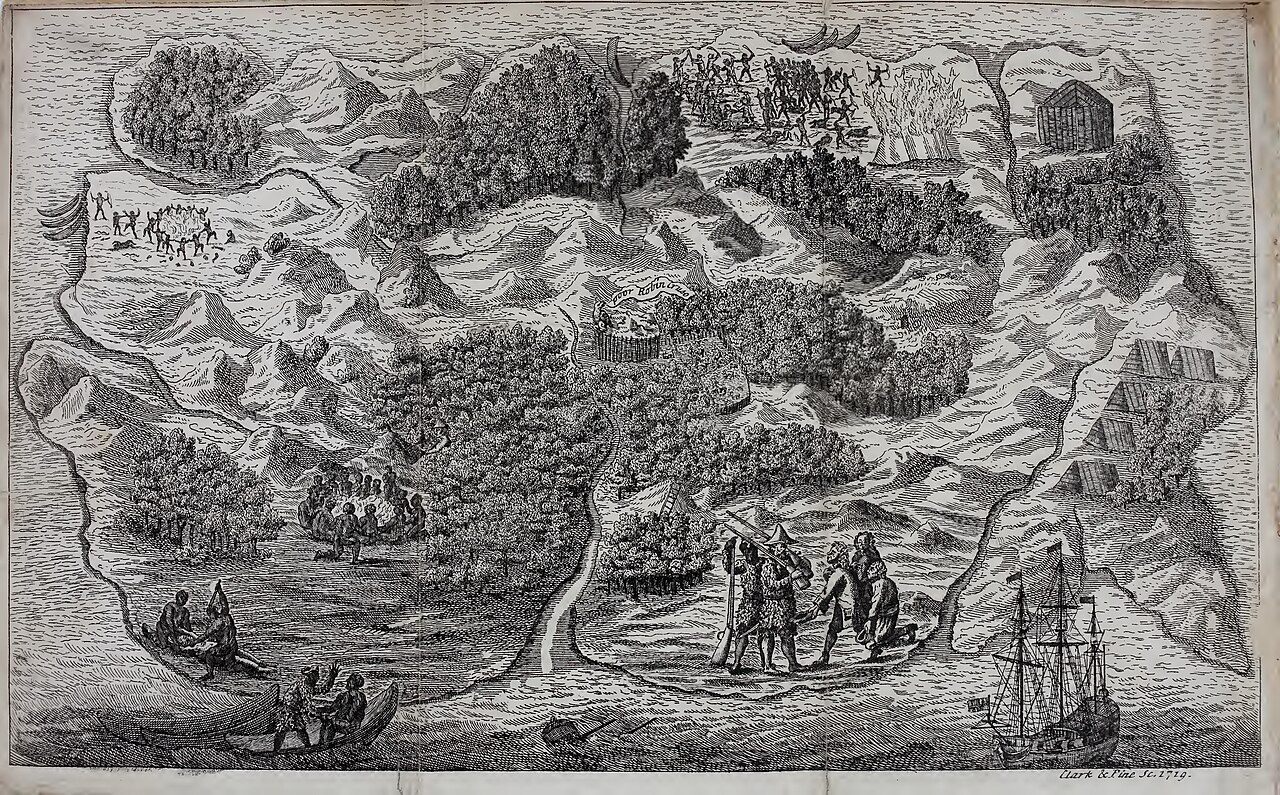
Task 1 - Like Robinson Crusoe, imagine that you and 100 people have been shipwrecked on a desert island. You all have to create a new society from scratch. There are enough resources to survive for everyone, but there are currently no rules, laws, institutions or forms of government. In groups, discuss your plans to survive and create a plan or diagram that answers these questions:
- How will decisions be made?
- Who will be responsible for organising work?
- How will disputes and disagreements be resolved?
- What happens if someone refuses to follow the group's decisions?
- Will your society need leaders and laws?
Task 2 - One day whilst exploring, to your surprise you find a body washed up on the shore. You groan as you realise it is a world famous anarchist. As he wakes and you explain the society you have created, would he:
- Support any parts of your new society?
- Criticise any parts of your new society?
Task 1 - You can help students to discuss their plans by sharing some of these ideas:
- How will decisions be made? - Direct voting, consensus, elected representatives, or committees?
- Who will be responsible for organising work? - Rotating responsibilities? Elected managers? Freedom?
- How will disputes and disagreements be resolved? - Group discussion? Mediation? Community rules?
- What happens if someone refuses to follow the group's decisions? - Sanctions? Authority to enforce?
- Will your society need leaders and laws? - Yes for order and coordination, no for voluntary cooperation
Task 2 - Remind students that anarchists are not against rules, they are just against illegitimate hierarchies and powers that enforce rules from above.
- An anarchist would like - decisions being made collectively, voluntary cooperation, shared ownership of resources, mutual aid between islanders, decisions by consensus or fair voting, equality
- An anarchist wouldn't like - a permanent ruler, small groups making decisions for all, unequal ownership, ability to coerce given to small groups like police, laws without collective agreement, authorities.
One common mistake is to believe that anarchism is simply the idea that all rules are bad, and that chaos or disorder is better. Most anarchists would disagree with this view. They would argue that people are capable of organising themselves in society without the need for strict rules or authorities. Anarchists argue over the best way to achieve this cooperation, but it could be done through mutual aid and voluntary organisations like trade unions.
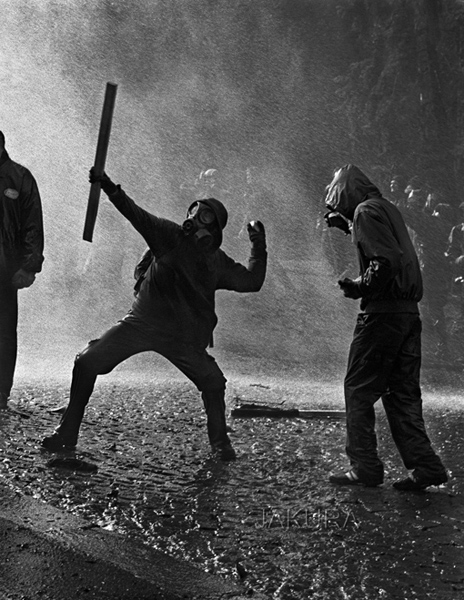
Due to the questioning of authority, you can see how this could lead anarchists to be involved in a wide range of causes and movements throughout history such as the rights of individuals and civil liberties, to workers' rights and more collective identities. Anti-colonial and anti-governments across the world have also been supported by anarchists. Some modern anarchists even focus on championing the rights of the environment and non-human animals, as well as female suffrage and the rights of marginalised groups such as LGBTQ+ rights.
The debate over anarchism is ongoing. By questioning power and authority, it is easy to see why many view the ideas as unworkable. Order and authority are seen as key features of a functioning society, including laws and institutions. If these are removed, many fear that ‘anarchy’ and violence would follow. Supporters of anarchism say this is just scaremongering, and that by questioning power, anarchists hold it to account and help society to balance power amongst all people more fairly.
Critical Thinking Skills - Considering Ideas from Multiple Perspectives
On first reflection, it seems easy to dismiss the ideas of anarchism as a childish rebellion against authority. Yet when we think more deeply about our own lives, we can begin to realise how many power structures we belong in. Are we comfortable with the power they have over us? Are they all justified or legitimate?
| Government | Police | Schools |
| Religious Organisations | Businesses and Corporations | Families |
| Courts and Judges | Trade Unions | The military |
Task 1 - Examine the table of institutions above. Create a spectrum or diamond 9 diagram and arrange them from most legitimate authority to least legitimate authority.
Task 2 - Share your finished diagram with a partner. Justify and explain why you ordered the authorities in that way. Are there any similarities or differences between both diagrams?
Task 3 - Discuss the following questions with your partner to explore the concept of the ‘legitimacy’ of authority:
- Which forms of authority are most necessary in society?
- Should all forms of authority have to justify their power?
- Are there any institutions that should have less power than they currently do?
- How might an anarchist answer these questions differently from other people?
Task 1 - Students may need to think about the criteria they will use to establish whether an authority is legitimate or not. Some concepts that may help them could include:
- Consent - Have people agreed to this authority?
- Accountability - Can those exercising power be challenged or removed?
- Necessity - Is the authority necessary for society to function?
- Rule of law - Are there limits on its power?
- Fairness - Is authority exercised equally and justly?
- Purpose - Is power being exercised for the benefit of those affected?
Task 2 - Listen to students as they have discussions. These are typical responses you might hear:
- Which forms of authority are most necessary in society? - Some students might favour institutions like law and order as most necessary due to the protections it offers for wider society. Others might explore the importance of family structures as the bedrock of human development.
- Should all forms of authority have to justify their power? - Most students i'd imagine would argue yes to this but can they envisage institutions that shouldn't or times in which this might be unwise?
- Are there any institutions that should have less power than they currently do? - This is an interesting question to see what students discuss. Prompt them for specific powers they would be against.
- How might an anarchist answer these questions differently from other people? - An anarchist would be particularly sceptical of hierarchical and coercive authority.
To understand why anarchism developed, it is first necessary to consider the historical conditions in which anarchist ideas emerged. Between the seventeenth and nineteenth centuries, many Europeans lived in societies where power was highly concentrated in the hands of a small number of people. Kings, emperors, land owners and religious leaders all exercise authority with very little accountability. Most people had no say over the power these groups had. For centuries, many people had accepted these authorities as natural and necessary, however this view became challenged over time.
Critical Thinking Skills - Formulating Conceptual Questions
The historical images below each depict a range of events that took place across the centuries. Although they took place in different countries, they share many similarities that can help you to understand the historical conditions in which anarchist ideas developed.


Task 1 - Observe each of the images above carefully. For each image consider:
- What do you see?
- Who appears to hold power?
- Who appears to be challenging that power?
Task 2 - What research questions about power, authority, or legitimacy can you develop from these images? Write three inquiry questions that these images inspire.
Task 3 - How might these events help explain the development of anarchist ideas? Discuss this as a class.
Task 1 - The provenance of each source should be attached to each image and gives much of the context students will need to examine each historical image. However if it is not displaying, you may like to adapt this guidance for students:
| Source | What do you see? | Who appears to hold power? | Who appears to be challenging that power? |
| A – Storming of the Bastille, 1789 | Revolutionaries seize a royal prison and arrest its governor. | French monarchy and its officials | French revolutionaries |
| B – Peterloo Massacre, 1819 | A large political demonstration is attacked by mounted soldiers | British government and military | Protesters demanding political representation |
| C – Barricades of the Rue Soufflot, Paris, 1848 | Workers build barricades and fight following the closure of workshops | French government | Workers and revolutionaries |
| D – Emancipation Proclamation in Russia, 1861 | Russian serfs listen to the proclamation freeing them from serfdom. | Tsar and landowning elite | Less direct challenge as reform is imposed from above, although serfdom itself is being dismantled |
| E – Paris Commune, 1871 | Revolutionaries construct barricades and attempt to establish an alternative government. | French state | Communards and radical workers |
| F – Haymarket Riot, Chicago, 1886 | Workers and police clash during a demonstration for an eight-hour working day. | Police, state and employers more broadly | Organised workers and labour activists |
| G – Tragic Week, Barcelona, 1909 | Churches burn during a working-class uprising against military conscription. | Spanish state, military and established institutions | Workers, anti-conscription protesters and radicals |
Task 2 - This is good practice for eAssessment style questions on developing research questions. Remind students that the strongest questions should be open-ended, debatable and transferable to other times or places. For example, "Why did the Peterloo Massacre occur?" is factual and applicable only to that time and place in Britain. Whereas "When does resistance to authority become legitimate?" is conceptual and applicable to other times and places in history.
Task 3 - In each of the cases in the sources, people are questioning who should govern and who has the right to wield coercive authority. Try to prompt students to consider how in each case, the concepts of authority, power, equality and legitimacy are being contested.
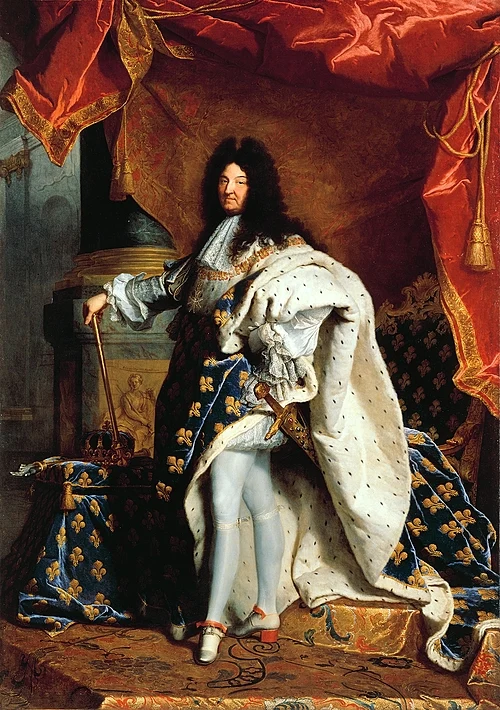
One reason was due to the rise of absolute monarchies. These were Kings and Queens that held unchallenged power. In France, King Louis XIV (1643-1715) famously declared that ‘I am the State’. He felt that his word was the law. He justified this under the idea of the divine right of kings which argued that God had given power to monarchs. This led to situations across Europe where rulers used their power unfairly. The execution of English King Charles I in 1649 and later the French Revolution of 1789 challenged this as people started to declare that political authority came from the people, rather than a King. Intellectuals began to realise that if even Kings could be questioned, what other forms of authority could be?
In the nineteenth century, the industrial revolution led to factory owners and merchants becoming fabulously wealthy and powerful. This led to new forms of authority where individual businessmen had almost total power over the lives of their workers, resulting in exploitation. Workers questioned the authority that these people had over their lives and the system of government which enabled it. Workers' rights movements emerged that were often violently stopped. In Britain, the 1819 Peterloo Massacre saw government troops kill many workers. This made many question whether a government was deserving of its authority if it didn't listen to the concerns of its people.
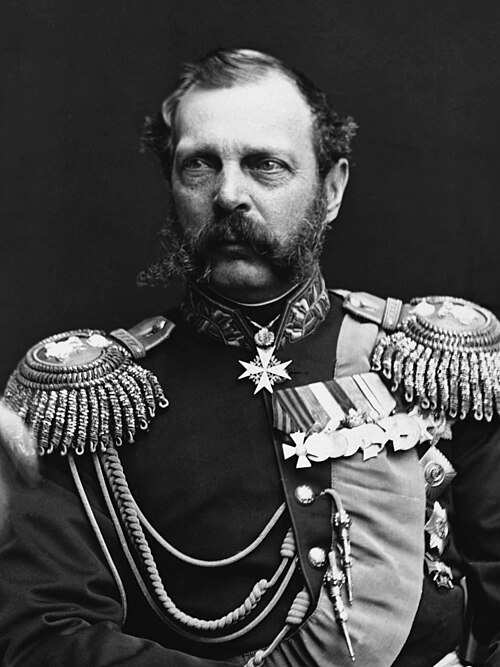
Whilst many governments responded by reforming their laws to improve lives, some countries responded reluctantly, often with more repression. Russia was one such country. In 1861, millions of Russia peasants lived in Serfdom where their lives were severely restricted. That year, Tsar Alexander II abolished the system, but Serfs were forced to pay a tax to free themselves. This left millions indebted to landowners, and forced to work to pay off their debts. Russian peasants compared their lives to those of the landowners and elites who help complete power. It is little wonder that many of the first anarchists lived in Russia at this time.
For anarchists the key question became not whether authority existed, but whether it was justified. Whether it was economic inequality, a lack of political rights, unrepresentative government, the desire to form their own nation, or rebellion against the dogmatic authority of the Church, legitimacy became the key concept to judge authority by.
Critical Thinking Skills - Recognising Unstated Assumptions and Biases in History
Different forms of authority began to become questioned and challenged over time as people questioned their legitimacy. This task will help to familiarise you with some of the key historical events that inspired anarchism.
| Historical Example | Who held authority? | Why was the authority questioned? | How was the authority challenged? | Do you think the authority legitimate? |
| Execution of Charles I (1649) | ||||
| French Revolution (1789) | ||||
| Peterloo Massacre (1819) | ||||
| European Revolutions of 1848 | ||||
| Emancipation of the Serfs (1861) | ||||
| Paris Commune (1871) | ||||
| The Kulturkampf (1871-1878) | ||||
| Haymarket Affair (1886) |
Task 1 - In groups, choose one of the historical events above where authority was challenged. Research your event and complete each part of the table to examine the event in more detail.
Task 2 - Share your findings with your class by discussing the following prompt, using examples from your event: ‘How might events such as these have encouraged the development of anarchist ideas?’
As a more open inquiry task student responses will vary but for your own knowledge as a benchmark, you may find the following summary about each event useful:
- Execution of Charles I (1649) - Following the English Civil War, Charles I was tried for treason and executed. The event radically challenged the idea that monarchs ruled by divine right.
- French Revolution (1789) - Revolutionaries challenged the absolute monarchy and the privileges of the aristocracy and Church. The monarchy was eventually abolished, showing that established hierarchies could be overthrown.
- Peterloo Massacre (1819) - Around 60,000 people gathered in Manchester to demand parliamentary reform. Local authorities sent cavalry killing many and raising questions about state repression.
- European Revolutions of 1848 - Revolutions and uprisings spread across Europe as a coalition of liberals, nationalists and workers challenged monarchies and demanded reforms. Although many revolutions failed like in Italy and Germany, they demonstrated widespread anger with authority.
- Emancipation of the Serfs (1861) - Tsar Alexander II abolished serfdom in Russia, freeing millions of peasants from legal dependence on landowners. However, continuing poverty meant that the legitimacy of Russia's system continued to be questioned.
- Paris Commune (1871) - Following France's defeat in the Franco-Prussian War, radical workers seized control of Paris and established the Paris Commune. It was violently suppressed by the French state.
- Kulturkampf (1871-78) - Bismarck's German government attempted to reduce the influence of the Catholic Church. It illustrates conflict over whether authority should rest with the state or Church.
- Haymarket Affair (1886) - A labour demonstration in Chicago became violent after a bomb was thrown at police. The subsequent prosecution of anarchists became an international symbol of labour struggle.
In response to these historical processes and events, a number of intellectuals developed ideas that would challenge these traditional forms of authority. Their ideas would develop into the intellectual movement we know as anarchism. They all shared a common belief that power should not be concentrated in the hands of elites, whether governments, religious leaders or business owners.
Information Literacy Skills - Making Connections Between Various Sources of Information
Anarchism developed through the ideas of many different thinkers which we will explore in this inquiry. This task will help introduce you to these thinkers and how they explain anarchism's solutions to society's problems.
Task 1 - As you watch the video above, fill in a table like the one below to help you identify their ideas:
| Intellectual | What problem did they identify? | What solution did they propose? |
| Pierre-Joseph Proudhon | ||
| Mikhail Bakunin | ||
| Peter Kropotkin | ||
| Emma Goldman |
Task 2 - Which anarchist thinker do you think developed the most practical vision for society? Explain your answer.
Task 1 - These notes can be used to check student understanding of the video and prior knowledge:
| Intellectual | What problem did they identify? | What solution did they propose? |
| Pierre-Joseph Proudhon | Property and wealth created inequality and exploitation. | Mutualism or voluntary exchange and worker cooperation. |
| Mikhail Bakunin | The state, religion and capitalism oppressed people. | Revolution to replace hierarchy with self-governing communities. |
| Peter Kropotkin | Capitalism encouraged inequality and competition. | Mutual aid and communal ownership based on cooperation. |
| Emma Goldman | State and social conventions restricted individual freedom. | Individual liberty, voluntary cooperation and social equality. |
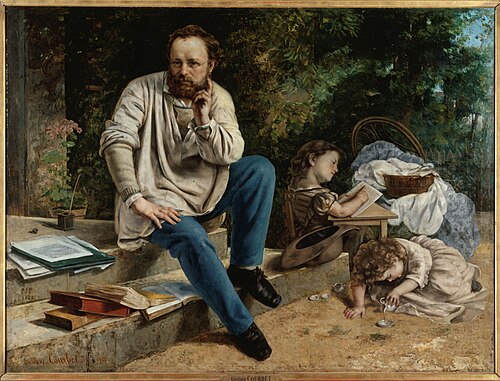
One of the earliest anarchists was the French philosopher Pierre-Joseph Proudhon (1809-1865). He is known for the famous quote ‘Property is theft’ and was the first intellectual to call himself an anarchist. Proudhon articulated his ideas in the works 'What is Property?' and 'The Philosophy of Poverty'. His main argument was that the concept of private property had allowed a small minority of people to accumulate vast wealth, whilst the majority of people had little control over their lives. He also argued against the total loss of property as advocated by Karl Marx. Instead, he called for voluntary cooperation and mutual support amongst workers. His ideas would later influence many of the participants in the Paris Commune of 1871.
Interesting Fact - What was Nihilism?
An unusual area of political thought at this time in Russia was nihilism. Often linked to radical movements that were not afraid to use violence to achieve their means, nihilists were opposed to Tsarism. However, they did not articulate clear views of alternative forms of government or social structure. Moreover, they advocated for a renouncement of existing norms and values without any fixed position except for a rejection of the state. In contrast to anarchists, such as Bakunin, nihilists did not advocate for any positive visions of a future society.
Why might the terms anarchist and nihilist sometimes be confused with each other? What might be some of the benefits / dangers of a nihilist viewpoint which looks to question all social structures?
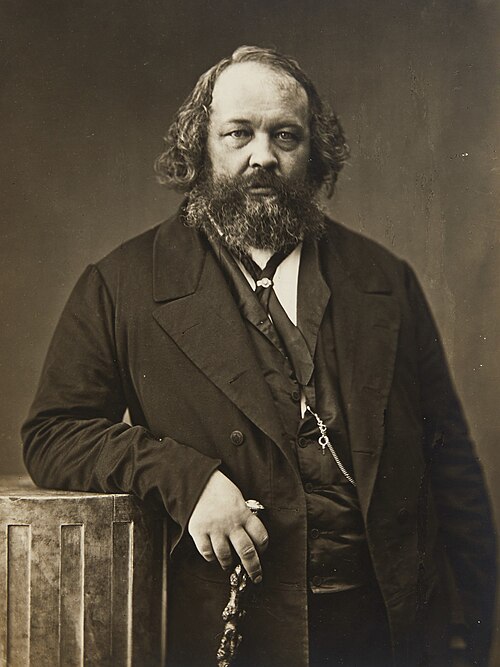
Like France, Russia was also a society in the nineteenth century in which numerous strands of intellectual thinking were occurring. One leading thinker was Mikhail Bakunin (1814-1876). Bakunin had met Proudhon and Marx whilst in Paris as a young man. Inspired by their ideas, he tried to apply them to Russia which was plagued by repression and the legacy of Serfdom. Bakunin was pessimistic about the ability of the state to reform and called for existing systems to be dismantled, including religion. This made him an outlaw across Europe. Like Proudhon, he also argued that freedom could only exist through local communities and voluntary associations rather than through states. For this reason, he later opposed Marx's idea of communism as he feared a dictatorship of the proletariat would end freedom.
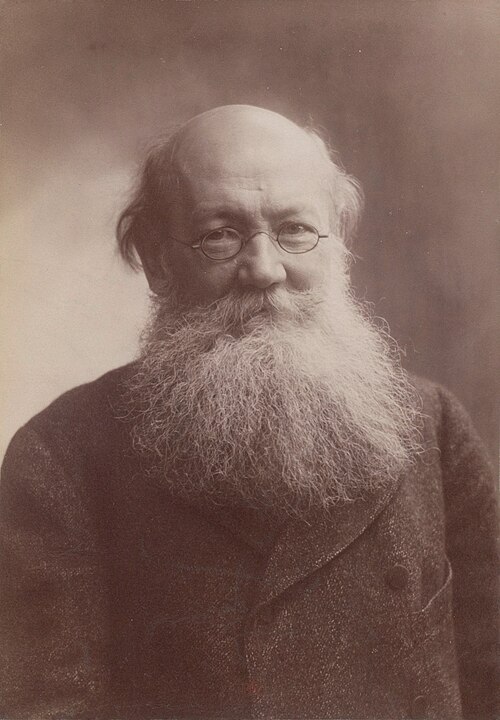
Another key Russian thinker was Peter Kropotkin (1842-1921). Born into an aristocratic family, he grew up to reject this privilege, working in the army as a Geographer which is a career he pursued after leaving the military. He was concerned with leading a socially useful life. Travelling to Western Europe in the 1870s, he met many anarchist revolutionaries and began to believe in the inevitability of social revolution. He developed the concept of mutual aid after studying examples of it in nature and argued that cooperation amongst workers could remove the need for governments. He later settled in London, co-founding Freedom, the first English language anarchist magazine.
Although all three intellectuals disagreed on details, they all questioned whether authority was legitimate in their search for a more equal society. This put them at odds with the idea of communism developed by Karl Marx. Their writings were influential in inspiring revolutionary groups across the world and their ideas are still debated today.
Creative Thinking Skills - Practising Flexible Thinking
Whilst anarchist thinkers did criticise existing forms of authority and society, they also proposed alternative ways of thinking about social organisation. This task will help you to consider how their ideas may have worked.

Task 1 - In groups, choose one of the three anarchist thinkers above. First, try to understand your intellectual better by summarising their ideas. Research the following three questions:
- What problem did your thinker identify in society?
- What forms of authority did they oppose?
- What kind of society did they want to create?
Task 2 - Your next task is to design a community based on their ideas. Imagine a 1,000 people have decided to found a community based on your intellectuals' ideas. Create a diagram, concept map, poster or any other plan:
- How will decisions be made?
- Who will organise work?
- How will resources be shared?
- How will disagreements be solved?
- Will any forms of authority exist?
- What challenges may your community face?
Task 3 - Finally, present your ideas to the class whilst listening for strengths and weaknesses in the other groups. Which anarchist thinker's community was the most realistic and most likely to succeed?
The key distinctions for the three thinkers can be summarised as:
- Proudhon - Focused on mutualism which retained private possessions and exchange, but sought to remove exploitative concentrations of property and power.
- Bakunin - Focused on revolution believing that existing structures of state and economic authority need to be dismantled before genuinely free communities can develop.
- Kropotkin - Focused on mutual aid as he believed that humans can organise through cooperation rather than coercion and that resources could be held communally and distributed according to need.
For much of the nineteenth century, anarchism was mostly just an ideological movement. Where it did inspire attempted revolutions, it was quickly defeated by more organised forms of authority. Thinkers like Proudhon, Bakunin and Kropotkin were very persuasive in their diagnosis of the problems of society, but could their ideas work in practice?
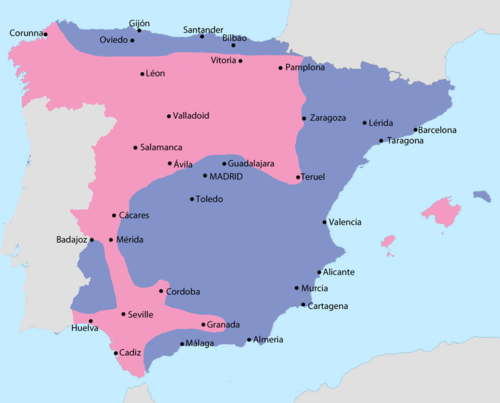
One of the most historically significant attempts to apply anarchist principles in reality came with the Spanish Civil War (1936-1939). This conflict began when a group of military officers led by Francisco Franco, launched an armed uprising against the elected Second Spanish Republic. Spain had become a very divided society between traditional landowning elites supported by the Catholic Church, and a growing workers and peasant movement. As Spain descended into civil war, groups like the anarchists emerged who saw an opportunity to create a better society.
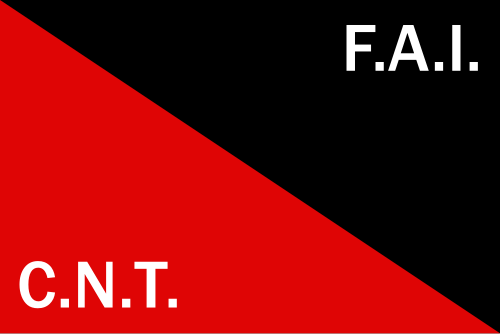
The key anarchist groups was the trade union federation called CNT (Confederación Nacional del Trabajo) and the anarchist political organisation called FAI (Federación Anarquista Ibérica). Working together as CNT-FAI, they took over factories, farms and many cities in the East of Spain in regions such as Catalonia and Aragon. They created a system of collective decision making, with workers electing representatives and managing workplaces themselves. They experimented with collectivising farm land, sharing resources and improving education and healthcare.
Critical Thinking Skills - Evaluating Historical Evidence and Arguments
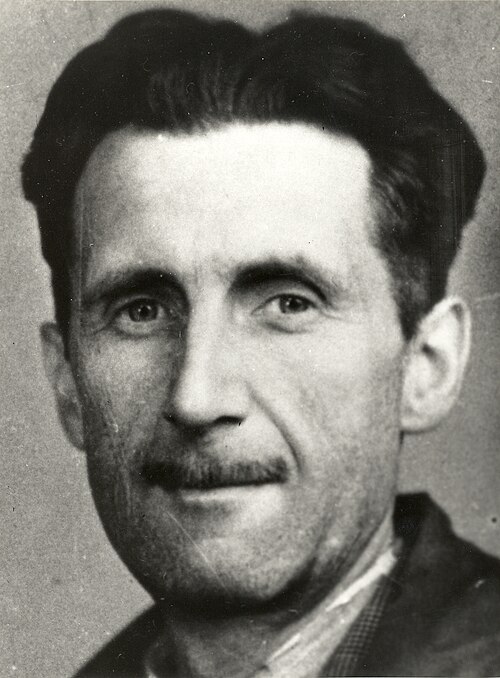
The British writer George Orwell travelled to Spain in late 1936 and volunteered to fight for the Republicans. His book ‘Homage to Catalonia’ describes what he observed of the anarchists. This task will help you understand how first-hand accounts can used by historians to help us understand the past.
Task 1 - In pairs, choose one of the quotes below to investigate. For your source, take notes on:
- What evidence of anarchist ideas can you identify?
- Does the source suggest success or failure of anarchist ideas?
Task 2 - Discuss your findings with the class. To what extent was anarchism successfully implemented?
Task 3 - Does Orwell appear supportive or critical of the anarchists? How reliable do you think he is?
Quote 1 - ‘It was the first time that I had ever been in a town where the working class was in the saddle. Practically every building of any size had been seized by the workers and was draped with red flags or with the red and black flag of the Anarchists; every wall was scrawled with the hammer and sickle and with the initials of the revolutionary parties …almost every church had been gutted and its images burnt. Churches here and there were being systematically demolished by gangs of workmen. Every shop and café had an inscription saying that it had been collectivized; even the bootblacks had been collectivized and their boxes painted red and black. Waiters and shop-walkers looked you in the face and treated you as an equal’ (p.2)
Quote 2 - ‘The revolutionary posters were everywhere, flaming from the walls in clean reds and blues that made the few remaining wall advertisements look like daubs of mud. Down the Ramblas, the wide central artery of the town, were crowds of people streaming constantly to and fro, the loud-speakers were bellowing revolutionary songs all day and far into the night ... There was much in it that I did not understand, in some ways I did not even like it, but I recognized it immediately as a state of affairs worth fighting for.’ (p.3)
Quote 3 - ‘Yet so far as one could judge the people were contented and hopeful. There was no unemployment, and the price of living was still extremely low; you saw very few conspicuously destitute people, and no beggars except the gipsies. Above all, there was a belief in the revolution and the future, a feeling of having suddenly emerged into an era of equality and freedom. Human beings were trying to behave as human beings and not as cogs in the capitalist machine.’ (p. 4)
Quote 4 - ‘The Anarchist viewpoint is less easily defined. In any case the loose term ‘Anarchists’ is used to cover a multitude of people of very varying opinions… …even the members of the F.A.I. , though always tinged, as perhaps most Spaniards are, with the Anarchist philosophy, were not necessarily Anarchists in the purest sense… since the beginning of the war they had moved more in the direction of ordinary Socialism, because circumstances had forced them to take part in centralized administration and even to break all their principles by entering the Government… they aimed at workers’ control and not a parliamentary democracy…’ (p.45)
Quote 5 - ‘…Roughly speaking, the C.N.T.-F.A.I. stood for: (i) Direct control over industry by the workers engaged in each industry, e.g. transport, the textile factories, etc.; (2) Government by local committees and resistance to all forms of centralized authoritarianism; (3) Uncompromising hostility to the bourgeoisie and the Church. The last point, though the least precise, was the most important. The Anarchists were the opposite of the majority of so-called revolutionaries in so much that though their principles were rather vague their hatred of privilege and injustice was perfectly genuine…’ (p.45)
Quote 6 - ‘Philosophically, Communism and Anarchism are poles apart. Practically — i.e. in the form of society aimed at — the difference is mainly one of emphasis, but it is quite irreconcilable. The Communist’s emphasis is always on centralism and efficiency, the Anarchist’s on liberty and equality. Anarchism is deeply rooted in Spain and is likely to outlive Communism when the Russian influence is withdrawn…’ (p.45)
Quote 7 - ‘During the first two months of the war it was the Anarchists more than anyone else who had saved the situation, and much later than this the Anarchist militia, in spite of their indiscipline, were notoriously the best fighters among the purely Spanish forces.’ (p.45)
The following information can be used to review student perspectives on each of the sources:
- Success - Anarchist principles visibly transformed everyday life and workplaces as he discusses worker control, collectivised businesses and the rejection of Church authority.
- Mostly a Success - Quote 2 suggests enthusiasm and support although Orwell admits some personal reservations. Highlights how revolutionary culture could be found everywhere.
- Success - Orwell describes optimism, the low unemployment and greater social equality found in Republican Spain at this time.
- Failure - Mentions how wartime conditions forced anarchists to join central government, compromising their principles in the process.
- Mixed - Orwell clearly demonstrates the adoption anarchist principles by the main political parties, although it does not prove they worked successfully in practice.
- Some Success - Anarchism appears deeply rooted and influential but the quote mainly describes ideology rather than implementation. Orwell suggests how the left-wing was plagued by the split between anarchism and communism which seemed incompatible.
- Success - Orwell credits anarchists with helping save the Republican cause early in the war, although he notes problems with discipline.
Task 2 - Overall, you could argue that Orwell suggests that anarchist ideas were implemented to a significant extent in Republican Spain but incomplete in many ways. It transformed aspects of economic and social life but wartime conditions made a completely decentralised anarchist society difficult to sustain. We know from history how problems in anarchists governments contributed to decision making inefficiencies, especially during the key battles of the war.
Task 3 - Orwell is valuable because he personally witnessed revolutionary Catalonia and fought on the Republican side. He provides detailed observations of everyday life that official documents might not reveal. Students might acknowledge that this is just one viewpoint though.
These groups implemented many of the ideas of Proudhon, Bakunin and Kropotkin. Concepts such as mutual aid, local decision making, collective ownership of property and hostility to authority were all experimented with. For a time, it demonstrated that anarchist ideas could work and that people could cooperate without being compelled. Yet critics have pointed out that the war created special circumstances which motivated people to cooperate more.
News of these social revolutionaries soon spread throughout the world and thousands of international volunteers flooded to Republican-held Spain. Known as the International Brigades, many individuals travelled to Spain to support the Republican cause, ranging from Marxist communists to anarchists and moderate socialists. The British writer George Orwell was just one of many famous volunteers. He later describes his experiences fighting in his book ‘Homage to Catalonia’.
Interesting Fact - What were the International Brigades?
The Spanish Civil War involved an international dimension. Although most of the fighting was between people in Spain there was the involvement of other countries (e.g. Mussolini's Italy deployed many soldiers to support the Nationalists, the Soviet Union gave some support to the Republic) and a group called the International Brigades.
The International Brigades were volunteer fighters who supported the Republic, often for ethical or political reasons. Included within the International Brigades were a number of high profile intellectuals, writers and future political leaders from the time.
- George Orwell - author of 'Animal Farm' and '1984' - he wrote about his experience in the war in a book called 'Homage to Catalonia'.
- Ernest Hemingway - author of 'The Old Man and the Sea' amongst others
- Simone Weil - French philosopher who identified with the anarchist movement, she also supported the French resistance during the Second World War
- Joseph Broz Tito - communist and future leader of Yugoslavia after the Second World War
The International Brigades was made up of many different people. Discuss - why do you think people signed up to fight in a war away from their home country? What reasons might compel people to do this?
In the end, the Republicans were eventually defeated and a dictatorship under Franco established. Whilst not perfect, the war had shown that anarchism could work in practice. Many of the ideas and groups of the time would eventual inspire other movements across Europe and the world, well into the twentieth century and today.
As we have seen in the past, anarchism was not just about rejecting all authority. It was about questioning whether authority is legitimate and necessary. In that way, although there are few truly anarchist political groups throughout the world today, there are many movements who continue to question the legitimacy of authority. They subject those who hold power, like governments and corporations, to the idea that they should be accountable.
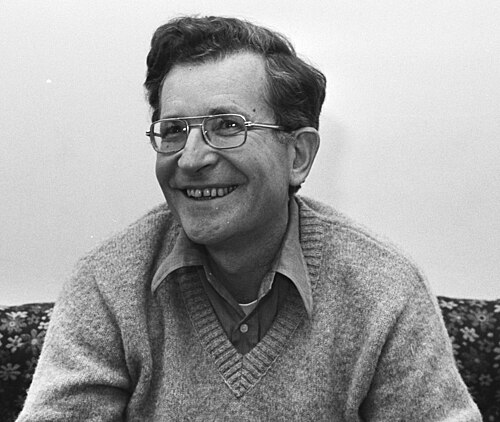
One contemporary thinker is the American intellectual Noam Chomsky. Chomsky has applied many anarchist ideas to the question of power and authority. Since the 1960s, he has questioned US foreign policy in Vietnam and other places and has argued openly against apartheid, imperialism and corporate power. He argues that if an authority cannot demonstrate that is acting fairly, then it should be changed or reformed. He applied this to many modern issues like government surveillance, workers' rights, education, policing and others.
Critical Thinking Skills - Evaluating Evidence and Arguments
Contemporary thinkers like Noam Chomsky continue to debate the meaning of anarchism. Exploring their ideas can help you to better understand the continuities of historical ideas.
Source A - Noam Chomsky being interviewed about the topic anarchy in 2014[1]
'Anarchism is nothing to do with bomb throwing and mayhem. Anarchism is a point of view which... and first of all, this covers a lot of things, political rhetoric is not the clearest, is not a model of clarity. Anarchism has covered a lot of ground...the mainstream of it has just been the basic principle, which I think comes straight out of classical liberalism and the Enlightenment, that any form of authority and domination has a burden of proof to bear, it has to demonstrate that it is legitimate. Does not matter what it is; whether its inside a family or... the global economy. If it is a form of authority and domination and coercion, it has to show that it is legitimate...If it can show that it is legitimate, then okay, if not it ought to be dismantled. That's anarchism.'
Task - Read the statement from Chomsky about anarchism above and answer the questions that follow:
- What does Chomsky mean when he says political ideas are not a model of clarity?
- Do you agree that authority should always have to justify its power? Explain your view.
- Why is anarchism often associated with violence? Do you think this is a fair representation of the ideology?
Suggested Answers
- What does Chomsky mean when he says political ideas are not a model of clarity? - Chomsky is perhaps hinting at the fact that anarchism can have different meanings and contain different strands of thought. Points out it is hard to define.
- Do you agree that authority should always have to justify its power? Explain your view - Students could argue both ways here. Some might say that because authority restricts your freedom, it should of course have to justify itself in terms of legitimacy and accountability. The problem is that if we did this all the time, effective government would be impossible and decision making slow.
- Why is anarchism often associated with violence? Do you think this is a fair representation of the ideology? - The main reason is because of historical anarchism in the 19th and 20th centuries which for a time used assassination and violence. This view can unfairly focus on what anarchism is against, rather than what anarchism is for such as mutual aid, decentralisation, and voluntarism.
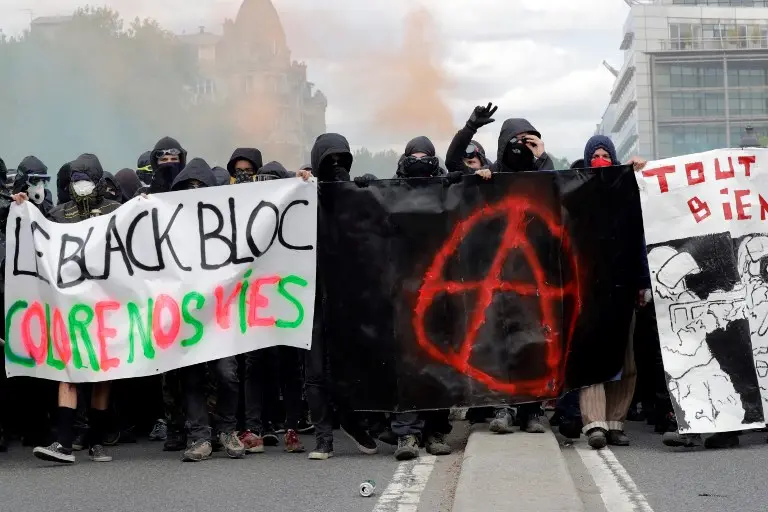
Although anarchism remains a minority political ideology, many of its ideas continue to influence intellectuals like Chomsky and broader social movements across the world. Campaigns for environmental protection or economic equality still draw upon those ideas of Proudhon, Bakunin and Kropotkin. Some groups still draw upon examples of anarchist direct action to challenge authorities. For example in France in 2018, protests by anarchist groups led to the destruction of private property, shops and a McDonalds was burned down.
Nevertheless, there are many who continue to question the ideas of anarchism. Forms of radical protest can undermine anarchist support. There is also the fact that many of the problems confronting the world in the recent past have required greater regulation and coordination by authorities - not less. This raises a question that young historians will need to answer in their own lives. Does the rich intellectual tradition of anarchism help us with the problems of the world today, or was anarchism wrong? Do we need more authority in the world today?
Communication Skills - Writing for Different Purposes
Is anarchism still relevant to the problems of the twenty-first century? Or has it had its time? This claim-support-challenge task will help you to apply what you have learnt about the history of anarchist ideas to the world today.
| Claim | Evidence Supporting the Claim | Questions, Limitations, Challenges |
| Anarchism remains relevant in the twenty-first century | ||
| Anarchism is not relevant in the twenty-first century |
Task 1 - Divide your group or class into two. Each group should investigate a different claim. Complete the table above by seeking evidence to support your claim from the case studies below. Also try to identify evidence that challenges your claim.
Task 2 - Research and write a well-structured essay on the following question:
'To what extent have anarchist ideas influenced societies from the nineteenth century to the present day?'
In your response:
- Refer to both historical and contemporary examples.
- Consider the contributions of Proudhon, Mikhail Bakunin, Peter Kropotkin and Emma Goldman.
- Discuss attempts to put anarchist ideas into practice such as the Spanish Civil War.
- Consider evidence that suggests anarchist ideas remain relevant today.
- Consider challenges and criticisms of anarchism.
- Reach a clear and supported judgement.
As an extended response essay, you could use the 24-mark eAssessment rubric to help you grade and assess student responses. Feel free to use and adapt the following:
Criteria A - Knowledge and Understanding (8 marks)
| Marks | Descriptor |
| 1-2 | Shows limited knowledge of anarchist ideas; uses few relevant thinkers or examples. |
| 3-4 | Shows adequate knowledge of anarchism with some relevant reference to thinkers and historical/contemporary examples. |
| 5-6 | Shows substantial knowledge of anarchism, accurately explaining relevant thinkers, examples and attempts to apply anarchist ideas. |
| 7-8 | Shows detailed and thorough knowledge, effectively using a range of thinkers and historical/contemporary examples to demonstrate anarchism's influence. |
Criteria C - Communication (8 marks)
| Marks | Descriptor |
| 1-2 | Essay has limited structure; ideas are communicated unclearly or inconsistently. |
| 3-4 | Essay has a recognisable introduction, argument and conclusion; ideas are generally clear and organised. |
| 5-6 | Essay is well structured; paragraphs develop clear arguments supported by relevant evidence; language is appropriate and accurate. |
| 7-8 | Essay is consistently clear, coherent and effectively structured; evidence and arguments are integrated logically to answer the question. |
Criteria D - Thinking Critically (8 marks)
| Marks | Descriptor |
| 1-2 | Makes basic assertions about anarchism's influence with limited analysis or judgement. |
| 3-4 | Explains some ways anarchism influenced society and considers some challenges or alternative perspectives. |
| 5-6 | Analyses the extent of anarchism's influence, weighs supporting and challenging evidence, and reaches a supported judgement. |
| 7-8 | Develops a convincing and balanced argument about the extent of anarchism's influence, synthesising historical and contemporary evidence and reaching a well-supported judgement. |
Case Study 1 - Occupy Wall Street
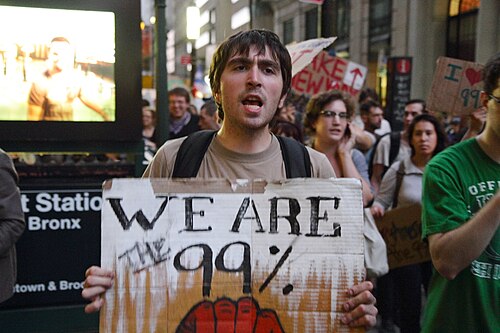
In 2011, thousands of protesters gathered in New York's Wall Street, home of the US stock exchange. Protesters had been criticising growing economic inequality and corporate power. Since the 2008 economic crash, banks around the world had been ‘bailed out’ by tax payers and many sought more accountability over banks for this. The Occupy groups that emerged used assemblies and collective decision making rather than appointing leaders. These groups reflected anarchist ideas of decentralisation of decision making and mass participation.
Although the movement didn't achieve major political reform, it did help others in society by popularising debates about corporate and banking interests. It soon spread to hundreds of other cities around the world like London and Hong Kong. Many historians have argued that Occupy was an example of anarchist principles in action. In 2012, Noam Chomsky commented, ‘The Occupy movement spontaneously created something that doesn’t really exist in the country: communities of mutual support, cooperation, open spaces for discussion … just people doing things and helping each other.’[2]
Case Study 2 - Mutual Aid during COVID-19

During the COVID-19 pandemic of 2020-2023, communities around the world spontaneously created volunteer networks to support each other. Individuals delivered food to vulnerable people, collected medicines and helped neighbours. All without government direct or support. These actions were known as mutual aid.
We can trace the idea of mutual aid to the Russian anarchist intellectual Peter Kropotkin who argued that cooperation was a natural part of human nature. For many anarchists and others, the pandemic showed that humans can cooperate and help each other without government authority. Yet critics argued that the main tools to fight COVID, such as society lock-downs and the trialling of vaccines, required the extensive use of government authority and power.
Case Study 3 - Environmental Activism and Deep Ecology
Most environmental activists have argued over time that large corporations and governments have led the destruction of the natural world, primarily due to the focus on unsustainable economic growth. This has prioritised the exploitation of natural resources in order to sustain human systems. Some environmental thinkers like Arne Næss have supported living in harmony and humility with the natural world as a solution.
“The smaller one comes to feel compared to the mountain, the nearer one comes to sharing in its greatness. I don't know why this is so.”
Næss, A. (2016). The Ecology of Wisdom. Penguin Classics.
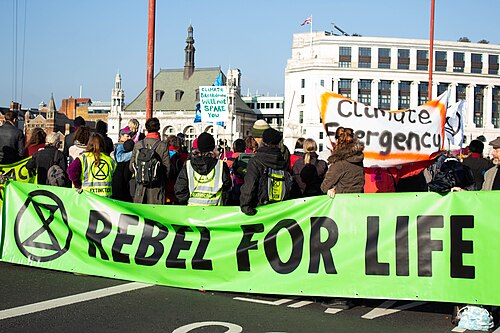
The Deep Ecology movement shares many similarities with anarachist principles, such as Kroptkin's emphasis on cooperation and mutual support. Kroptkin gained many of his initial ideas by studying the biology of the natural world. The focus on grassroots activism and decentralisation appeals to many environmentalists. Some activists have even gone further. Groups like Extinction Rebellion have used nonviolent civil disobedience and disruptive direct action to hold governments to account about issues like climate change and the biodiversity crisis.
Case Study 4 - The Digital Revolution
Since the rise of the internet and social media in the 1990s and 2000s, societies have transformed in the way they communicate and organise. In many ways, this reflects anarchist ideas. Pierre-Joseph Proudhon argued that people should cooperate through voluntary associations rather than rely on powerful institutions. Social media and instant messaging have made this possible on a global scale. Online communities and open-source software also illustrate the ideas of mutual aid developed by Peter Kropotkin. As we all know, digital networks allow us all to collaborate without the need for government or corporations.

Yet the digital revolution has also created new challenges that require authorities to exercise their power. Whilst the internet begun as an anarchist paradise of free exchange and cooperation, it is now a very different place. Unknown actors have misused the internet via misinformation, hacking, cyber-bullying, and extremism. The business model of social media itself operates by selling our identities to corporate powers for advertising. The rapid development of AI also raises the question of the legitimacy of power. Mikhail Bakunin and Emma Goldman warned that concentrated power could threaten freedom. Yet these challenges require greater control of the internet by authorities.
Footnotes
2. https://www.democracynow.org/2012/5/14/chomsky_occupy_wall_street_has_created